
非银金融

Search documents
光大证券:消费与成长有望成为春季行情的两条主线
Di Yi Cai Jing· 2026-01-04 07:15
(文章来源:第一财经) 光大证券研报表示,当前来看,2025年12月下旬的上涨或许是本轮春季行情起点。对于1月份指数的行 情,投资者或许应该保持耐心。消费与成长有望成为今年春季行情的两条主线。1月行业配置方面,关 注电子、电力设备、有色金属、汽车等。若市场风格为成长,五维行业比较框架打分靠前的行业分别为 电子、电力设备、通信、有色金属、汽车、国防军工;若1月份市场风格为防御,五维行业比较框架打 分靠前的行业分别为非银金融、电子、有色金属、电力设备、汽车、交通运输等。 ...

中信建投2026年投资展望:把握A股资源品新主线 港市活跃度将进一步被激发
Zhi Tong Cai Jing· 2026-01-03 09:33
Group 1 - The core view is that the A-share bull market is expected to continue into 2026, with resource products likely becoming a new main direction after the technology sector [1][2] - The concept of "New Four Bulls" for A-shares and Hong Kong stocks includes "Capital Inflow Bull," "Technology Innovation Bull," "Institutional Reform Bull," and "Consumption Upgrade Bull," which will continue to drive the market upward in 2026 [1][3] - The expected GDP growth for 2026 is around 5%, supported by policy support, stable domestic demand, and industrial upgrades [2] Group 2 - In the A-share market, the index is expected to continue to rise but with a slower growth rate, and investors will focus more on fundamental improvements and economic verification [2] - Key industries to focus on include new energy, non-ferrous metals, basic chemicals, oil and petrochemicals, non-bank financials, military industry, machinery, and computers [2] - The Hong Kong market is anticipated to see increased activity due to the listing of high-quality domestic companies and the evolution of the U.S. interest rate cycle, presenting significant upward opportunities [1][3] Group 3 - In the global market, key assets to track in 2026 include precious metals like gold and silver, and under the influence of major trends, non-ferrous metals such as copper and aluminum [3] - The AI industry chain remains worth tracking amid the U.S.-China technology security competition [3] - The bond market is expected to see a steepening yield curve, with credit spreads remaining low, and convertible bonds may exhibit significant oscillation characteristics [3]

年度策略报告姊妹篇:2026年策略组风险排雷手册-20251231
ZHESHANG SECURITIES· 2025-12-31 12:32
Group 1 - The core viewpoint of the report is that the A-share market in 2026 will revolve around "structural transformation and confidence restoration," with a focus on technology investments and external demand recovery [3][4] - The report emphasizes a "systematic slow bull" market phase, suggesting a gradual upward trend in the market, with the Shanghai Composite Index expected to oscillate between the high point of February 2021 and the 0.809 quantile of 5178-2440 [9] - Investment strategies include focusing on four main lines: consumer services, sectors with growth potential like automotive and pharmaceuticals, traditional industries, and dividend-paying stocks such as banks and transportation [9] Group 2 - Policy risks are highlighted, particularly the impact of new public fund regulations on asset allocation, which may lead to a reallocation of equity fund performance benchmarks in the second half of 2026 [10][12] - Geopolitical risks are identified, with potential impacts from U.S. actions in Venezuela and Japan's political stance affecting market sentiment and inflation expectations [13][14] - Other risks include the pace of U.S. interest rate cuts, domestic economic recovery, and the performance of U.S. tech stocks, all of which could influence market dynamics in the second half of 2026 [15][17][20]
2025年A股再融资数据盘点:电子行业项目数量位列全行业第一(40个) 银行业募资额高居榜首(5200亿元)
Xin Lang Cai Jing· 2025-12-31 08:01
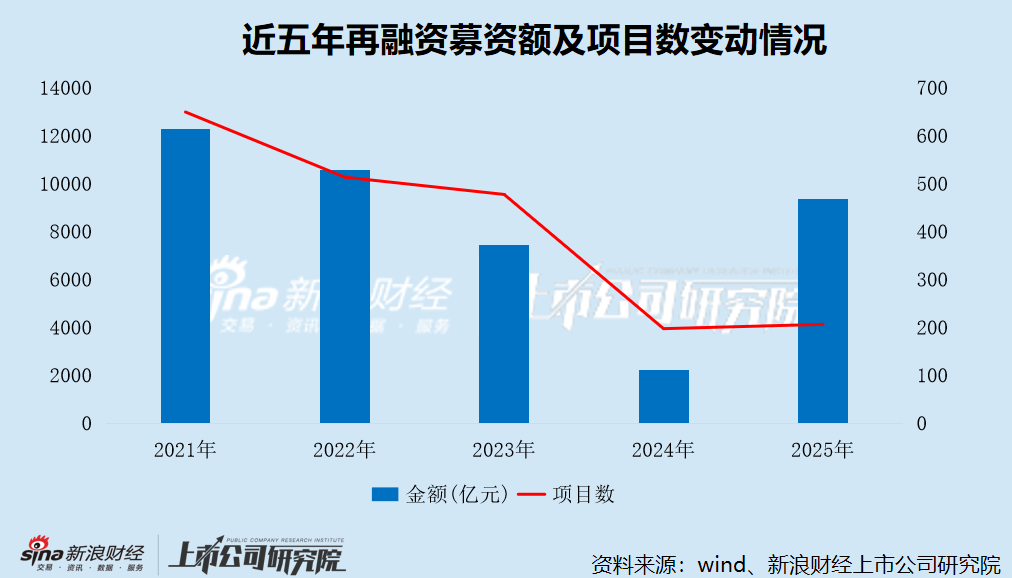
Core Insights - The A-share market in 2025 marked a significant milestone with the index crossing a decade threshold, market capitalization exceeding one trillion, and record trading volumes, driven by policy incentives and liquidity [1][8] Group 1: Overall Market Performance - The total refinancing scale reached 950.865 billion, a year-on-year increase of 326.17% [3][10] - The majority of the refinancing growth came from private placements, which totaled 887.732 billion, reflecting a 412.99% increase year-on-year [3][10] - The number of refinancing applications accepted was 251, with a 100% approval rate across all listed sectors [3][10] Group 2: Specific Financing Types - The total amount raised through convertible bonds was 63.133 billion, marking a 30.77% increase year-on-year [7][14] - No funds were raised through rights issues or preferred shares during the year [3][10] Group 3: Industry Breakdown - The banking sector led in fundraising through private placements, raising 520 billion, accounting for 58.58% of the total [5][12] - The electronics industry had the highest number of private placement projects at 30 [5][12] - The top five industries in terms of total fundraising included banking, electronics, non-bank financials, public utilities, and defense, collectively raising 708.618 billion, which is 79.82% of the total [5][12] Group 4: Convertible Bonds Industry Breakdown - The electronics sector also led in the number of convertible bond projects with 10 [7][14] - The real estate sector raised 13.3 billion through convertible bonds, representing 21.07% of the total [7][14] - The top five industries for convertible bond fundraising included public utilities, power equipment, electronics, and machinery, raising a total of 475.72 billion, which is 75.35% of the total [7][14]




银河期货股指期货年报
Yin He Qi Huo· 2025-12-31 05:00
1. Report Industry Investment Rating No information provided. 2. Core Viewpoints of the Report - In 2026, the strategy of a technology - powered nation combined with the AI wave will remain the main theme of the A - share market. The listing of technology leaders like Changxin Technology will strengthen the contribution of technology stocks to the index. Small - cap indexes are expected to perform well, and the market will maintain a slow - bull trend despite fluctuations from valuation and capital factors [6]. - In the assumption of constant valuation, the market value of the Shanghai Composite 50 Index in 2026 may rise by 5% - 10%, the CSI 300 by 8% - 18%, and the CSI 500 and CSI 1000 by 18% - 26% [54]. - In 2026, the phenomenon of stock index futures trading at a discount will still exist. The cost advantage of short - position holders moving from the current - month contract to the quarterly - month contract is evident, and the main trading and holding contracts have shifted to quarterly - month contracts [60]. 3. Summary by Relevant Catalogs 3.1 2025 Market Review Stock Market - In 2025, the A - share market showed a slow - bull trend of fluctuating upward. The AI industry chain, robotics, and non - ferrous metal sectors led by artificial intelligence rose significantly, but there were differences in the performance of different indexes. By December 30, the annual increase of the CSI 300 Index was 18.21%, the Shanghai Composite 50 Index rose 13.1%, the CSI 500 Index rose 30.27%, and the CSI 1000 Index rose 27.52% [5][11]. Stock Index Futures - In 2025, the discount of stock index futures widened compared to the previous year, showing a cyclical pattern of convergence at the beginning and end of the year and expansion in the middle. The average daily discounts of the four IM contracts reached record highs. The trading volume and open interest of stock index futures continued to grow steadily. IM was the most - concerned variety, with trading volume and open interest increasing by 19.4% and 20.4% respectively. The trading volume and open interest of IC recovered after hitting a bottom in April, and the annual average daily trading volume increased by 3.7%. The trading volume and open interest of IH both declined, while the trading volume of IF was stable and the open interest increased by 5.2% [13][16]. 3.2 Future Outlook and Investment Strategy Index Space Calculation - In 2025, there were significant differences in the performance of major indexes, which were mainly due to differences in industry indexes. The non - ferrous metal and communication sectors had annual increases of 93% and 87% respectively, while the food and beverage and coal sectors had negative returns. The weight of the electronics industry in major indexes increased significantly. In 2025, electronics was the most - contributing industry to the four major indexes [21][24][30]. - In 2026, the consensus forecast for the profit growth of each index is 5% for the Shanghai Composite 50, 9% for the CSI 300, 22% for the CSI 500, and 23% for the CSI 1000. Considering industry growth and weight, the possible market - value growth of the Shanghai Composite 50 is 18%, the CSI 300 is 26%, the CSI 500 is 36%, and the CSI 1000 is 36%. After adjustment, in the assumption of constant valuation, the market - value increase of the Shanghai Composite 50 Index in 2026 may be 5% - 10%, the CSI 300 may be 8% - 18%, and the CSI 500 and CSI 1000 may be 18% - 26% [45][50][54]. Stock Index Futures Basis Outlook - In 2025, the basis of stock index futures generally showed a significant increase in discount. The main reason is that the market provided large fluctuations, making the performance of individual stocks and indexes differentiated, and the excess return of the neutral strategy was significant, allowing it to continue hedging even with a large discount. In 2026, the discount phenomenon of stock index futures will still exist. The cost of short - position holders in stock index futures for contract roll - over has increased significantly, and since October 2024, the main trading and holding contracts have shifted to quarterly - month contracts, which reduces the operation risk of investors [55][58][61]. Policy, Capital, and Valuation Outlook - Since the release of the new "Nine - Article National Plan", policies have clearly supported the market. In 2026, the policy focus will shift to "actively contributing to high - quality economic development and a good start of the 15th Five - Year Plan", while maintaining stable development. In 2025, long - term capital continued to enter the market, and the margin balance continued to grow, keeping the market capital abundant. However, the reversal of the M1 - M2 spread at the end of the year and the difficulty of further interest - rate cuts will have an impact on investors' psychology. In 2025, as the market continued to rise, the stock index valuation was no longer cheap, which will suppress the performance of the index and increase market volatility [67][70][75]. Future Strategy - Unilateral: Given the slow - bull trend, conduct trading based on fluctuations. - Arbitrage: Go long on IM/IC main contracts and short ETFs. - Options: Adopt the bull - spread strategy [7].
30日转债行业涨跌参半,估值环比抬升:转债市场日度跟踪20251230-20251231
Huachuang Securities· 2025-12-31 01:13
Report Industry Investment Rating No information provided in the given content. Core Viewpoints - On December 30, the convertible bond industry showed mixed performance in terms of gains and losses, with valuations rising on a month - on - month basis [1]. - The mid - cap growth style was relatively dominant in the market [1]. - The trading sentiment in the convertible bond market weakened [1]. - The convertible bond price center increased, and the proportion of high - price bonds rose [2]. - The convertible bond valuations increased [2]. - In the A - share market, more than half of the underlying stock industry indices declined, while in the convertible bond market, 14 industries rose [3]. Summary by Related Catalogs Market Overview - **Index Performance**: The CSI Convertible Bond Index rose 0.14% month - on - month, the Shanghai Composite Index remained unchanged, the Shenzhen Component Index rose 0.49%, the ChiNext Index rose 0.63%, the SSE 50 Index rose 0.06%, and the CSI 1000 Index rose 0.04% [1]. - **Market Style**: Mid - cap growth was relatively dominant. Large - cap growth rose 0.57%, large - cap value fell 0.13%, mid - cap growth rose 0.81%, mid - cap value rose 0.66%, small - cap growth rose 0.66%, and small - cap value rose 0.34% [1]. - **Fund Performance**: The trading sentiment in the convertible bond market weakened. The trading volume of the convertible bond market was 75.057 billion yuan, a 2.96% month - on - month decrease; the total trading volume of the Wind All - A was 2.161532 trillion yuan, a 0.18% month - on - month increase; the net outflow of the main funds in the Shanghai and Shenzhen stock markets was 23.828 billion yuan, and the yield of the 10 - year treasury bond decreased by 0.02 bp to 1.86% [1]. Convertible Bond Price - The overall weighted average closing price of convertible bonds was 134.53 yuan, a 0.09% month - on - month increase. Among them, the closing price of equity - biased convertible bonds was 202.44 yuan, a 1.47% increase; the closing price of bond - biased convertible bonds was 118.85 yuan, a 0.18% decrease; the closing price of balanced convertible bonds was 129.71 yuan, a 0.01% increase [2]. - The proportion of bonds with a closing price above 130 yuan was 59.95%, a 1.15 - percentage - point increase. The largest change in proportion occurred in the 120 - 130 (including 130) range, with a proportion of 28.01%, a 1.39 - percentage - point decrease. There were no bonds with a closing price below 100 yuan. The median price was 132.60 yuan, a 0.07% month - on - month decrease [2]. Convertible Bond Valuation - The fitted conversion premium rate of 100 - yuan par value was 33.54%, a 0.45 - percentage - point month - on - month increase; the overall weighted par value was 101.88 yuan, a 0.19% month - on - month decrease [2]. - The premium rate of equity - biased convertible bonds was 18.25%, a 1.38 - percentage - point increase; the premium rate of bond - biased convertible bonds was 86.78%, a 2.11 - percentage - point increase; the premium rate of balanced convertible bonds was 25.17%, a 0.42 - percentage - point increase [2]. Industry Performance - **Underlying Stock Market**: Among the A - share industries, the top three decliners were Commerce and Retail (-1.56%), Real Estate (-1.22%), and Utilities (-1.14%); the top three gainers were Petroleum and Petrochemical (+2.63%), Automobile (+1.35%), and Non - Ferrous Metals (+1.31%) [3]. - **Convertible Bond Market**: Among the convertible bond industries, the top three gainers were Automobile (+2.08%), Petroleum and Petrochemical (+1.25%), and Textile and Apparel (+0.77%); the top three decliners were Environmental Protection (-2.57%), National Defense and Military Industry (-1.23%), and Building Materials (-1.16%) [3]. - **By Category**: - **Closing Price**: The large - cycle category decreased by 0.38%, manufacturing increased by 0.54%, technology decreased by 0.24%, large - consumption increased by 0.10%, and large - finance decreased by 0.05% [3]. - **Conversion Premium Rate**: The large - cycle category decreased by 0.21 percentage points, manufacturing increased by 0.57 percentage points, technology increased by 0.028 percentage points, large - consumption increased by 0.63 percentage points, and large - finance increased by 0.79 percentage points [3]. - **Conversion Value**: The large - cycle category decreased by 0.74%, manufacturing increased by 0.17%, technology decreased by 0.36%, large - consumption decreased by 0.43%, and large - finance decreased by 0.20% [3]. - **Pure Bond Premium Rate**: The large - cycle category decreased by 0.55 percentage points, manufacturing increased by 0.81 percentage points, technology decreased by 0.16 percentage points, large - consumption increased by 0.12 percentage points, and large - finance decreased by 0.065 percentage points [4]. Industry Rotation - Industries such as Petroleum and Petrochemical, Automobile, and Non - Ferrous Metals led the gains. For example, Petroleum and Petrochemical had a daily increase of 2.63% in the underlying stock market and 1.25% in the convertible bond market; Automobile had a 1.35% increase in the underlying stock market and 2.08% in the convertible bond market [54].
中国“双碳”五年ESG覆盖2529家上市公司 央企100%披露彰显“压舱石”底色
Chang Jiang Shang Bao· 2025-12-30 23:21
Core Insights - The integration of Environmental, Social, and Governance (ESG) factors into corporate strategy and practice has significantly deepened and broadened among Chinese listed companies in the five years since the "dual carbon" goals were proposed [1][4] - The ESG concept has evolved rapidly in China's capital market from awareness to institutional development, with regulatory bodies enhancing disclosure guidelines and investors incorporating ESG performance into decision-making [1][2] Group 1: ESG Disclosure Progress - From 2019 to 2024, the number of A-share listed companies disclosing ESG practices increased from 1,011 to 2,529, representing a 150% overall growth [2] - The disclosure rates for these years were 26.82%, 27.16%, 31.14%, 35.99%, 41.45%, and 46.53%, showing a steady upward trend [2] - In 2024, the banking sector had the highest disclosure rate at 100%, followed by non-bank financials (87.06%), steel (81.82%), coal (74.81%), utilities (73.28%), real estate (63.74%), and media (63.57%) [2] Group 2: ESG Ratings and Challenges - In 2024, among companies that disclosed ESG information, the distribution of ESG ratings was as follows: 94 companies rated AAA, 696 rated AA, 1,096 rated A, and 1,031 rated BBB, indicating a "middle-heavy" distribution [3] - Despite the increase in disclosure volume, there are structural challenges in ESG development, such as inconsistent report quality, lack of key quantitative data, and a tendency to focus on form over substance [3] - The governance mechanisms often lack integration, with ESG efforts typically confined to specific departments rather than being incorporated into board-level strategic oversight and long-term planning [3] Group 3: Future Outlook - The ESG landscape in China is transitioning from a "scale expansion phase" to a "quality improvement phase," necessitating deeper integration of disclosure and practice [4] - As regulatory frameworks continue to improve and market understanding deepens, ESG is expected to evolve from mere compliance to a core driver of long-term value creation and sustainable development [4] - For Chinese companies to achieve high-quality development amidst the green transition, it is essential to align strategic actions with ESG practices effectively [4]
年报行情打响!一文梳理高景气度行业,还有一份业绩大幅预增个股名单
Xuan Gu Bao· 2025-12-30 06:57
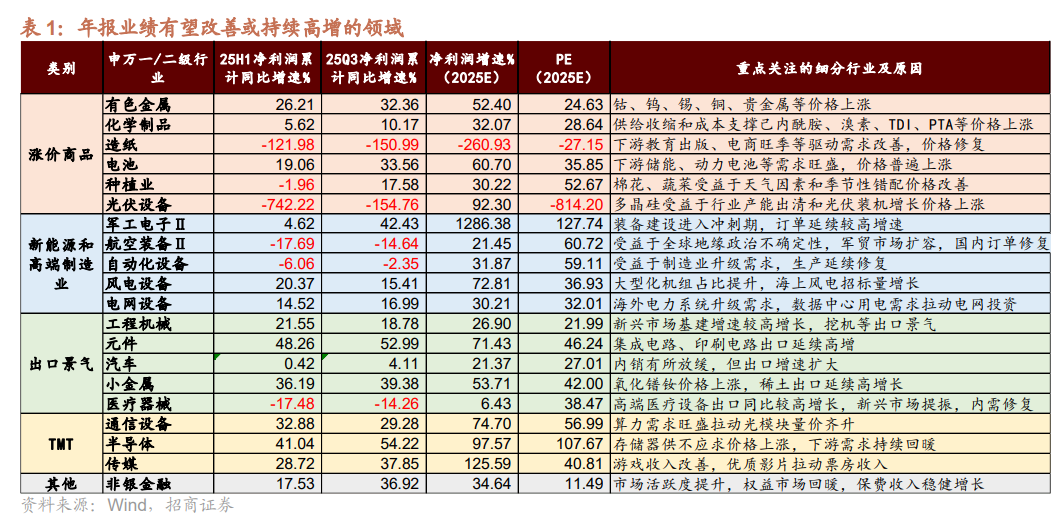
Event Summary - The annual report disclosure schedule for 2025 has been released, with ChipGuide Technology being the first to disclose on February 3, 2026, and *ST Huawang on February 13, 2026 [1] Industry Insights - Key sectors expected to show improved or sustained high growth in annual report performance include "price-increasing commodities," "new energy and high-end manufacturing," "export-oriented sectors," and "TMT sectors with strong or improving demand" [1] - In the "price-increasing commodities" category, items with price increases exceeding 200% include black tungsten concentrate, VC, and lithium hexafluorophosphate, while those with increases over 100% include platinum and cobalt [4] - The new energy and high-end manufacturing sector is benefiting from high growth in military equipment orders and expanding demand for industrial robots and energy storage [6] - The export sector has seen significant growth, with high-tech and electromechanical product exports increasing by 7.7% and 9.7% year-on-year, respectively [6] Company Performance - A list of companies expected to see net profit growth exceeding 50% for the year has been compiled, based on preliminary quarterly report data [8] - Notable companies include Yuanjie Technology, with a projected net profit increase of 1726.36%, and Runze Technology, with an increase of 262.73% [9] - The semiconductor industry is projected to grow by 13.7% in sales in 2025, driven by strong demand for memory chips [7]

【盘中播报】沪指涨0.11% 石油石化行业涨幅最大
Zheng Quan Shi Bao Wang· 2025-12-30 06:24
Market Overview - The Shanghai Composite Index increased by 0.11% today, with a trading volume of 1,004.34 million shares and a transaction value of 17,424.85 billion yuan, representing a 0.72% increase compared to the previous trading day [1]. Industry Performance - The top-performing industries included: - Oil and Petrochemicals: Up by 2.43%, with a transaction value of 162.59 billion yuan, led by Tongyi Co., which rose by 10.01% [1]. - Machinery Equipment: Increased by 1.38%, with a transaction value of 1,591.32 billion yuan, led by Buke Co., which surged by 20.00% [1]. - Automotive: Gained 1.35%, with a transaction value of 949.77 billion yuan, led by Tsinghua Technology, which rose by 30.00% [1]. - The worst-performing industries included: - Commercial Retail: Decreased by 1.66%, with a transaction value of 298.04 billion yuan, led by Baida Group, which fell by 10.00% [2]. - Social Services: Down by 1.13%, with a transaction value of 104.28 billion yuan, led by Tian Su Measurement, which dropped by 15.65% [2]. - Real Estate: Fell by 1.02%, with a transaction value of 180.88 billion yuan, led by Suzhou High-tech, which declined by 6.88% [2].
12月29日有色金属、国防军工、电力设备等行业融资净买入额居前
Zheng Quan Shi Bao Wang· 2025-12-30 03:19
Summary of Key Points Core Viewpoint - As of December 29, the market's latest financing balance reached 25,348.43 billion yuan, reflecting an increase of 8.38 billion yuan compared to the previous trading day, indicating a positive trend in market financing activity [1]. Industry Analysis - **Industries with Increased Financing Balance**: - The non-ferrous metals industry saw the largest increase in financing balance, rising by 2.46% to 922.41 billion yuan, with an increase of 24.49 billion yuan [1]. - Other notable increases were observed in the defense and military industry (22.19 billion yuan increase, 2.46% growth), electric power equipment (19.54 billion yuan increase, 0.86% growth), and computer industry (10.63 billion yuan increase, 0.61% growth) [1][2]. - **Industries with Decreased Financing Balance**: - The non-bank financial sector experienced the largest decrease, with a reduction of 3.05 billion yuan, representing a decline of 0.16% [2]. - Other sectors with significant decreases included banks (2.54 billion yuan decrease, 0.34% decline) and environmental protection (1.94 billion yuan decrease, 0.98% decline) [2]. - **Financing Balance Changes by Percentage**: - The defense and military industry had the highest percentage increase in financing balance, followed by non-ferrous metals (1.96%), public utilities (1.86%), and real estate (0.98%) [1]. - Conversely, the construction materials industry saw the largest percentage decrease at 1.23%, followed by environmental protection (0.98%) and retail (0.37%) [2].