啤酒

Search documents
2025Q4基金食品饮料持仓分析:持仓继续下降,结构向大众品倾斜
Soochow Securities· 2026-01-26 12:12
Investment Rating - The report maintains an "Increase" rating for the food and beverage industry [1] Core Insights - The food and beverage sector continues to see a decline in holdings, with a shift towards mass-market products. The proportion of active equity funds in the food and beverage sector decreased to 4.04% in Q4 2025, down 0.14 percentage points from the previous quarter [9][15] - The report highlights a continued reduction in allocations to alcoholic beverages, while holdings in mass-market products have shown signs of recovery. The proportion of holdings in white liquor decreased by 0.29 percentage points to 2.92% in Q4 2025 [14][17] - The report emphasizes the importance of capturing valuation switching opportunities in five key areas: health food and supplements, leading snack brands, quality retail chains, beverage leaders with long life cycles, and sectors expected to recover from downturns, particularly dairy [29][30] Summary by Sections 1. Holdings Decline and Shift Towards Mass-Market Products - Active equity funds' holdings in the food and beverage sector decreased by 9.01% to 784 billion yuan in Q4 2025, with a total market value of approximately 1.94 trillion yuan [9][10] - The decline in holdings is attributed to a preference for technology and other sectors, while the alcoholic beverage sector continues to face downward pressure [10][14] 2. Increased Diversification in Holdings - The number of heavily held stocks in the food and beverage sector has become more diversified, with only Kweichow Moutai remaining in the top 20 heavy holdings [24][28] - The report notes that the top five stocks with the largest increase in heavy holdings include Baba Foods, Yingjia Gongjiu, Youran Dairy, Ximai Foods, and Modern Dairy [28][29] 3. Investment Recommendations - The report suggests focusing on five areas for investment: innovative health food, leading snack brands, quality retail chains, beverage leaders, and sectors expected to recover from downturns [29][30] - It emphasizes the need to pay attention to the health food sector, which is expected to benefit from an expanding consumer base and product innovation [29][30]

食品饮料行业周报:白酒动销渐起-20260126
CMS· 2026-01-26 04:52
Investment Rating - The report maintains a positive outlook on the liquor industry, indicating a bottoming out and potential for a rebound during the Spring Festival, with a focus on key stocks such as Guizhou Moutai, Wuliangye, and Shanxi Fenjiu [5][16]. Core Insights - The report highlights that the safety margin for liquor companies is derived more from brand strength, market share, and sales momentum rather than just dividend yields, which are expected to be adjusted downwards for the years 2025-2026 [1][16]. - Recent sales tracking shows that Moutai's sales and pricing are better than market expectations, with a slight increase in overall channel sales volume and stable pricing [1][16]. - The report emphasizes the importance of cash flow and dividend planning, with companies like Yanghe planning to maintain dividends at no less than 100% of their net profit for 2025-2027 [2][11]. Summary by Relevant Sections Core Company Tracking - Yanghe's net profit for 2025 is projected to be between 2.12 billion and 2.52 billion yuan, a decline of 62.2%-68.3% year-on-year, with a focus on inventory reduction and price stabilization [2][11]. - Yanjing Beer expects a net profit of 1.58 billion to 1.74 billion yuan for 2025, reflecting a year-on-year increase of 50.0%-65.0%, with plans to launch a high-end product in 2026 [3][12]. - Yihai International anticipates low single-digit growth in H2 2025, driven by improved gross margins and a return of key personnel, which is expected to enhance business performance [4][13]. - IFBH is expected to face pressure in H2 2025, but with potential recovery in 2026 as supply issues are resolved [4][14]. Investment Recommendations - The report suggests a bottom-up approach to investing in liquor stocks, with a focus on key players and potential rebounds in sales, particularly in the context of the upcoming Spring Festival [5][16]. - It identifies four main lines for consumer goods: restaurant chains, dairy products, valuation-matched companies, and bottom-up recovery plays [5][17]. Industry Overview - The report notes that the food and beverage industry has a total market capitalization of 4,560.2 billion yuan, with 142 listed companies [5]. - The industry index shows a 1-month performance of 0.6%, a 6-month performance of 4.4%, and a 12-month performance of 17.7% [7].




食品饮料周报(26年第4周):各品类春节备货有序进行,预制菜国标将征求意见-20260126
Guoxin Securities· 2026-01-26 02:59
Investment Rating - The report maintains an "Outperform the Market" rating for the food and beverage sector [4][5][11]. Core Views - The food and beverage sector is expected to perform well in 2026, driven by cost advantages, efficiency improvements, innovation, and potential recovery opportunities in the liquor segment [3][11][15]. - The report highlights a diversified performance across sub-sectors, with beverages outperforming food and liquor categories [2][11]. Summary by Relevant Sections 1. Sector Overview - The food and beverage sector saw a cumulative decline of 1.37% this week, with A-shares down 1.57% and H-shares up 1.21% [1]. - Key performers included companies like Hao Xiang Ni and Wei Zhi Xiang, with significant weekly gains [1]. 2. Sub-sector Insights - **Liquor**: - Moutai's price remains stable with an upward trend, and the focus is on sales momentum during the Spring Festival. Recommendations include Moutai, Shanxi Fenjiu, and Luzhou Laojiao [2][11]. - **Beverages**: - The dairy segment is seeing orderly preparations for the Spring Festival, with a focus on leading companies like Yili. Recommendations include Nongfu Spring and Dongpeng Beverage [2][15]. - **Snacks**: - The report emphasizes strong alpha stocks in the snack sector, particularly in konjac products, with companies like Weidong and Yanjinpuzi showing strong innovation [2][13]. - **Catering Supply Chain**: - The sector is entering a peak season for inventory and sales, with new standards for prepared dishes being solicited for public opinion [2][14]. 3. Investment Recommendations - The report suggests a focus on four main lines for investment: cost advantages, efficiency improvements, innovation-driven companies, and potential recovery in the liquor sector [3][11]. - Recommended stocks include Baba Foods, Dongpeng Beverage, Weidong, and Shanxi Fenjiu, which have shown resilience and growth potential [17][19]. 4. Earnings Forecasts - Key companies are projected to maintain strong earnings growth, with Moutai expected to achieve a stable performance and Yili showing significant recovery potential [4][15][19]. - The report provides detailed earnings forecasts for several companies, indicating a positive outlook for the food and beverage sector [4][19].




中信建投:强推零售连锁变革的投资机会
智通财经网· 2026-01-26 00:00
Group 1 - The core viewpoint of the report indicates that the liquor industry, particularly brands like Shui Jing Fang and Yanghe, is expected to experience significant performance declines in 2025 due to deep industry adjustments and proactive inventory control by companies [1] - The report suggests that the long-term performance improvement potential remains clear, supported by brand strength and channel barriers, despite short-term challenges [1][5] - The upcoming Q1 is anticipated to show a recovery in the liquor sector post-Spring Festival, with inventory adjustments and stable pricing beginning to manifest [2][5] Group 2 - Three main investment themes for Q1 are highlighted: the leading performance of consumer staples like snacks and dairy, the potential for profit surprises from leading brands in the consumer sector, and the positive impact of pre-Spring Festival inventory buildup [2][3] - The report emphasizes that the liquor sector is currently in a "bottoming out" phase, with expectations for a valuation recovery following the Spring Festival as consumer demand is expected to rebound [2][3] - The report notes that some liquor companies are maintaining stable profitability despite slowing revenue growth, with certain regional brands expected to outperform due to market penetration and improved sales dynamics [3][5] Group 3 - The report identifies multiple catalysts in late January that could lead to better-than-expected Q1 results, including the peak sales season for liquor companies and improved data from consumer staples due to pre-holiday stocking [4] - The liquor industry is undergoing a structural recovery cycle, with expectations for inventory reduction and price stabilization in the high-end and mass-market segments by 2026 [5][6] - Companies are advised to seize current low valuation opportunities, as leading liquor brands are expected to benefit from the recovery in business and gift consumption, providing stable returns [5][6] Group 4 - The beer industry is experiencing a continued inventory reduction, with production figures showing a decline in output, indicating a need for strategic planning for the upcoming year [7] - The dairy sector is seeing a slight increase in milk prices, with major dairy groups seeking mergers to enhance market share as they prepare for a cyclical recovery [8] - The condiment and frozen food sectors are expected to see a stabilization in pricing as the restaurant chain enters a peak season, with potential cost elasticity from raw material price reductions [9]

食品饮料行业周报:湖北和广东调研反馈&周观点:啤酒推新蓄力,烘焙旺季稳健
GOLDEN SUN SECURITIES· 2026-01-25 12:24
Investment Rating - The report maintains an "Accumulate" rating for the food and beverage industry [5] Core Insights - The upcoming Spring Festival is expected to boost sales in the liquor sector, with Moutai leading the industry towards an unexpected improvement. Short-term focus should be on the demand for the Spring Festival, while medium-term investments should target leading brands across various price segments [1] - In the beer segment, new product launches are being prepared, with a focus on high-growth channels and consumer trends towards personalized and diversified consumption [2][3] - The baking sector is showing stable performance, with companies like Lihigh Foods preparing for the sales peak and benefiting from favorable policies regarding cream products [3][4] Summary by Sections Liquor Sector - The liquor market is entering the Spring Festival sales peak, with Moutai expected to lead improvements. Key short-term stocks include Guizhou Moutai, Guo Jiu Gong Jiu, and others, while medium-term focus should be on Wuliangye and Shanxi Fenjiu [1] Beer Sector - Beer remains in a low season, but new product launches and high growth in instant retail channels are promising. Companies like Chongqing Beer are launching new 1L cans to cater to consumer preferences [2] Food Sector - Lihigh Foods is preparing for the sales peak with a focus on quality over quantity, while Anqi Yeast is benefiting from declining sugarcane prices, enhancing profit margins [3] - Yizhi Konjac is experiencing rapid demand growth, with a stable supply chain and product innovation driving expansion in both domestic and international markets [4]
湖北和广东调研反馈、周观点:啤酒推新蓄力,烘焙旺季稳健-20260125
GOLDEN SUN SECURITIES· 2026-01-25 11:22
Investment Rating - The report maintains an "Accumulate" rating for the food and beverage industry [5] Core Insights - The upcoming Spring Festival is expected to boost sales in the liquor sector, with Moutai leading the industry towards an unexpected improvement. Short-term focus should be on the demand for the Spring Festival, while medium-term investments should target leading brands across various price segments [1] - In the beer segment, new product launches are being prepared, with a focus on high-growth channels and consumer trends towards personalized and diversified consumption [2] - The baking sector is showing stable performance, with companies like Lihigh Foods preparing for the sales peak and benefiting from favorable policies regarding cream products [3] Summary by Relevant Sections Liquor Sector - The Spring Festival is driving demand, with Moutai expected to lead the market. Key short-term stocks include Guizhou Moutai, Guo Jiu Gong Jiu, and others, while medium-term focus should be on Wuliangye and Shanxi Fenjiu [1] Beer Sector - Current beer sales are in a low season, but new product launches and high growth in instant retail channels are promising. Companies like Chongqing Beer are launching new 1L cans to meet consumer preferences [2] Food Sector - Lihigh Foods is preparing for the sales peak with a focus on quality over quantity, while Anqi Yeast is benefiting from declining sugarcane prices, enhancing profit margins [3] - Yizhi Konjac is experiencing rapid demand growth, with a stable supply chain and product innovation driving its market position [4]



食品饮料行业研究:飞天茅台动销逐步起势,关注子版块春节备货催化
SINOLINK SECURITIES· 2026-01-25 07:50
Investment Rating - The report maintains a cautious outlook on the liquor industry, particularly on high-end liquor such as Moutai, with expectations of gradual recovery in sales and pricing stability post-Spring Festival [10][11][12]. Core Insights - The high-end liquor segment, especially Moutai, is experiencing a sales boost as the Spring Festival approaches, with expectations of price recovery due to increased demand driven by wealth effects [10][11]. - The report suggests that the market's concerns about post-festival price drops for Moutai are likely to be unfounded, predicting only minor seasonal fluctuations [10][12]. - The overall sentiment in the liquor industry is shifting from a pessimistic outlook to a more stable one, with expectations of improved sales dynamics as external constraints on consumption ease [11][12]. Summary by Sections Liquor Industry - The report highlights that Moutai's sales are performing better than previously cautious expectations, leading to a price recovery for both Moutai and newer Moutai products [10]. - It is noted that the market is still wary of potential price declines after the Spring Festival, but historical patterns suggest only minor adjustments are likely [10][11]. - The report emphasizes the importance of brand strength and market positioning for high-end liquor companies, recommending investments in brands with strong market presence and growth potential [12]. Beer Industry - The beer sector is seeing a steady recovery in on-premise consumption, with companies diversifying into non-drink channels and soft drinks [12]. - The report suggests that the beer industry's performance is expected to stabilize, with a focus on maintaining competitive pricing and improving dividend yields [12]. Snack Industry - The snack sector is benefiting from pre-Spring Festival stocking and product innovation, with companies like Qiaqia and Ganyuan expected to show significant profit elasticity due to low comparative bases [14]. - The report recommends focusing on leading snack companies that are expanding their store presence and adapting their product offerings [14]. Beverage Industry - The soft drink sector is currently facing challenges due to seasonal demand fluctuations and competition from ready-to-drink tea brands, leading to a slight decline in overall sales growth [14]. - Despite these challenges, leading brands like Dongpeng and Nongfu are expected to maintain double-digit growth through brand strength and market share consolidation [14]. Seasoning Industry - The seasoning sector is stabilizing as restaurant demand begins to recover, with expectations of improved performance in 2026 driven by seasonal effects [15]. - The report highlights companies like Angel Yeast and Qianhe Condiments as having strong growth potential due to favorable market conditions and dividend yields [15].

食品饮料行业周报 2026年第4期:白酒探底,餐供积极
GUOTAI HAITONG SECURITIES· 2026-01-25 07:45
Investment Rating - The report assigns an "Overweight" rating for the food and beverage industry, indicating a positive outlook compared to the market benchmark [6]. Core Insights - The report emphasizes the recovery of the consumer price index (CPI) in December, suggesting a turning point in supply and demand dynamics. It highlights the importance of focusing on growth opportunities and the valuation flexibility of consumer goods [3][9]. - The report identifies key investment targets in the liquor sector, including Guizhou Moutai, Wuliangye, and Luzhou Laojiao, as well as other brands expected to clear inventory [9]. - The beverage sector is expected to benefit from improved travel conditions, with recommendations for companies like Dongpeng Beverage and Nongfu Spring [9]. - The report notes the ongoing recovery in the restaurant supply chain and the high growth potential of companies like Bailong Chuangyuan [15]. Summary by Sections Investment Recommendations - The report suggests focusing on companies with price elasticity, including Guizhou Moutai, Wuliangye, and Luzhou Laojiao, as well as those expected to clear inventory like Yingjia Gongjiu and Guxi Gongjiu [9]. - It recommends beverage companies such as Dongpeng Beverage and Nongfu Spring, while also highlighting low-valuation, high-dividend stocks like China Foods and Master Kong [9]. - For snacks and food raw materials, it suggests Bailong Chuangyuan, Yanjinpuzi, and Three Squirrels as growth targets [9]. Liquor Sector Insights - As the Spring Festival approaches, the report highlights the importance of monitoring sales volume and pricing. It notes that the peak sales period is expected in February, with varying performance among brands [10]. - The report mentions that the liquor industry faced a significant production decline in 2025, with a total output of 3.549 million kiloliters, a year-on-year decrease of 12.1%, marking the largest drop since 2019 [11][13]. - It anticipates that the recovery in market conditions and inventory reduction will take time, with companies likely to maintain relationships through pricing strategies [11]. Consumer Goods Sector Insights - The report indicates that the restaurant supply chain is recovering, with the pre-prepared food sector expected to benefit from new national standards [15]. - Bailong Chuangyuan is highlighted for its strong growth, reporting a revenue of 1.38 billion yuan in 2025, a year-on-year increase of 19.8%, and a net profit of 366 million yuan, up 48.9% [15][16]. - The report notes that the company’s growth is driven by product optimization and increased production capacity utilization [16].

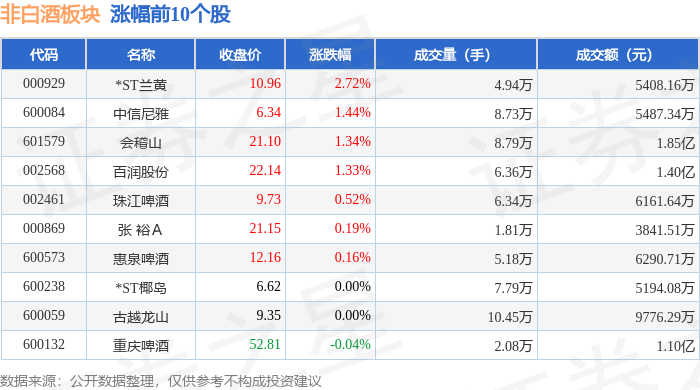
非白酒板块1月23日涨0.18%,*ST兰黄领涨,主力资金净流出2353.25万元
Zheng Xing Xing Ye Ri Bao· 2026-01-23 09:04
Core Viewpoint - The non-liquor sector experienced a slight increase of 0.18% on January 23, with *ST Lanhuang leading the gains, while the overall market indices also showed positive movement [1]. Group 1: Market Performance - The Shanghai Composite Index closed at 4136.16, up by 0.33% [1]. - The Shenzhen Component Index closed at 14439.66, up by 0.79% [1]. - The non-liquor sector stocks showed varied performance, with *ST Lanhuang rising by 2.72% to a closing price of 10.96 [1]. Group 2: Stock Performance - The top performers in the non-liquor sector included: - *ST Lanhuang: 10.96, +2.72%, trading volume of 49,400 shares, turnover of 54.08 million [1]. - Zhongxin Niya: 6.34, +1.44%, trading volume of 87,300 shares, turnover of 54.87 million [1]. - Huijuan Beer: 12.16, +0.16%, trading volume of 51,800 shares, turnover of 62.91 million [1]. - Conversely, stocks like Weilang Co. and ST Xifa saw declines of 2.12% and 1.88%, respectively [2]. Group 3: Capital Flow - The non-liquor sector experienced a net outflow of 23.53 million from institutional funds and 36.39 million from speculative funds, while retail investors contributed a net inflow of 59.92 million [2]. - Notable capital flows included: - Qingdao Beer: -35.13 million from institutional funds, with a retail outflow of -49.91 million [3]. - *ST Yedao: +5.45 million from institutional funds, with a retail inflow of +1.50 million [3].




亮点新营销:金星啤酒中式精酿新营销赴港IPO之路
Sou Hu Cai Jing· 2026-01-23 07:41
Core Insights - Jin Xing Beer has successfully transformed from a traditional brewery to a leader in the Chinese craft beer market through a "Chinese-style" transformation and innovative marketing strategies, leading to significant revenue and profit growth and an IPO application to the Hong Kong Stock Exchange [1][12] Company Background - Established in 1982, Jin Xing Beer was once a benchmark in the Central Plains beer market with 16 production bases and an annual capacity of 2 million tons, but faced stagnation with a net profit of only 0.12 million yuan and a gross margin below 30% in 2023 [2][13] Transformation Strategy - The company shifted from traditional competition based on capacity and price wars to focus on the blue ocean of Chinese craft beer, integrating local culinary culture into its brewing process, such as using Xinyang Maojian tea and other regional ingredients [2][14] Product Launch and Performance - The first product, "Jin Xing Maojian Chinese Craft Beer," launched in August 2024, sold out immediately, followed by other flavors like ice sugar hawthorn and jasmine tea, with the ice sugar hawthorn beer generating over 720 million views on Douyin [3][14] - In just 10 months, the production and sales of Chinese craft beer exceeded 100,000 tons, contributing 78.1% of the company's revenue in the first three quarters of 2025, with revenue soaring from 356 million yuan in 2023 to 1.109 billion yuan in 2025 [3][14] Business Model Innovation - Jin Xing Beer restructured its business model by focusing on high-end products, reducing SKUs from 229 to 166, and creating a product matrix that caters to different consumer scenarios, thus transforming beer from a "drinking necessity" to an "experiential consumer product" [6][15] - The company maintained its traditional distribution network while also expanding into online retail, creating a comprehensive channel strategy that allows products to reach consumers through both traditional and modern means [7][15] Marketing Strategy - The marketing approach shifted to new media, utilizing platforms like Douyin and Xiaohongshu to connect with younger consumers through lifestyle scenarios rather than traditional advertising [9][18] - The company created viral topics around its products, achieving significant social media engagement, and leveraged live streaming to convert traffic into sales, demonstrating a user-centered marketing strategy [11][19] IPO and Market Outlook - Jin Xing Beer has submitted an IPO application to the Hong Kong Stock Exchange, aiming to become the first Chinese craft beer stock, with funds intended for production expansion, channel development, and product innovation [12][20] - The Chinese craft beer market is experiencing rapid growth, with a compound annual growth rate exceeding 38%, and the segment for Chinese-flavored craft beer growing at 49.3%, indicating a shift from niche to mainstream [20]