
家电

Search documents
数码家电行业周度市场观察-20260212
Ai Rui Zi Xun· 2026-02-12 07:06
Investment Rating - The report does not explicitly provide an investment rating for the industry Core Insights - The report highlights significant trends in the digital home appliance industry, particularly focusing on AI infrastructure investments by major tech companies and the emerging potential of space photovoltaic technology [3][4][10][13] Industry Trends - Major US tech giants are entering a capital expenditure expansion cycle focused on AI infrastructure and cloud services, with investments expected to nearly double from 2024 to 2026, despite short-term market concerns over cash flow [4] - The space photovoltaic market is projected to reach a trillion-dollar scale by 2030, driven by Elon Musk's initiatives, although the industry faces challenges such as ground losses and rising metal prices [4][10] - AI meteorological models are transitioning from technical validation to industrial application, optimizing decision-making in energy and finance sectors [7] - The robot industry is evolving from showcasing technology to practical applications, with significant collaborations for the upcoming Spring Festival [8] - The rise of silver prices, driven by AI demand, has disrupted traditional pricing models, with industrial demand becoming the primary driver [10] - The introduction of standardized pricing for surgical robots in China is expected to accelerate the commercialization and high-quality development of the industry [13] - Smart home appliances are gaining popularity among young consumers during the festive season, reflecting a trend towards emotional and functional products [13] Top Brand News - Apple is enhancing Siri with a new AI model, emphasizing privacy and ecosystem integration, while local competitors are exploring AI assistants tailored to Chinese users [16] - Google's Q4 2025 revenue reached $113.8 billion, with significant growth in cloud services and a doubling of capital expenditure for AI infrastructure [16] - Alibaba is focusing on AI in education, with plans to develop self-researched AI chips and a strategic emphasis on bridging imagination and creativity in education [17] - The potential acquisition of A.O. Smith's China business by Hisense could reshape the competitive landscape in the home appliance sector [19] - Li Auto is accelerating its entry into embodied intelligence and humanoid robots, aiming for L4 autonomous driving by 2028 [20] - Apple's acquisition of Q.ai for nearly $2 billion aims to revolutionize human-computer interaction in wearable devices [21]
泰国人“爆买”中国家电的秘密
2 1 Shi Ji Jing Ji Bao Dao· 2026-02-12 06:04
Group 1 - Chinese home appliance companies are establishing significant manufacturing bases in Thailand, with major players like Hisense, Haier, TCL, and Midea leading the charge [1] - Hisense's HHA smart manufacturing industrial park is set to be the largest overseas production base for the company, while Haier's air conditioning industrial park in Thailand is the largest for Chinese brands in Southeast Asia [1] - The construction of these factories is characterized by rapid development, with Haier's facility being completed in just nine months, showcasing industry-leading construction speed [1] Group 2 - Chinese home appliances are increasingly preferred in Thailand, previously dominated by Japanese and Korean brands, due to their competitive pricing and advanced technology [2] - The core competitive advantages of Chinese appliances include tailored product designs that meet local needs, efficient cost management through supply chain optimization, and innovative marketing strategies [2] - Thailand serves as a key observation point for how Chinese home appliance companies can successfully establish a strong market presence in foreign territories [2]


中国宏观经济月度分析报告202601:烽火科技纠缠,时间藏一陬-20260212
中采咨询· 2026-02-12 05:56
Economic Indicators - The manufacturing PMI for January 2026 is 49.3%, a decrease of 0.8 percentage points from the previous month, indicating a slowdown in manufacturing activity[4] - The CPI growth rate for January 2026 is 0.2%, primarily due to the high base effect from the previous year's Spring Festival[6] - The PPI for January 2026 is -1.4%, with a narrowing decline of 0.5 percentage points, reflecting improved internal structure and demand driven by technology[6] Trade and Investment - In December 2025, China's total imports and exports amounted to $601.42 billion, with exports increasing by 6.6% and imports rising by 5.7% year-on-year[20] - The M1 growth rate in December 2025 fell to 3.8%, while M2 grew by 8.5%, leading to an expanding M1-M2 gap of -4.7%[34] - The real estate market shows signs of recovery, with new home prices averaging 17,114 RMB per square meter, a month-on-month increase of 0.18%[48] Sector Performance - The service sector's business activity index has stabilized around 49.5% for three consecutive months, supported by financial activities and holiday-related consumption[4] - The consumer goods sector experienced a decline of 2.2 percentage points, primarily due to a drop in clothing orders[27] - The equipment sector shows resilience, with significant demand for computers and automation equipment, indicating a positive trend in industrial investment[28]
开局有新风|消费、就业、投资……这些变化与你息息相关!
Sou Hu Cai Jing· 2026-02-12 04:13
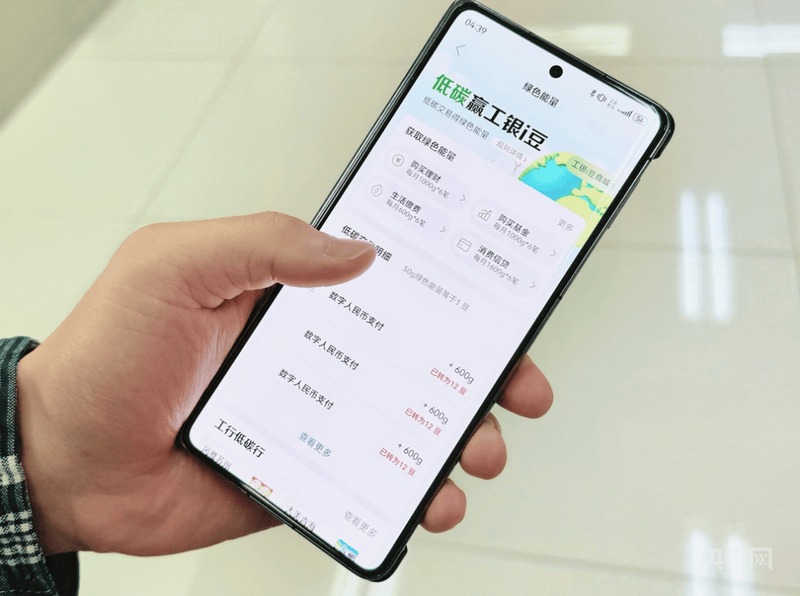
Group 1: Green Consumption and Policy Framework - In 2026, the "dual carbon" goals will enter a critical phase, with green consumption transitioning from policy advocacy to widespread public practice. The first policy document focusing on green consumption has been released, establishing a comprehensive policy framework for the supply-consumption-recycling chain [2][3] - The policy outlines three main strategies: over 88,000 national green agricultural product certifications, a sales boost of over 3.9 trillion yuan from trade-in policies for automobiles and home appliances, and a resource recycling industry with an annual output value exceeding 5 trillion yuan [2] Group 2: Employment Opportunities in Green Sector - There is a significant demand for green jobs, with nearly one million positions expected in the "dual carbon" field, while current practitioners number only around 100,000, indicating a substantial gap [3] - The Ministry of Human Resources and Social Security has recognized 137 green occupations, with new roles like carbon accountants and ESG consultants seeing a surge in demand, potentially creating 38 million jobs by 2050 [3] Group 3: Rural Revitalization and Digital Agriculture - The story of a new farmer in Pinggu, who has utilized smart algorithms to redefine agricultural practices, illustrates that rural revitalization involves the emergence of new productive forces rather than mere industrial transfer [4][6] - The recent central government document emphasizes high-quality rural e-commerce development and the integration of agriculture with tourism, which aligns with the efforts of new farmers to enhance local income through innovative practices [4] Group 4: Employment Market Trends - The employment policy direction is shifting from "stabilizing employment" to "high-quality employment," with opportunities emerging at the intersection of policy and industry [7] - Key sectors for future job growth include high-end manufacturing and digital services, with significant developments in digital economy, low-altitude economy, and artificial intelligence expected to create numerous job opportunities [9] Group 5: Wealth Management and Investment Trends - The wealth management sector has seen significant activity, with international gold prices experiencing volatility and approximately 70 trillion yuan in household deposits maturing, leading to discussions about "deposit migration" [10][12] - Predictions indicate that the scale of bank wealth management could exceed 35 trillion yuan by 2026, with "fixed income+" products likely to remain a mainstream choice due to their balanced risk and return profile [12]

行业唯一!海尔智家荣获2025福布斯“循环经济实践领航者奖”
Jing Ji Guan Cha Wang· 2026-02-12 03:23
Core Viewpoint - Haier Smart Home has been recognized as a leader in sustainable development within the home appliance industry by winning the "Circular Economy Practice Pioneer Award" at the 2025 Forbes China Business Brand Management Influence Awards, being the only company in the sector to receive this honor [1][2] Group 1: Award Recognition - Haier Smart Home's mature and comprehensive home appliance recycling system has set a benchmark for sustainable development in the industry [1] - The award emphasizes the importance of innovation and responsibility, requiring selected companies to balance innovation with environmental and social responsibilities [1] Group 2: Circular Economy Initiatives - Haier has established the first "recycling-disassembly-regeneration-reuse" closed-loop system to accelerate the green, high-end, and technological development of the circular economy [2] - The company focuses on three competitive upgrades: first experience in recycling, first efficiency in disassembly, and first quality in regeneration, solidifying its model and accelerating national layout [2] Group 3: Technological Advancements - Haier is addressing the pain points of low-end utilization of traditional recycled materials by continuously breaking through circular technology, leading the industry's high-end transformation [2] - The company is expanding its circular technology capabilities and collaborating with upstream and downstream resource providers, moving from plastic recycling to metal recycling [2] Group 4: Standards and Quality Control - In October 2025, Haier led the formulation of the national standard for "Recycled Material Use in Household Appliances," which provides a basis for quality control and supply chain traceability of recycled materials [2] Group 5: User-Centric Approach - Haier's recycling practices demonstrate that the circular economy can drive high-quality growth and create diverse value, rather than being a burden on development [2] - The company consistently prioritizes user needs through a comprehensive approach from green products to smart scenario solutions, continuously optimizing and upgrading the quality of life experience for users [2]
高效、精准、便捷 金融“活水”润泽消费“沃土”为假日经济添动能
Yang Shi Wang· 2026-02-12 02:51
Core Viewpoint - The Chinese government is promoting financial institutions to enhance innovation in financial products and services during the Spring Festival, focusing on key consumer areas to provide efficient and convenient financial services [1] Group 1: Consumer Loan Support - Financial institutions are encouraged to increase personal consumption loan issuance, determining reasonable loan issuance ratios, terms, and interest rates to support the replacement of durable consumer goods such as automobiles, home appliances, and home renovations [3] - The development of comprehensive grading systems for insurance models is being accelerated to effectively promote automobile consumption [3] Group 2: Service Consumption Enhancement - There is a push to develop commercial insurance annuity products that combine elderly risk protection and wealth management functions, as well as commercial medical insurance that benefits chronic disease patients and the elderly [5] - The development of commercial long-term care insurance is being strongly promoted, alongside optimizing financial service models in cultural tourism, sports, entertainment, and education sectors to stimulate service consumption [5] Group 3: New Consumption Models - Financial institutions are encouraged to broaden online financial support channels for consumption, collaborating with merchants to develop financial products and services that cater to new consumption characteristics [7] - Support is being provided for the development of digital consumption, experiential consumption, smart consumption, and customized consumption models [7]
商务部:保障消费者在春节期间更好享受以旧换新补贴
Shang Hai Zheng Quan Bao· 2026-02-12 02:46
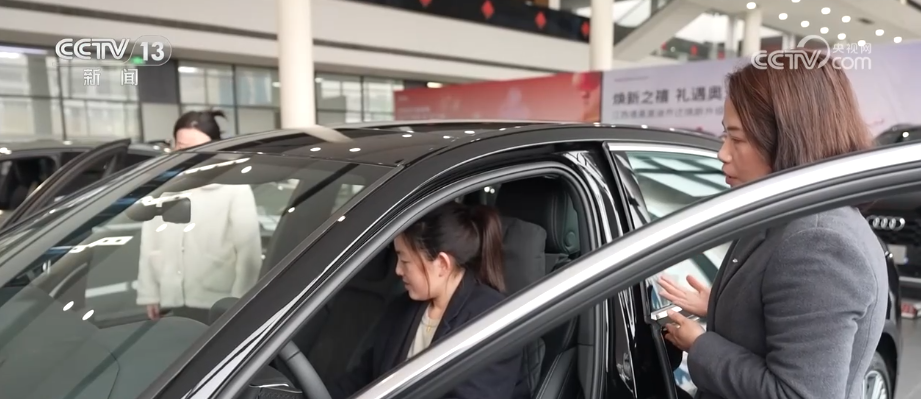
Core Viewpoint - The Ministry of Commerce has issued a notice to enhance the "old-for-new" subsidy program for consumer goods during the 2026 Spring Festival holiday, aiming to stimulate consumer spending and ensure sufficient supply of products [1] Group 1: Subsidy Program Details - The notice emphasizes the need for local governments to secure funding for the "old-for-new" subsidies during the Spring Festival, which lasts for 9 days from February 15 to 23, 2026 [1] - Consumers purchasing new appliances, digital, and smart products can apply for subsidies through offline channels during the holiday [1] - Car buyers during the holiday period are also eligible for the "old-for-new" subsidy according to policy requirements [1] Group 2: Supply Chain and Market Readiness - Local authorities are instructed to guide automotive dealers and retailers of home appliances and digital products to prepare quality inventory and ensure operational hours to meet consumer demand [1] - There is a focus on ensuring product supply in rural areas, with an increase in local policy participants and a push for online channels to cater to rural residents [1]
商务部:春节假期购买新车消费者均可按政策要求申领汽车以旧换新补贴
Bei Jing Shang Bao· 2026-02-12 02:24
Core Viewpoint - The Ministry of Commerce has issued a notice to enhance the implementation of the old-for-new consumption subsidy policy during the 2026 Spring Festival holiday, aiming to stimulate consumer spending and meet demand [1] Group 1: Policy Implementation - Local governments are required to ensure sufficient funding for the old-for-new consumption subsidies during the Spring Festival [1] - The policy encourages consumers to engage in shopping and consumption during the 9-day holiday period from February 15 to 23, 2026 [1] - Consumers purchasing new cars during the holiday can apply for the old-for-new subsidy according to policy requirements [1] Group 2: Market Preparation - Local authorities are tasked with guiding automotive dealers and retail outlets for home appliances and digital products to prepare quality inventory and ensure operational hours during the holiday [1] - There is an emphasis on ensuring adequate supply of subsidized products to meet market demand during the Spring Festival [1] Group 3: Rural Focus - The policy aims to enhance the supply of goods in rural areas during the holiday, increasing the number of local policy participants [1] - Online channels are encouraged to focus on rural areas to facilitate residents' participation in the subsidy program [1]
商务部等九部门派送“乐购新春”大礼包
Huan Qiu Wang· 2026-02-12 02:08
Core Viewpoint - The Chinese government is launching a comprehensive initiative to boost consumer spending during the upcoming 2026 Spring Festival, with a total funding of 20.5 billion yuan allocated for various consumer incentives [1][3]. Group 1: Consumer Incentives - The initiative includes three major policy packages aimed at stimulating consumption: 1. The first package focuses on "trade-in" programs, with 625 billion yuan in national subsidies allocated to support the replacement of durable goods like home appliances and automobiles during the nine-day holiday [3]. 2. The second package involves a "prize invoice" pilot program in 50 cities, with 100 billion yuan in reward funds, including over 10 million yuan specifically for the Spring Festival period, encouraging consumers to participate by shopping and dining [3]. 3. The third package includes support from financial institutions, which will offer various discounts and incentives across high-frequency consumption areas such as travel and dining [3][4]. Group 2: Financial Services - Financial institutions will collaborate with key merchants to create promotional activities such as consumer red envelopes, discounts for minimum payments, and loyalty points redemption [4]. - During the holiday, financial services will remain operational, with banks ensuring adequate branch availability to meet consumer needs [5]. Group 3: Supply and Price Stability - The government is also focusing on ensuring the supply and price stability of essential goods, with significant reserves of meat and vegetables being prepared for the holiday season [6]. - Analysts view the Spring Festival as a critical indicator of economic vitality, noting that the combination of subsidies and financial support is expected to effectively stimulate large-scale and service consumption [6][7].

商务部:要保障农村地区节日期间消费品货源供应,推动线上渠道重点向农村地区倾斜
Sou Hu Cai Jing· 2026-02-12 01:54
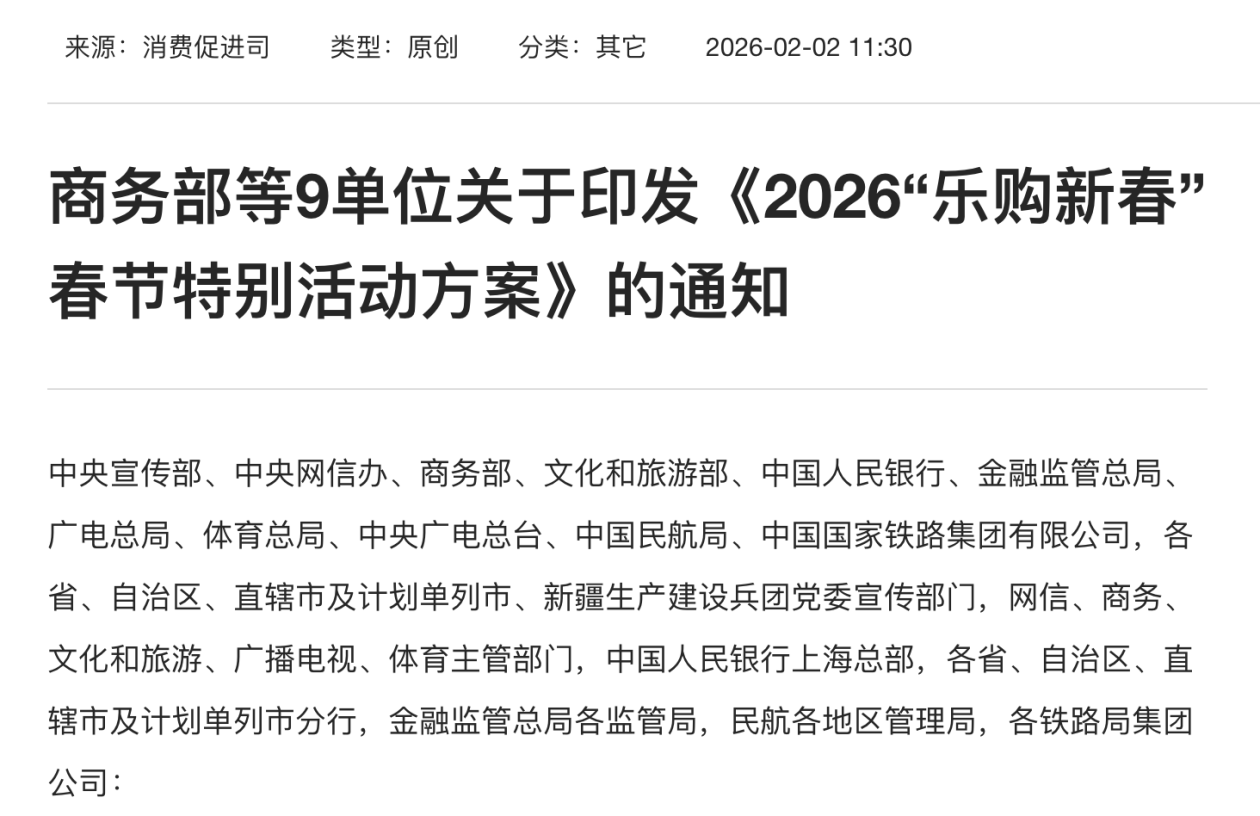
Core Viewpoint - The Ministry of Commerce has issued a notice regarding the implementation of a trade-in policy for consumer goods during the 2026 Spring Festival, emphasizing the need for adequate supply and participation from various sectors [1] Group 1: Policy Implementation - Local authorities are instructed to guide automotive dealers, home appliance stores, and digital product retailers to participate in the trade-in policy, ensuring they are well-stocked with quality goods [1] - The notice highlights the importance of maintaining operational hours and ensuring sufficient supply of subsidized products during the holiday period [1] Group 2: Rural Market Focus - There is a specific emphasis on securing supply for rural areas during the holiday, with a call to increase the number of local policy participants [1] - The initiative aims to enhance online channels to better serve rural residents, facilitating their participation in and benefit from the trade-in policy [1]