金融业

Search documents
全球市场观察系列:地缘冲突再起
Soochow Securities· 2025-06-16 12:01
Group 1 - The report highlights that the escalation of the conflict in the Middle East is likely to create short-term volatility in the US stock market, primarily due to geopolitical uncertainties [1] - It is noted that while "soft" economic data has shown improvement, there is a lack of supporting "hard" data in the short term [1] - The report indicates that historical analysis shows wars typically do not prevent long-term gains in the US stock market, as the key factors are the nature of the conflict and the US economy's response [1] Group 2 - The report discusses the recent US CPI data, which showed a month-on-month increase of 0.1%, below the expected 0.2%, and a year-on-year increase of 2.4%, meeting expectations [2] - It mentions that the market is increasingly betting on two interest rate cuts by the Federal Reserve this year due to the CPI data [2] - The report expresses a cautious outlook on the US long-term treasury yields, suggesting that the risks of rising yields outweigh the risks of falling yields in the short term [3] Group 3 - The report notes that the Hong Kong stock market is experiencing increased rotation, with a need for new capital and sustained policy stimulus for continued rebounds [4] - It highlights that global funds are primarily flowing into developed markets, with US stocks still in a rebound trend [4] - The report indicates that the gold ETFs have seen significant inflows, particularly into SPDR Gold Trust, which received $721 million [6][19]
港股“狂飙”:南向资金创纪录涌入,机构押注科技、消费与红利资产
Huan Qiu Wang· 2025-06-12 03:08
Market Performance - The Hong Kong stock market has outperformed major global markets since 2025, with the Hang Seng Index and Hang Seng Tech Index both showing over 21% cumulative gains as of June 11, 2023 [1] - The net inflow of southbound funds has exceeded 670 billion HKD this year, setting a historical record for the same period, significantly boosting the market's performance [1] - Nearly 80% of the stocks in the Hang Seng Index have risen, with BYD leading the charge with over 60% growth [1] Sector Performance - The healthcare, materials, and information technology sectors have led the market, with gains of 50.54%, 36.41%, and 28.32% respectively [1] - The financial and discretionary consumer sectors have also recorded gains exceeding 22% [1] Investment Outlook - Analysts from CICC highlight structural advantages in the Chinese macro and market environment, such as stable dividend returns and growth lines in new consumption, AI technology, and innovative pharmaceuticals, making Hong Kong stocks more attractive compared to other markets [3] - Multiple brokerage firms maintain an optimistic outlook for the second half of the year, with expectations of a rebound in valuations and earnings in the fourth quarter [3] - Predictions suggest that southbound capital inflows could reach between 200 billion to 300 billion HKD in the second half, with total annual inflows potentially exceeding 1 trillion HKD [3] Investment Recommendations - CICC recommends focusing on stable returns (like deposits, government bonds, and dividend assets) and growth returns (such as technology, new consumption, and innovative pharmaceuticals) [4] - Huatai Securities identifies consumption and technology as key investment themes, favoring internet consumption, pharmaceuticals, personal care products, and hard tech sectors [4] - The primary market for Hong Kong stocks is showing signs of recovery, with opportunities in the brokerage sector due to increased demand for cross-border wealth management [4]



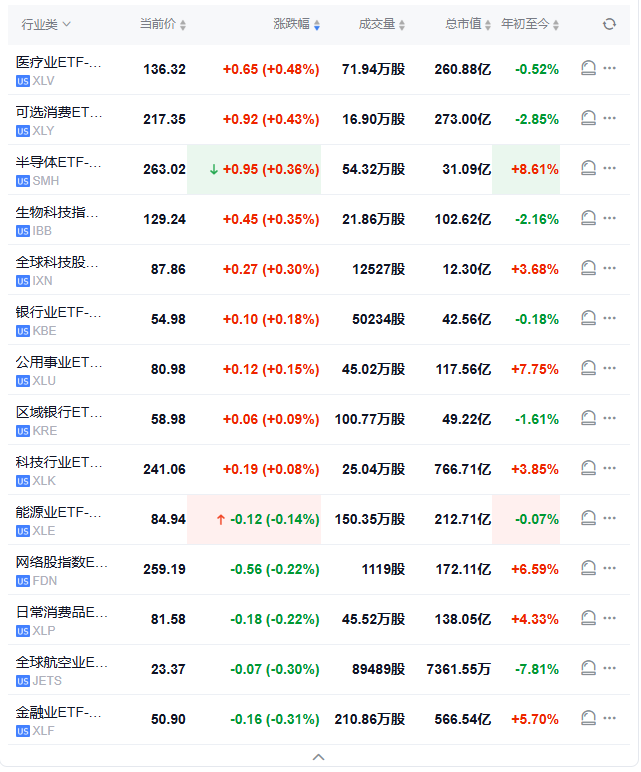
美股盘初,主要行业ETF涨跌不一,医疗业ETF涨0.48%,可选消费ETF涨0.4%;金融业ETF跌0.31%,全球航空业ETF跌0.3%。
news flash· 2025-06-11 13:46
Core Viewpoint - The performance of major industry ETFs in the U.S. stock market shows mixed results, with healthcare and consumer discretionary sectors experiencing gains, while financial and global airline sectors faced declines [1]. Industry Performance Summary - **Healthcare ETF**: Increased by 0.48%, closing at $136.32 with a trading volume of 719,400 shares and a total market capitalization of $26.088 billion. Year-to-date performance is down by 0.52% [2]. - **Consumer Discretionary ETF**: Rose by 0.4%, ending at $217.35 with a trading volume of 169,000 shares and a market cap of $27.3 billion. Year-to-date performance decreased by 2.85% [2]. - **Financial Sector ETF**: Decreased by 0.31%, closing at $50.90 with a trading volume of 2.1086 million shares and a market cap of $56.654 billion. Year-to-date performance increased by 5.7% [2]. - **Global Airline ETF**: Fell by 0.3%, closing at $23.37 with a trading volume of 89,489 shares and a market cap of $736.155 million. Year-to-date performance is down by 7.81% [2]. - **Semiconductor ETF**: Increased by 0.36%, closing at $263.02 with a trading volume of 543,200 shares and a market cap of $3.109 billion. Year-to-date performance is up by 8.61% [2]. - **Biotechnology ETF**: Rose by 0.35%, closing at $129.24 with a trading volume of 218,600 shares and a market cap of $10.262 billion. Year-to-date performance decreased by 2.16% [2]. - **Technology Sector ETF**: Increased by 0.08%, closing at $241.06 with a trading volume of 250,400 shares and a market cap of $76.671 billion. Year-to-date performance is up by 3.85% [2]. - **Energy Sector ETF**: Decreased by 0.14%, closing at $84.94 with a trading volume of 1.5035 million shares and a market cap of $21.271 billion. Year-to-date performance is down by 0.07% [2].
美股策略:市场进入观察期 贸易战反复不定
国证国际证券· 2025-06-11 02:23
Group 1: Market Overview - The S&P 500 index rose by 1.5% last week, driven by signs of easing in the US-China trade war[11] - The Nasdaq 100 increased by 2.0%, while the Russell 2000 saw a rise of 3.2%[11] - The trade war has shown signs of thawing, with a meeting between US and Chinese officials being viewed as a significant step towards negotiations[11] Group 2: Economic Indicators - The US consumer confidence index surged from 85.7 in April to 98 in May, marking the first increase since November of the previous year[20] - The April Personal Consumption Expenditures (PCE) price index rose by 0.1% month-on-month, with a year-on-year increase of 2.5%[25] - The unemployment rate slightly increased from 4.187% in April to 4.244% in May, indicating a rise in joblessness despite a modest increase in non-farm payrolls[35] Group 3: Market Risks - There is a persistent trend of de-dollarization in global liquidity, as investors show reduced confidence in US dollar assets[16] - The ISM manufacturing PMI fell to 48.5 in May, indicating a contraction in the manufacturing sector for the third consecutive month[41] - The forecast for S&P 500 earnings per share (EPS) has been revised downwards by approximately 4.0% in April and May, reflecting concerns over inflation and tariffs[46]
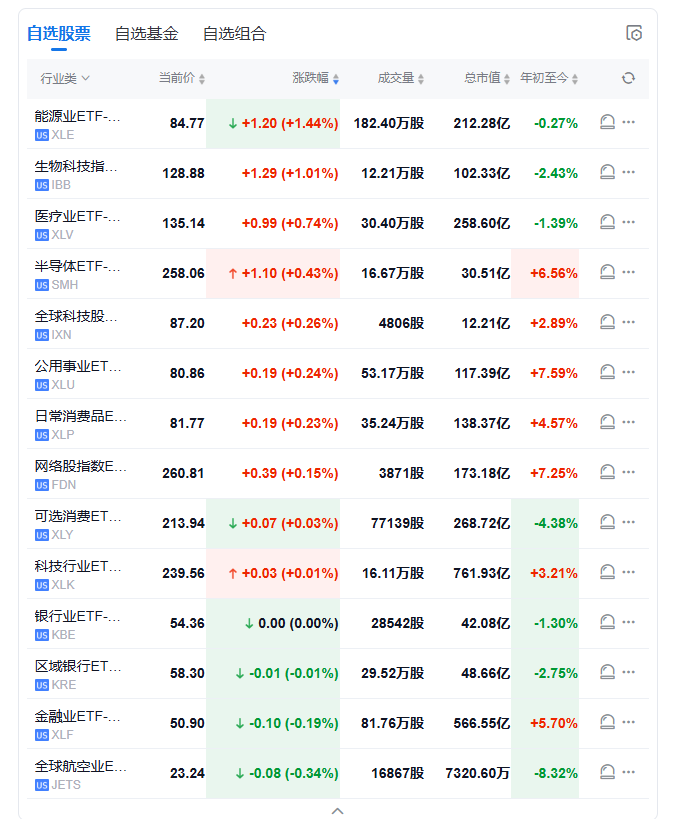
美股盘初,主要行业ETF多数上涨,能源业ETF、生物科技指数ETF涨超1%,医疗业ETF涨近1%。
news flash· 2025-06-10 13:38
Group 1 - Major industry ETFs in the US stock market mostly rose, with Energy ETFs and Biotechnology Index ETFs increasing over 1%, and Healthcare ETFs rising nearly 1% [1] Group 2 - Energy ETF (XLE) current price is $84.77, up by $1.20 (+1.44%), with a trading volume of 1.824 million shares and a total market value of $21.228 billion, showing a year-to-date change of -0.27% [2] - Biotechnology Index ETF (IBB) current price is $128.88, up by $1.29 (+1.01%), with a trading volume of 122,100 shares and a total market value of $10.233 billion, reflecting a year-to-date change of -2.43% [2] - Healthcare ETF (XLV) current price is $135.14, up by $0.99 (+0.74%), with a trading volume of 304,000 shares and a total market value of $25.860 billion, indicating a year-to-date change of -1.39% [2] - Semiconductor ETF (SMH) current price is $258.06, up by $1.10 (+0.43%), with a trading volume of 166,700 shares and a total market value of $3.051 billion, showing a year-to-date change of +6.56% [2] - Global Technology ETF (IXN) current price is $87.20, up by $0.23 (+0.26%), with a trading volume of 4,806 shares and a total market value of $1.221 billion, reflecting a year-to-date change of +2.89% [2] - Utilities ETF (XLU) current price is $80.86, up by $0.19 (+0.24%), with a trading volume of 531,700 shares and a total market value of $11.739 billion, indicating a year-to-date change of +7.59% [2] - Consumer Staples ETF (XLP) current price is $81.77, up by $0.19 (+0.23%), with a trading volume of 352,400 shares and a total market value of $13.837 billion, reflecting a year-to-date change of +4.57% [2] - Internet Index ETF (FDN) current price is $260.81, up by $0.39 (+0.15%), with a trading volume of 3,871 shares and a total market value of $17.318 billion, indicating a year-to-date change of +7.25% [2] - Consumer Discretionary ETF (XLY) current price is $213.94, down by $0.07 (+0.03%), with a trading volume of 77,139 shares and a total market value of $26.872 billion, showing a year-to-date change of -4.38% [2] - Technology Sector ETF (XLK) current price is $239.56, up by $0.03 (+0.01%), with a trading volume of 161,100 shares and a total market value of $76.193 billion, reflecting a year-to-date change of +3.21% [2] - Banking ETF (KBE) current price is $54.36, unchanged (0.00%), with a trading volume of 28,542 shares and a total market value of $4.208 billion, indicating a year-to-date change of -1.30% [2] - Regional Banking ETF (KRE) current price is $58.30, down by $0.01 (-0.01%), with a trading volume of 295,200 shares and a total market value of $4.866 billion, reflecting a year-to-date change of -2.75% [2] - Financials ETF (XLF) current price is $50.90, down by $0.10 (-0.19%), with a trading volume of 817,600 shares and a total market value of $56.655 billion, indicating a year-to-date change of +5.70% [2] - Global Airlines ETF (JETS) current price is $23.24, down by $0.08 (-0.34%), with a trading volume of 16,867 shares and a total market value of $73.206 million, reflecting a year-to-date change of -8.32% [2]
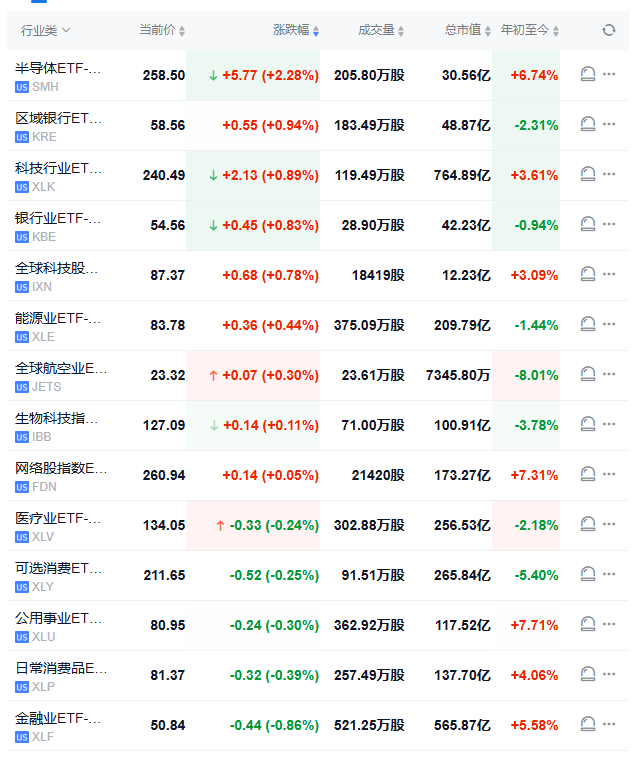
美股盘初,主要行业ETF涨跌不一,半导体ETF涨超2%,区域银行业ETF涨近1%,金融业ETF跌近1%。
news flash· 2025-06-09 14:28
Core Viewpoint - The performance of major industry ETFs in the U.S. stock market is mixed, with semiconductor ETFs showing significant gains while financial sector ETFs are declining [1]. Group 1: Semiconductor Sector - Semiconductor ETF increased by 2.28%, reaching a price of $258.50, with a trading volume of 205.80 million shares and a total market value of $30.56 billion [2]. - Year-to-date performance for the semiconductor ETF is up by 6.74% [2]. Group 2: Regional Banks - Regional bank ETF rose by 0.94%, priced at $58.56, with a trading volume of 183.49 million shares and a total market value of $48.87 billion [2]. - Year-to-date performance for the regional bank ETF is down by 2.31% [2]. Group 3: Financial Sector - Financial sector ETF decreased by 0.86%, priced at $50.84, with a trading volume of 521.25 million shares and a total market value of $565.87 billion [2]. - Year-to-date performance for the financial sector ETF is up by 5.58% [2]. Group 4: Technology Sector - Technology sector ETF increased by 0.89%, priced at $240.49, with a trading volume of 119.49 million shares and a total market value of $764.89 billion [2]. - Year-to-date performance for the technology sector ETF is up by 3.61% [2].
新疆证监局深化联合走访常态化机制 助力辖区上市公司提质发展
Zheng Quan Shi Bao Wang· 2025-06-08 02:58
Group 1 - The Xinjiang Securities Regulatory Bureau is implementing a regular visiting mechanism to support listed companies in the region, addressing their difficulties and suggestions to promote high-quality development [1] - Since 2024, the bureau and local government have visited over 60% of listed companies, with 13 companies visited this year across various industries including manufacturing, mining, finance, and information technology [1] - A total of 17 issues and suggestions have been collected from these visits, covering industrial policies, corporate financing, and operational challenges, with 7 issues already resolved and 10 ongoing [1] Group 2 - The bureau emphasizes policy promotion, guiding listed companies to leverage new policies for value management through mergers, buybacks, dividends, and equity incentives [2] - As of now, 33 listed companies in the region have announced cash dividend plans totaling 11.608 billion yuan, representing 82.5% of profitable companies; 11 companies have conducted stock buybacks amounting to 1.224 billion yuan [2] - The bureau plans to deepen regulatory collaboration with local government, focusing on enhancing regulatory services and optimizing corporate governance to foster a virtuous cycle of regulatory guidance, value enhancement, and economic empowerment [2]
5月美国非农数据点评:就业稳中趋弱,亮点在时薪增长
Huachuang Securities· 2025-06-08 00:25
Employment Data Summary - In May, the U.S. added 139,000 non-farm jobs, slightly exceeding the expectation of 130,000[2] - Job growth was concentrated in three sectors: education and healthcare services (+87,000), leisure and hospitality (+48,000), and finance (+13,000)[2] - The unemployment rate remained steady at 4.2%, with a slight increase in the labor force participation rate from 62.6% to 62.4%[4] Wage Growth Insights - Hourly wage growth was 0.4% month-on-month, surpassing the expected 0.3%, and year-on-year growth was 3.9%, up from a revised 3.8%[3] - The average weekly hours worked remained at 34.3 hours, indicating stable labor income growth[3] - Wage growth is crucial for protecting consumer purchasing power, especially for low- and middle-income groups, amid inflation concerns[5] Market Reactions and Economic Outlook - Market expectations for interest rate cuts have cooled, with the probability of a September rate cut dropping from 61.3% to 51.8%[3] - The anticipated number of rate cuts for the year decreased from 2.1 to 1.8, and the year-end policy rate expectation rose from 3.795% to 3.886%[3] - Following the report, U.S. stock indices rose, with the Dow Jones up 1.05% and the Nasdaq up 1.2%, indicating a rebound in risk appetite[3]
宏观快评:5月美国非农数据点评:就业稳中趋弱,亮点在时薪增长
Huachuang Securities· 2025-06-08 00:25
Employment Data Summary - In May, the U.S. added 139,000 non-farm jobs, slightly exceeding the expectation of 130,000[2] - Job growth was concentrated in three sectors: education and healthcare services (+87,000), leisure and hospitality (+48,000), and finance (+13,000) while other sectors experienced job losses[2][25] - The unemployment rate remained steady at 4.2%, with a slight increase in the labor force participation rate dropping from 62.6% to 62.4%[4][29] Wage Growth Insights - Hourly wage growth was 0.4% month-over-month, surpassing the expected 0.3%, and year-over-year growth was 3.9%, up from a revised 3.8%[3][34] - The increase in wages is crucial for protecting the purchasing power of low- and middle-income consumers amid inflation concerns[5][19] Market Reactions - Market expectations for interest rate cuts have cooled, with the probability of a September rate cut dropping from 61.3% to 51.8%[3][39] - Following the employment report, U.S. stock indices rose, with the Dow Jones up 1.05%, Nasdaq up 1.2%, and S&P 500 up 1.03%[3][39] Employment Trends - The employment diffusion index fell to 50% for the month, indicating a decline in the breadth of job growth across sectors[4][24] - The total number of jobs added in the previous two months was revised down by 95,000, indicating a trend of slowing job growth[2][21]
就业稳中趋弱,亮点在时薪增长——5月美国非农数据点评
一瑜中的· 2025-06-07 14:41
Core Viewpoint - The article discusses the May non-farm payroll data, highlighting that while job additions slightly exceeded expectations, the overall employment market shows signs of slowing down, with a notable focus on wage growth as a positive aspect [1]. Group 1: Employment Data Overview - In May, non-farm employment increased by 139,000, surpassing the expected 130,000, with job growth concentrated in three sectors: education and health services (+87,000), leisure and hospitality (+48,000), and financial activities (+13,000) [2][16]. - The unemployment rate remained steady at 4.2%, but this stability was achieved at the cost of a declining labor force participation rate, which fell from 62.6% to 62.4% [5][22]. - The employment growth breadth has decreased, with the employment diffusion index dropping to 50%, indicating that job growth is becoming less widespread across various sectors [4][16]. Group 2: Wage Growth Insights - Wage growth in May was a highlight, with hourly earnings increasing by 0.4% month-over-month, exceeding the expected 0.3%, and a year-over-year increase of 3.9%, also above the anticipated 3.7% [6][31]. - The article emphasizes that the wage growth is crucial for protecting the purchasing power of consumers, particularly for low- and middle-income groups, amidst rising inflation concerns [6][12]. Group 3: Market Reactions - Following the non-farm report, market expectations for interest rate cuts have cooled, with the probability of a September rate cut dropping from 61.3% to 51.8% [3][35]. - The stock market reacted positively, with major indices such as the Dow Jones and Nasdaq rising, indicating a rebound in risk appetite among investors [3][35].