
快递

Search documents
快递企业多措并举迎年货物流高峰
Zheng Quan Ri Bao Zhi Sheng· 2026-01-29 17:06
Core Insights - The upcoming Spring Festival has led to a surge in demand for logistics services, with e-commerce platforms launching promotional events that test the capabilities of courier companies [1] - The National Postal Administration has issued a plan to ensure delivery services meet consumer needs during the holiday season, prompting courier companies to enhance their operational strategies [1] Group 1: Industry Response - Yunda Holdings has initiated its 2026 work deployment, focusing on network efficiency and service quality improvements to ensure effective delivery during the Spring Festival [2] - Shentong Express has implemented operational measures, including real-time monitoring of capacity and flexible sorting adjustments, to maintain delivery stability during peak periods [2] - SF Express has adopted customized packaging solutions to ensure the safe delivery of diverse products, including perishables and fragile items [3] Group 2: Service Optimization - Yunda has introduced a "scheduled pickup" service to enhance efficiency, ensuring timely collection and processing of packages [3] - The logistics industry is focusing on precision, differentiation, and intelligence in service offerings, catering to both general and specialized delivery needs [4] - The overall logistics capability during the Spring Festival is seen as a reflection of the resilience and competitiveness of courier companies [4]

2025快递之城出炉:粤浙苏守擂成功 西部跑出“黑马”
2 1 Shi Ji Jing Ji Bao Dao· 2026-01-29 14:41
Core Insights - China has established the world's largest and most widely utilized express delivery network, with 2025 express delivery volume reaching 1989.5 billion pieces, a year-on-year increase of 13.6%, and revenue totaling 1.5 trillion yuan, up 6.5%, both setting historical records [1][9]. Express Delivery Volume - In 2025, Guangdong, Zhejiang, and Jiangsu ranked as the top three provinces in express delivery volume, achieving 460.05 billion, 344.04 billion, and 157.88 billion pieces respectively [1][6]. - Western provinces such as Shaanxi, Ningxia, and Guizhou exhibited remarkable growth rates of 38.6%, 35.6%, and 34.4%, leading the national growth [1][7]. Express Delivery Revenue - Guangdong, Shanghai, Zhejiang, and Jiangsu led in express delivery revenue, generating 300.18 billion, 271.33 billion, 154.3 billion, and 108.39 billion yuan respectively [3][10]. - Notably, Guangdong experienced a decline in revenue by 1.3% despite an 8% increase in volume, indicating a "volume increase but price drop" phenomenon [3][12]. Growth Trends - The express delivery market in western provinces is rapidly expanding, driven by e-commerce and local support policies, with Shaanxi leading the national growth in express delivery volume [8][9]. - A total of 17 provinces achieved double-digit growth in express delivery revenue, with Shaanxi, Hebei, and Anhui leading at 19.3%, 17.1%, and 15% respectively [11]. Policy and Infrastructure Development - Shaanxi has implemented policies to enhance rural logistics, establishing numerous processing centers and service stations to improve delivery coverage [8]. - Various provinces, including Guangdong and Sichuan, are focusing on reducing logistics costs and enhancing service quality through new policies and initiatives [14][15].


2025快递之城出炉:广东、浙江、江苏稳居前三
2 1 Shi Ji Jing Ji Bao Dao· 2026-01-29 14:40
Core Insights - China has established the world's largest and most widely utilized express delivery network, with 1989.5 billion packages delivered in 2025, marking a 13.6% year-on-year increase, and total revenue reaching 1.5 trillion yuan, up 6.5% year-on-year, both setting historical records [1][11]. Group 1: Express Delivery Volume - In 2025, Guangdong, Zhejiang, and Jiangsu were the top three provinces in express delivery volume, with 460.05 billion, 344.04 billion, and 157.88 billion packages respectively [2][7]. - Western provinces such as Shaanxi, Ningxia, and Guizhou exhibited remarkable growth rates of 38.6%, 35.6%, and 34.4% respectively, leading the national growth [2][8]. - The overall express delivery volume in China reached 1989.5 billion packages, with a historical growth rate of 13.6% [6][11]. Group 2: Express Delivery Revenue - In terms of revenue, Guangdong, Shanghai, Zhejiang, and Jiangsu led the nation with revenues of 300.18 billion yuan, 271.33 billion yuan, 154.3 billion yuan, and 108.39 billion yuan respectively [12][13]. - The total express delivery revenue in China reached 1.5 trillion yuan, reflecting a growth of 6.5% year-on-year, although this was a slowdown compared to the previous year's growth of 13.8% [11][12]. - Notably, 17 provinces achieved double-digit growth in express delivery revenue, with Shaanxi, Hebei, and Anhui leading at 19.3%, 17.1%, and 15% respectively [13][14]. Group 3: Regional Dynamics - Guangdong remains the only province with express delivery volume exceeding 400 billion packages, accounting for 23% of the national total [6][8]. - The express delivery market in western provinces is rapidly expanding, driven by e-commerce and local support policies, with significant infrastructure developments in Shaanxi, including 303 county-level processing centers and 1.73 million village-level logistics service stations [9][10]. - The logistics cost in Guangdong has decreased, with the ratio of social logistics costs to GDP dropping to approximately 13.6% [14][15].
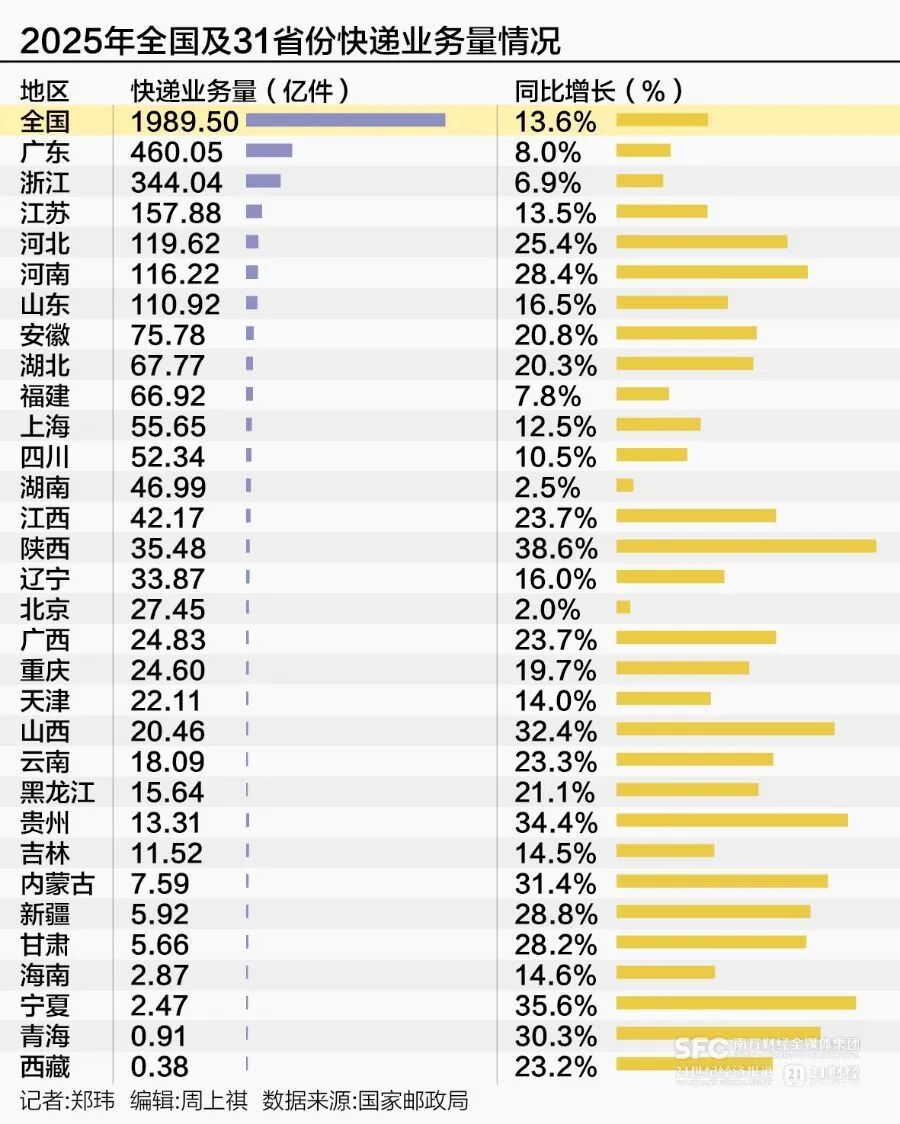
2025快递之城出炉:广东、浙江、江苏稳居前三
21世纪经济报道· 2026-01-29 14:17
Core Viewpoint - The article highlights that China has established the world's largest and most utilized express delivery network, with significant growth in both express delivery volume and revenue in 2025, indicating a robust logistics market driven by demand and infrastructure support [1][5]. Express Delivery Volume - In 2025, China's total express delivery volume reached 1989.5 billion pieces, a year-on-year increase of 13.6%, setting a historical record [1][5]. - Guangdong, Zhejiang, and Jiangsu were the top three provinces in express delivery volume, achieving 460.05 billion, 344.04 billion, and 157.88 billion pieces respectively [2][5]. - Western provinces like Shaanxi, Ningxia, and Guizhou showed remarkable growth rates of 38.6%, 35.6%, and 34.4%, respectively, becoming the "growth dark horses" of the country [6][7]. Express Delivery Revenue - The total express delivery revenue in 2025 reached 1.5 trillion yuan, a year-on-year increase of 6.5%, also a historical high [10][11]. - Guangdong, Shanghai, Zhejiang, and Jiangsu led in express delivery revenue, with figures of 300.18 billion, 271.33 billion, 154.3 billion, and 108.39 billion yuan respectively [11][12]. - Notably, 17 provinces achieved double-digit growth in express delivery revenue, with Shaanxi, Hebei, and Anhui leading at 19.3%, 17.1%, and 15% respectively [12]. Market Trends - There is a notable "volume increase but price drop" phenomenon in some provinces, particularly in Guangdong, where express delivery volume grew by 8% while revenue decreased by 1.3% [3][9]. - The logistics costs in Guangdong have decreased, with the ratio of social logistics costs to GDP dropping to approximately 13.6% [12][13]. - The article indicates a shift in the express delivery industry towards a focus on quality and efficiency rather than just volume growth, with various provinces implementing new policies to reduce logistics costs [13][14].

2025快递之城出炉:粤浙苏守擂成功,西部跑出“黑马”
2 1 Shi Ji Jing Ji Bao Dao· 2026-01-29 13:18
Core Insights - China has established the world's largest and most widely utilized express delivery network, with 2025 express delivery volume reaching 1989.5 billion pieces, a year-on-year increase of 13.6%, and revenue totaling 1.5 trillion yuan, up 6.5%, both hitting historical highs [1][8]. Express Delivery Volume - In 2025, Guangdong, Zhejiang, and Jiangsu ranked as the top three provinces in express delivery volume, achieving 460.05 billion, 344.04 billion, and 157.88 billion pieces respectively [1][5]. - Western provinces such as Shaanxi, Ningxia, and Guizhou exhibited remarkable growth rates of 38.6%, 35.6%, and 34.4%, leading the national growth [1][6]. Express Delivery Revenue - The top four provinces in express delivery revenue for 2025 were Guangdong (300.18 billion yuan), Shanghai (271.33 billion yuan), Zhejiang (154.3 billion yuan), and Jiangsu (108.39 billion yuan), with significant gaps between them and the fifth-ranked Shandong (69.56 billion yuan) [2][9]. - National express delivery revenue growth has slowed, with a 6.5% increase in 2025 compared to 13.8% in 2024 [8][10]. Regional Growth Trends - The express delivery market in western provinces is rapidly expanding, driven by e-commerce and local support policies, with Shaanxi leading the growth [7][6]. - In 2025, 17 provinces achieved double-digit growth in express delivery revenue, with Shaanxi, Hebei, and Anhui leading at 19.3%, 17.1%, and 15% respectively [10][11]. Price Dynamics - Some provinces experienced a "volume increase but price drop" phenomenon, notably Guangdong, where express delivery volume grew by 8% while revenue declined by 1.3% [3][11]. - Overall, 30 provinces saw a slowdown in express delivery revenue growth compared to 2024, indicating a shift towards a more quality-focused growth model [11][13]. Policy and Infrastructure Development - Provinces like Sichuan and Shandong are implementing new policies to reduce logistics costs and enhance the express delivery industry, aiming for lower logistics costs as a percentage of GDP [13][14]. - Guangdong is focusing on sectors such as 3C electronics and new energy vehicles to develop comprehensive logistics services [14].
美国开年频传大规模裁员,科技和仓储业成“重灾区”
第一财经· 2026-01-29 10:37
Group 1 - The article highlights a wave of layoffs across various industries in the U.S., with significant job cuts announced by companies like UPS, Pinterest, and Amazon, totaling approximately 30,000 jobs for UPS and 16,000 for Amazon [3][5][6] - The layoffs are attributed to a combination of factors including organizational adjustments following aggressive expansions during the pandemic, the impact of AI, and uncertainties related to high interest rates and tariffs [5][6] - The job cuts in the tech and warehousing sectors are particularly pronounced, with the tech sector losing 154,000 jobs and warehousing losing 95,000 jobs in 2025 [3][6] Group 2 - Amazon's layoffs are focused on operational and technical roles, with the company aiming to streamline management and reduce bureaucracy [6] - UPS's restructuring is linked to a decrease in business volume from Amazon, which is expected to reduce its delivery volume through UPS by over 50% by mid-2026 [6] - The article notes that many companies are reassessing their business structures as consumer demand normalizes and labor costs rise, leading to a realization that they may have expanded too much during the pandemic [6][7] Group 3 - The article discusses the rising long-term unemployment rate in the U.S., with the average duration of unemployment increasing to 24.4 weeks, significantly higher than the 19.4 weeks recorded in 2022 [9] - Despite a slight decrease in the unemployment rate to 4.4%, the job market shows signs of weakness, with only 50,000 new non-farm jobs added in December 2025 [9][10] - Economic experts indicate that high interest rates and tariff uncertainties are contributing to a slowdown in hiring, leading to a challenging employment landscape [9][10]



极兔速递-W(01519)注销7969.26万股库存股份
智通财经网· 2026-01-29 09:01
Core Viewpoint - Jitu Express-W (01519) announced the cancellation of 79.6926 million Class B shares, which were repurchased and held as treasury shares, effective January 29, 2026 [1] Summary by Relevant Categories Company Actions - The company will cancel a total of 79.6926 million Class B shares that were repurchased between October 30, 2024, and November 25, 2025 [1]
四川省人大代表唐建:关注残障人士就业 让“规则”更有温度
Zhong Guo Xin Wen Wang· 2026-01-29 03:31
Core Viewpoint - The article emphasizes the need for improved employment opportunities for disabled individuals in Sichuan Province, highlighting the challenges they face in the job market and the importance of corporate social responsibility in addressing these issues [1][3]. Group 1: Employment Challenges for Disabled Individuals - Sichuan Province has over 6.22 million disabled individuals, many of whom are willing to work but are excluded by market rules [3]. - A specific case illustrates the difficulties faced by a woman with a disability who encountered numerous obstacles in her job search due to stringent physical requirements for many positions [3]. - Research indicates that despite a national employment guarantee fund for disabled individuals, some companies prefer to pay high fees to avoid hiring them, citing concerns over efficiency, safety, and management costs [3][4]. Group 2: Corporate Responsibility and Initiatives - Companies are urged to take on social responsibilities by providing job opportunities for disabled individuals, with a focus on creating a supportive employment environment [3]. - A total of 926 disabled individuals have been employed in the express delivery sector through initiatives led by a representative from the industry [4]. - Proposed measures include stricter enforcement of employment guarantee funds and incentives for companies that actively hire disabled individuals, such as tax benefits [4]. Group 3: Entrepreneurship and Market Challenges - Disabled entrepreneurs face significant challenges in the market, as seen in a case of a cake shop run by hearing-impaired individuals that struggles due to high competition and non-essential product offerings [4]. - A community canteen project aimed at employing disabled individuals faced financial difficulties, with monthly costs exceeding 100,000 yuan while revenues only reached 40,000 to 80,000 yuan [4][5]. - The representative emphasizes the importance of sustainable business practices in social projects, advocating for a focus on self-sufficiency and diverse revenue streams [5]. Group 4: Labor Rights and Safety Concerns - Attention is drawn to the labor rights and safety issues faced by new employment groups such as delivery workers, with specific concerns about the rules set by platforms that may compromise their safety [5]. - Structural issues within the industry are acknowledged, with a call for improvements in the assessment criteria for delivery workers to enhance their safety and working conditions [5].

大摩闭门会:汽车、工业、交运、房地产行业更新
2026-01-29 02:43
Summary of Key Points from the Conference Call Industry Overview - **Industries Discussed**: Transportation, Real Estate, Automotive, and Industrial sectors were the main focus of the conference call [1][2]. Transportation Industry Insights - **Airline Industry Outlook**: The airline industry is experiencing an upward cycle, with supply-side disruptions continuing. Boeing and Airbus are slightly accelerating aircraft deliveries, but still slower than expected. New orders from Chinese airlines are primarily for deliveries post-2028 [3][4]. - **Engine Maintenance Impact**: Engine maintenance is expected to peak between 2026 and 2028, affecting capacity utilization. Airlines are managing capacity to maximize profits during peak seasons [5][6]. - **Spring Festival Travel**: Demand for travel during the Spring Festival is strong, with no significant drop in ticket prices expected. The first half of the travel period is anticipated to be robust, while the second half may see a slight decline in business travel due to overlapping events [6][7]. - **International Flight Pricing**: International flight prices are expected to rise due to less competition compared to domestic routes, with inflation pressures affecting foreign competitors [9][10]. - **Cost Factors**: Rising costs from international routes and engine maintenance are concerns, but low fuel prices and potential efficiency improvements may offset some of these pressures [10][11]. Real Estate Market Analysis - **Recent Trends**: There has been a slight improvement in second-hand home transactions in major cities like Shanghai and Beijing, with a notable reduction in the rate of price decline. However, this is attributed to seasonal factors and temporary policy adjustments rather than a sustainable recovery [21][23]. - **Policy Expectations**: The likelihood of significant stimulus policies for the real estate sector remains low, as the macroeconomic environment shows resilience and no immediate risks have emerged [25][26]. - **Price Forecasts**: Predictions indicate that national second-hand home prices may decline by 8% and 6% in the next two years following a 12% drop last year, with major cities potentially experiencing more significant declines [27][28]. Automotive Sector Insights - **Impact of Storage Price Increases**: The rising costs of storage components are significantly affecting vehicle production costs, with increases of $100 to $200 for fuel vehicles and $300 to $400 for electric vehicles expected by 2025 [49][50]. - **Cost Sharing Dynamics**: The burden of increased costs will depend on negotiations between automakers and suppliers, with potential for production cuts if supply issues arise [50][51]. - **Market Demand**: Current demand for vehicles remains weak, complicating the ability to raise prices despite increased production costs. Dealers, particularly for fuel vehicles, may benefit from tighter supply conditions [52][53]. Industrial Sector Outlook - **Demand Recovery**: The industrial sector is gradually recovering, driven by domestic upgrades and AI-related capital expenditures. However, demand varies significantly across sub-sectors [32][33]. - **Key Growth Areas**: The AIDC equipment sector is expected to see strong growth due to AI advancements, while sectors like chemicals and real estate-related industries are currently weak [34][35]. - **Investment Recommendations**: Companies like Dazhu Laser and Xianlead are highlighted as strong investment opportunities due to their positioning in growing markets [35][37]. Additional Insights - **Logistics and Express Delivery**: The express delivery sector is facing challenges with volume growth, but major players are still focused on maintaining market share. The potential for international expansion is seen as a growth driver [16][19]. - **Overall Market Sentiment**: The overall sentiment across industries remains cautious, with a focus on monitoring economic indicators and market dynamics closely [22][27]. This summary encapsulates the key insights and forecasts discussed during the conference call, providing a comprehensive overview of the current state and future expectations across the transportation, real estate, automotive, and industrial sectors.

大摩闭门会:汽车、工业、交运、房地产行业更新 _纪要
2026-01-29 02:43
Summary of Key Points from Conference Call Records Industry Overview Aviation Industry - The peak period for aircraft engine maintenance is expected between 2026 and 2028, with Spring Airlines already affected [1] - Healthy ticket prices and demand during the Spring Festival, with no significant price drops anticipated [2] - International flight ticket prices outperform domestic ones due to less competition and lower price sensitivity among travelers [2] - Cost inflation and maintenance expenses are rising, but low oil prices and increased aircraft utilization hours can partially offset these pressures [2] - Inbound tourism is expected to improve overall industry load factors by approximately one percentage point [2] Express Delivery Industry - Management anticipates a nearly 10% growth in parcel volume for 2026, exceeding some market pessimism [4] - Major players like ZTO and YTO aim for growth rates above the industry average, with ZTO targeting over-average growth and YTO seeking 5-10 percentage points higher [4] - Continued focus on avoiding price wars is expected to benefit leading companies, optimizing cost structures and enhancing profitability [4] - Companies like Jitu and YTO are actively expanding into international markets, viewed as a significant growth engine for the logistics sector [4] Real Estate Market - Improvement in second-hand housing transaction volumes noted, but primarily driven by short-term factors [5][6] - Expectations for continued moderate real estate policies in 2026, with limited potential for aggressive stimulus measures [7] - National second-hand housing prices are projected to decline by 8% this year and 6% next year, with first-tier cities potentially seeing larger declines [7] - Market recovery sustainability is viewed with caution due to reliance on temporary factors [6] Retail Sector (China Resources Vientiane) - Concerns about growth slowdown in 2026-2027 are considered overstated; expansion of third-party malls is expected to support profit growth [8] - A profit growth assumption of 10% could yield a dividend yield of 5.2% in 2026 and nearly 6% in 2027, indicating potential for stock price appreciation [8] Industrial Sector - Overall demand in the industrial sector is recovering, with equipment demand entering an upward cycle [9] - Strong growth expected in sectors related to data centers, energy storage, and robotics, with recommendations for companies like Han's Laser [9] - The AIDC equipment sector is particularly promising due to global AI capital expenditure growth [9] - The robotics sector is anticipated to see significant commercialization, with recommendations for companies like Harmonic Drive and Hengli Hydraulic [9] Construction Machinery Sector - The construction machinery sector is expected to experience a domestic and international market upturn over the next two to three years, driven by replacement demand and recovery in overseas markets [10][11] - Anticipated growth in excavator sales of 15-20% annually, with total sales expected to exceed 380,000 units by 2027 [11] Automotive Industry - Significant impact of storage price increases on automotive costs, raising costs for both fuel and electric vehicles [14][15] - The cost of storage per vehicle has increased significantly, with fuel vehicles now costing an additional $100-$200 and electric vehicles $300-$400 due to storage price hikes [15] - Long-term need for upgrading automotive electronic architectures to address supply shortages [15] Additional Insights - The industrial sector's recovery is supported by domestic replacement cycles and international expansion opportunities [9] - The express delivery sector's growth is bolstered by strategic expansions and avoidance of price wars among leading companies [4] - The real estate market's short-term improvements are not expected to lead to sustainable recovery, with cautious outlooks on policy changes [6][7]