航运业

Search documents
美国最大港口货物量骤减35%,航运业受创初显
Hu Xiu· 2025-05-09 06:33
Group 1: Impact of Tariffs on Shipping Industry - The first batch of ships carrying goods subject to a 145% tariff is arriving in the U.S., indicating a significant impact on the shipping industry [1] - The Port of Los Angeles, which relies heavily on trade with China, has seen a 35% decrease in business volume compared to the same period last year, affecting truck drivers and dock workers [1][2] - The decline in imports is expected to lead to product shortages and rising prices, exacerbating inflation in the U.S. economy [1][2] Group 2: Economic Consequences - The shipping slowdown is anticipated to affect the broader economy, leading to empty store shelves and a halt in hiring and investment [2] - The U.S. consumer price index (CPI) has risen from 257.97 in January 2020 to 308.41 by December 2024, reflecting ongoing inflationary pressures [2] Group 3: Customs Warehousing Trends - Customs warehouses near ports are experiencing increased activity as U.S. importers store goods there to potentially avoid high tariffs in the short term [3] - These warehouses, typically used for transshipment or duty-free stores, are now being utilized to navigate the uncertainties of U.S. trade policies [3] Group 4: Shipbuilding Industry Developments - The U.S. is attempting to revitalize its nearly non-existent shipbuilding industry, with Hanwha Marine acquiring the Philly Shipyard for $100 million [4] - Hanwha plans to build LNG carriers in the U.S., marking the first such construction in American shipyards since the 1970s [5] Group 5: Challenges in LNG Shipbuilding - Building LNG carriers is considered one of the most complex and technically demanding projects in shipbuilding, requiring significant investment and long-term industry experience [6] - The U.S. currently lacks any compliant LNG carriers, and the construction of such vessels is projected to take decades and substantial capital [6] - The cost of building LNG ships in the U.S. is significantly higher than in countries like South Korea or China, posing profitability challenges for projects [6]
冲突升温,印度巴基斯坦接连公布贸易禁令
Huan Qiu Shi Bao· 2025-05-05 22:46
【环球时报报道 记者 苑基荣】"以眼还眼,以牙还牙",5日,多家国际媒体如此评论印度与巴基斯坦之间的相互贸易制裁。4日,巴基斯坦商务部 发布通知称,禁止通过陆运、海运和空运转运印度原产商品入境,并禁止第三国出口至印度的货物过境巴基斯坦。此前一日,巴基斯坦宣布禁止 悬挂印度国旗的船只使用其港口。而在这之前,印度对外贸易总局2日发布通知,宣布全面禁止源自或途经巴基斯坦的货物贸易,禁止巴基斯坦船 只进入印度港口。 4月22日,印控克什米尔地区发生的枪击事件导致至少26名游客死亡后,印巴关系陷入新一轮紧张。据《今日印度》此前报道,印政府指责此次袭 击与巴政府支持的恐怖组织有关,巴方对此予以否认。随后印度宣布了包括暂停执行两国1960年签订的《印度河用水条约》、关闭边境口岸、驱 逐巴方人员在内的多个针对巴基斯坦的打击措施。而巴基斯坦也宣布了对印度关闭领空、暂停与印度的一切贸易以及降级两国关系等反制措施。 巴基斯坦《黎明报》4日报道称,巴基斯坦方面表示,禁止悬挂印度国旗的船只停靠巴基斯坦港口是为了"维护海上主权、经济利益和国家安全"。 这一系列禁令对印巴经贸联系造成了冲击。事实上,近年来两国间贸易额已大幅萎缩。2019年 ...


深观察丨关税政策满月 美国受“内伤”
Zhong Guo Xin Wen Wang· 2025-05-02 15:31
Group 1 - The recent tariff policy in the U.S. has led to significant economic concerns, with a notable decline in GDP by 0.3% in Q1, marking the first contraction in three years [2] - Consumer spending, a critical component of the U.S. economy, grew only 1.8% in Q1, the slowest rate since mid-2023 [2] - Various industries, including agriculture, pharmaceuticals, shipping, apparel, and retail, are experiencing severe impacts from the tariff policy, leading to widespread investor sell-offs and consumer dissatisfaction [2] Group 2 - A survey by the American Toy Association revealed that over 80% of the 400+ companies surveyed are delaying or canceling orders due to tariff impacts, with nearly half fearing bankruptcy within months [3] - The agricultural sector, traditionally a strong export area for the U.S., is facing turmoil, with small farms struggling to survive amid the tariff war [4] - The Port of Los Angeles, the largest container receiving port in the U.S., is expecting a 35.91% year-on-year decline in container arrivals for the week of May 4-10, indicating a significant slowdown in imports [4] Group 3 - The logistics industry, employing approximately 9 million people nationwide, is likely to see reduced demand for truck transportation and warehouse work due to declining container volumes, which could lead to widespread layoffs [5] - Economic experts warn that the ongoing decline in imports may result in material shortages and increased prices for consumers, creating a dual challenge of empty shelves and rising costs [5] - Concerns are growing among political and economic figures regarding the long-term effects of the tariff policy, with warnings that it could push the U.S. economy towards a recession [6] Group 4 - The tariff policy is viewed as a significant tax increase, potentially adding thousands of dollars to the tax burden of middle-class families [6] - Experts argue that the new tariffs will reduce manufacturing jobs rather than increase them, undermining the competitiveness of U.S. manufacturing [6] - The current tariff strategy is described as a "national disaster," with predictions of delayed investment decisions and declining consumer confidence [6][7]
美征收高额港口费必将反噬自身
Jing Ji Ri Bao· 2025-04-29 22:00
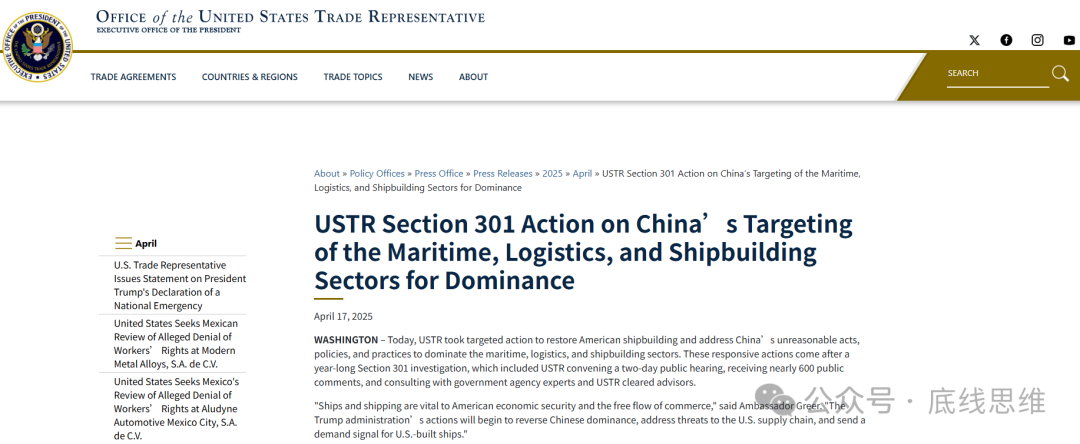
美国贸易代表办公室近日宣布对中国海事、物流和造船领域301调查的最终措施,包括征收高额港口 费、运输限制等。美方相关做法损人害己,将推高全球海运成本,扰乱全球供应链稳定,也将损害美国 消费者和企业利益。 美方声称,中国有针对性地主导海运、物流和造船业是导致美国造船和航运业无法满足国内和对外贸易 需求的关键因素。美征收高额港口费等措施旨在促进美国造船业发展,并遏制中国在该领域的主导地 位。 美方将自身问题归咎于中国,既缺乏事实依据,也有悖经济常识。中国造船业能实现今天的发展成就, 靠的不是所谓的"针对性措施",而是完备的工业体系、训练有素的工程师和产业工人以及开放的商业环 境,是相关企业积极参与国际合作和全球竞争的成果。 征收高额港口费等措施,只不过是已被反复证明无效的保护主义"旧药方",注定治不了美国造船业的沉 疴,还将破坏全球航运体系,进一步加剧国际贸易混乱。美国商船在全球占比很低,且造船产能极为有 限,相关措施若强行实施,将进一步限制美国国际贸易,推高美国商品价格,加剧通胀压力,反噬美国 经济。据彼得森国际经济研究所测算,一旦中美海运成本增加15%,美国通胀率或上升0.8个百分点。 美国根科船务贸易公司首 ...
中远海控一季度净利增超7成 新一轮回购已完成6亿元
Zhong Guo Jin Rong Xin Xi Wang· 2025-04-29 13:19
Core Viewpoint - 中远海运 reported strong financial performance for Q1 2025, with significant increases in revenue and net profit, indicating robust growth in the container shipping sector [1][2]. Financial Performance - The company achieved operating revenue of 57.96 billion yuan, a year-on-year increase of 20.05% [1]. - Net profit attributable to shareholders was 11.695 billion yuan, reflecting a 73.12% year-on-year growth [1]. - Earnings per share rose to 0.74 yuan, up 76.19% compared to the previous year [1]. - The asset-liability ratio decreased to 41.97% as of March 31, 2025 [1]. - Net cash flow from operating activities was 15.062 billion yuan, an increase of 69.49% year-on-year [1]. - Cash and cash equivalents reached 186.699 billion yuan [1]. Shipping and Terminal Operations - Container shipping business completed a total of 6.4815 million TEUs, a year-on-year increase of 7.53% [1]. - Revenue from shipping operations was 55.883 billion yuan, up 20.07% year-on-year [1]. - Terminal operations achieved a total throughput of 35.7489 million TEUs, reflecting a 7.48% increase [1]. - Revenue from terminal operations was 2.767 billion yuan, a year-on-year growth of 16.06% [1]. Share Buyback - In April 2025, 中远海控 announced a new round of share repurchase, having repurchased 43.2444 million A-shares at a cost of approximately 600 million yuan [1]. - From October 2024 to April 2025, the company repurchased A and H shares totaling about 3.894 billion yuan, with all repurchased shares being canceled [1]. Industry Outlook - The container shipping industry is expected to face a complex and changing market environment due to geopolitical factors, the situation in the Red Sea, and uncertainties in U.S. trade policies [2]. - New environmental regulations will also impact the shipping industry [2]. - The company aims to focus on global digital supply chain operations and investment platforms, optimizing resource allocation and enhancing service quality to create greater value for shareholders [2].
“对等关税”落地观察,亚洲内转口贸易与美国库存情况
2025-04-27 15:11
Summary of Conference Call Records Industry Overview - The records primarily discuss the impact of the US-China trade tensions on global shipping and trade dynamics, particularly focusing on Southeast Asia and its role in transshipment trade to the US [1][2][4][5][17][25]. Key Points and Arguments Trade Dynamics and Impact - The US-China trade friction has led to order delays and cancellations, particularly affecting shipments to the US, with Southeast Asian order volumes dropping by 20%-30% [1][2]. - Following a 90-day grace period announced by the Trump administration, Southeast Asian shipping volumes have started to recover, although this grace period does not apply to Chinese exports to North America [1][2][4]. - The NRF predicts a 10% reduction in US port cargo volumes by June 2025, with further declines of 15%-20% expected in July [6]. Shipping and Regulatory Changes - The US is tightening regulations on transshipment trade, requiring detailed documentation and compliance with origin rules, which may lead companies to relocate production to Southeast Asia or Latin America [2][11][12]. - The 301 Action Plan will impose significant fees on Chinese vessels docking at US ports starting October 14, 2025, impacting Chinese shipping companies significantly [17]. Product Margin Sensitivity - Low-margin products such as retail, textiles, and toys are more adversely affected by the trade tensions, while high-margin e-commerce products continue to ship [8][19]. - Exporters are utilizing the 90-day window to export completed products through Southeast Asia to avoid high tariffs [1][8]. Future Trends and Challenges - Southeast Asia is expected to see a recovery in orders starting from April 2025, leading to increased shipping rates due to limited vessel capacity [13]. - The region's logistics infrastructure is currently inadequate to fully replace China as a manufacturing hub, although it is becoming a significant outsourcing destination [20][34]. - The potential for compliance issues and penalties in transshipment trade poses risks for exporters, especially with the possibility of 100% inspections by US customs [9][31]. Market Sentiment and Strategic Adjustments - Companies are advised to develop strategies to adapt to the changing trade environment, including potential shifts in production and logistics to comply with new regulations [12][22]. - The demand for shipping services is expected to remain strong, but high inventory levels in the US may dampen immediate shipping needs [18]. Regional Trade Relationships - Southeast Asia is becoming a focal point for investment and trade as countries navigate the complexities of US-China relations, with a growing emphasis on infrastructure development [25][36]. - The dynamics of global trade are shifting, with countries weighing the benefits of entering the US market against the support offered by China in technology and finance [21]. Additional Important Insights - The shipping rates from Southeast Asia to the US are expected to rise due to increased demand and limited capacity, with current costs comparable to those from China [20]. - The overall trend indicates a gradual shift in manufacturing and shipping patterns, with Southeast Asia emerging as a key player in the global supply chain [34][36].
申银万国期货首席点评:央行MLF操作,黄金强势依旧
Shen Yin Wan Guo Qi Huo· 2025-04-25 03:33
报告日期:2025 年 4 月 25 日 申银万国期货研究所 首席点评:央行 MLF 操作,黄金强势依旧 中美没有就关税问题磋商或谈判,更谈不上达成协议。据新华网,有记者问:近 来美方不断有消息称,中美之间正在谈判,甚至将会达成协议。你能否证实双方 有没有开始谈判?外交部发言人郭嘉昆说,这些都是假消息。"据我了解,中美 双方并没有就关税问题进行磋商或谈判,更谈不上达成协议。"特朗普考虑对华 关税分级方案。央视网援引《华尔街日报》报道,美方高级官员透露,特朗普政 府正考虑多种方案。中国央行 25 日将开展 6000 亿元 MLF 操作,将实现净投放 5000 亿。本月有 1000 亿元 MLF 到期,在 4 月 25 日进行 6000 亿元 MLF 操作后, 将实现净投放 5000 亿元。3 月央行超量续作 MLF,实现净投放 630 亿元,是 2024 年 7 月以来 MLF 首次净投放,展现了适度宽松的货币政策取向。 重点品种:原油、贵金属、集运指数 原油:SC 上涨 1%。有消息援引哈萨克新任命的能源部长的话说,在决定石油产 量水平时,哈萨克斯坦将优先考虑国家利益,而非欧佩克及其减产同盟国的利益。 他还表 ...
停一次2000万元,美国为何对中国船舶开征天价“港口费”?
虎嗅APP· 2025-04-24 10:07
以下文章来源于财经杂志 ,作者王静仪 蒋瑛芙 财经杂志 . 《财经》杂志官方微信。《财经》杂志由中国证券市场研究中心主办,1998年创刊,秉承"独立、独家、独到"的新闻理念,以权威性、公正 性、专业性报道见长,是政经学界决策者、研究者、管理者的必读刊物。 本文来自微信公众号: 财经杂志 ,作者:王静仪、蒋瑛芙(实习生),编辑:施智梁,题图来自:视觉中国 一旦中国制造或运营的船舶停靠美国港口,美国将征收额外费用。这是美国贸易代表办公室 (USTR) 于4月17日公布的"港口费",旨在打击中国航运 业。 港口费分为两类,第一类针对中国船东和运营商,从2025年10月14日开始,每次美国航程会收取每净吨50美元的费用。未来三年,每年增加每净吨30 美元。每艘船舶每年最多只会被征收五次费用。 第二类是针对使用中国制造船舶的非中国运营商 (只针对中国造船舶) ,"港口费"略低,每净吨18美元或每集装箱120美元,择高收取,并在未来三 年内每年按比例增加。 港口费有多贵?以即将停靠美国长滩港的COSCO THAILAND号为例,该船最大载箱量8500TEU (标准箱) ,净吨约5.9万吨,是中美航线的主流船型 之一,由于 ...
中美关税存谈判可能,关注马士基5月下半月价格情况
Hua Tai Qi Huo· 2025-04-24 03:01
1. Report Industry Investment Rating No relevant information provided. 2. Core Viewpoints of the Report - Geopolitical events such as the postponement of the Iran - US indirect talks and the uncertainty of US - China tariff policies are affecting the shipping market [4][5] - The shipping capacity in May is gradually increasing, with the monthly average weekly capacity around 270,500 TEU, a year - on - year increase of over 18% in 2024. There are many empty sailings on the US routes, and some ships may be transferred to European routes [4] - The 06 and 08 contracts are seasonal peak - season contracts, and the uncertainty of tariff policies affects their valuations. The probability of the Suez Canal reopening in June and August is decreasing [5] - The cargo volume on European routes is fair, but the US tariff policy has a significant impact on US routes. Ship companies are formulating route adjustment plans, and if more US - bound ships are transferred to European routes, European route freight rates will face pressure [5] - It is necessary to closely monitor the possibility of China - US negotiations. If negotiations occur and some goods are exempted from export tariffs, there may be supply - demand mismatches on US routes, which will have a positive impact on European routes. Due to the uncertainty of tariff policies, it is recommended to focus on arbitrage operations [5] 3. Summary According to Relevant Catalogs Market Analysis - Online quotes: Different shipping alliances and companies have different price trends. For example, Maersk's quotes have been decreasing, and some companies' quotes in May have significant changes. The price center in the first half of May will continue to decline to around $1,800 - $1,900/FEU, and Maersk's quotes for the second half of May are expected to be between $1,600 - $1,700/FEU [2][3] Geopolitical and Capacity - Geopolitical events: The Iran - US indirect talks' technical meeting was postponed to the 26th [4] - Capacity: The shipping capacity in May is gradually increasing, and there are many empty sailings on US routes. A total of 8 ships on US routes have been transferred to European routes after May, with a total capacity of 91,300 TEU [4] Contract and Price Analysis - Contracts: The 06 and 08 contracts are affected by tariff policies and seasonal factors. The 06 contract will gradually return to "real - world" trading, while the 08 contract will face a game between expectations and reality [5] - Price trends: The price increase expectation in May may be disappointed again. If more US - bound ships are transferred to European routes, European route freight rates will face pressure [5] Strategy - Unilateral: The main contract fluctuates [8] - Arbitrage: Suspend the long 06 and short 10 arbitrage, and focus on the long 08 and short 10 and long 08 and short 06 arbitrage operations [5][8] Market Data - As of April 24, 2025, the total open interest of all contracts of the Container Shipping Index European Line Futures is 93,217 lots, and the single - day trading volume is 95,684 lots. The closing prices of different contracts vary [6] - As of April 18, the SCFI (Shanghai - Europe route) price is $1,316/TEU, the SCFI (Shanghai - US West route) price is $2,103/FEU, and the SCFI (Shanghai - US East) price is $3,251/FEU. As of April 21, the SCFIS (Shanghai - Europe) is 1,508.44 points, and the SCFIS (Shanghai - US West) is 1,368.41 points [7] - In 2025, 82 container ships have been delivered, with a total capacity of 644,300 TEU. As of April 18, 2025, 26 ships with a capacity of 12,000 - 16,999 TEU have been delivered, with a total capacity of 390,000 TEU, and 3 ships with a capacity of over 17,000 TEU have been delivered, with a total capacity of 70,872 TEU [7]
美对华海运业发动“301条款”,或导向一个讽刺性局面
Hu Xiu· 2025-04-24 02:35
Core Points - The U.S. Trade Representative (USTR) announced the results of the 301 investigation into China's shipping, logistics, and shipbuilding industries, detailing new fee structures for Chinese shipping companies and vessels built in China [1][3]. Implementation Details - The implementation of the new measures will occur in two phases: the first phase will take effect in 180 days, imposing fees on Chinese shipowners and operators, as well as on non-U.S. shipping companies using vessels built in China. The fee structure will vary based on the type of vessel, calculated by net tonnage, with a maximum of five charges per year [3][4]. - The second phase, effective in three years, will impose fees on non-U.S. liquefied natural gas (LNG) vessels docking at U.S. ports, with rates increasing annually. The latest version of the proposal includes a 180-day buffer and narrows the scope of applicable vessels, enhancing the focus on China [4][5]. Industry Reactions - Industry leaders, such as Andrew Abbott, CEO of Atlantic Container Line (ACL), have expressed strong opposition to the legislation, indicating that it could force their company to exit the U.S. market due to the predominance of Chinese-built vessels in their fleet [5][6]. - Despite ACL's unique situation, the overall share of Chinese-built vessels in the global fleet is relatively low, with only 23% of the current fleet being constructed in China [6][7]. Market Statistics - According to Clarkson's data, Chinese-built container ships account for 39% of the global container fleet, while the order book for container ships in 2024 shows China with a 69% share, indicating a significant increase in new orders [7][9]. - The U.S. container shipping market exports approximately 13.9 million TEUs annually and imports 34 million TEUs, representing about 22.5% of global container shipping trade [12]. Cost Implications - If the new fees are implemented, the cost per container for routes from the U.S. West Coast could increase by $450 to $550, while East Coast routes may see increases of $200 to $300, representing significant percentages of current freight rates [13][17]. - Historical trends suggest that shipping companies are likely to pass these additional costs onto consumers, potentially leading to a market environment similar to that experienced during the pandemic [17]. Comparative Analysis - The U.S. container shipping market's dynamics are compared to the Russian market, which has faced similar external pressures. The U.S. market is expected to maintain supply levels, unlike the drastic changes seen in Russia following the Ukraine conflict [19][21]. - The differences in market size and operational structures between the U.S. and Russia highlight the potential for U.S. shipping companies to adapt rather than exit the market entirely [20][23]. Strategic Opportunities - The 301 legislation may inadvertently create strategic opportunities for Chinese shipping and shipbuilding industries, as market gaps left by exiting foreign companies could be filled by domestic firms [35][36]. - The potential restructuring of the U.S. shipping market could lead to increased market share for Chinese companies, particularly in logistics and shipping services [38][39]. Regulatory Implications - The legislation highlights the inefficacy of current international shipping governance systems, as it may lead to a decrease in the competitiveness of Chinese-built vessels in the global market [40][41]. - China is encouraged to develop its own regulatory framework to counteract the effects of the U.S. legislation, focusing on establishing standards that could enhance its competitive position in the shipping and shipbuilding sectors [43][44].