
贵金属

Search documents
玻纤板块集体涨停,化工牛股5天4板,白银急升4%,加密货币超10万人爆仓
2 1 Shi Ji Jing Ji Bao Dao· 2026-02-11 08:11
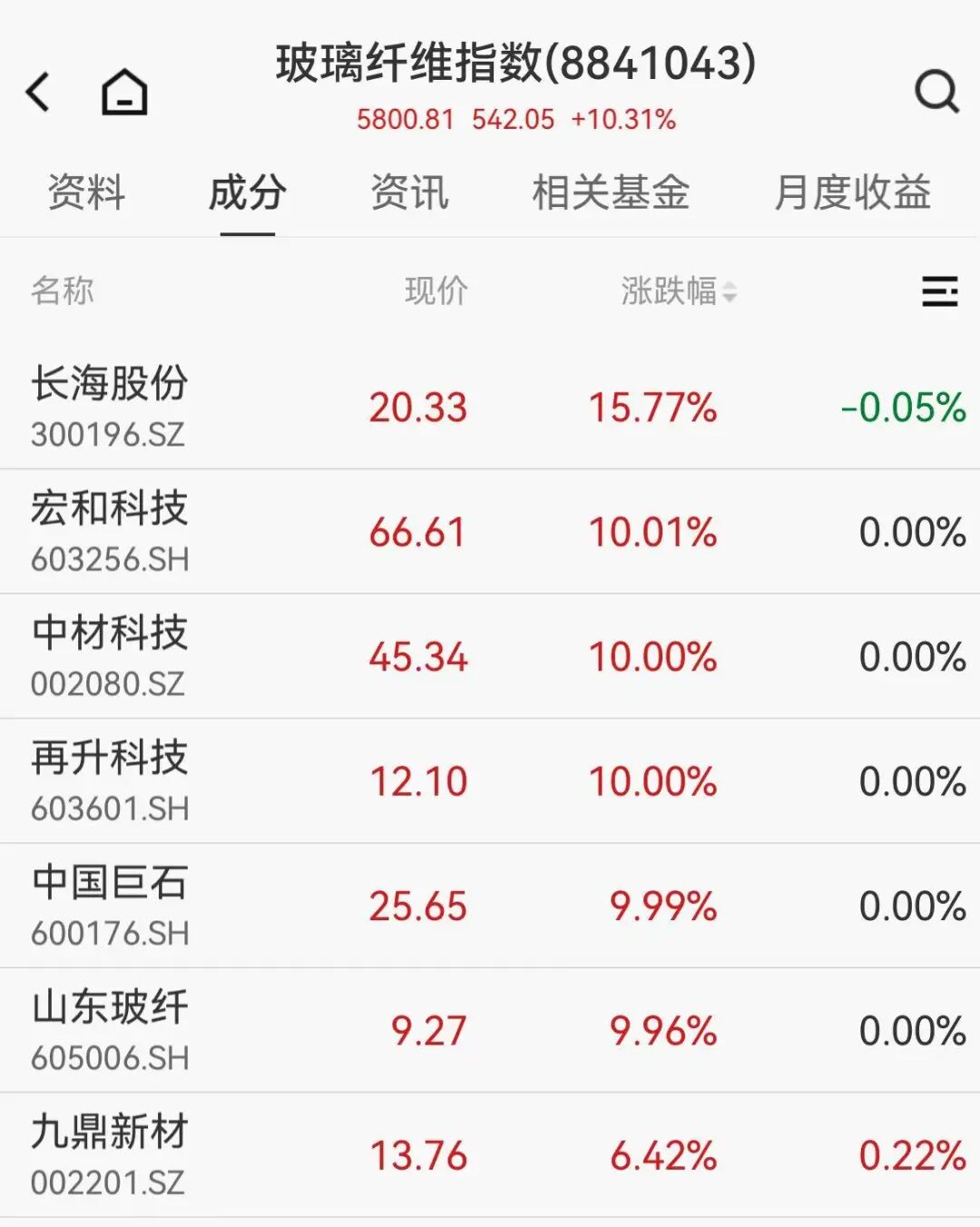
Group 1: Market Overview - The A-share market showed mixed performance on February 11, with the ChiNext Index falling over 1% and total trading volume in the Shanghai and Shenzhen markets reaching 2 trillion yuan, a decrease of 123.7 billion yuan from the previous trading day [1] - Over 3,200 stocks in the market experienced declines, indicating a broad-based sell-off [1] Group 2: Chemical Industry Insights - UBS recently released a report raising expectations for the Chinese chemical industry, predicting a new upward cycle from 2026 to 2028 due to multiple positive factors, with expectations for profit recovery and valuation increases [1] - The chemical sector has shown resilience, with companies like Jihua Group and Taihe New Materials experiencing significant stock price increases [1] Group 3: Fiberglass Sector Performance - The fiberglass manufacturing sector saw a collective surge, with nearly all stocks hitting the daily limit, a rare occurrence in the market [1] - Notable stocks included International Composite Materials, which hit a 20% limit up shortly after market open, and others like Changhai Co., Honghe Technology, and China Jushi also saw significant gains [1][2] - The fiberglass sector's revaluation is linked to price increases and demand driven by AI, with major manufacturers indicating price hikes and low inventory levels [3] Group 4: Lithium Battery and Precious Metals - Lithium battery stocks were active, with Zhongcai Technology hitting the limit up and reaching a historical high [4] - The domestic commodity futures market saw most prices rise, with lithium carbonate increasing over 9% [4] - Precious metals also experienced volatility, with silver futures rising over 4% and gold prices recovering above $5,050 per ounce [5]


A股收评:创业板指跌超1%,短剧、影视院线概念回调
Ge Long Hui· 2026-02-11 07:41
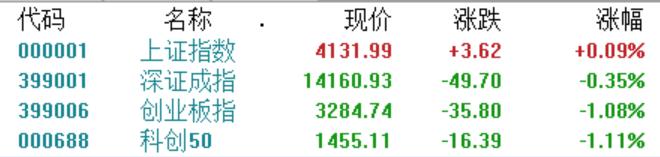
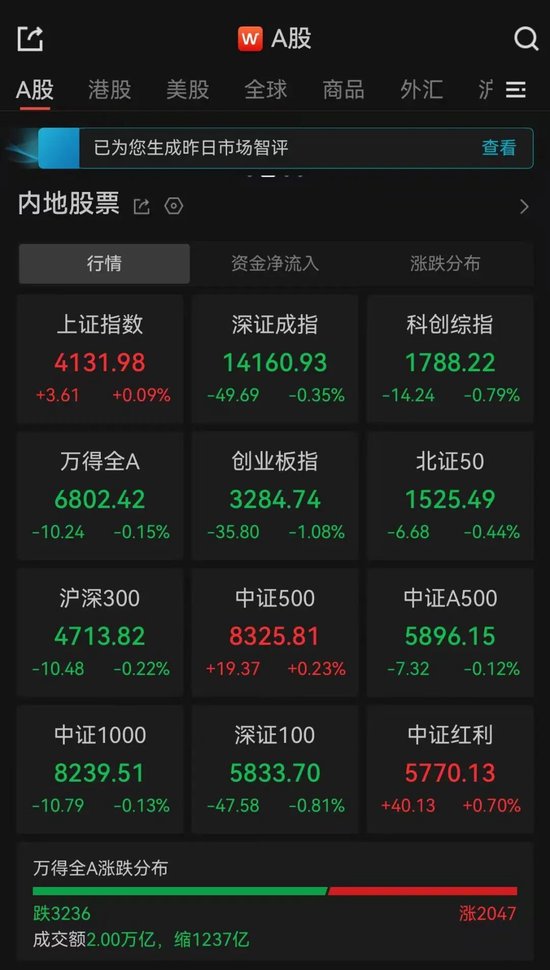
Market Overview - The A-share market showed mixed performance with the Shanghai Composite Index rising by 0.09% to 4131.99 points, while the Shenzhen Component Index fell by 0.35% and the ChiNext Index dropped by 1.08% [1][2] - The total market turnover was 2 trillion yuan, a decrease of 123.7 billion yuan compared to the previous trading day, with over 3200 stocks declining [1] Sector Performance - The small metals and dye chemical sectors performed positively, with stocks like Zhangyuan Tungsten and Xianglu Tungsten reaching new highs [2][4] - The coal, steel, cement, and lithium mining sectors saw significant gains, while the recently surging film and short drama sectors experienced collective adjustments, with stocks like Hengdian Film and Jinyi Film hitting the daily limit down [2][3] - The cultivation diamond sector saw widespread declines, led by Sifangda, while tourism, education, and military equipment sectors also faced downturns [2][3] Notable Stocks - In the small metals sector, Dongfang Tantalum, Zhongtung High-tech, Xianglu Tungsten, and Zhangyuan Tungsten hit the daily limit up, with Xiamen Tungsten and Jintong Co. rising over 7% [4][5] - The paper industry saw collective gains, with Minshida rising over 8% and Yueyang Lin Paper increasing nearly 6% [7][8] - The lithium extraction sector was active, with Huayou Cobalt and Shengxin Lithium Energy rising over 5%, and Lanxiao Technology increasing over 4% [9] - The oil and gas extraction sector also saw gains, with Haiyou Engineering hitting the daily limit up and Zhongman Petroleum rising by 5.9% [10] Declining Sectors - The film and television sector faced significant declines, with stocks like Happiness Blue Sea and Huace Film dropping over 10% [12][13] - The education sector also saw declines, with stocks like Huatu Shandian and Kevin Education falling over 3% [14][15] - The cultivation diamond sector experienced widespread declines, with Sifangda leading the drop [16] Market Outlook - The market sentiment is expected to improve with potential catalysts and the "Spring Festival effect" creating a favorable environment for recovery [17] - Key sectors to focus on include TMT, high-end manufacturing, and price increase chains, particularly in chemicals, construction materials, and steel [17]

主力板块资金流入前10:小金属流入41.87亿元、玻璃玻纤流入29.43亿元
Jin Rong Jie· 2026-02-11 07:17
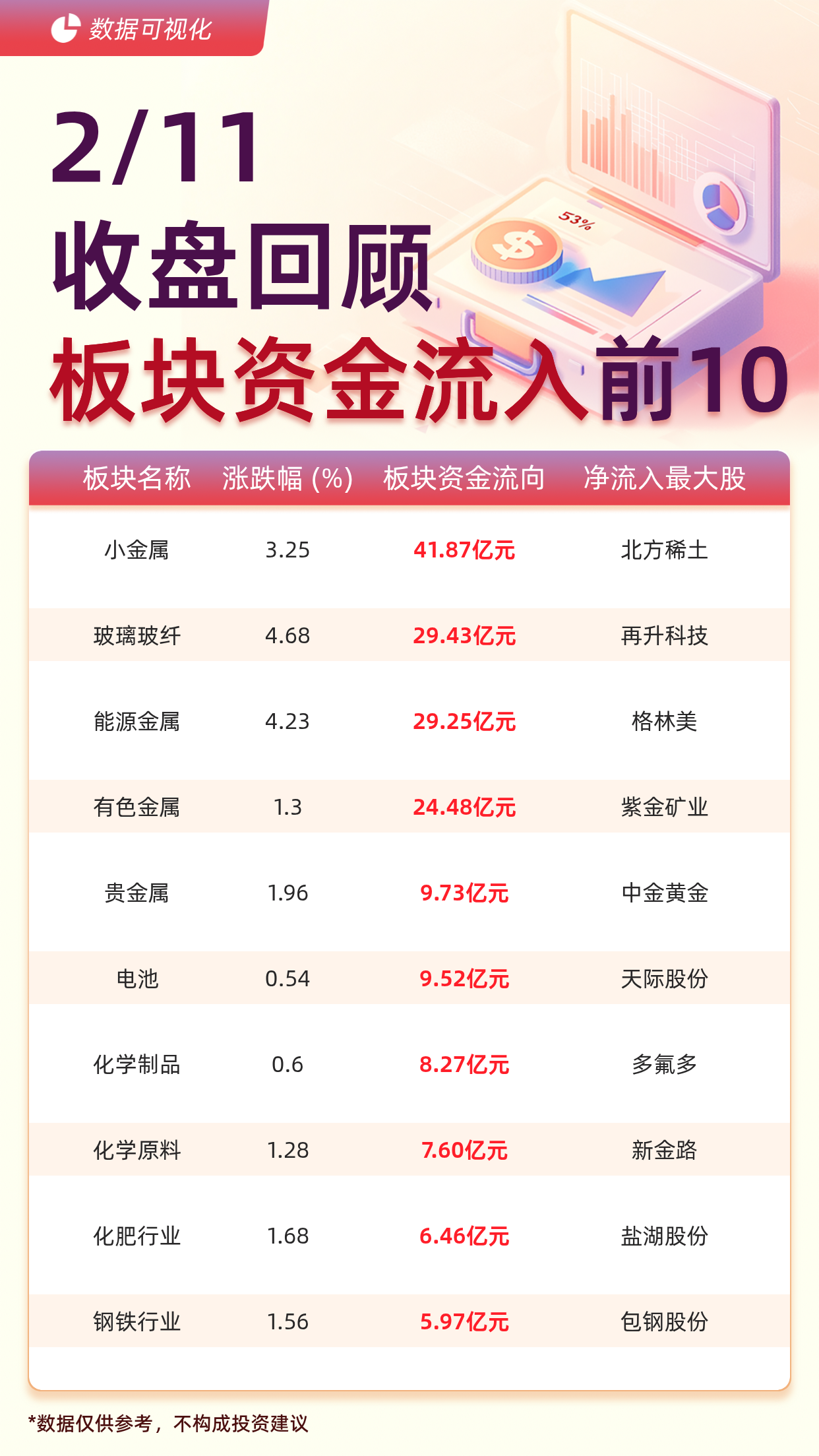
Group 1 - The main market experienced a net outflow of 52.808 billion yuan as of February 11 [1] - The top ten sectors with net inflows of main funds include: - Minor Metals (4.187 billion yuan) - Glass and Fiberglass (2.943 billion yuan) - Energy Metals (2.925 billion yuan) - Nonferrous Metals (2.448 billion yuan) - Precious Metals (0.973 billion yuan) - Batteries (0.952 billion yuan) - Chemical Products (0.827 billion yuan) - Chemical Raw Materials (0.760 billion yuan) - Fertilizer Industry (0.646 billion yuan) - Steel Industry (0.597 billion yuan) [1] Group 2 - The Minor Metals sector saw a price increase of 3.25% with a net inflow of 4.187 billion yuan, led by Northern Rare Earth [2] - The Glass and Fiberglass sector increased by 4.68% with a net inflow of 2.943 billion yuan, driven by Zais Technology [2] - The Energy Metals sector rose by 4.23% with a net inflow of 2.925 billion yuan, primarily from Greeenmei [2] - The Nonferrous Metals sector had a 1.3% increase with a net inflow of 2.448 billion yuan, featuring Ziwente [2] - The Precious Metals sector increased by 1.96% with a net inflow of 0.973 billion yuan, led by Zhongjin Gold [2] - The Battery sector saw a slight increase of 0.54% with a net inflow of 0.952 billion yuan, represented by Tianji Shares [2] Group 3 - The Chemical Products sector increased by 0.6% with a net inflow of 0.827 billion yuan, led by Duofluor [3] - The Chemical Raw Materials sector rose by 1.28% with a net inflow of 0.760 billion yuan, represented by Xinjing Road [3] - The Fertilizer Industry saw a 1.68% increase with a net inflow of 0.646 billion yuan, led by Salt Lake Shares [3] - The Steel Industry had a 1.56% increase with a net inflow of 0.597 billion yuan, featuring Baogang Shares [3]
A股收评:三大指数涨跌不一,创业板指跌超1%失守3300点,两市成交额不足2万亿,全市场超3200股下跌
Jin Rong Jie· 2026-02-11 07:17
Market Overview - The A-share market showed mixed performance on February 11, with the Shanghai Composite Index closing up by 3.61 points, a 0.09% increase, while the Shenzhen Component Index fell by 49.69 points, down 0.35%, and the ChiNext Index decreased by 35.80 points, down 1.08% [1] - The total trading volume of the Shanghai and Shenzhen markets fell below 2 trillion yuan for the first time in 31 trading days, with over 3,200 stocks declining [1] Sector Performance - The chemical sector has shown strong performance recently, with stocks like Jihua Group hitting the limit up for four out of five days, and other companies such as Taihe New Materials and Baichuan Co. also reaching the limit up [1] - The glass fiber sector experienced a surge, with leading companies like International Composites and China Jushi hitting the limit up due to price increases for electronic cloth [1] - The non-ferrous metals sector was active, particularly tungsten concepts, with Xianglu Tungsten Industry hitting the limit up [1] - The tourism sector declined, with Haikan Co. dropping over 11% [1] Price Increase Themes - The strongest market theme was the "price increase," with small metals, dyes, and electronic cloth driving the surge in the non-ferrous metals and chemical sectors [2] - The non-ferrous metals sector saw significant gains, particularly in gold, zinc, and copper, driven by global supply chain restructuring and the rise of emerging industries [2] - The chemical and dye sectors continued to rise, with Zhejiang Longsheng's dye prices increasing by 5,000 yuan per ton [2] Emerging Themes - The electronic cloth theme emerged strongly, with International Composites and China Jushi both hitting the limit up [3] - The commercial aerospace sector showed signs of recovery, with companies like Zengsheng Technology hitting the limit up, supported by upcoming rocket launches and a commercial aerospace industry development conference [3] - The computing power leasing concept also saw gains, with Nanjing Xingsheng hitting the limit up, driven by positive sentiment from Cloudflare's strong performance in the US market [3] Institutional Insights - Minsheng Securities noted that the market is likely to shift towards small and medium growth stocks as the holiday effect approaches, suggesting to seize opportunities before the Spring Festival [4] - BlackRock's CIO emphasized that the continuation of the A-share bull market depends on four conditions, including liquidity, profit realization, policy support, and reduced geopolitical risks [4] - China Galaxy Securities highlighted the potential for significant box office releases during the upcoming Spring Festival, while also noting advancements in AI video tools that could empower the film industry [4]
大宗周期板块集体上涨,有色金属ETF基金(516650)、石化ETF(159731)双双涨超2%
Mei Ri Jing Ji Xin Wen· 2026-02-11 07:13
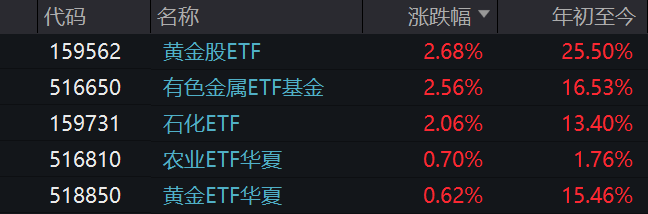
Core Viewpoint - The major indices continued to fluctuate with slight gains, driven by strong performances in the commodity cycle sectors, including precious metals, non-ferrous metals, petrochemicals, and agriculture [1] Group 1: Market Performance - As of 14:43, the following ETFs showed notable gains: Gold Stock ETF (159562) increased by 2.68%, Non-Ferrous Metals ETF (516650) rose by 2.56%, Petrochemical ETF (159731) gained 2.06%, Agricultural ETF (516810) was up by 0.7%, and Gold ETF (518850) increased by 0.62% [2] - Year-to-date performance for these ETFs includes: Gold Stock ETF up 25.50%, Non-Ferrous Metals ETF up 16.53%, Petrochemical ETF up 13.40%, Agricultural ETF up 1.76%, and Gold ETF up 15.46% [2] Group 2: Investment Insights - The strengthening of precious metals, non-ferrous metals, and oil prices has led to increased investor awareness of the appeal of cyclical markets [1] - The cyclical market logic indicates that precious metals are the first to rally, driven by their monetary and safe-haven attributes, which are sensitive to global liquidity, real interest rates, dollar trends, inflation, and risk aversion expectations [1] - Non-ferrous metals act as the "vanguard" of the cycle, being highly sensitive to liquidity and economic expectations, while petrochemicals tend to lag behind due to their dual dependence on oil prices and chemical supply-demand dynamics [1] - Agricultural products are influenced by upstream cost transmission and supply disruptions, representing the final phase of the cyclical market [1]
A股收评:超3200只个股下跌,沪指飘红,深指、创业板指收跌
Xin Lang Cai Jing· 2026-02-11 07:12
Market Overview - On November 11, A-shares opened lower and experienced fluctuating performance, with the Shanghai Composite Index closing up by 0.09% [1][5] - The Shenzhen Component Index fell by 0.35%, and the ChiNext Index decreased by 1.08% [1][5] Index Performance - Shanghai Composite Index: 4131.98, up by 3.61 points (+0.09%) [6] - Shenzhen Component Index: 14160.93, down by 49.69 points (-0.35%) [6] - ChiNext Index: 3284.74, down by 35.80 points (-1.08%) [6] - Total market turnover reached 2 trillion, a decrease of 123.7 billion [6] Sector Performance - Coal sector showed activity in the afternoon, while oil and gas stocks experienced fluctuations [3][7] - Precious metals sector rebounded during the day, with glass fiber, chemicals, rare earths, and lithium battery sectors leading in gains [3][7] - Media and film sectors collectively declined, with short drama games, tourism, solar energy, and CPO concept stocks leading the losses [3][7]
财新周刊-第6期2026
2026-02-11 05:58
Summary of Key Points from Conference Call This document is a summary based on the Caixin article [https://a.caixin.com/FA909Zlp](https://a.caixin.com/FA909Zlp). The summary may deviate from the original intent of the text and does not represent Caixin's views or positions. It is recommended to click the link for detailed comparison and verification. Industry Overview - The document discusses the recent volatility in the precious metals market, particularly focusing on gold and silver prices, which have experienced significant fluctuations in early 2026. Core Insights and Arguments 1. **Market Volatility**: In January 2026, gold and silver prices saw extreme volatility, with gold reaching approximately $5,600 per ounce before dropping to around $4,683 per ounce, marking a daily decline of 40%, the largest in 40 years [10][11][24]. 2. **Speculative Behavior**: The market is characterized by speculative trading, with significant price movements driven by investor sentiment rather than fundamental factors. This has led to a bubble-like state in the gold and silver markets [22][33]. 3. **Impact of External Factors**: Political events, such as actions taken by former President Trump, have been cited as catalysts for price increases in gold, indicating that geopolitical tensions can significantly influence market dynamics [22][39]. 4. **Central Bank Purchases**: Central banks have been increasing their gold reserves, viewing gold as a hedge against currency risk, which has contributed to the upward pressure on gold prices [38][39]. 5. **Investment Strategies**: Investors are advised to adopt long-term holding strategies for gold and to avoid leveraging due to the current market volatility. It is suggested that gold should be treated as a safe-haven asset within a diversified portfolio [30][31][32]. Additional Important Content 1. **Regulatory Responses**: In response to market volatility, exchanges have increased trading costs and adjusted margin requirements to mitigate risks associated with excessive speculation [23][24]. 2. **Market Sentiment**: The sentiment among investors is mixed, with some looking to capitalize on price dips while others remain cautious due to the high volatility [30][31]. 3. **Supply Chain Concerns**: The document highlights potential supply chain disruptions for silver due to new tariffs and regulations, which could further impact market liquidity and pricing [41]. 4. **Long-term Outlook**: Despite short-term fluctuations, the long-term outlook for gold remains positive, driven by ongoing geopolitical uncertainties and the potential for continued central bank purchases [38][39]. This summary encapsulates the key points discussed in the conference call regarding the precious metals market, focusing on the dynamics of gold and silver prices, investor behavior, and the broader economic implications.
现货黄金反弹,黄金ETF国泰(518800)涨超0.4%,资金抢筹,近20日资金净流入超77亿元
Mei Ri Jing Ji Xin Wen· 2026-02-11 02:44
Core Viewpoint - Short-term decline in precious metal prices is attributed to previous rapid increases, technical overbought conditions, and the hawkish nomination of Kevin Walsh as the next Federal Reserve head. Long-term trends indicate a reshaping of monetary credit dynamics, with an expected rise in the U.S. fiscal deficit rate following the passage of the "Big and Beautiful" bill. [1] Group 1: Precious Metals Market Analysis - Current low gold reserves in China suggest a long-term trend of central bank gold purchases, leading to an upward movement in gold prices. [1] - A decrease in real interest rates post-rate cuts is expected to attract inflows into gold ETFs. [1] - The gold-silver ratio is currently high, and expectations of marginal demand recovery may lead to a convergence of this ratio. [1] Group 2: Valuation and Investment Opportunities - The valuation of the precious metals sector is at the lower end of its historical range, indicating potential for sustained recovery. [1] - The long-term trend for gold remains strong, supported by monetary expansion and the monetization of fiscal deficits, which challenge the U.S. dollar credit system. [1] - Increased global geopolitical instability is driving diversification in asset reserves, enhancing the demand for gold as a safe asset. [1] - The trend of "de-dollarization" globally positions gold as a potential new pricing anchor, providing upward momentum for precious metals. [1] - The logic supporting gold prices remains intact with the combination of a Federal Reserve rate cut cycle, increasing overseas uncertainties, and the global de-dollarization trend. [1] - Investors are encouraged to monitor investment opportunities in gold ETFs such as Guotai (518800) and gold stock ETFs (517400). [1]
首席点评:非农数据临阵预警
Shen Yin Wan Guo Qi Huo· 2026-02-11 01:50
Report Industry Investment Rating - The report provides a cautious view on various commodities, with some marked as "cautiously bearish" and others as "cautiously bullish". For example, crude oil, methanol, etc., are marked as "cautiously bearish", while gold, silver, etc., are marked as "cautiously bullish" [4]. Core Viewpoints - The report analyzes multiple aspects including economic data, geopolitical events, and market trends. It mentions that the US is at a critical stage of its economic cycle, and the global market is affected by various factors such as US employment data, geopolitical negotiations, and supply - demand changes in different industries [1][5]. - In the commodity market, different commodities have different trends. For example, precious metals are expected to return to an upward trend in the long - term, while the short - term is affected by data announcements; the crude oil market is influenced by geopolitical negotiations and supply changes [2][3]. Summary by Directory 1. Chief Comment - US API crude oil inventory increased by 13.4 million barrels last week. US soybean export inspection volume decreased by 14% week - on - week but increased by 3% year - on - year. As of February 5, 2026, the weekly US soybean export inspection volume was 1,136,099 tons. The total US soybean export inspection volume in the 2025/26 season reached 23,136,299 tons, a year - on - year decrease of 34.4%. The US non - farm employment data to be released this Wednesday is expected to show an increase of 69,000 in non - farm employment in January, with the unemployment rate remaining at 4.4%. Futures markets mostly rose at night, with propylene up over 2% and glass down over 1% [1]. 2. Key Varieties Precious Metals - Precious metals are in a consolidation phase. The market is waiting for US employment and inflation data, which may affect subsequent interest rate cut expectations. After a sharp rise in January, precious metals had a significant shock. In the long - term, factors such as de - dollarization, geopolitical risks, and central bank gold purchases still support the upward trend of gold. The central bank of China has increased its gold holdings for 15 consecutive months. It is recommended to wait and see for silver due to its high volatility and relatively low gold - silver ratio [2]. Crude Oil - SC crude oil rose 0.21% at night. Iran and the US held indirect negotiations in Muscat. The negotiation started well, and both sides agreed to continue. Kazakhstan's oil export volume in February may drop by up to 35% due to the slow recovery of the Tengiz oil field [3]. Stock Index - US stock indexes were mixed. The stock index rose slightly the previous trading day, with the media sector leading the rise and the real estate sector leading the fall. The market turnover was 2.12 trillion yuan. The margin trading balance increased by 523 million yuan on February 9. In February, the market is expected to continue the phased upward trend, but the potential impact of overseas market fluctuations during the Spring Festival should be noted [3]. 3. Main News of the Day International News - Ray Dalio warned that the US is at the "fifth stage" of the imperial cycle, on the verge of order collapse and conflict. He suggested that gold should account for 5% - 15% of the investment portfolio [5]. Domestic News - The People's Bank of China will continue to implement a moderately loose monetary policy, use various policy tools such as reserve requirement ratio cuts and interest rate cuts, and carry out regular treasury bond trading operations [6]. Industry News - An article in Qiushi emphasized the importance of cultivating future industries for high - quality development [7]. 4. Daily Returns of Overseas Markets - The report provides the daily returns of various overseas markets on February 9 and 10, including the S&P 500, European STOXX50, etc. Some indexes and commodities rose, while others fell [8]. 5. Morning Comments on Main Varieties Financial - **Stock Index**: The stock index is expected to continue the phased upward trend in February, but the potential impact of overseas market fluctuations during the Spring Festival should be noted [9]. - **Treasury Bonds**: Treasury bonds fluctuated narrowly. The central bank will continue to implement a moderately loose monetary policy. The market expects the new Fed chairman's policy to be a combination of interest rate cuts and balance - sheet reduction. The bond futures price is expected to stabilize, and cautious operation is recommended before the Spring Festival [10][11]. Energy and Chemicals - **Crude Oil**: SC crude oil rose 0.21% at night. Iran - US negotiations started well, and Kazakhstan's oil export volume may decline [12]. - **Methanol**: Methanol fell 0.09% at night. The operating rate of coal - to - olefin plants increased, and the methanol inventory in coastal areas decreased [13]. - **Natural Rubber**: Natural rubber rebounded slightly. The domestic production area is in the off - season, and the supply elasticity is weak. The demand side supports the stable operation of all - steel tire production. It is expected to fluctuate and adjust before the Spring Festival [14]. - **Polyolefins**: Polyolefin futures rebounded slightly. The market focuses on supply improvement and macro factors. It is recommended to control positions before the Spring Festival [15]. - **Glass and Soda Ash**: Glass futures declined, and soda ash futures also fell. The glass supply - demand situation is gradually improving, and the supply of soda ash is slightly shrinking. It is recommended to control positions before the Spring Festival [16]. - **Precious Metals**: Precious metals are in a consolidation phase. They are affected by US data announcements. In the long - term, gold is expected to rise, and it is recommended to wait and see for silver [17]. - **Copper**: Copper prices rose 0.17% at night. The concentrate supply is tight, and the copper price may enter an adjustment phase [18]. - **Zinc**: Zinc prices rose 0.08% at night. The zinc concentrate processing fee decreased, and the zinc price may follow the overall trend of non - ferrous metals [19]. - **Aluminum**: The Shanghai aluminum market was flat at night. The aluminum production rate is high, but the downstream demand is weakening, and the inventory is accumulating. In the long - term, low inventory and stable demand support the price [20]. - **Lithium Carbonate**: The production and production plan of lithium carbonate decreased, and the inventory decreased. The market sentiment is weak, and it is recommended to pay attention to trading opportunities after volatility reduction [21]. Black Metals - **Coking Coal and Coke**: The prices of coking coal and coke rebounded at night. The supply of coking coal decreased slightly, and the demand growth is limited. After the Spring Festival, factors such as iron - making production, mine operation, and import policies should be noted [22]. - **Steel**: Steel production decreased slightly, and the inventory increased. The construction downstream demand is weakening. The steel market is in a situation of weak supply and demand, and the price is expected to be weak and volatile [23]. - **Iron Ore**: The global iron ore shipment increased slightly, and the port inventory continued to rise. The steel mill's demand for iron ore is expected to be based on on - demand replenishment, and the iron ore price is expected to be weak and volatile [24]. Agricultural Products - **Protein Meal**: The prices of soybean meal and rapeseed meal rose at night. The Brazilian soybean harvest is progressing, and the US soybean price is under pressure. The domestic soybean meal price is also affected by high inventory and sufficient supply expectations [25]. - **Oils and Fats**: Oils and fats were weak at night. The palm oil inventory in Malaysia decreased, and the production decreased. The palm oil price is supported by inventory reduction but restricted by crude oil prices. It is expected to fluctuate in the short - term [26][27]. - **Sugar**: The sugar price continued to fluctuate. The global sugar supply is in an oversupply situation, and the domestic sugar supply is increasing seasonally. The sugar price is expected to fluctuate in the short - term [28]. - **Cotton**: The cotton price maintained a range - bound trend. The textile factory's restocking is coming to an end, and the cotton price is expected to fluctuate. Attention should be paid to the implementation of direct subsidy policies [29]. - **Hogs**: The hog futures market continued to be weak. The supply in the spot market exceeds demand, and the price is expected to be under pressure in the short - term [30]. Shipping Index - **Container Shipping to Europe**: The EC index fell 4.57%. The spot freight rate in February is relatively stable, and the market is expected to be volatile before the Spring Festival. After the Spring Festival, the impact of export demand and price increase letters should be noted [31].
黄金早参|美联储官员释放鹰派信号,关键数据披露前夕,金价承压回落
Mei Ri Jing Ji Xin Wen· 2026-02-11 01:20
Group 1 - The core viewpoint of the articles indicates that gold prices are under pressure due to hawkish signals from Federal Reserve officials and the exit of speculative funds, leading to a slight decline in gold futures and related ETFs [1][2] Group 2 - The Federal Reserve officials, including Logan and Harmack, have indicated that the current policy stance is appropriate, suggesting no further rate cuts are needed if inflation stabilizes and the labor market remains steady [1] - The upcoming U.S. non-farm payroll data is seen as a critical indicator; a significantly weak report could lead to increased bets on economic recession and faster rate cuts, potentially boosting gold prices [2] - The U.S. CPI inflation data is crucial as it directly impacts the Fed's effectiveness in combating inflation; persistent inflation could undermine market confidence in rate cuts, exerting pressure on gold prices [2]