
金融业

Search documents
就业降温趋势不变——5月美国非农数据解读
CAITONG SECURITIES· 2025-06-07 13:25
Employment Data Summary - In May, the U.S. non-farm payrolls increased by 139,000, continuing a downward trend from previous months[2] - The combined downward revision for March and April was 95,000, indicating a potential overestimation of current employment levels[2][5] - The unemployment rate remained stable at 4.2%, while the labor force participation rate decreased by 0.2 percentage points to 62.4%[2][10] Sector Analysis - Job growth in May was primarily driven by the service sector, which added 145,000 jobs, while government employment decreased by 22,000[8] - Manufacturing jobs saw a decline of 13,000, influenced by tariff policies[2][8] - The federal government has reduced employment by 59,000 since January, reflecting ongoing layoffs[5][8] Wage and Hour Trends - Average hourly earnings increased by 0.4% month-over-month, maintaining a year-over-year growth rate of 3.9%[13] - The average workweek remained steady at 34.3 hours, suggesting stable wage growth may support consumer spending[13] Market Expectations - Following the release of the May non-farm data, market expectations for Federal Reserve rate cuts have slightly adjusted to two potential cuts within the year, with the earliest possible in September[21] - Despite the overall stability in unemployment rates, the declining labor force participation and continuous downward revisions in employment data suggest a cooling job market[21] Risks - Potential risks include unexpected inflation increases, tighter monetary policy from the Federal Reserve, and a downturn in the U.S. economy[25][26]
非农数据高于预期,美联储或更偏观望——2025年5月美国非农数据点评兼光大宏观周报
EBSCN· 2025-06-07 13:15
Employment Data - In May 2025, the U.S. added 139,000 non-farm jobs, exceeding the market expectation of 130,000 jobs and slightly down from the revised previous value of 147,000 jobs[1][13][15] - The unemployment rate remained stable at 4.2%, matching both the forecast and the previous month's rate[1][13][15] - Average hourly earnings increased by 3.9% year-on-year, surpassing the expected 3.7% and matching the previous value[1][13][15] Sector Performance - The leisure and hospitality sector saw a significant increase, adding 48,000 jobs, up from 29,000 in the previous month, contributing to the stability of the overall employment data[2][24] - Manufacturing jobs decreased by 5,000, a decline from the previous increase of 14,000, indicating pressure from tariff disruptions[3][23] - Financial activities added 13,000 jobs, up from 3,000 previously, showing a recovery in this sector[3][24] Labor Market Dynamics - The labor force participation rate fell by 0.2 percentage points to 62.4%, with notable declines in youth employment willingness[4][29] - The U3 unemployment rate remained at 4.2%, with a slight increase of 71,000 in the number of unemployed individuals[4][35] - The U6 unemployment rate, which includes those working part-time for economic reasons, held steady at 7.8%[4][35] Federal Reserve Outlook - The robust non-farm data reinforces the Federal Reserve's wait-and-see approach, with a near 100% probability that interest rates will remain unchanged in June 2025[5][19] - Market expectations indicate two rate cuts in 2025, with the first anticipated in September, having a probability of approximately 50%[5][19][22]
2025年5月美国非农数据点评兼光大宏观周报(2025-06-07):非农数据高于预期,美联储或更偏观望-20250607
EBSCN· 2025-06-07 12:55
Employment Data - In May 2025, the U.S. added 139,000 non-farm jobs, exceeding the market expectation of 130,000 jobs and slightly down from the revised previous value of 147,000 jobs[1][15] - The unemployment rate remained stable at 4.2%, matching both the forecast and the previous month's rate[1][15] - Average hourly earnings increased by 3.9% year-on-year, surpassing the expected 3.7% and matching the previous value after revision[1][15] Sector Performance - The leisure and hospitality sector saw a significant increase, adding 48,000 jobs in May, up from 29,000 in the previous month, contributing to the overall employment stability[2][24] - Manufacturing jobs decreased by 5,000, contrasting with a previous increase of 14,000, indicating pressure from tariff disruptions[3][23] - Financial activities added 13,000 jobs, up from 3,000 in the previous month, showing a recovery in this sector[3][24] Labor Market Dynamics - The labor force participation rate fell by 0.2 percentage points to 62.4%, with notable declines in youth employment willingness[4][29] - The U3 unemployment rate remained at 4.2%, with a slight increase of 71,000 in the number of unemployed individuals[4][35] - The U6 unemployment rate, which includes those working part-time for economic reasons, held steady at 7.8%[4][35] Federal Reserve Outlook - The robust non-farm data reinforces the Federal Reserve's wait-and-see approach, with a near 100% probability that interest rates will remain unchanged in June 2025[5][19] - Market expectations indicate two potential rate cuts in 2025, with the first anticipated in September, having a probability of approximately 50%[5][19]
王文最新发声:中国股市"DeepSeek时刻"将至,六大黄金赛道蓄势待发!
私募排排网· 2025-06-07 02:11
点击图片查看完整路演回放↑↑↑ 6月4日,我们非常荣幸地邀请到了深圳市日斗投资管理有限公司的创始人、董事长王文先生做客私募排排网直播间, 王总深入剖析了当前资本 市场的关键趋势, 从人工智能产业的突破性进展,到港股市场的投资机会,再到消费行业的价值挖掘, 为我们带来了一场精彩纷呈的投资盛 宴。王总特别提到"期待中国股票市场的DeepSeek崛起时刻",这一新颖比喻引发了广泛共鸣。以下小编整理出来的直播精华片段: ( 点击图片 查看完整直播回放 ) Q:王总,您近期提到"期待中国股票市场的DeepSeek崛起时刻",这个比喻非常新颖,能否请您解释一下,什么是"DeepSeek崛起时刻"? ( 点 击蓝字查看完整直播回放 ) 王文:今年春节期间,市场对贸易战的担忧情绪较为浓厚。与此同时,Deepseek公司的崛起改变了市场对中国人工智能产业的认知。此前普遍 认为中国人工智能技术与美国存在十年以上的差距,数字鸿沟难以逾越 。但Deepseek的出现证明中美技术差距远比预期要小,这显著增强了市 场对中国科技实力的信心。 从供给端观察,在A股IPO节奏调整的背景下,港股市场承接了大量内地优质企业的上市需求,为投资者提供 ...


【UNFX课堂】美国5月非农前瞻:就业市场寒意渐浓,降息预期再受考验
Sou Hu Cai Jing· 2025-06-06 03:41
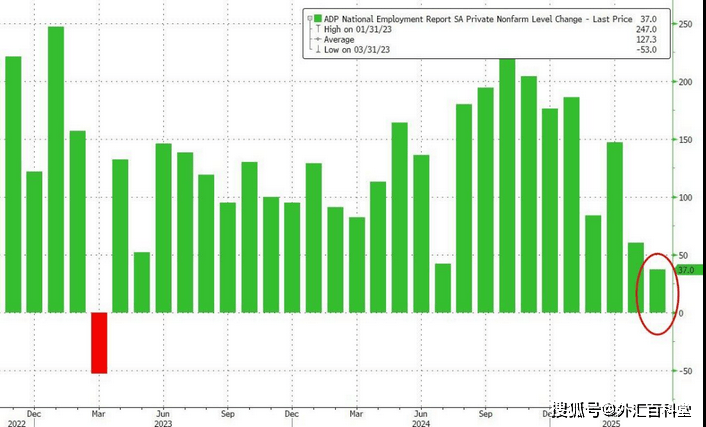
Core Viewpoint - The upcoming US May non-farm payroll report is anticipated to reveal significant cooling in the labor market, as indicated by a series of concerning leading indicators, particularly the disappointing ADP employment data [1][3]. Employment Data - The ADP report for May showed only 37,000 new jobs added, far below the expected 114,000, marking the lowest figure since March 2023 and the largest deviation from expectations in nearly three years [1][3]. - Job losses were noted in the goods-producing sector, with a decrease of 2,000 positions, while the service sector saw a modest increase of 36,000 jobs, primarily driven by leisure and hospitality (+38,000) and finance (+20,000) [3]. - Small businesses (fewer than 50 employees) were particularly affected, losing 13,000 jobs, reflecting the direct impact of macroeconomic policy uncertainty on these vulnerable entities [3]. Economic Indicators - Initial jobless claims rose to 247,000, exceeding expectations and reaching an eight-month high, with the four-week moving average also at its highest since November 2021, suggesting prolonged unemployment durations [4]. - The ISM non-manufacturing PMI unexpectedly fell to 49.9 in May, indicating contraction in business activity for the first time since mid-2022, attributed to policy uncertainties affecting order delays [4]. Policy Uncertainty - Current policy uncertainties, especially regarding tariffs, are seen as a core factor contributing to the unclear economic outlook, with potential cost increases looming if negotiations fail [5]. - The upcoming non-farm payroll report is crucial for understanding structural changes in employment, particularly in the goods-producing sector, small businesses, and temporary jobs [5]. Market Reactions - Market consensus for new non-farm jobs has dropped to 130,000 from a previous 177,000, with some institutions predicting as low as 125,000 [7]. - The unemployment rate is expected to remain at 4.2%, but a rise to 4.3% or higher could signal recession risks [7]. - Average hourly wage growth is projected to slightly increase to 0.3%, raising concerns about a potential wage-inflation spiral due to high labor costs and declining productivity [7]. Short-term Volatility - The release of employment data is likely to cause significant volatility in stock, bond, and currency markets, similar to the reactions following the ADP data release [8]. - Current interest rate futures reflect expectations of at least two rate cuts by the Federal Reserve this year, with increased bets on a September rate cut if unemployment rises significantly [8].
海外避险情绪升温,国内弱复苏延续
Tong Guan Jin Yuan Qi Huo· 2025-06-03 12:12
Report Title - Macro Weekly Report: Overseas Risk-Aversion Sentiment Intensifies, Domestic Weak Recovery Continues [1] Core Views - Overseas, there are signs of partial recovery in the US "soft data", with the Michigan Consumer Sentiment Index rising in May and inflation expectations falling from their highs. However, the manufacturing sector remains sluggish due to tariff disruptions, with the May ISM Manufacturing PMI contracting for three consecutive months, weaker than expected, and the import sub-index hitting a 16-year low, while the price sub-index remains high. Overall, the US economic fundamentals remain resilient, and the GDPNow model has revised up its Q2 economic growth forecast to 4.6%. This week, attention is focused on the May non-farm payroll report and the services PMI. Last week, the US dollar index maintained a weak oscillation, and the gold price returned to a high level, reflecting three risks: internal conflicts in the US weakening its sovereign credit, setbacks in the US tariff negotiations with other countries, and renewed conflicts in war-torn countries. In June, attention is on the progress of Trump's tax cut bill in the Senate and the trade court's ruling on tariffs [2]. - Domestically, the manufacturing sector's sentiment improved slightly in May, with both supply and demand improving. The reduction in Sino-US tariffs has led to a marginal recovery in production driven by pre-export activities, and new orders have significantly improved due to external demand. However, price pressures remain, and the signs of companies "trading price for volume" and actively reducing inventory continue. In addition, the sentiment in the service and construction sectors remains lower than in previous years, indicating that domestic demand is still the main drag in the second quarter, and more policy support is urgently needed in the context of weak inflation. In June, attention is on the possibility of a meeting between the Chinese and US presidents [3] Section Summaries Overseas Macro - US May Manufacturing PMI Weakens: The May ISM Manufacturing PMI was weak, indicating that the "rush to import" may have ended. The May ISM Manufacturing PMI was 48.5, lower than the expected 49.5 and the previous value of 48.7, remaining in the contraction range for three consecutive months. New orders continued to shrink, external demand was under pressure, costs were high, and employment was weak. The import sub-index hit a 16-year low, suggesting that the peak of "rush to import" may have passed under tariff disruptions. The trade surplus has led the GDPNow to revise up the Q2 economic growth rate to 4.6%. Meanwhile, the final value of the US May Markit Manufacturing PMI was 52.0, slightly lower than the expected 52.3 and the initial value of 52.3, still in the expansion range. The difference between the two may be due to the ISM PMI's high dependence on external demand, supply chains, and large manufacturers, making it more sensitive to policy shocks and external uncertainties [5]. - Consumer Confidence Recovers, Inflation Expectations Fall from Highs: After the easing of tariff negotiations, the US "soft data" has improved. The final value of the US May Michigan Consumer Sentiment Index was 52.2, higher than the expected 51.0 and the initial value of 50.8. With the significant reduction in Sino-US tariffs, consumer confidence has recovered, but the absolute level remains at a historical low, indicating that consumers are still highly concerned about the future economy. The final value of the one-year inflation expectation in May was 6.6%, lower than the expected 7.1% and the initial value of 7.3%; the final value of the 5 - 10-year inflation expectation was 4.2%, lower than the expected 4.5% and the initial value of 4.6%, ending four months of sharp increases [7]. Domestic Macro - China's May Manufacturing Sentiment Improves as Expected: The May Manufacturing PMI rose slightly to 49.5, in line with expectations and up from the previous value of 49.0. There were differences among enterprises of different sizes, with large enterprises rising 1.5 to 50.7, entering the expansion range, while medium and small enterprises remained in the contraction range. Both supply and demand improved, with external demand making a prominent contribution. Production rose 0.9 to 50.7, returning to the expansion range; new orders rose 0.6 to 49.8, approaching the boom-bust line; new export orders rose significantly by 2.8 to 47.5, showing obvious marginal improvement. Overall, with the phased easing of Sino-US tariff frictions, enterprises have seized the window period to accelerate production, and the release of export orders has driven the recovery of the production side. Prices were weak, and enterprises actively reduced inventory. The raw material inventory rose to 47.4, and the finished product inventory fell 0.8 to 46.5. In terms of prices, the purchase price of raw materials in April fell 0.1 to 46.9, and the ex-factory price fell 0.1 to 44.7, indicating that the signs of companies "trading price for volume" and actively reducing inventory continue [10]. - Construction and Service Sectors Remain Sluggish, Domestic Demand Recovery is Weak: In the non-manufacturing sector, the May Service PMI was 50.2, slightly higher than the previous value of 50.1 but lower than the level of previous years. Driven by the May Day holiday, tourism, travel, and catering consumption were active, and the sentiment in the transportation and accommodation industries rose to the expansion range; high - growth industries such as postal, communication, and the Internet continued to grow steadily. The Construction PMI was 51.0, lower than the previous value of 51.9 and at the lowest level in the same period over the years, with real estate construction remaining sluggish [11]. Performance of Major Asset Classes - Equity: The performance of equity markets varied. In the A-share market, the Wind All - A Index was at 5074.29, with a weekly decline of -0.02%, a monthly increase of 2.39%, and a year - to - date increase of 1.04%. The Shanghai Composite Index was at 3347.49, with a weekly decline of -0.03%, a monthly increase of 2.09%, and a year - to - date decline of -0.13%. In the Hong Kong stock market, the Hang Seng Index was at 23289.77, with a weekly decline of -1.32%, a monthly increase of 5.29%, and a year - to - date increase of 15.44%. Overseas, the Dow Jones Industrial Average was at 42270.07, with a weekly increase of 1.60%, a monthly increase of 3.94%, and a year - to - date decline of -0.64% [19]. - Bonds: In the domestic bond market, the 1 - year Treasury yield was 1.46%, with a weekly increase of 1.51 basis points, a monthly increase of 0.08 basis points, and a year - to - date increase of 35.30 basis points. In the overseas bond market, the 2 - year US Treasury yield was 3.89%, with a weekly decline of 11.00 basis points, a monthly increase of 29.00 basis points, and a year - to - date decline of 36.00 basis points [22]. - Commodities: The Nanhua Commodity Index was at 2349.69, with a weekly decline of -1.62%, a monthly decline of -2.40%, and a year - to - date decline of -5.88%. The CRB Commodity Index was at 290.43, with a weekly decline of -2.10%, a monthly increase of 0.57%, and a year - to - date decline of -2.12%. COMEX Gold was at 3313.10, with a weekly decline of -1.57%, a monthly decline of -0.18%, and a year - to - date increase of 25.45% [23]. - Foreign Exchange: The US dollar to RMB exchange rate was 7.1953, with a weekly increase of 0.08%, a monthly decline of -0.93%, and a year - to - date decline of -1.42%. The US dollar index was at 99.4393, with a weekly increase of 0.32%, a monthly decline of -0.20%, and a year - to - date decline of -8.34% [26]. High - Frequency Data Tracking - Domestic: The report includes data on the congestion index of 100 cities, the subway passenger volume of 23 cities, the commercial housing transaction area of 30 cities, the second - hand housing transaction area of 12 cities, passenger car sales, and the apparent consumption of rebar [28]. - Overseas: The report includes data on the Redbook commercial retail sales and the number of unemployment benefit claims in the US [32]. This Week's Important Economic Data and Events - The report lists important economic data and events for this week, including China's May Caixin Manufacturing PMI, the eurozone's May CPI annual and monthly rates, the US's May ADP employment data, and the US's May ISM Non - Manufacturing PMI [39].
加快推进服务业扩大开放
Jing Ji Ri Bao· 2025-05-29 22:25
Core Viewpoint - The expansion of the service industry is a key component of China's opening-up strategy and an important support for economic development, with foreign investment in the service sector expected to account for about 70% of the total foreign investment in 2024, and service trade surpassing $1 trillion for the first time [1][6] Group 1: Service Industry Opening-Up - The service industry has become the focus of high-level opening-up in China, with a continuous expansion of the scope and level of openness through institutional and autonomous measures [2][3] - The establishment of a negative list management model for foreign investment in the service sector has been implemented nationwide, enhancing the transparency and efficiency of market access [3][4] - The reduction of special management measures for foreign investment in the service sector has significantly decreased from 95 to 22, with a 76.8% reduction, particularly in finance and real estate [4] Group 2: Key Areas of Focus - The 2024 pilot program for expanding foreign investment in value-added telecommunications services has removed foreign ownership restrictions in several major cities, facilitating greater foreign participation [5][6] - The healthcare sector is being prioritized for opening-up, with policies allowing foreign investment in hospitals and medical services, aiming to improve service quality and fill gaps in high-end medical resources [13][14] - The financial sector has seen the complete removal of foreign ownership limits across various financial services, promoting a more inclusive and competitive environment for foreign financial institutions [18][19] Group 3: Achievements and Future Directions - The number of foreign-funded telecommunications companies has increased significantly, with over 2,400 foreign firms operating in the sector, reflecting a 26.5% year-on-year growth [9][10] - The financial market has expanded to include over 1,160 foreign institutions in the bond market, with a total bond holding of 4.5 trillion yuan, indicating a robust integration of foreign capital [20][21] - Future efforts will focus on enhancing the regulatory framework, improving the business environment, and ensuring a balance between openness and security in the financial sector [22]
"见微知著”系列专题之七:就业"新趋势”?
Shenwan Hongyuan Securities· 2025-05-29 14:52
Group 1: Employment Trends - In 2024, the average annual salary for urban non-private sector employees is 124,000 yuan, reflecting a decrease of 6.8 percentage points since 2021, now at a growth rate of 2.8%[3] - Employment is shifting from high-salary industries to sectors with shorter working hours and higher hourly wages, indicating a trend towards "anti-involution" since 2021[4] - The transportation and service industries have seen a reduction in weekly working hours by 4.2 and 3.6 hours respectively, while hourly wages increased by 3.9 and 3.6 yuan/hour, suggesting improved job attractiveness[4] Group 2: Regional Wage Convergence - From 2019 to 2023, the wage growth in the eastern region was 7.5%, compared to 7.1% in the central and western regions, with the gap narrowing from 0.8 percentage points in 2019 to 0.5 percentage points in 2023[5] - The wage growth in the central and western regions has shown resilience, with the central region's wage growth remaining stable at around 7.1%[5] - Employment in the service sector is increasingly migrating to the central and western regions, with the proportion of employees in accommodation and retail sectors decreasing from 20.8 and 10.1 percentage points below the eastern region to 18.2 and 9 percentage points respectively[6] Group 3: Private and Flexible Employment - The average salary growth for private sector employees is lower than that of non-private sector employees, but certain sectors like education and retail services have seen higher growth rates of 8.9% and 5.3% respectively[7] - The concentration of small and medium enterprises in the service sector has led to better salary growth in private units compared to non-private units[10] - New flexible employment roles, such as ride-hailing drivers and delivery personnel, have higher average monthly salaries of 10,506 yuan, significantly above traditional employees' 8,910 yuan, despite longer working hours[10]
热点思考 | 就业“新趋势”?(申万宏观·赵伟团队)
申万宏源宏观· 2025-05-29 09:45
Core Viewpoint - The article discusses the new trends in employment and wage data for urban employees in 2024, highlighting shifts from high salary pursuits to a focus on reducing work intensity and improving hourly wages across various sectors [1]. Group 1: Employment Trends - Trend 1: Employment is shifting from "pursuing high salaries" to "anti-involution," with a notable decrease in average wage growth for urban non-private sector employees, which has dropped to 2.8% in 2024, down 6.8 percentage points since 2021 [2][9]. - The transportation, leather, and clothing industries have shown resilience in wage growth, with transportation revenue growth exceeding 8% in 2024, while the average wage in the non-private sector is 124,000 yuan [2][9]. - Employment is increasingly moving towards sectors with shorter working hours and higher hourly wages, such as healthcare, where weekly working hours decreased by 1.5 hours and hourly wages increased by 9.3 yuan from 2021 to 2023 [2][32]. Group 2: Regional Wage Convergence and Employment Consumption - Trend 2: There is a convergence in wage growth between eastern and western regions, with the wage growth rate in eastern urban non-private sectors at 7.5% from 2019 to 2023, compared to 7.1% in the western regions, narrowing the gap from 0.8 percentage points in 2019 to 0.5 percentage points in 2024 [4][52][53]. - Employment in the service sector is increasingly migrating towards the western regions, driven by stronger wage growth resilience in these areas, particularly in hospitality and retail sectors [4][75]. - The shift in consumer behavior from local to cross-province consumption is further concentrating employment in the service sector in the western regions, with significant growth in consumer spending in these areas [5][80]. Group 3: Wage Growth in Private and Flexible Employment - Trend 3: Some private and flexible employment sectors are experiencing wage increases, particularly in the service industry, where private sector wage growth is higher than in non-private sectors, with education and retail showing increases of 8.9% and 5.3% respectively [6][96]. - The average wage growth for private sector employees has decreased to 1.7%, while flexible employment, particularly in new roles like ride-hailing drivers and delivery personnel, has seen a rise in average monthly income to 10,506 yuan, significantly higher than traditional employment [7][114]. - New flexible employment roles are characterized by higher pay but also increased work intensity, with platform-based workers averaging 54.3 hours per week, compared to traditional workers [7][122].

一季度我省服务业取得开门红
Sou Hu Cai Jing· 2025-05-26 23:10
Core Viewpoint - Jiangsu's service industry has shown a strong start in the first quarter, with significant growth in both high-tech and traditional service sectors, contributing to the province's economic development [1][2][3]. Group 1: Service Industry Performance - In the first quarter, Jiangsu's service industry added value reached 18,831 billion yuan, a year-on-year increase of 5.9%, accounting for 56.9% of the regional GDP, an increase of 1.3 percentage points from the previous year [1]. - The accommodation and catering industry saw a value-added growth of 7.5%, while wholesale and retail grew by 7.7%, and profit-oriented services increased by 8.9% [1]. - The contribution rate of the service industry to economic growth was 56.5%, driving a 3.3 percentage point increase in regional GDP [1]. Group 2: Production Service Sector - The revenue of large-scale service enterprises in Jiangsu grew by 8% year-on-year in the first quarter, surpassing the national average by 1 percentage point [2]. - The productive service sector accounted for 68.7% of the revenue from large-scale service enterprises, with a year-on-year growth of 9.9%, contributing 83.6% to the overall growth of the service sector [2]. - Business service revenue increased by 12.5%, contributing 33% to the growth of large-scale service enterprises [2]. Group 3: High-Tech Service Sector - High-tech services have shown strong growth, with e-commerce services leading at a year-on-year increase of 39.8% [3]. - Internet and related services saw a revenue growth of 17.1%, with internet information services and platforms growing by 14.9% and 30.8%, respectively [3]. - The revenue from technology transfer services grew by 27.8%, while research and design services increased by 10.5% [3]. Group 4: Transportation and Financial Services - The transportation network in Jiangsu operated efficiently, with railway passenger volume reaching 74.4 million, a growth of 5.1% [4]. - The total revenue of financial institutions reached 26.7 trillion yuan, with a loan balance of 27.4 trillion yuan, growing at a rate of 10.7% [5]. - The postal network's business volume reached 38.4 billion yuan, with express delivery volume exceeding 3.63 billion pieces, reflecting a growth of 21.1% [5]. Group 5: Telecommunications and Digital Economy - The telecommunications sector reported a total business volume of 34.95 billion yuan, with a steady growth of 5.1% [6]. - By the end of March, the number of internet broadband users reached 49.43 million, growing by 2.6% [6]. - The data indicates a robust integration of the digital economy with the real economy, showcasing the vitality of the service industry in Jiangsu [6].