乘用车

Search documents
乘用车1月月报:内需静待改善,出口韧性较强-20260130
Soochow Securities· 2026-01-30 08:28
证券研究报告 乘用车1月月报:内需静待改善,出口韧性较强 证券分析师 :黄细里 执业证书编号:S0600520010001 联系邮箱:huangxl@dwzq.com.cn 联系电话:021-60199790 2026年1月30日 核心观点 电动化数据跟踪:2025年12月行业景气度低于预期,2026年1月以旧换新政策落地 ———————————————————————————————— ◼ 2025年12月多数省市以旧换新政策预算资金池告罄,消费者观望情绪严重,行业零售同比下滑明显;批发层 面车企主动调节生产/库存节奏,环比下行。2025年12月新能源汽车零售渗透率58.7%,同环比分别+10.9/- 2.5pct。12月乘用车行业渠道去库6.9万辆,其中新能源车去库4.3万辆。12月新能源车格局基本保持稳定,其 中比亚迪市占率25%,环比+0pct;吉利市占率11%,环比-1pct。2026年1月乘用车以旧换新政策落地。 全球化数据跟踪:2025年12月东南亚市场新能源渗透率超预期,比亚迪出口表现超预期 投资建议与风险提示 2 ———————————————————————————————— —————— ...

盘前公告淘金:中国铝业拟与力拓设合资公司收购巴西铝业公司股权,新诺威与阿斯利康签署战略合作协议
Jin Rong Jie· 2026-01-30 01:20
立中集团:子公司获铝合金车轮项目定点 预计项目周期内销售金额约13.7亿元 英联股份:子公司江苏英联与LG化学签署联合实验室(核心股)战略协议 加速布局全球锂电创新材料 市场 【重要事项】 兆易创新:拟使用5亿元A股募集资金向全资子公司及全资孙公司增资 以实施DRAM募投项目 泽璟制药:注射用ZG005与含铂化疗联用获得药物临床试验批准通知书 【业绩】 兆易创新:2025年净利同比预增46%左右 福田汽车:2025年净利同比预增1551%左右 北摩高科:2025年净利润同比预增1076%-1262% 崇达技术:子公司普诺威拟投资10亿元建设端侧功能性IC封装载板项目 东鹏饮料:拟投资11亿元在成都设立生产基地 华菱钢铁(核心股):子公司华菱涟钢投资4.5亿元实施焦化厂6m焦炉原地大修项目 中国铝业:公司及力拓拟通过合资公司收购巴西铝业68.596%股权,代价约合人民币62.86亿元;合资公 司中公司附属公司持股67%,收购完成后目标公司将成为公司附属公司 复星医药(核心股):控股子公司药品重酒石酸去甲肾上腺素注射液获注册批准 新诺威:控股子公司巨石生物及关联方与阿斯利康签署战略合作与授权协议,涉及创新多肽分子 ...

二月策略及十大金股:实物资产与中国资产
SINOLINK SECURITIES· 2026-01-29 14:16
Group 1: Strategy Overview - The report emphasizes the resilience of the A-share market amidst multiple overseas risks and signals of regulatory easing in China, suggesting that the relationship between market performance and regulatory changes warrants further consideration [5][12] - It highlights the significant outperformance of the A-share market compared to other major indices, particularly the CSI 300, which has faced substantial redemption pressure [5][12] - The report suggests that investors should not overly worry about the CSI 300's performance, as it has already aligned with regulatory easing requirements, reducing the necessity for further pressure [5][12] Group 2: Economic Insights - China's exports continued to show strong performance in December, driven by overseas investment during a global easing cycle, positively impacting sectors like electrical and mechanical equipment [6][13] - Domestic consumption is recovering, with a rebound in per capita consumer spending in the fourth quarter, aligning with the report's annual strategy predictions [6][13] - The report notes that recent government policies aimed at boosting domestic demand and stabilizing real estate are expected to support synchronized recovery in both domestic and external demand [6][13] Group 3: Asset Allocation and Investment Recommendations - The report identifies a dual focus for 2026 on physical assets and Chinese assets, with thematic investments being essential [7][16] - Recommended sectors include physical assets such as copper, aluminum, tin, gold, lithium, and oil, alongside Chinese equipment export chains like electrical grid equipment and renewable energy [7][16] - The report also highlights sectors benefiting from capital market expansion and improving long-term asset returns, such as non-bank financials and consumer sectors like aviation and duty-free retail [7][16] Group 4: Company-Specific Insights - **Yunnan Aluminum Co. (000807.SZ)**: The report recommends a long-term investment due to favorable conditions for aluminum exports and a strong balance sheet, with potential for increased dividends [18] - **Hua Aluminum (600301.SH)**: The company is seen as a strong growth candidate due to rising tin and antimony prices and its position as a key beneficiary of metal consolidation in Guangxi [19] - **Yingliu Co. (603308.SH)**: The report anticipates a surge in global gas turbine demand, positioning the company to increase its market share in turbine blades [20] - **Shangfeng Cement (000672.SZ)**: The company is recognized for its strong cash flow from cement operations and potential for significant dividends [21] - **Pop Mart (9992.HK)**: The company is expected to maintain rapid growth in the entertainment market through IP incubation and diverse monetization strategies [22] - **China Duty Free Group (601888.SH)**: The company is projected to strengthen its market position in the duty-free sector, benefiting from increased inbound tourism and overseas expansion [24] - **China Southern Airlines (1055.HK)**: The airline is expected to benefit from improved industry supply-demand dynamics and a large fleet size [25] - **Li Auto (2015.HK)**: The company is focusing on advancements in AI and smart driving technology, with expectations for increased vehicle sales [26] - **Lante Optics (688127.SH)**: The company is positioned to benefit from strong demand in automotive and smart imaging sectors [27] - **InnoCare Pharma (9606.HK)**: The company is advancing in the ADC field with a robust pipeline and partnerships, with several products nearing clinical registration [29]




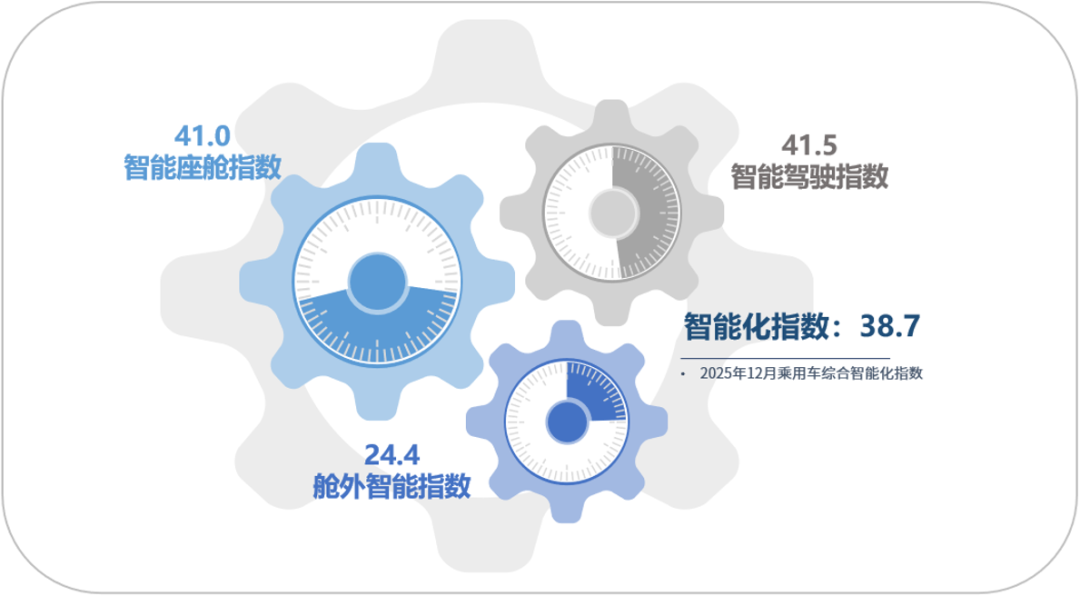
2025年12月乘用车智能化指数为38.7 三大核心分项指数同步刷新年内峰值
Zhi Tong Cai Jing· 2026-01-29 11:19
通过追溯2025年1月起的乘用车智能化指数数据,可以清晰观察12个月以来的乘用车智能化指数走势变化。 2025年12月,智能驾驶指数41.5,环比增长了0.3个单位,创年内新高。 2025年12月,舱外智能指数24.4,环比增长了2.9个单位,创年内新高。 乘联分会联合上海安路勤企业管理咨询有限公司联合发布乘用车智能化指数:2025年12月,乘用车智能化指数为38.7,创年内新高。具体而言,智能座舱 指数达41.0,环比提升1.0个单位,增长幅度显著;智能驾驶指数攀升至41.5,环比上涨0.3个单位,延续稳健增长态势;舱外智能指数为24.4,环比大幅增 长2.9个单位,上行趋势持续凸显。三大核心分项指数同步刷新年内峰值,行业智能化发展动能充沛、势头强劲。 目前,乘用车智能化指数有三个分项指数,分别为智能座舱指数、智能驾驶指数和舱外智能指数。 2025年12月,智能座舱指数41.0,环比增长1个单位,创年内新高。 2025年12月全国乘用车市场零售销量为226.1万辆,同比下降14.0%,环比增长1.6%,其中新能源车市场零售133.7万辆,同比增长2.6%,环比增长1.2%。 ...

乘用车板块1月29日涨0.12%,上汽集团领涨,主力资金净流出7.09亿元
Zheng Xing Xing Ye Ri Bao· 2026-01-29 09:03
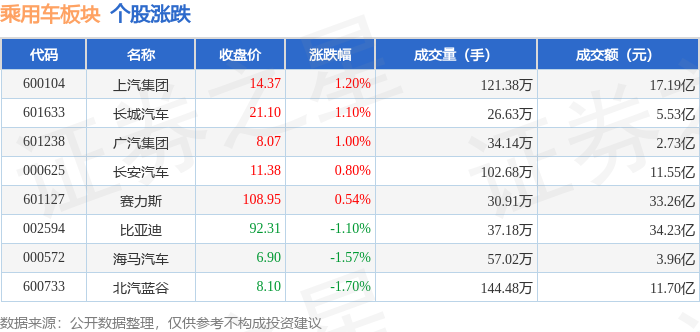
Group 1 - The passenger car sector increased by 0.12% on January 29, with SAIC Motor leading the gains [1] - The Shanghai Composite Index closed at 4157.98, up 0.16%, while the Shenzhen Component Index closed at 14300.08, down 0.3% [1] - Key stocks in the passenger car sector showed varied performance, with SAIC Motor closing at 14.37, up 1.20%, and BYD closing at 92.31, down 1.10% [1] Group 2 - The net outflow of main funds in the passenger car sector was 709 million yuan, while retail investors saw a net inflow of 501 million yuan [1] - Detailed fund flow data indicates that major stocks like GAC Group and Great Wall Motors experienced significant net outflows from main funds [2] - Retail investors showed positive net inflows in several stocks, including GAC Group and Haima Automobile, despite overall sector outflows [2]






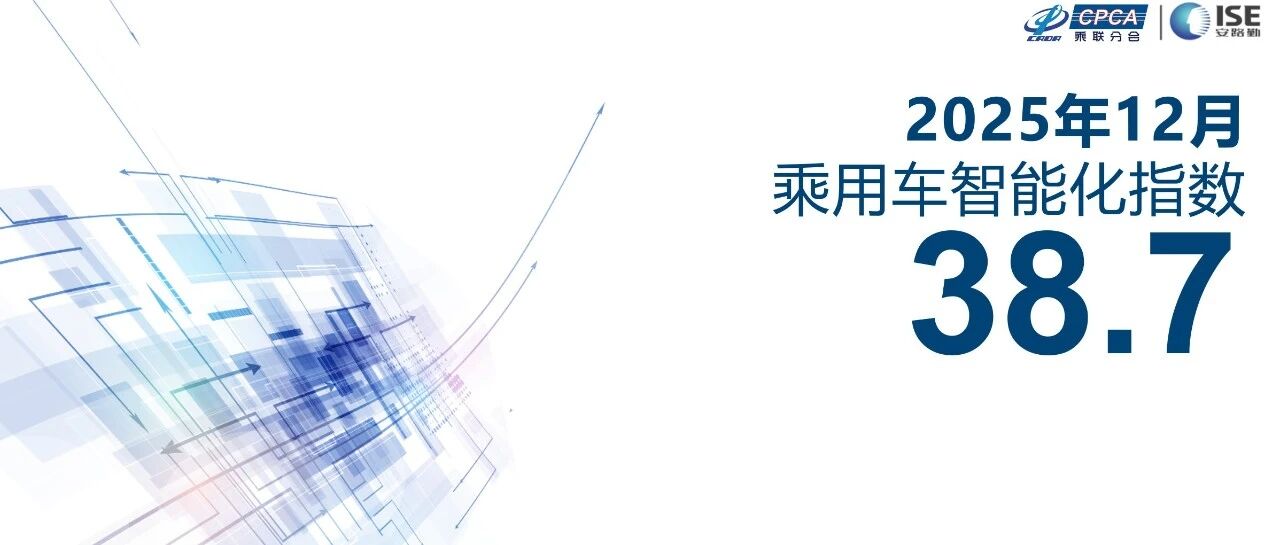
【联合发布】2025年12月乘用车智能化指数为38.7
乘联分会· 2026-01-29 08:51
Core Viewpoint - The article discusses the development of the passenger vehicle intelligence index in China, highlighting the growth trends and performance of various sub-indices related to vehicle intelligence [4][13]. Summary by Sections Passenger Vehicle Intelligence Index Overview - The passenger vehicle intelligence index is designed to monitor the development of intelligence in the domestic passenger vehicle market and predict future trends based on historical data [4]. - As of December 2025, the overall intelligence index reached 38.7, marking a new high for the year, with significant contributions from the sub-indices [13]. Sub-Indices Performance - The smart cockpit index stood at 41.0, reflecting a month-on-month increase of 1.0 units, achieving a new peak for the year [8][13]. - The smart driving index reached 41.5, with a month-on-month growth of 0.3 units, indicating a steady growth trend [10][13]. - The external smart index was recorded at 24.4, showing a substantial month-on-month increase of 2.9 units, highlighting a continuous upward trend [13]. Market Sales Data - In December 2025, the national retail sales of passenger vehicles totaled 2.261 million units, representing a year-on-year decline of 14.0% but a month-on-month increase of 1.6% [13]. - The retail sales of new energy vehicles reached 1.337 million units, showing a year-on-year growth of 2.6% and a month-on-month increase of 1.2% [13]. Index Calculation Methodology - The passenger vehicle intelligence index is calculated using a weighted formula that incorporates the smart cockpit index, smart driving index, and external smart index [15]. - Each sub-index reflects the market performance of vehicles meeting specific intelligence criteria, with the smart cockpit and smart driving being the most influential areas [18][19]. Future Development Goals - The article indicates that as the intelligence of vehicles continues to evolve, the standards for measuring these indices will be adjusted to better reflect market dynamics [13].
策略专题研究:2026年牛市展望系列3:哪些领域反内卷更值得期待?
Guoxin Securities· 2026-01-29 07:58
证券研究报告 | 2026年01月29日 哪些领域"反内卷"更值得期待?——2026 年牛市展望系列 3 策略专题研究 证券分析师:吴信坤 021-61761046 wuxinkun@guosen.com.cn S0980525120001 核心结论:①本次反内卷较 16 年供改背景更复杂,需求端内弱外强,供给 端受制造实力与地方非经济决策驱动。②26 年反内卷仍是经济工作重点,参 考 25 年及 16 年行情经验,反内卷行情或仍有可观上行空间。③政策干预角 度看,关注企业配合度高、地方、落地动力强的行业(如钢铁、油服工程、 水泥等)。④从行业自身周期看,关注供需两旺的景气行业(贵金属、化学 原料等),以及供需格局优化领域(养殖业、能源金属等)。 本轮反内卷背景更复杂,行情节奏相对波折。相较于供改,本轮反内卷再供 需背景上更复杂:需求端看,不同于供给侧结构性改革时期,棚改货币化等 强政策刺激快速拉动总需求,本次内需不足的特征更为突出,但外需支撑或 相对有韧性;供给端看,本次供给扩张与我国制造业实力提升有关,地方政 府"非经济"决策进一步加剧产能过剩。在此背景下,从行业结构看,本轮 呈"涉及面广、新兴行业多、民 ...
汽车和汽车零部件行业周报:特斯拉计划2027年销售机器人 关注机器人板块
Xin Lang Cai Jing· 2026-01-28 10:37
零部件: 1)智能化:推荐智能驾驶-【伯特利、地平线机器人、科博达】,智能座舱-【继峰股份】; 2)新势力产业链:推荐H 链-【星宇股份、沪光股份】;推荐T 链-【拓普集团、新泉股份、双环传 动】;3)出海链:推荐【爱柯迪、中鼎股份】。 机器人:推荐汽配机器人标的【拓普集团、新泉股份、伯特利、银轮股份、均胜电子、沪光股份、豪能 股份、爱柯迪、双环传动、隆盛科技】,汽车机器人主机厂【小鹏汽车】。 摩托车:推荐中大排量龙头车企【春风动力、隆鑫通用】。 轮胎:推荐【赛轮轮胎、森麒麟】。 本周行情:汽车板块本周表现优于市场。汽车板块本周表现优于市场。本周(1 月19 日-1 月25 日)A 股汽车板块上涨2.6%,在申万子行业中排名第14 位,表现优于沪深300(-0.6pct)。细分板块中,汽车 服务、商用载货车、汽车零部件、摩托车及其他、商用载客车分别上涨6.9%、4.8%、4.0%、1.4%、 0.7%,乘用车-1.4%。 本周观点:本月建议关注核心组合【吉利汽车、小鹏汽车、比亚迪、伯特利、拓普集团、新泉股份、春 风动力】。 特斯拉计划2027 年面向公众销售机器人,关注机器人板块。智通财经1 月22 日报道, ...




乘用车板块1月28日跌0.81%,赛力斯领跌,主力资金净流出10.29亿元
Zheng Xing Xing Ye Ri Bao· 2026-01-28 08:58
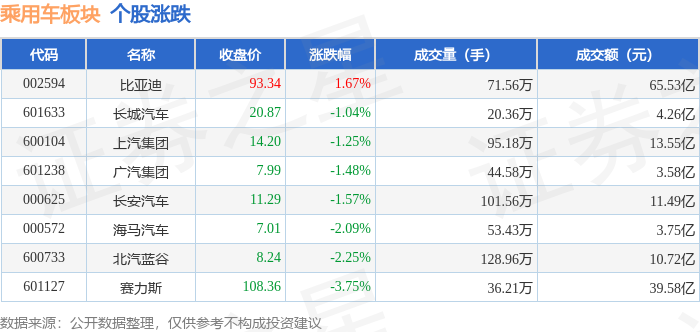
Group 1 - The passenger car sector experienced a decline of 0.81% on January 28, with Seres leading the drop [1] - The Shanghai Composite Index closed at 4151.24, up 0.27%, while the Shenzhen Component Index closed at 14342.9, up 0.09% [1] - BYD's stock price increased by 1.67% to 93.34, while several other major automakers like Great Wall Motors and SAIC Motor saw declines of 1.04% and 1.25% respectively [1] Group 2 - The passenger car sector saw a net outflow of 1.029 billion yuan from institutional investors, while retail investors contributed a net inflow of 762 million yuan [1] - Specific stocks like SAIC Motor and Great Wall Motors experienced significant net outflows from institutional investors, with amounts of -12.24 million yuan and -24.21 million yuan respectively [1] - In contrast, Haima Automobile and BYD saw net inflows from retail investors of 40.35 million yuan and 28.6 million yuan respectively [1]

乘用车板块1月27日跌0.89%,赛力斯领跌,主力资金净流出8.12亿元
Zheng Xing Xing Ye Ri Bao· 2026-01-27 08:49
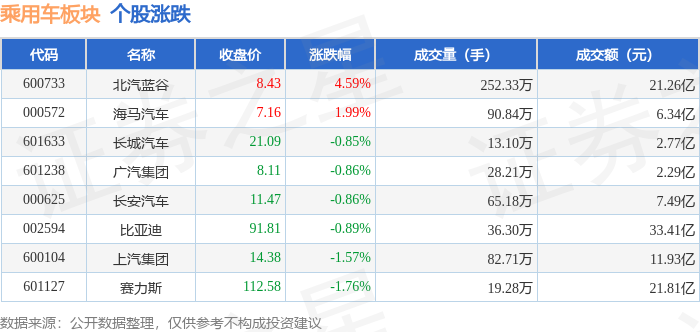
Group 1 - The passenger car sector experienced a decline of 0.89% on January 27, with Seres leading the drop [1] - The Shanghai Composite Index closed at 4139.9, up 0.18%, while the Shenzhen Component Index closed at 14329.91, up 0.09% [1] - Notable stock performances included Beiqi Blue Valley, which rose by 4.59% to a closing price of 8.43, while BYD fell by 0.89% to 91.81 [1] Group 2 - The passenger car sector saw a net outflow of 8.12 billion yuan from main funds, while retail investors contributed a net inflow of 6.36 billion yuan [1] - Beiqi Blue Valley had a main fund net inflow of 220 million yuan, while Great Wall Motors experienced a net outflow of 320.82 thousand yuan [2] - BYD faced a significant main fund net outflow of 5.937 billion yuan, with retail investors contributing a net inflow of 4.33 billion yuan [2]