
炼油

Search documents
石油化工行业周报(2026/2/2—2026/2/8):长丝原料成本支撑稳固,节后刚需补库行情可期-20260209
Shenwan Hongyuan Securities· 2026-02-09 11:17
Investment Rating - The report maintains a positive investment outlook for the polyester sector, particularly recommending high-quality companies in the polyester filament and bottle chip segments [6][13]. Core Insights - The report highlights that the cost support for polyester filament remains solid, with expectations for inventory replenishment post-holiday. The operating rate of polyester filament has significantly decreased, laying a foundation for recovery after the Spring Festival [6][7]. - Polyester filament inventory has been consistently declining since the beginning of 2026, with downstream textile raw material inventory also at low levels, indicating a strong demand for replenishment after the holiday [7][11]. - The price spread of polyester filament has improved significantly, with cost support expected to remain strong due to stable raw material prices and proactive supply adjustments [11][13]. Summary by Sections Supply and Demand Dynamics - The operating rate of polyester filament has dropped to 79.65%, down approximately 16 percentage points from previous highs, as companies conduct maintenance ahead of the holiday [6]. - Downstream textile operating rates have fallen to 25.15%, marking a low for the year, which is expected to lead to a rigid demand for inventory replenishment post-holiday [6][7]. Price Trends - As of February 6, 2026, the price spreads for polyester filament POY, FDY, and DTY are 1375, 1575, and 2475 CNY/ton respectively, indicating a recovery in price spreads since late January 2026 [11]. - The PTA price, a key raw material for polyester filament, remains high, with limited downward pressure expected, providing solid support for filament prices throughout the year [11][13]. Company Recommendations - The report recommends focusing on high-quality companies in the polyester filament sector such as Tongkun Co., Ltd. and in the bottle chip sector like Wankai New Materials. It also suggests monitoring leading refining companies such as Hengli Petrochemical and Rongsheng Petrochemical due to expected improvements in cost structures [13][15].



没官宣,印度炼油商已开始不买…
Guan Cha Zhe Wang· 2026-02-09 08:51
【文/观察者网 张菁娟】美国总统特朗普口中的"承诺",似乎正由印度炼油商用行动验证。 据路透社8日报道,为促成美印贸易协议落地,印度核心炼油企业已暂停采购俄油,而印度政府始终闭 口不提相关计划。 上周五(6日),美国白宫发布声明称,美印已就互惠互利贸易达成临时协议框架。双方希望在3月前敲 定该协议,以降低关税、深化经济合作。 炼油及贸易行业消息人士透露,印度炼油商已调整采购策略,正规避4月交付的俄油订单,且停购态势 或将持续。 一位接触过相关炼油企业的贸易商表示,印度国有炼油企业印度石油公司、巴拉特石油公司及印度最大 的私营炼油商信实工业,均不接受贸易商提供的3月、4月装船的俄油报价。 不过,炼油行业消息人士介绍说,这些炼油商此前已敲定部分3月交付的俄罗斯石油订单,目前其他多 数炼油商已停止采购俄油。 值得一提的是,印度政府未宣布停止进口俄罗斯石油的计划,面对外界关于俄油采购的追问,印度官方 也始终保持模糊态度。 上述三大炼油商及印度石油部均拒绝回应置评请求,印度贸易部长7日则将相关问题转交外交部处理。 印度外交部发言人既未承认也未否认停购俄油的举动,仅称"依据客观市场状况及不断变化的国际局 势,实现能源供应 ...


协议达成,没抗住50%关税,印度停购俄油,特朗普新政生效
Sou Hu Cai Jing· 2026-02-09 07:47
面对这一沉重打击,印度政府的反应显得异常激烈,外交部门强烈抨击这是不公平且不合理的贸易惩罚。然而,面对美国绝对的市场准入权,印度的愤怒显 得有些苍白。美国是印度最大的出口市场之一,尤其是在IT服务、纺织品和仿制药领域,印度的产品高度依赖北美客户。当关税大棒落下,印度政府的选择 变得非常明确:要么放弃俄罗斯的廉价石油,要么失去美国的巨大市场。 在极限施压下,印度企业的反应则更加直接。在2025年11月,信实工业作为印度最大的民营炼油商,也是全球最大的单体炼油厂运营商,最终做出了停止进 口俄罗斯石油的决定。信实为什么做出这一选择?因为它是完全的外向型企业,其精炼产品高度依赖欧美市场。当美国挥出了50%的关税大棒,并威胁要将 制裁范围扩大到具体企业时,信实不得不在廉价原油和生存资格之间做出选择。尽管俄罗斯石油每桶便宜10至15美元,但所带来的差价利润,正被美国的 50%惩罚性关税所吞噬。印度确实可以继续购买俄罗斯石油,但若因此失去进入美国市场的资格,造成的GDP损失将远远超过能源套利所得。与此同时,美 国并未把所有的路都堵死。在加大制裁的同时,华盛顿向印度提供了一个诱人的选择:愿意向印度出售美国能源。这一信号清晰地 ...

芳烃市场有所降温,聚酯产业链价格重心下行 | 投研报告
Sou Hu Cai Jing· 2026-02-09 01:59
【炼油板块】周前期,特朗普计划同伊朗对话,重启核谈判,地缘风险降温,叠加哈萨克斯坦油田及美 国原油产量逐渐恢复,供应压力回升,国际油价大幅下跌。周中期,美国击落一架伊朗无人机,伊朗武 装快艇逼近悬挂美国国旗的油轮,有媒体报道称原定的美伊谈判取消,地缘风险溢价迅速回归,叠加美 印达成贸易协议,有望提振需求,国际油价宽幅反弹。周后期,美国与伊朗同意周五举行核谈判,缓解 了市场对伊朗供应中断的担忧,地缘风险溢价回落,油价有所回落。2026年2月6日布伦特、WTI原油价 格分别为68.05、63.55美元/桶,较2026年1月30日分别-2.64、-1.66美元/桶。成品油方面,本周国内外成 品油价格价差偏震荡运行。 【化工板块】本周成本端支撑有限,化工品价格偏震荡运行,部分产品短期供给影响,价格有所上行。 聚烯烃方面,本周聚烯烃价格价差小幅震荡。EVA价格偏稳运行,价差小幅改善。纯苯产品价格价差小 幅上涨。苯乙烯华东码头本周期内到货有限,产品价格价差继续上涨。丙烯腈场内装置降负与检修情况 延续,局部供应偏紧,产品价格价差继续上行。聚碳酸酯产品价格稳中有涨。MMA产品价格偏稳运 行,价差小幅改善。 【聚酯&锦纶板块】 ...
大炼化周报:芳烃市场有所降温,聚酯产业链价格重心下行-20260208
Xinda Securities· 2026-02-08 08:32
Investment Rating - The report does not explicitly state an investment rating for the petrochemical industry, but it provides insights into price trends and market dynamics that could influence investment decisions. Core Insights - The report highlights a cooling in the aromatics market and a downward shift in the price focus of the polyester industry chain [1] - Brent crude oil's weekly average price was $67.33 per barrel, reflecting a decrease of 0.60% [2] - Domestic and international refining project price differentials have shown slight increases, with domestic projects at ¥2515.90 per ton (+0.37%) and international projects at ¥1104.12 per ton (+0.63%) [3] Refining Sector Summary - The report discusses geopolitical factors affecting oil prices, including U.S.-Iran relations and supply recovery from Kazakhstan and the U.S. [2] - Brent and WTI crude prices as of February 6, 2026, were $68.05 and $63.55 per barrel, respectively, showing declines from the previous week [15] - Domestic refined oil prices showed slight fluctuations, with diesel, gasoline, and aviation kerosene averaging ¥6270.57, ¥7588.29, and ¥5140.28 per ton, respectively [15] Chemical Sector Summary - The chemical sector experienced limited support from cost factors, leading to fluctuating prices for various chemical products [2] - Polyethylene prices showed slight fluctuations, with LDPE, LLDPE, and HDPE averaging ¥9300.00, ¥6885.29, and ¥7600.00 per ton, respectively [54] - The report notes that the price of pure benzene increased slightly, with an average of ¥6150.00 per ton, reflecting a price differential of ¥2727.98 per ton [54] Polyester & Nylon Sector Summary - The polyester industry chain saw a price decline, with upstream costs weakening significantly [2] - The report indicates that the market for polyester filament yarn is experiencing a notable decrease in operating rates, leading to reduced demand [2] - Nylon filament prices have seen slight increases, but the price differential remains narrow [2] Market Performance of Major Refining Companies - The report provides stock performance data for six major refining companies, with notable weekly changes including Hengli Petrochemical (-5.29%) and Hengyi Petrochemical (+3.28%) [2] - Over the past month, stock performance varied significantly, with Rongsheng Petrochemical showing a +25.06% increase [2]
为与美达成贸易协议 印度炼油商回避购买俄罗斯原油
Xin Lang Cai Jing· 2026-02-08 06:10
Core Viewpoint - Indian refiners are avoiding the purchase of Russian oil scheduled for delivery in April and are expected to stay away from Russian oil for a longer period, which may facilitate a trade agreement between India and the United States [1] Group 1: Indian Refiners' Actions - Indian oil companies, including Indian Oil Corporation, Bharat Petroleum, and Reliance Industries, are not accepting offers for Russian oil shipments scheduled for March and April [1]
能源日报-20260206
Guo Tou Qi Huo· 2026-02-06 12:42
Report Industry Investment Ratings - Crude oil: ★★★ (predicted upward trend with a relatively appropriate investment opportunity) [1] - Fuel oil: ★★★ (predicted upward trend with a relatively appropriate investment opportunity) [1] - Low-sulfur fuel oil: ☆☆☆ (short-term long/short trend in a relatively balanced state, poor operability on the current market, advisable to wait and see) [1] - Asphalt: ★☆★ (predicted upward trend, with a driving force for price increase, but poor operability on the market) [1] Core Viewpoints - The geopolitical situation has a significant impact on the energy market, and the oil price is expected to continue to fluctuate sharply [3] - High-sulfur fuel oil is expected to maintain a strong trend due to supply and demand and geopolitical factors, while low-sulfur fuel oil is under pressure [4] - The supply pressure of asphalt is limited, consumption has improved, and the price is expected to continue to strengthen [5] Summary by Related Catalogs Crude Oil - This week, the crude oil market was affected by the alternating tension and relaxation of the US-Iran geopolitical situation, and the oil price maintained a fluctuating trend. The main contract of SC crude oil futures fell slightly by 0.6% (-2.9 yuan/barrel) compared to last Friday [3] - The premium of the near-month contract over the far-month contract has dropped more significantly. The market's concern about the interruption of crude oil supply due to a direct military conflict in the Middle East has temporarily eased [3] - Geopolitical news has a phased and intermittent impact on crude oil prices. The current global oil market inventory accumulation pressure is still significant, and the situation of intensified oil price fluctuations is expected to continue [3] Fuel Oil & Low-Sulfur Fuel Oil - High-sulfur fuel oil: Geopolitics is the current main contradiction. Due to the high uncertainty of future geopolitical evolution and the structural irreplaceability of high-sulfur resources in the Middle East to the Asian market, the price is supported. The spot price difference remains strong, indicating a tight supply and demand pattern, and it is expected to continue the strong trend [4] - Low-sulfur fuel oil: It is facing greater pressure. Overseas refinery device problems persist, and the arrival of arbitrage cargoes from the West will increase marginal supply. With the arrival of the shipping off-season around the Spring Festival, demand support is expected to weaken, and the overall market is under pressure [4] Asphalt - Some local refineries in Shandong have shut down production, and the main refineries in the south have maintained intermittent production. The scheduled production in February has decreased both year-on-year and month-on-month, and the supply pressure is limited [5] - As of the end of January, the cumulative year-on-year increase in the shipment volume of 54 sample enterprises was 4.9%, and the consumption performance has improved year-on-year [5] - A domestic chemical company bid for Canadian Cold Lake crude oil at a discount of $5 per barrel compared to Brent crude oil as a substitute for Venezuelan crude oil. It is expected that refineries will face an increase in the cost of substitute raw materials after the second quarter, and the futures contracts for relevant months have relatively high increases. The asphalt price is expected to continue the strong trend, and the cracking spread is expected to continue to fluctuate upward [5]
油价传导分析44:原油成本上涨 但成品油批零、炼油毛利呈现差异化表现
Sou Hu Cai Jing· 2026-02-06 10:18
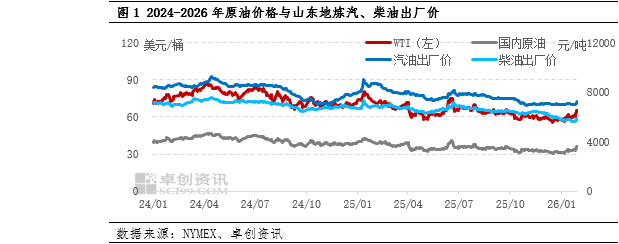
Core Viewpoint - The article discusses the impact of rising crude oil prices on refined oil products, highlighting the differentiated performance of gasoline and diesel margins in January, with expectations for continued divergence in February [1][12]. Group 1: International Oil Price Analysis - In January, the average WTI crude oil price increased by 4.13%, while Brent crude rose by 5.03%, driven by geopolitical tensions and supply disruptions [1]. - The outlook for February suggests a potential decline in crude oil prices, influenced by ongoing geopolitical risks and market sentiment [1][12]. Group 2: Domestic Refined Oil Price Transmission - The fluctuations in crude oil prices directly affect the domestic refining sector, impacting product prices and profit margins [2]. - In January, the gasoline market in Shandong saw a price increase of 290 CNY/ton, while the diesel market experienced a slight increase of 15 CNY/ton, despite overall price declines [4][5]. Group 3: Gasoline and Diesel Margin Analysis - The average gasoline crack spread in Shandong decreased by 16.01% to 716.14 CNY/ton, while the diesel crack spread fell significantly by 61.23% to 275.2 CNY/ton [6][8]. - The theoretical gasoline retail margin decreased by 5.17% to 1833.24 CNY/ton, whereas the diesel retail margin increased by 17.92% to 1655.86 CNY/ton [10][12]. Group 4: Future Outlook - For February, it is anticipated that gasoline margins may improve slightly, while diesel margins are expected to continue their upward trend [12][14]. - The average gasoline price in Shandong is projected to be around 7100 CNY/ton, with a trading range of 7050-7150 CNY/ton, while diesel prices are expected to be around 5650 CNY/ton [12][14].
中国炼化产业向高端化持续提升,成全球市场压舱石
Xin Lang Cai Jing· 2026-02-06 00:10
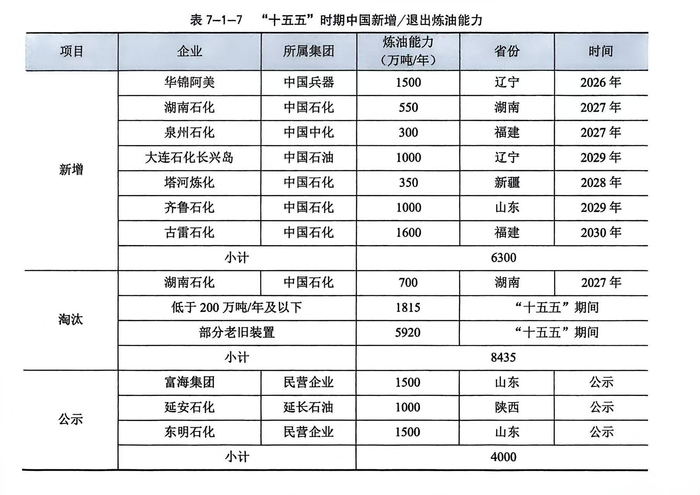
Core Viewpoint - The Chinese refining industry is undergoing significant structural adjustments driven by the "dual carbon" goals and rapid development of the new energy vehicle sector, as highlighted in the "2025 Domestic and International Oil and Gas Industry Development Report" released by the China National Petroleum Corporation Economic and Technological Research Institute [1] Group 1: Industry Structural Changes - The shift towards "oil conversion" and "oil-to-chemical" has become a key direction for structural adjustments in the Chinese refining industry [2] - By 2025, domestic refined oil production is expected to decrease from 433 million tons in 2021 to 414 million tons, a decline of 4.4%, with the refined oil yield dropping from 63% to 56% [2] - Chemical light oil production is projected to increase from 126 million tons to 184 million tons, a growth of 46.7%, with the yield rising to 25.0% [2] - The industry has eliminated or replaced 35.7 million tons/year of outdated capacity, enhancing secondary processing and deep refining capabilities, contributing to significant progress in green, low-carbon, and intelligent transformation [2] Group 2: Capacity and Market Dynamics - By 2025, China's refining capacity is expected to reach 940 million tons/year, maintaining its position as the largest globally, with a net increase of 66.3 million tons/year compared to the end of the 13th Five-Year Plan [3] - The industry concentration has improved, with major players like Sinopec, PetroChina, Sinochem, CNOOC, and private and foreign enterprises forming a competitive landscape, leading to a "four-way division" of the market by 2025 [3] - The average scale of domestic refineries is projected to reach 7.17 million tons/year by 2025, nearing the average level of 7.5 million tons/year in the United States [3] - The share of refining capacity from large-scale refineries (over 10 million tons) is expected to increase to 58.4%, up 5.7 percentage points from 2021 [3] Group 3: Future Outlook - The report anticipates that during the 15th Five-Year Plan period, the refining industry will shift from "scale-driven" to "value creation," with overall refining capacity expected to remain stable despite structural adjustments [5] - By 2030, domestic refining capacity is projected to be around 920 million tons/year, a net decrease of 20 million tons/year compared to the end of 2025 [5] - The industry will focus on "reducing oil while increasing chemicals and specialties," with a comprehensive and in-depth green low-carbon transformation and continuous enhancement of technological innovation capabilities [6]
炼油厂维护和运输延误导致山谷地区液化石油气短缺
Shang Wu Bu Wang Zhan· 2026-02-05 07:46
尼泊尔《加德满都邮报》2月4日报道: 近几周来,加德满都谷地持续面临液化石油气短缺,消费者购买困难。尼泊尔石油公司解释,短缺主因 是印度巴劳尼炼油厂进行维护,导致常规供应减少,尼泊尔被迫转而从更远的帕拉迪普炼油厂采购,运 输时间从三天延长至十天,造成物流延误。尽管该公司声称实际供应缺口并不大,但冬季需求上升及消 费者因恐慌而囤积气瓶的行为加剧了市场紧张,居民生活因此受到直接影响。此次短缺也反映出供应层 面的结构性挑战,尼泊尔石油公司已采取增加进口配额等措施以缓解问题。进口数据显示,本财年上半 年(截至1月中旬),尼泊尔液化石油气进口量为274,805吨,价值270亿卢比,较去年同期下降9%。作 为对比,上一财年全年进口量为554,612吨,价值625.8亿卢比,此次供应中断发生在整体进口量已呈下 降趋势的背景下。 ...