
服务业

Search documents
财政部发布重磅报告!继续实施好提振消费专项行动
Sou Hu Cai Jing· 2025-11-07 09:51
Core Viewpoint - The Ministry of Finance emphasizes the implementation of a more proactive fiscal policy to stimulate domestic demand, enhance consumption, and support economic recovery amid complex external challenges [2][3]. Group 1: Fiscal Policy Implementation - The report highlights the need for a more proactive fiscal policy, focusing on improving budget execution and ensuring effective use of funds [2][3]. - It mentions the allocation of 300 billion yuan in special bonds to support consumption, particularly in key sectors like automotive and home appliances, which has already driven sales of 1.6 trillion yuan [3][12]. - The report outlines the importance of local government special bonds and long-term treasury bonds in enhancing financial cooperation and encouraging private investment [2][3]. Group 2: Economic Growth and Investment - The report indicates that the central government has allocated 398.12 billion yuan for technology funding, marking a 10% increase from the previous year, to support innovation and industrial upgrades [4][20]. - It emphasizes the need for effective investment in infrastructure and key industries, with a focus on modern transportation systems and manufacturing technology upgrades [15][16]. - The issuance of special bonds has accelerated, with 555 billion yuan issued in the first half of the year, representing 42.7% of the annual target [15][16]. Group 3: Employment and Social Welfare - The report states that 667.4 billion yuan has been allocated for employment support, with 6.95 million new urban jobs created in the first half of the year [27][28]. - It highlights the increase in education spending to 2.15 trillion yuan, a 5.9% year-on-year growth, to improve educational resources and quality [29][30]. - The report also mentions the enhancement of basic public health services, with 804.35 billion yuan allocated for public health service subsidies [32][33]. Group 4: Risk Management - The report stresses the importance of risk prevention and management, particularly in addressing hidden debts and ensuring local government financial stability [5][10]. - It outlines measures to curb new hidden debt and emphasizes the need for strict supervision of local government financing platforms [5][10]. Group 5: Environmental and Ecological Initiatives - The report allocates 340 billion yuan for air pollution control and 267 billion yuan for water pollution prevention, aiming to improve environmental quality [38][39]. - It highlights the commitment to carbon neutrality and ecological restoration, with significant funding directed towards these initiatives [40][41].
【环球财经】日经225指数下跌1.19%
Xin Hua Cai Jing· 2025-11-07 07:33
Core Points - The Tokyo stock market experienced a decline on November 7, with the Nikkei 225 index falling by 1.19% and the Tokyo Stock Exchange index decreasing by 0.44% [1][2] - Investor risk aversion increased due to the significant drop in the U.S. stock market, particularly affecting semiconductor-related stocks, which saw major sell-offs by institutional investors [1] - The Nikkei index briefly dropped over 1200 points, falling below the 50000 mark, with a peak decline exceeding 2% [1] Market Performance - The Nikkei index closed down by 607.31 points at 50276.37 points, while the Tokyo Stock Exchange index fell by 14.60 points to 3298.85 points [2] - Among the 33 industry sectors on the Tokyo Stock Exchange, service, marine transportation, and steel sectors showed gains, while non-ferrous metals, electrical products, and machinery sectors led the declines [2]
10月制造业PMI为49.0%,高技术制造业仍处于扩张区间 | 高频看宏观
Sou Hu Cai Jing· 2025-11-07 03:58
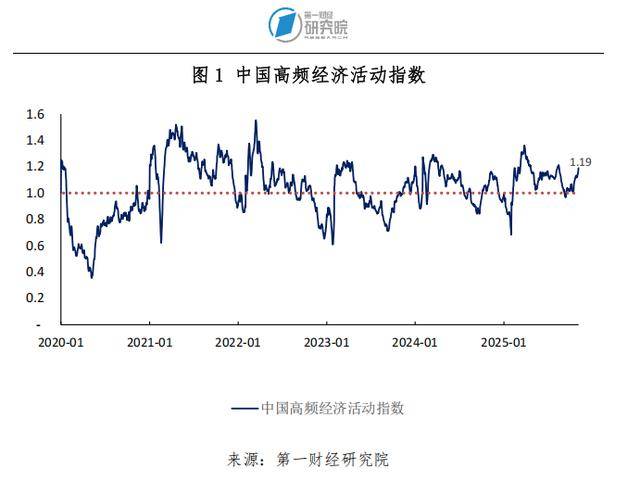
Group 1: Economic Activity Index - The China High-Frequency Economic Activity Index (YHEI) reached 1.19 on November 4, 2025, an increase of 0.07 from October 28 [1][3] - Key contributors to the YHEI increase include the Coastal Coal Freight Index and the Imported Dry Bulk Freight Index, which rose to 1.22 and 1.12, respectively [1][3] - The 30-City Commodity Housing Sales Index fell by 0.06 during the same week [1][3] Group 2: Manufacturing and PMI - The Manufacturing Purchasing Managers' Index (PMI) for October was 49.0%, down 0.8 percentage points from the previous month, indicating a contraction in manufacturing activity [23][24] - High-tech manufacturing, equipment manufacturing, and consumer goods sectors maintained expansion with PMIs of 50.5%, 50.2%, and 50.1%, respectively [23][24] - Large manufacturing enterprises saw a PMI drop to 49.9%, while medium and small enterprises' PMIs decreased to 48.7% and 47.1% [23][24] Group 3: Supply and Demand Indicators - The production index fell to 49.7% in October, influenced by the National Day holiday [24] - New orders and new export orders indices decreased to 48.8% and 45.9%, respectively [24] - The purchasing index dropped to 49.0%, indicating reduced procurement activity amid slowing production [24] Group 4: Non-Manufacturing Sector - The Non-Manufacturing Business Activity Index was 50.1%, slightly up by 0.1 percentage points from the previous month [24] - The construction sector's index fell to 49.1%, while the services sector's index rose to 50.2% [24] Group 5: Monetary Policy and Interest Rates - The central bank's net fund injection was 119.9 billion yuan for the week ending November 4, 2025 [5][6] - The overnight interbank rate decreased by 17 basis points to 1.36%, while the seven-day repo rate fell by 16 basis points to 1.47% [10][11] - One-year and ten-year government bond yields decreased by 3.85 and 1.95 basis points to 1.39% and 1.80%, respectively [10][16] Group 6: Commodity Prices - Steel billet prices decreased by 1.68% over the past week and 6.39% year-on-year [25] - Cement prices increased by 0.12% week-on-week but fell by 22.28% year-on-year [25] - Power coal prices rose by 1.18% month-on-month but decreased by 4.20% year-on-year [25] Group 7: Real Estate Market - New housing transaction areas in first and third-tier cities fell by 20.39% and 26.08%, respectively, while second-tier cities saw a 1.59% increase [35][36] - Second-hand housing transaction areas decreased by 5.24%, 1.75%, and 17.04% in first, second, and third-tier cities, respectively [39] Group 8: Global Economic Indicators - The US Dollar Index rose by 1.49 points to 100.21, while the RMB/USD exchange rate fell by 227 basis points to 7.1233 [45][46] - The Chicago Board Options Exchange VIX Index increased by 2.58 points to 19 [49]

惠城区前三季度GDP达858.71亿元
Nan Fang Du Shi Bao· 2025-11-06 23:14
Economic Overview - The GDP of Huicheng District reached 858.71 billion yuan in the first three quarters, showing a stable growth of 4.0% year-on-year at constant prices [1] - The primary industry added value was 28.60 billion yuan, growing by 2.4%; the secondary industry decreased by 2.1% to 221.57 billion yuan; the tertiary industry increased by 6.7% to 608.55 billion yuan [1] Agricultural Sector - The total output value of agriculture, forestry, animal husbandry, and fishery in Huicheng District was 44.10 billion yuan, with a year-on-year growth of 2.7% [2] - Forestry output value surged by 196.6%, while agricultural output increased by 5.5% [2] - Vegetable production reached 380,700 tons, up 4.5% year-on-year; fruit production increased by 13.4% to 54,500 tons [2] Industrial Performance - The total industrial output value for the first three quarters was 684.36 billion yuan, reflecting a year-on-year growth of 9.1% [3] - In September alone, the industrial output value was 94.44 billion yuan, showing a significant increase of 16.7% year-on-year [3] - Manufacturing sector grew by 10.5%, while mining and electricity sectors saw declines [3] Service Sector Growth - The service sector's added value grew by 6.7%, with notable increases in various sub-sectors [4] - The wholesale and retail sector grew by 11.9%, and the information technology services sector increased by 12.3% [4] - Social retail sales totaled 609.96 billion yuan, with a year-on-year growth of 4.8% [4] Consumer Trends - Retail sales of food and household appliances saw significant growth, with food retail reaching 39.22 billion yuan, up 8.6% [5] - Online retail sales increased by 31.6%, accounting for 32.8% of total retail sales [5] Trade and Investment - The total import and export value reached 302.2 billion yuan, growing by 20.3% [6] - Exports totaled 185.4 billion yuan, with a growth of 19.6% [6] - Fixed asset investment saw a significant decline of 39.6%, with real estate investment dropping by 49.2% [6]

连平:明年经济工作运行的六方面政策建议
和讯· 2025-11-06 09:55
Core Viewpoint - The article discusses the current state of China's economy, highlighting the challenges and structural imbalances in investment, while emphasizing the need for targeted policies to stimulate growth in the face of external uncertainties and insufficient domestic demand [2][3]. Economic Performance - In the first three quarters, China's GDP grew by 5.2% year-on-year, exceeding the target of around 5% set during the "Two Sessions" [3]. - The quarterly growth rates were 5.4%, 5.2%, and 4.8%, indicating a trend of "high at the beginning and stable later" [3]. Industrial Production - The industrial added value for large-scale enterprises increased by 6.2% year-on-year, with a notable recovery in the last quarter [5]. - The capacity utilization rate for large-scale industries rose to 74.6%, with manufacturing at 74.8% [5]. - The equipment manufacturing sector saw a 9.7% increase in added value, contributing significantly to overall industrial growth [5][6]. Consumption Trends - Retail sales of consumer goods increased by 4.5% year-on-year, with a growth rate of 2.4% in the third quarter [6][8]. - New consumption patterns, including digital and green consumption, are on the rise, with significant growth in online retail and new energy vehicles [8]. Export Performance - Exports grew by 6.1% year-on-year in the first three quarters, with a notable 7.84% increase in the third quarter [8]. - The share of exports to the U.S. has decreased from approximately 20.7% during Trump's first term to 10.44% [8]. - Mechanical and high-tech products, such as integrated circuits and automobiles, are driving export growth [9]. Inflation and Price Trends - The Consumer Price Index (CPI) fell by 0.1% year-on-year, with food prices declining by 1.8% [13][14]. - Core CPI, excluding food and energy, has shown a steady increase, reaching 1.0% in September [15]. - The Producer Price Index (PPI) decreased by 2.8% year-on-year, but the rate of decline has narrowed [17]. Investment Challenges - Fixed asset investment decreased by 0.5%, with real estate investment dropping by 13.9% [23][24]. - The decline in foreign investment is significant, with a 12.6% drop in foreign enterprise investment [27]. - Investment in the eastern region is particularly weak, with a 4.5% decline [27]. Policy Recommendations - The article suggests setting a GDP growth target of around 5.0% for the next year, with a CPI target of 2.0% [32][34]. - It recommends maintaining an active fiscal policy with a deficit rate of around 4.2% and increasing government investment in infrastructure and technology [34][35]. - Monetary policy should remain moderately loose, with potential interest rate cuts to stimulate consumption and investment [36].

消费维权指南:五大正规投诉渠道全解析
Xin Lang Cai Jing· 2025-11-06 03:35
Core Viewpoint - The article emphasizes the importance of effective complaint channels and consumer rights protection methods in addressing various consumer disputes and ensuring fair market competition [2][5]. Group 1: Common Consumer Disputes and Necessity of Complaints - Common consumer disputes include issues with electronic products, food quality, and discrepancies in online purchases, which can lead to economic losses and affect quality of life [2]. - Active complaints are essential to restrain unethical business practices and maintain market order [2]. Group 2: Complaint Platforms and Channels - The National 12315 platform serves as a national authority for consumer complaints, providing a structured process for addressing grievances [3][5]. - Industry associations can mediate disputes within specific sectors, such as the China Architectural Decoration Association for home renovation issues [3]. - Media supervision can amplify consumer complaints when traditional channels fail, leveraging local newspapers and TV programs to exert public pressure on businesses [3][4]. - Black Cat Complaint platform is particularly effective for e-commerce, tourism, and finance-related issues, facilitating quick communication between consumers and businesses [3][5]. - Consumer Protection offers a comprehensive service for emerging internet sectors, addressing issues like shared economy and live shopping disputes [3][5]. Group 3: Additional Complaint Avenues - Legal avenues are available for significant disputes, allowing consumers to file lawsuits when necessary, with local lawyer associations providing support [6]. - Consumer rights protection committees can also offer consultation and mediation services [6]. Group 4: Efficient Complaint Handling by Companies - Companies typically have official customer service channels for initial complaint handling, but platforms like Black Cat Complaint are noted for their higher efficiency in resolving issues due to the impact on corporate reputation [7]. - Consumers are encouraged to retain evidence such as receipts and communication records to support their complaints effectively [7].
欧元区经济现分化复苏:服务业PMI持续扩张 PPI疲软凸显通缩压力
Xin Hua Cai Jing· 2025-11-05 16:30
Core Insights - The Eurozone economy shows a clear divergence in early Q4, with significant recovery in business activity but ongoing pressure on industrial prices [1][2] - The composite Purchasing Managers' Index (PMI) for October rose to 52.5, indicating the fastest expansion since May 2023, driven mainly by a surge in service sector activity [1] - The Producer Price Index (PPI) for September declined for the second consecutive month, reflecting persistent deflationary pressures in the industrial sector [1][2] Economic Indicators - The final value of the Eurozone's October composite PMI was 52.5, up from the initial estimate of 52.2 and September's 51.2, signaling a notable acceleration in overall economic activity [1] - Service sector activity accelerated sharply, becoming the primary growth driver, while manufacturing output saw only a slight increase [1] - New business volumes grew at the fastest pace in two and a half years, contributing to a 16-month high in employment growth [1] Price Trends - The Eurozone's PPI for September fell by 0.1% month-on-month, marking the second month of negative growth, and the year-on-year decline was 0.2%, consistent with expectations [1][2] - Energy prices decreased by 0.2% month-on-month, continuing to be a major factor in the PPI decline, following a 1.5% drop in August [1] - Core PPI, excluding energy, remained flat month-on-month, with a year-on-year growth rate of 0.9%, indicating stability in non-energy industrial prices [1] Sector Analysis - Durable consumer goods prices increased by 0.3% month-on-month and 1.6% year-on-year, while non-durable consumer goods prices saw a slight rise of 0.1% [2] - Intermediate goods prices fell by 0.1% month-on-month, and capital goods prices remained stable, with a year-on-year increase of 1.8% [2] - The current economic structure in the Eurozone is characterized by strong service sector performance and weak manufacturing, with stable consumer demand but cautious investment in industrial sectors [2]
商品消费向服务消费变迁的国际经验
Guohai Securities· 2025-11-05 11:35
Economic Transition - The shift from goods consumption to service consumption is a historical trend observed across economies, driven by economic development, demographic changes, and policy transformations[5] - In Japan, service consumption surpassed goods consumption in 1993, with service spending in 2024 projected to be 1.4 times that of goods consumption[7] - In the U.S., service consumption reached 68.5% of total consumption by 2024, reflecting a significant transition from goods to services[9] Economic Growth and GDP - Service consumption has become a key driver of economic growth, with its share of GDP in the U.S. increasing from 21.4% in 1944 to 46.5% in 2024, a rise of 25.1 percentage points[11] - In China, service consumption accounted for 46.1% of total consumption in 2024, indicating substantial growth potential[10] - The transition to service consumption is closely linked to GDP per capita surpassing $10,000, marking a shift from survival to development-oriented consumption[10] Employment Impact - The growth of service consumption has led to significant job creation, particularly in labor-intensive sectors such as education, healthcare, and entertainment[12] - In Japan, service sector employment increased from 10.55 million in 1981 to 17.64 million in 2001, a growth of 67.2%[59] - In the U.S., service sector employment rose from 15.39 million in 1939 to 113.71 million in 2024, an increase of 639%[62] Future Development Areas - Key growth areas for service consumption include healthcare and entertainment in Japan, driven by aging demographics and changing consumer preferences[15] - In the U.S., sectors such as internet services, healthcare, and luxury services are expected to see significant growth due to demographic shifts and increased demand for quality experiences[14] - China's healthcare sector is projected to expand significantly, alongside a shift towards experience-oriented consumption[15]
英国制造业与服务业形成罕见“双轮复苏”格局
Xin Hua Cai Jing· 2025-11-05 10:12
Core Insights - The UK services PMI for October recorded at 52.3, significantly above the market expectation of 51.1, and up from 50.8 in September, indicating a return to expansion in the services sector [1] - The composite PMI rose to 52.2, also exceeding the expected 51.1, marking the strongest performance since November 2024 [1] - There is a rare "dual recovery" pattern as both manufacturing and services show improvement [1] Economic Outlook - Business expectations for the next year have reached the highest level since October 2024, driven by an increase in domestic orders and a notable improvement in business confidence [1] - The employment market shows signs of stabilization, with a significant slowdown in layoffs in the services sector and easing labor market tightness [1] Cost and Pricing Dynamics - Wage growth remains a primary source of pressure, but overall input cost inflation has dropped to the lowest level since November 2024 [1] - Companies' pricing power has weakened, with output price increases hitting a six-month low, indicating a further easing of inflationary pressures [1] Fiscal Policy Impact - Some corporate decisions are constrained by uncertainties surrounding fiscal policy, with several companies postponing major spending plans ahead of the UK budget announcement on November 26 [1] Economic Balance - The latest data strengthens the possibility of a "soft landing" for the UK economy, but there remains a need for careful balancing between inflation risks and growth pressures, with the monetary policy path still unclear [1]
西班牙经济动能全面增强 服务业与制造业同步扩张
Xin Hua Cai Jing· 2025-11-05 10:12
Core Insights - Spain's private sector activity accelerated significantly in October, with the composite Purchasing Managers' Index (PMI) rising from 53.8 in September to 56.0, marking the fastest expansion since December 2024 and the highest level since 2025 [1] Group 1: PMI and Sector Performance - The services PMI surged from 54.3 to 56.6, exceeding market expectations of 54.8, and has remained above the neutral line for 26 consecutive months, recording the strongest growth in ten months [1] - The manufacturing PMI also improved, rising to 52.1, contributing to the overall expansion of the private sector [1] Group 2: Drivers of Growth - The acceleration in business activity was primarily driven by an increase in new orders, with companies enhancing marketing efforts, executing existing contracts, and acquiring new business, leading to a notable rise in output [1] - Companies expanded hiring at the fastest pace in three months due to increased workloads and ongoing capacity pressures, continuing a growth trend in employment that has lasted over three years [1] Group 3: Price and Confidence Trends - Input cost inflation pressures eased, dropping to a three-month low, while output prices showed stronger increases, indicating enhanced pricing power for businesses [1] - Business confidence also improved, with the services business confidence index reaching its highest level since March, and the composite business confidence index hitting a nine-month high, slightly above the long-term average [1]