农产品

Search documents
农林牧渔行业周报(20260126-20260130):生猪价格转弱,节后供应压力仍存-20260203
Hua Yuan Zheng Quan· 2026-02-03 13:11
Investment Rating - The industry investment rating is "Positive" (maintained) [1] Core Viewpoints - The pig price is weakening, and supply pressure remains after the festival, with the current industry breeding profit turning positive and the sentiment for replenishment continuing to recover [2][12] - The industry policy is undergoing a profound transformation, focusing on protecting farmers' rights and activating enterprise innovation, which may lead to a better performance of growth stocks in the future [3][12] - The high-quality development of the industry is imperative, with cost-leading and farmer-linked enterprises likely to enjoy excess profits and valuation premiums [3][13] Summary by Sections 1. Swine Industry - The swine breeding sector has seen a slight increase of 0.2%, gradually digesting concerns about slow capacity reduction [2][12] - The average weight of pigs for slaughter has decreased from high levels, with prices adjusting weakly to 12.31 CNY/kg [2][12] - The price of 7 kg piglets has risen to 367 CNY, indicating a weak expectation for capacity reduction [2][12] - The policy shift towards protecting farmers' rights and promoting innovation is expected to positively influence pig prices and profitability in 2026 [3][12] 2. Poultry Industry - The poultry sector is experiencing a contradiction of "high capacity, weak consumption," with the price of broiler chickens at 3.7 CNY/kg, down 3.4% week-on-week [4][13] - The impact of avian influenza in France may lead to a reduction in imported breeding chickens, potentially increasing prices for parent stock [4][13] - Integrated enterprises and contract farming are expected to expand market share in 2026 [4][14] 3. Feed Industry - The prices of various aquatic products have rebounded, with significant year-on-year increases for some species [5][15] - Hai Da Group is recommended due to its clear long-term growth path and plans to increase its dividend payout ratio [6][15][16] - The company aims for a global sales target of 100 million tons by 2050, with ongoing overseas market expansion [6][16] 4. Pet Industry - The pet industry is facing pressure with concerns over Q4 2025 performance, but there are signs of recovery in domestic sales [7][17] - Companies like Zhongchong and Peidi are recommended for their strong domestic sales growth potential [7][17] 5. Agricultural Products - Domestic soybean meal prices have increased slightly, supported by weather disturbances and procurement demand [8][18] - Corn prices have shown fluctuations, with a slight decrease due to reduced channel stocking [8][18] - The price of eggs has decreased, indicating a potential peak in trade inventory [8][18]




豆粕期货月报-20260203
An Liang Qi Huo· 2026-02-03 13:07
1. Report's Industry Investment Rating - Not provided in the content 2. Core Viewpoints of the Report - The current soybean meal market is in a game between "strong expectations" and "weak realities." The trading logic of the external market revolves around the performance of US soybean exports and the supply pressure from South America. Short - term price premiums caused by weather disturbances in South America lead to market fluctuations. In the medium to long term, attention should be paid to changes in Sino - US trade policies and the implementation of biodiesel policies. However, the overall tone of loose global supply still suppresses the global soybean price center, with limited upside potential for prices. In China, supply is expected to be tight in the first quarter, but the pattern of strong supply and weak demand will remain after the arrival of new South American soybeans. Currently, downstream buyers are building positions in far - month contracts due to suitable soybean meal prices, resulting in high trading volumes in far - month contracts. However, spot trading volumes have not increased significantly during the Spring Festival stocking period, falling short of market expectations. The price center of soybean meal is oscillating downward, and cautious operation is recommended. [5] 3. Summary by Relevant Catalogs Cost End - **US Soybeans**: In January, China completed the procurement plan of 12 million tons of US soybeans ahead of schedule, which was mainly a policy - based purchase by COFCO and Sinograin. The market doubts the subsequent sales of US soybean orders. As of the week ending January 22, the net sales volume of US soybeans in the 2025/26 season was 819,000 tons, a 67% decrease from the previous week, a 50% decrease from the four - week average, and the lowest in 10 weeks. With the upcoming listing of South American soybeans, which are more price - attractive to Chinese buyers, there is little motivation for Chinese buyers to continue purchasing US soybeans. The implementation of the US biodiesel policy has become the focus of the market. In January, the CBOT soybean price first declined and then rebounded. Although strong NOPA crushing data and South American weather issues provided short - term support, the overall loose global supply situation still restricts the price upside. [6] - **Brazil**: Brazil's soybean harvest was initially delayed due to rainfall, but analysts still expect a bumper harvest. ABIOVE predicts Brazil's soybean output to be 177.124 million tons, higher than last year's 171.481 million tons. CONAB estimates the 2025/26 season output to reach a record 176.124 million tons, a 2.7% year - on - year increase. As of January 30, the soybean price at the Paranagua port decreased. The bumper harvest in Brazil lays the foundation for a loose global soybean supply pattern in the 2025/26 season, and short - term weather disturbances will only cause market fluctuations. [7] Profit - Supported by costs and the boost in terminal demand during the Spring Festival stocking period, the oil mill's crushing profit has strengthened. [11] Supply End - **Arrival Quantity**: In the first quarter, due to the switch of the export windows of US and Brazilian soybeans, the quantity of imported soybeans will seasonally decline. The estimated arrival quantities in January, February, and March are about 7.72 million tons, 5.005 million tons, and 4.8 million tons respectively. In 2025, the total annual import of soybeans was 111.833 million tons, a 6.46% year - on - year increase. [12] - **Crushing and Operating Rate**: In January 2026, the domestic soybean crushing volume was 9.3672 million tons, a 2.76% month - on - month decrease, and the comprehensive operating rate was 57.71%, a 2.73% month - on - month decrease. Due to the decline in soybean arrivals in the first quarter, the operating rate and crushing volume of oil mills may decrease, and soybean meal may experience a short - term supply shortage. [12][13] Demand End - In January, the trading volume of soybean meal increased significantly, with far - month basis contracts dominating. Downstream enterprises mainly built positions for contracts from May - July and August - September to avoid price risks and prepare raw material inventories for the second half of the year. Spot trading was average, with an increase but less than that of far - month contracts. The Spring Festival stocking was lackluster. After the Spring Festival, the resumption of work by downstream enterprises may slightly boost spot trading. By January 30, the total monthly trading volume was 7.4655 million tons, a 10.23% increase from the previous month and a 141.01% year - on - year increase. Spot trading volume was 1.6767 million tons, and far - month basis trading volume was 5.7888 million tons. The monthly domestic major oil mill's soybean meal pick - up volume was 3.6946 million tons, a 13.32% month - on - month decrease but a 19.87% year - on - year increase. [18] Inventory - The significant increase in soybean meal trading volume in January led to a seasonal decrease in inventory. After the Spring Festival, the de - stocking speed may accelerate. As of January, the soybean meal inventory decreased to 947,000 tons, a 4.43% month - on - month increase, and the contract volume decreased to 4.4214 million tons, an 11.46% month - on - month decrease. As of January 31, the domestic feed enterprises' soybean meal inventory days were 11.33 days, a 19.8% increase from the end of last month and a 3.9% increase from the same period last year. [20]
黑龙江:“农业+文化+旅游” 桦川星火村解锁旅游新玩法
Xin Hua She· 2026-02-03 12:19
Core Insights - The tourism boom in Xinghuo Village, Heilongjiang Province, has transformed the local economy, with significant increases in visitor numbers and local business revenues [1][2] - The integration of agriculture, culture, and tourism has led to a shift from traditional farming to customized agricultural practices, enhancing local income [2] Group 1: Tourism Development - Xinghuo Village, previously a typical agricultural village, has developed into a tourist destination with over 110 million visitors since the establishment of the Xinghuo Rice Tourism Scenic Area in 2025 [1] - The scenic area features over 10 attractions, including the Xinghuo Supply and Marketing Cooperative and rice paddy art, which have significantly increased local tourism activity [1] - Local businesses, such as the "Liuhua Sister Restaurant," have seen daily revenues exceeding 16,000 yuan, reflecting a multiple increase compared to previous earnings [1] Group 2: Economic Impact - The tourism boom has attracted external investments, leading to the establishment of new winter tourism projects, such as the Xinghuo Snow World, which generated over 120,000 yuan in revenue during the New Year holiday [2] - The integration of local agricultural products into the tourism sector has resulted in increased sales of items like rice and chili sauce, showcasing the successful fusion of agriculture and tourism [2] - The county has achieved a total tourism revenue of 136 million yuan, contributing to a comprehensive income of 316 million yuan across the entire industry chain [2]
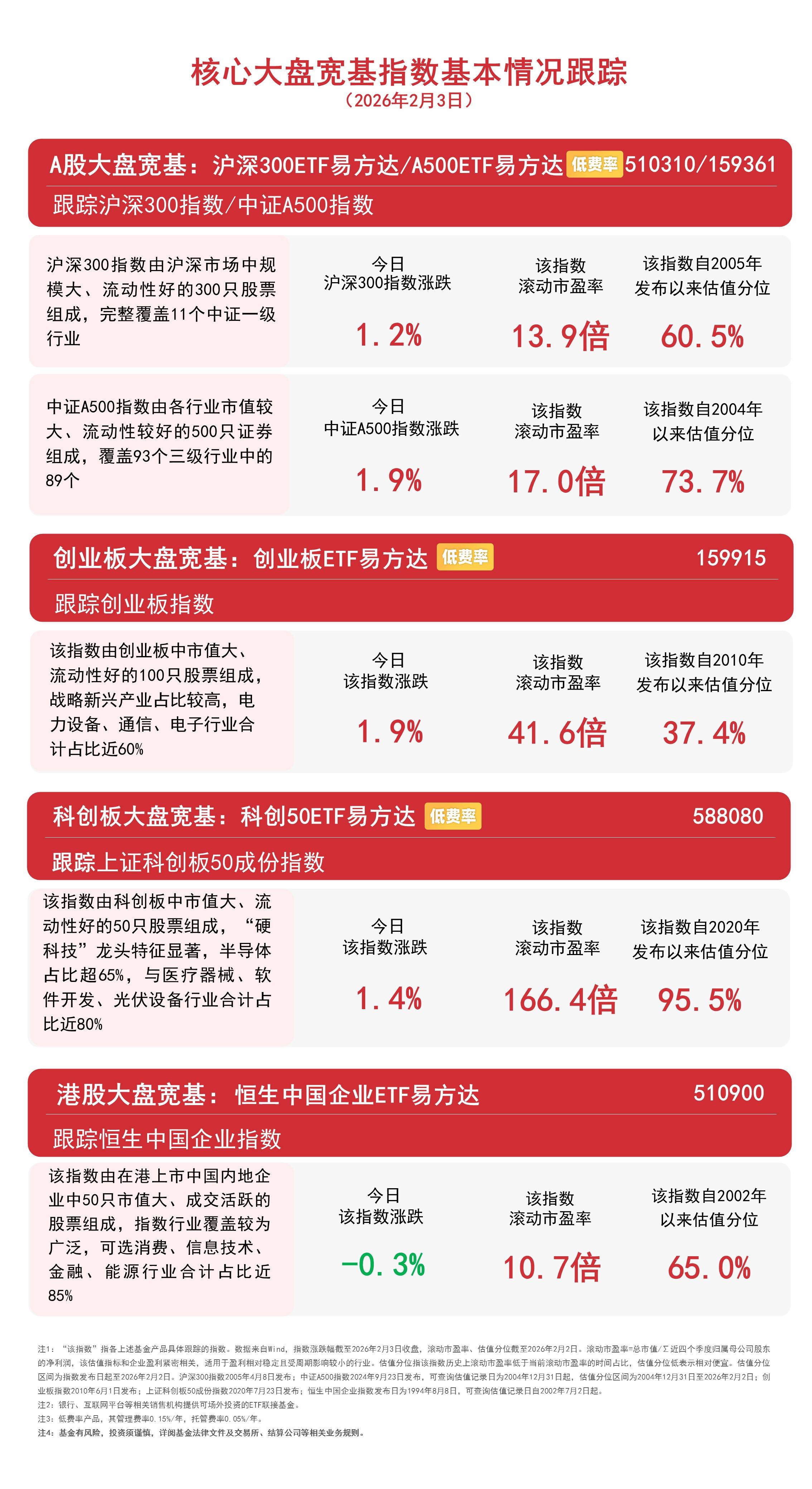
全市场超4800只个股上涨,A500ETF易方达(159361)、沪深300ETF易方达(510310)助力一键布局核心资产
Sou Hu Cai Jing· 2026-02-03 11:17
Group 1 - The A-share market experienced a collective rebound on February 3, with over 4,800 stocks rising across the market [1] - Key sectors that performed well included photovoltaic equipment, CPO, commercial aerospace, engineering machinery, rare earth permanent magnets, cloud gaming, storage chips, cultivated diamonds, and epoxy propylene [1] - The CSI A500 index rose by 1.9%, the CSI 300 index increased by 1.2%, the ChiNext index gained 1.9%, and the STAR Market 50 index went up by 1.4%, while the Hang Seng China Enterprises Index fell by 0.3% [1] Group 2 - The ChiNext ETF tracks the ChiNext index, which consists of 100 stocks with high market capitalization and liquidity, with a significant proportion in strategic emerging industries, particularly in the power equipment, communication, and electronics sectors, which together account for nearly 60% [3] - The STAR 50 ETF tracks the STAR Market 50 index, composed of 50 stocks with high market capitalization and liquidity, prominently featuring "hard technology" leaders, with semiconductors making up over 65% and combined with medical devices and software development, accounting for 80% [5]

警惕短期波动加剧,长期向好势头未变
Datong Securities· 2026-02-03 11:01
Group 1 - The core viewpoint indicates that the equity market and commodity market experienced a surge followed by a decline, with significant emotional amplification observed. The resource sector became the main focus of the market, leading to increased trading volume, but a subsequent profit-taking wave caused a sharp drop in precious and base metals, impacting the equity market as well [1][8][11] - The report highlights that the A-share market is experiencing increased volatility, with resource sectors like non-ferrous metals and gold taking over as the short-term market leaders. However, the market is cautioned against high-level risks due to the lack of performance support in low-performing sectors like liquor and real estate [2][12][11] - The report suggests a "barbell strategy" for asset allocation, recommending a focus on sectors that have undergone sufficient corrections, such as innovative pharmaceuticals and communications for the offensive side, while defensive opportunities may be found in dividend-paying sectors like banks [4][13] Group 2 - The bond market is showing signs of recovery, driven by expectations of increased liquidity and a shift of funds seeking safety from the equity market's volatility. This trend is expected to continue in the short term, although long-term challenges remain due to competition for capital from the commodity and equity markets [5][36] - The commodity market is under pressure after a period of rapid growth, with significant corrections observed in precious metals and other commodities. The report warns of potential volatility in the short term but notes that long-term demand for gold and industrial metals remains strong due to technological advancements [6][45][44] - The report emphasizes the importance of monitoring the dual innovation narrative in the equity market, as it is expected to drive future growth amid ongoing liquidity support and a global easing cycle [12][11][13]
“广货行天下 湛品进星城”在长沙举行
Nan Fang Ri Bao Wang Luo Ban· 2026-02-03 08:16
Group 1 - The event "Guanghuo Xing Tianxia Zhanpin Jin Xingcheng" was held in Changsha to promote Zhanjiang's特色产品 and cultural tourism, aiming to enhance regional consumer market prosperity through various interactive formats [1][2] - Zhanjiang's agricultural and marine products brand "Zhanpin" has been recognized for its quality, making it to the "2025 China Regional Agricultural Image Brand Influence Index" top 100 list, showcasing the city's commitment to high standards and quality control [2] - The event facilitated a significant sales contract worth 1.1 billion yuan, marking a crucial step for "Zhanpin" to enter the Changsha market and expand cooperation between the two regions [2] Group 2 - Zhanjiang is actively inviting tourists from Hunan to celebrate the 2026 Spring Festival with a series of cultural, tourism, and sports activities, enhancing community welfare and market vitality [3] - The event featured cultural performances that highlighted the unique charm of both Zhanjiang and Changsha, including traditional lion dances and folk songs, fostering cultural exchange [3] - Culinary demonstrations by chefs from both regions showcased the fusion of Zhanjiang seafood and Hunan cuisine, presenting innovative dishes that reflect the potential of culinary collaboration [3]
日本农产品出口连创13年新高,对中国大陆增7%
日经中文网· 2026-02-03 07:08
Core Viewpoint - Japan's agricultural and fishery exports are experiencing significant growth, driven by products like green tea, beef, and yellowtail, although the 2025 export target of 2 trillion yen has not been met [2][4]. Group 1: Export Growth - Agricultural exports increased by 12.1% to 1.1008 trillion yen, with fishery products growing by 17.2% to 423.1 billion yen [4]. - The top ten export markets all saw year-on-year growth, with the United States leading at a 13.7% increase, reaching 276.2 billion yen [4]. - Green tea exports surged by 98.2% to 72.1 billion yen, driven by rising demand in Europe and ASEAN countries [7]. Group 2: Specific Product Performance - Green tea, scallops, and beef are notable growth categories, with green tea increasing by 357 million yen due to heightened interest in Japanese food [8]. - Scallop exports rose by 211 million yen, primarily due to increased processing exports to Vietnam [8]. - Yellowtail exports grew by 27.4% to 52.8 billion yen, benefiting from its popularity as sushi material in various regions [7]. Group 3: Challenges and Future Goals - December saw a 2.2% decline in exports, attributed to changes in demand patterns due to the timing of the Chinese New Year [7]. - Japan's government aims to increase agricultural and fishery exports to 5 trillion yen by 2030, acknowledging the need for better marketing and diversification of export markets [9].

AmSpec:马来西亚1月1日-31日棕榈油出口量为1375718吨
Xin Hua Cai Jing· 2026-02-03 06:36
Core Viewpoint - Malaysia's palm oil exports increased by 14.89% in January 2023 compared to the previous month, indicating a positive trend in the palm oil industry [1] Group 1: Export Data - The export volume of palm oil from Malaysia for the period of January 1 to January 31, 2023, was 1,375,718 tons [1] - This figure represents an increase from the 1,197,434 tons exported in the same period of the previous month [1]
既有浓浓年味又有醇厚文化味 “花样”特色年货集市激活城乡消费活力
Yang Shi Wang· 2026-02-03 05:07
Group 1 - The upcoming Spring Festival has led to vibrant local markets, such as the annual New Year goods festival in Loufan County, which features a variety of traditional products and festive performances [1][3] - The Loufan County New Year goods festival includes 46 stalls offering local agricultural products, candies, nuts, and New Year decorations, providing a one-stop shopping experience for the community [3] - In Ningxia, local markets are bustling with activity as residents select New Year goods, contributing to a strong festive atmosphere [5] Group 2 - The Fengdeng Market has evolved into a comprehensive marketplace combining shopping and food, attracting over 10,000 visitors during peak times [7] - Fresh vegetables and free-range eggs from local farmers are popular among customers, stimulating urban and rural consumption [9] - In urban areas, the Huimin New Year goods market provides a convenient and affordable shopping platform for residents, offering essential items like grains, nuts, and condiments [11] Group 3 - In Sichuan's Pengzhou, the largest fruit and vegetable distribution center in Southwest China is meeting local and regional demand, with significant transactions occurring as the Spring Festival approaches [13] - It is projected that around 60,000 tons of imported fruits and 200,000 tons of leafy vegetables will be traded in the month leading up to the 2026 Spring Festival [15] - Sales of vegetables are primarily driven by a production-to-sales model, with merchants adjusting supply based on demand, and price stability is expected barring extreme weather [16] Group 4 - The Turpan New Year goods market has launched with various activities, allowing residents to enjoy a one-stop shopping experience while immersing themselves in festive traditions [17] - The market in Tokkuz County features over 150 vendors and includes interactive activities like paper-cutting and calligraphy, enhancing the festive experience for visitors [19] - The market in Shanshan County boasts over 300 stalls, with local specialties such as wine and large melons being particularly popular [21]
中美北京谈判在即,特朗普掀桌失败,美国大豆中国说不买就不买了
Sou Hu Cai Jing· 2026-02-03 04:50
Group 1 - The trade of soybeans between China and the U.S. is facing significant uncertainty, with Chinese importers signing contracts for at least 25 shipments of Brazilian soybeans for delivery in March and April, coinciding with Trump's planned visit to China [1] - Brazilian soybeans are cheaper and more abundant than U.S. soybeans, leading to a shift in Chinese purchasing behavior, as they have recently stopped buying U.S. soybeans in favor of Brazilian options [3] - The U.S. is experiencing severe weather conditions that have increased logistics costs for transporting soybeans, while Brazil is expected to achieve record soybean production due to favorable weather [3] Group 2 - The U.S. Treasury Secretary praised China's commitment to fulfilling soybean and rare earth supply agreements, but later indicated potential tariffs on China if trade agreements exceed previously announced terms [3] - China's recent support for Cuba, including the donation of rice and solar power equipment, may become a bargaining chip in future negotiations with the U.S. regarding soybean orders [5] - The cost difference between Brazilian and U.S. soybeans is becoming more pronounced, with Brazilian soybeans facing a 3% tariff compared to a 13% tariff on U.S. soybeans, further complicating U.S. market competitiveness [3]