
石化

Search documents
湖北亮出“十五五”支点建设新蓝图
Di Yi Cai Jing· 2025-11-23 05:32
Core Viewpoint - The overall goal of Hubei's 14th Five-Year Plan is to accelerate the construction of a significant strategic support point for the rise of the central region, achieving decisive progress [1][3]. Group 1: Strategic Development Goals - Hubei is in a period of strategic elevation, high-quality development transformation, and comprehensive advantage restructuring, aiming for decisive progress in becoming a strategic support point by 2030 and full establishment by 2035 [3]. - The plan emphasizes a continuous strategy with a focus on "one year to open a new situation, five years for significant changes, and ten years for fruitful results" [3]. Group 2: Key Tasks and Initiatives - Hubei will implement 12 key tasks over the next five years, including the construction of a modern industrial system that reflects Hubei's advantages and the strengthening of the real economy [4]. - The province aims to rejuvenate traditional industries and promote the development of smart and connected vehicles, smartphones, and autonomous computing industries [4]. - Hubei plans to enhance original innovation capabilities and establish a high-level laboratory system, aiming to build a nationally influential technology innovation center in Wuhan [5]. Group 3: Economic and Consumption Growth - The plan includes accelerating consumption expansion and enhancing quality supply, focusing on upgrading major consumer goods like automobiles and housing [5]. - Hubei will foster a world-class business district and promote a deep integration of commerce, tourism, culture, and sports to create quality consumption clusters [5]. Group 4: Regional Coordination and Urban Development - Hubei's new positioning in the national plan requires higher demands for regional coordinated development, with Wuhan's economy surpassing 2 trillion yuan and leading the central provincial cities [6]. - The plan supports the development of regional centers in Xiangyang and Yichang, promoting collaboration among these cities to enhance economic integration and competitiveness [7]. - Hubei will also focus on urbanization through county-level development, fostering county-level industries and enhancing the competitiveness of top counties [7].


全省经济社会发展专题会(西片区)在泰安召开
Da Zhong Ri Bao· 2025-11-23 01:02
Group 1 - The meeting focused on the economic and social development of the western region of Shandong province, emphasizing the importance of achieving annual economic goals and ensuring a strong start for the first quarter of the next year [2][3] - Key industries such as petrochemicals, steel, electrolytic aluminum, automotive, and textiles are prioritized for stabilizing production and improving efficiency [3] - The meeting highlighted the need for effective investment, consumer spending, and foreign trade stability, along with the implementation of supportive policies for enterprises [3] Group 2 - The meeting included discussions on the progress of major projects in the region, with a focus on optimizing traditional industries and fostering new emerging industries [4] - Participants expressed commitment to ensuring that project construction aligns with industry development directions and has strong market prospects [4]
第三批优先控制化学品名录酝酿,涉石化塑料橡胶等领域
Di Yi Cai Jing· 2025-11-22 03:26
Core Insights - The Ministry of Ecology and Environment has initiated the process to include another batch of chemical substances in the priority control list to enhance the management of new pollutants and ensure ecological safety and public health [1][2] Group 1: Priority Control Chemical List - The third batch of the priority control chemical list includes 24 types of chemical substances, primarily affecting industries such as petrochemicals, plastics, rubber, pharmaceuticals, textiles, dyes, coatings, pesticides, leather, and electroplating [1] - The previous two batches of the priority control chemical list included a total of 40 types of chemical substances, which encompass hazardous materials like short-chain chlorinated paraffins, formaldehyde, mercury and its compounds, hexavalent chromium compounds, lead compounds, and various carcinogens [1][2] Group 2: Environmental Risk Management - The "New Pollutant Management Action Plan" aims to complete environmental risk screening and assessment for high-concern and high-usage chemical substances by 2025, and to establish a regulatory framework for managing toxic and harmful chemical substances [2][5] - The priority control chemical list focuses on substances that pose significant environmental and health risks, considering factors such as persistence, bioaccumulation, and toxicity to aquatic environments [2][3] Group 3: Implementation and Compliance - Companies are required to provide detailed information on the production and usage of chemicals listed in the priority control list, including quantities, types, and applications, as part of their environmental impact assessments [4] - Facilities involved in the production or storage of priority control chemicals must implement measures to prevent soil and groundwater contamination, including the installation of monitoring devices [4]
供增需减,PTA上行乏力
Qi Huo Ri Bao· 2025-11-21 23:55
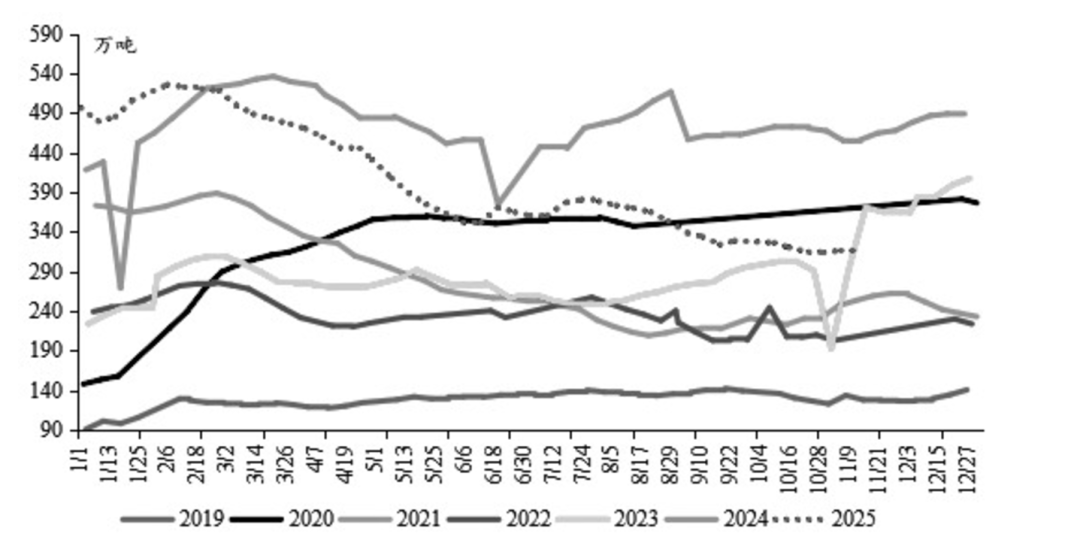
Core Viewpoint - PTA is currently supported by cost factors, with market focus on the execution of maintenance schedules and the recovery of export orders. The polyester futures prices are expected to remain supported due to cost boosts, domestic "anti-involution" policies, and improved export expectations from India [1] Group 1: Cost Support - The oil supply surplus is expected to be strong from Q4 to Q1 next year, leading to a weak and fluctuating international oil price. The low PTA processing fee results in a mild transmission of oil price changes to downstream industries [2] - The domestic PX operating rate has slightly decreased to 86.8%, down 3 percentage points week-on-week, while the Asian PX operating rate is at 78.5%, down 1.7 percentage points. This decline in operating rates is due to maintenance activities, leading to tight PX spot market supply [4] Group 2: Inventory Pressure - The total PTA production capacity is projected to reach 91.715 million tons by the end of 2025, with a capacity growth rate of 9.5%. Recent new capacities have led to a relatively loose spot liquidity [5] - PTA social inventory is approximately 3.1561 million tons, showing a slight accumulation. The inventory structure is reasonable, with polyester factories maintaining raw material stock for 13-14 days. The overall inventory level is lower than the same period in the past two years [5] Group 3: Market Dynamics - The PTA industry operating rate has adjusted to 75.7%, while the polyester industry operating rate is at 90.5%. The overall supply-demand dynamics for PTA remain stable [7] - The polyester industry is expected to exceed 90 million tons in total production by 2025, with an average operating rate of 88.29%. However, the demand for polyester is showing signs of weakness, leading to a forecasted trading range for PTA contracts between 4500 and 4900 yuan/ton [8]
PP日报:震荡下行-20251121
Guan Tong Qi Huo· 2025-11-21 11:06
Report Summary 1) Report Industry Investment Rating No investment rating information is provided in the report. 2) Core View of the Report The PP market is expected to experience weak and volatile trends due to factors such as increased supply from restarted devices and new capacity, limited downstream demand, high inventory levels, and falling crude oil prices [1]. 3) Summary by Relevant Catalogs **行情分析** - PP downstream operating rate increased by 0.29 percentage points to 53.57%, remaining at a relatively low level compared to the same period in previous years, with the plastic weaving operating rate for the main拉丝 product unchanged at 44.24% and slightly fewer orders than last year [1] - On November 21, some maintenance devices restarted, causing the PP enterprise operating rate to rise to around 83.5%, and the production ratio of the standard product拉丝 increased to around 27% [1][4] - Petrochemical inventory reduction slowed down, and the current inventory is at a moderately high level compared to the same period in recent years [1][4] - Crude oil prices fell due to factors such as Russia's oil production being unaffected by sanctions and the possibility of a cease - fire in the Ukraine conflict [1] - New capacity of 400,000 tons/year from PetroChina Guangxi Petrochemical was put into operation in mid - October, and the number of maintenance devices decreased recently [1] - The downstream is at the end of the peak season, with limited order follow - up and lack of large - scale centralized procurement, and traders generally offer discounts to stimulate transactions [1] - Anti - involution policies and the elimination of old devices to address over - capacity are macro - policies that will affect future market trends [1] **期现行情** - **Futures**: The PP2601 contract decreased by 0.61% to close at 6357 yuan/ton, with an increase of 8880 lots in open interest to 626,835 lots [2] - **Spot**: Most PP spot prices in various regions declined, with the拉丝 product priced at 6180 - 6500 yuan/ton [3] **基本面跟踪** - **Supply**: On November 21, some maintenance devices restarted, and the PP enterprise operating rate rose to around 83.5% [4] - **Demand**: As of the week ending November 21, the PP downstream operating rate increased by 0.29 percentage points to 53.57%, remaining at a relatively low level compared to the same period in previous years, and the plastic weaving operating rate for the main拉丝 product was unchanged at 44.24% [1][4] - **Inventory**: Petrochemical inventory decreased by 0.5 million tons to 68.5 million tons on Friday, 8 million tons higher than the same period last year, and inventory reduction slowed down [4] **原料端原油** - The Brent crude oil 01 contract dropped to 63 US dollars per barrel, and the CFR propylene price in China remained unchanged at 730 US dollars per ton [6]
碳市场周报-20251121
Jian Xin Qi Huo· 2025-11-21 11:03
Report Overview - Report Title: Carbon Market Weekly Report - Date: November 21, 2025 Industry Investment Rating - Not provided in the report Core Viewpoints - The Chinese government is actively promoting the construction of the carbon market, with policies aiming to expand coverage, control quota总量, and increase market vitality [9][10] - The expansion of the national carbon emissions trading market will gradually cover major industrial emission - intensive industries by 2027, marking a new stage in using market - based mechanisms for deep - emission reduction [10] Summary by Directory 1. Carbon Market Weekly Overview - In October, the national carbon market's comprehensive price had a high of 59.30 yuan/ton, a low of 50.34 yuan/ton, and a closing price of 51.96 yuan/ton, down 10.37% from the previous month. The trading volume and turnover of different trading methods were also reported [7] - In the 3rd week of November, the national carbon market quota had a high of 70.14 yuan/ton, a low of 60.02 yuan/ton, and a closing price of 65.27 yuan/ton, with a weekly increase of 8.48%. The total trading volume was 1169.44 million tons, and the total turnover was 701.0284 million yuan. Price expectations for November and December 2025 were also given [8] 2. Market News - The central government issued an opinion to expand the carbon market's coverage, implement quota总量 control and paid distribution, and improve market vitality [9] - China's carbon market construction aligns with the "dual - carbon" goal, and will gradually implement quota总量 control and paid distribution as the carbon - peak process advances [10] - The expansion schedule of the national carbon emissions trading market was announced, with major industrial sectors to be included by 2027, covering about 75% of CO2 emissions [10] - The "Chengdu Declaration" at the 2025 8th China International Photovoltaic and Energy Storage Industry Conference called for anti - "involution" in the industry and promoted high - quality development [10]
因地制宜发展新质生产力,山东有效推动产业提质升级
Feng Huang Wang Cai Jing· 2025-11-21 07:28
二是坚持创新驱动、塑强引擎,产业层次高端跃升。充分吸收提案关于创新引领的建议,突出企业主体 地位,强化要素定向集聚,最大程度释放创新资源协同集成效应。争取9家国家级工程研究中心落地, 推动222家国家级企业技术中心成功获批、数量占全国的1/9、稳居首位。我们依托这些优质平台,大力 支持企业研发创新,累计培养引进研发人员18.8万人,争取冶金、化工等领域38个项目承担国家重大技 术攻关任务,累计获批资金38.6亿元,带动一批事关国家战略安全的"卡脖子"技术加速突破。 三是坚持低碳引领、数智赋能,生产模式逐绿向新。针对提案提出的绿色发展、智能转型问题,出台化 解重点产业结构性矛盾实施意见,同步制定石化、钢铁、新能源汽车、船舶等9个行业提质升级行动方 案,协同推进高端转型、数智赋能、低碳发展。持续加力设备更新,今年累计争取366个项目获批超长 期国债29.6亿元,带动工业重点领域先进产能占比突破40%,拉动工业投资较快增长,1-10月同比增长 6%、高于全部投资增速11.3个百分点。持续深化实数融合,出台人工智能赋能13个重点领域推进方 案,配套28条政策措施,统筹10亿元财政资金支持重点平台、重点企业、重点项目, ...
碳市场大扩容,2027年八大行业全覆盖
Huan Qiu Wang· 2025-11-21 05:36
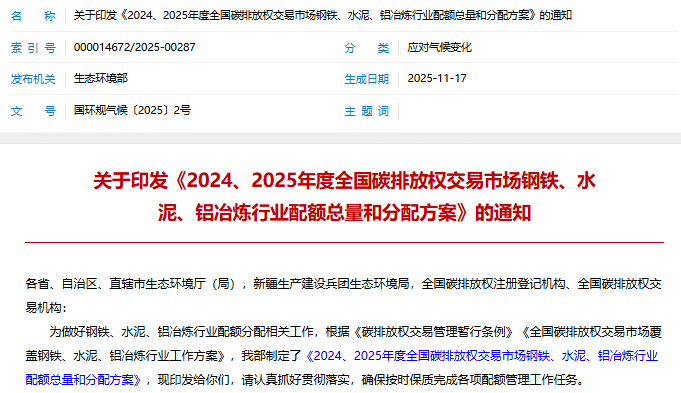
Core Insights - The expansion roadmap for China's national carbon emissions trading market has been officially unveiled, with a clear timeline for including additional industries by 2027, aiming to cover approximately 75% of national CO2 emissions [1][4]. Summary by Sections Carbon Market Expansion - The Ministry of Ecology and Environment has released a quota distribution plan for the steel, cement, and aluminum smelting industries for 2024 and 2025, marking a significant step in the carbon market's expansion [1][4]. - By including these three industries, the total number of key emission units will reach around 3,700, covering emissions of approximately 8 billion tons, which accounts for over 60% of national carbon emissions [4]. Future Industry Inclusion - The final goal is to achieve full coverage of major emission industries in the industrial sector by 2027, with preliminary preparations already underway for the chemical, petrochemical, civil aviation, and paper industries [4][5]. - Predictions suggest that once eight major industries are fully included, over 8,000 enterprises will enter the market, covering more than 70% of greenhouse gas emissions nationwide [4]. Technical Preparations - The Ministry has collected and verified carbon emission data from relevant industries since 2013, laying the groundwork for scientifically determining total quotas [5]. - A comprehensive set of technical documents related to quota distribution, accounting, reporting, and verification is being expedited, alongside upgrades to the national carbon market management platform and trading systems [5]. Market Dynamics and Pricing - The diversity of market participants is expected to enhance the pricing function of the carbon market, with the current closing price around 66 yuan per ton [5]. - Industry experts predict that carbon prices could rise significantly, potentially reaching between 130 to 180 yuan per ton by 2027, driven by quota control and paid distribution mechanisms [5]. Industry-Specific Impacts - Different industries will experience varying impacts from the carbon market expansion, with sectors like electricity and steel being better prepared compared to more complex industries like petrochemicals and paper [6]. - The aviation sector faces additional challenges, including external pressures such as the EU carbon border tax [6]. Future Market Development - By 2030, the goal is to establish a carbon market based on total quota control, combining free and paid distribution, to create a reasonable carbon pricing mechanism [7]. - The Ministry has indicated that total quota control will be prioritized in stable emission sectors, gradually tightening quotas to enhance market efficiency and optimize carbon reduction resource allocation [7].
刘琤:以智能化绿色化融合化发展推动转型升级
中国能源报· 2025-11-21 05:33
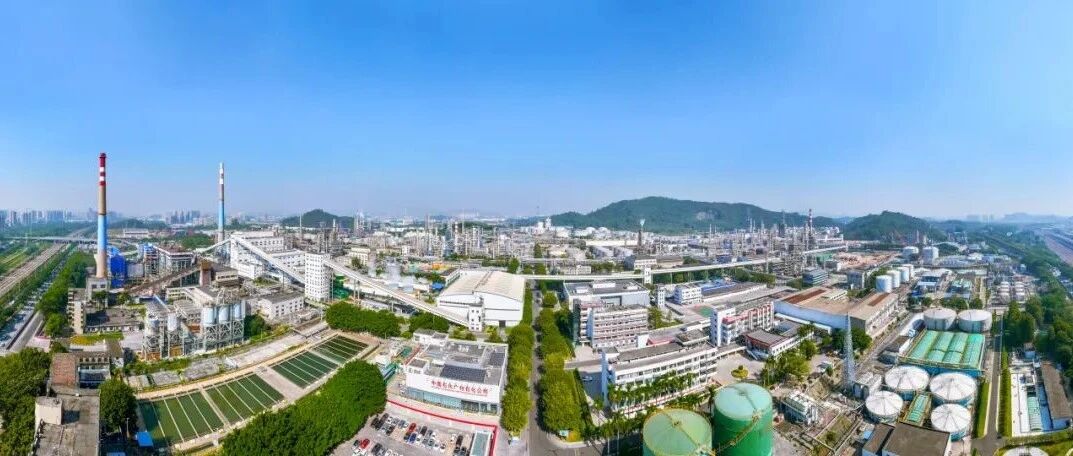
Core Viewpoint - The article emphasizes the importance of integrating intelligent, green, and collaborative development to drive transformation and upgrading in the petrochemical industry, particularly for Guangzhou Petrochemical as the only refining enterprise in the Guangdong-Hong Kong-Macao Greater Bay Area [4][10]. Intelligent Development - Intelligent development is identified as a key breakthrough for modernizing traditional industries, with the petrochemical sector undergoing a significant shift from "experience-driven" to "data-driven" operations. Guangzhou Petrochemical has been enhancing digital applications and information systems to improve operational stability and management efficiency [7]. - Future initiatives include establishing a higher standard for "Smart Guangzhou Petrochemical," focusing on risk control, financial decision-making models, and integrated scheduling systems, while promoting digital delivery and remote monitoring [7][10]. Green Development - Green transformation is deemed essential for the petrochemical industry, with Guangzhou Petrochemical committing to environmental governance and low-carbon initiatives. The company has maintained the title of "National Green Factory" for four consecutive years and aims to achieve a "waste-free factory" through comprehensive pollution reduction strategies [8][10]. - The company is targeting carbon peak goals and aims to build a green circular industrial system, emphasizing proactive carbon management and energy efficiency [8][10]. Collaborative Development - Collaborative development is viewed as a strategic choice to overcome growth bottlenecks. The "14th Five-Year Plan" period is seen as a critical phase for Guangzhou Petrochemical to advance new industrialization, focusing on safety, green development, and technological upgrades [10]. - The company plans to enhance its industrial and value chains, develop high-end specialty oils, and invest in hydrogen production and energy storage systems, thereby expanding its high-quality development space [10].
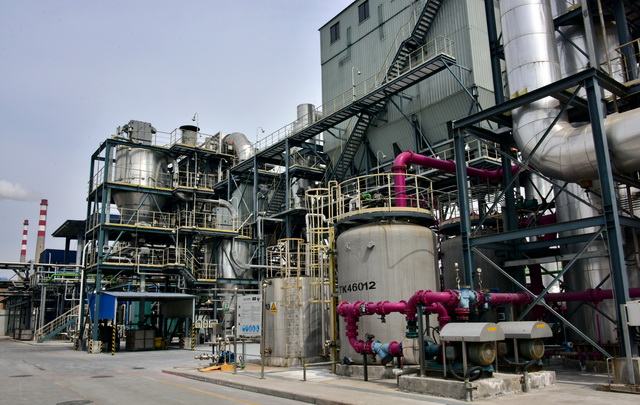
科莱恩、上海赛科扩展数字化服务
Zhong Guo Hua Gong Bao· 2025-11-21 03:38
Group 1 - Clariant has signed a ten-year cooperation agreement with Shanghai Secco to provide CLARITY flagship digital services, aimed at enhancing production efficiency at Secco's ethylene plant in Jinshan, Shanghai, which has an annual capacity of 900,000 tons [1][2] - The CLARITY flagship service, previously available only for ammonia, methanol, and hydrogen catalyst customers, has now expanded to the ethylene industry, integrating advanced AI-driven catalyst performance monitoring [1] - The CLARITY flagship platform combines AI with professional support to help ethylene producers like Secco optimize catalyst performance, improving reliability, safety, and profitability [1][2] Group 2 - The platform includes various specialized tools such as a hydrogenation process monitoring platform, virtual hydrogen analyzer, fluctuation prediction system, operating condition simulator, advanced alarm system, and performance tracker, providing real-time monitoring and rapid technical support [1] - Clariant's Vice President of Global Catalysts for Ethylene expressed satisfaction with the long-term partnership, emphasizing China's significance in the global petrochemical sector and the commitment to innovative technology in the region [2] - Secco's Ethylene Production Manager highlighted the company's dedication to seeking innovative solutions to enhance operational efficiency and maintain competitive advantage, anticipating performance improvements and long-term benefits from this technological collaboration [2]