
科技

Search documents
2026年,险资将布局这些方向
Zhong Guo Zheng Quan Bao· 2026-01-02 09:21
Core Insights - Insurance funds are expected to significantly increase their activity in equity markets by 2025, with a focus on key investment strategies and areas in 2026 driven by low interest rates, policy guidance, and product transformation [1][3] Investment Strategy - The overall strategy for insurance funds in equity investments in 2026 is anticipated to become more proactive and balanced, with a focus on high dividend assets and structural opportunities [5][4] - The investment approach will shift from seeking overall market elasticity to selecting individual stocks and sectors for excess returns, while maintaining a focus on high dividend assets as a stabilizing factor [5][4] Key Focus Areas - Key areas of focus for 2026 include dividends, AI, technology, and high-end manufacturing, which are frequently mentioned by insurance funds as priority investment directions [1][8] - Specific sectors within technology that are being targeted include computing power, storage, liquid cooling, humanoid robots, commercial aerospace, controllable nuclear fusion, low-altitude economy, quantum computing, and innovative pharmaceuticals [7][8] Market Outlook - The macroeconomic environment is expected to remain stable, with clear industrial trends and ample liquidity in equity markets, leading to an anticipated upward movement in the market [5][3] - Despite potential increases in market volatility, the overall trend is expected to remain positive, with a focus on high dividend assets and regular portfolio rebalancing [5][3]
恒生科指午后持续走强涨超4%,华虹半导体涨超10%,百度集团涨近9%
Jin Rong Jie· 2026-01-02 06:29
Group 1 - The Hang Seng Technology Index rose over 4%, with the Hang Seng Index up 2.68% at 26,317.5 points, and the Hang Seng Technology Index at 5,743.7 points, reflecting strong performance in sectors such as electric equipment, domestic retail, gaming software, semiconductors, and military industry stocks [1] - Major technology stocks saw significant gains, including Alibaba up 4.62%, Tencent up 4.09%, JD.com up 3.32%, Xiaomi up 2.85%, NetEase up 6.62%, Meituan up 1.84%, Kuaishou up 3.83%, and Bilibili up 3.42% [1] - Hua Hong Semiconductor surged over 10% after announcing plans to acquire a 97.4988% stake in Huali Micro for a transaction price of 8.268 billion RMB, along with plans to raise 7.556 billion RMB through a stock issuance [1] - Baidu Group increased nearly 9% following the announcement that Kunlun Chip submitted a listing application to the Hong Kong Stock Exchange, aiming for approval by January 1, 2026 [1] Group 2 - Guolian Minsheng Securities predicts that the Hong Kong stock market will benefit from a weak recovery in the domestic economy, ongoing Federal Reserve easing, and continued industry catalysts in the first half of 2026 [2] - There is an expected incremental capital inflow of 630 billion to 1,050 billion HKD from southbound funds in 2026, with passive index funds and insurance capital having significant potential [2] - The valuation of major Hong Kong technology stocks is currently aligned with earnings, and any further valuation increase will require earnings growth or an unexpected improvement in the funding environment [2] - Western Securities anticipates a short-term trend of RMB appreciation driven by substantial pending settlement funds and cross-border capital, with long-term support from China's strong industrial competitiveness [2]
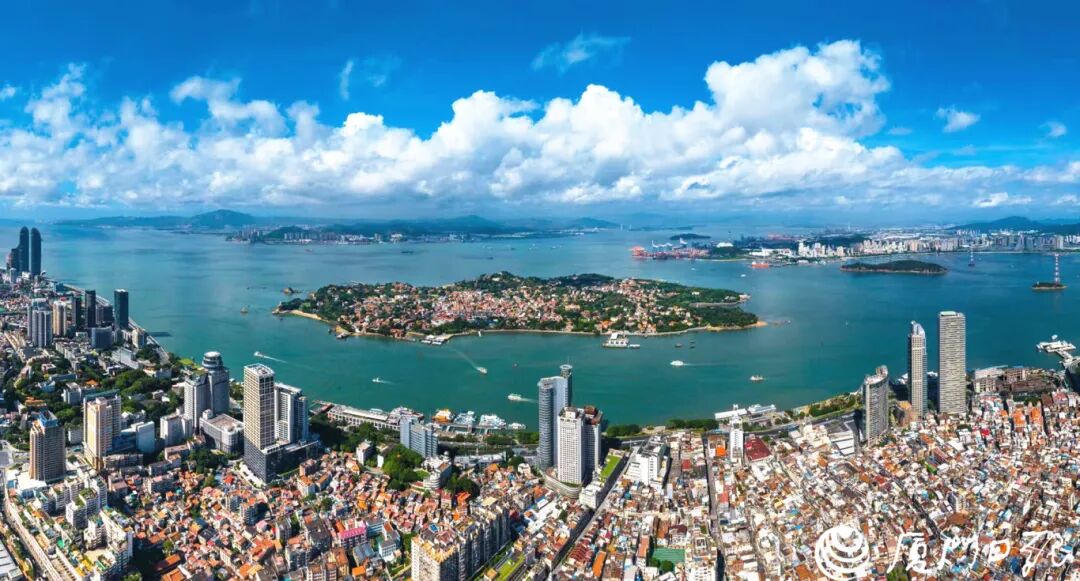
厦门最新出台!25条措施真金白银助企惠民
Xin Lang Cai Jing· 2026-01-02 05:02
Group 1: Core Initiatives - Xiamen has launched a series of measures to boost economic growth in the first quarter of 2026, focusing on consumption, investment, and support for various sectors [1][2] - The measures include 25 specific actions aimed at stabilizing and improving the economy, aligning with national and local economic policies [2][4] Group 2: Consumer Promotion - A total of 10 million yuan will be allocated for consumer promotion activities in the first quarter, including over 100 events focused on automobiles, home appliances, and clothing [5] - The city plans to implement a consumption upgrade program, encouraging the replacement of old consumer goods with new ones, and optimizing subsidy processes to enhance consumer experience [5] Group 3: Support for the Real Economy - Financial incentives will be provided to districts that excel in industrial electricity consumption, investment, and value-added output, with rewards of up to 400,000 yuan [6][7] - The government aims to enhance the development of the wholesale and retail sectors through financial support and incentives for businesses transitioning to higher operational standards [7] Group 4: Investment Expansion - The scale of the technology innovation fund will increase from 50 billion yuan to 60 billion yuan starting in 2026, broadening the scope of supported industrial projects [10] - Key infrastructure projects, including the Xiamen-Zhangzhou-Quanzhou intercity railway and Xiamen Xiang'an International Airport, are prioritized for expedited implementation [10][11] Group 5: Foreign Trade and Investment - Measures to support foreign trade enterprises include financial assistance for market expansion in emerging markets and incentives for cross-border e-commerce [11][12] - The city aims to simplify foreign debt registration processes and enhance financing options for high-tech and specialized small and medium-sized enterprises [12] Group 6: Agricultural Production and Employment - The government has set a target for spring grain planting across 16,200 acres and aims to stabilize production of key agricultural products [12] - Employment services will be strengthened, with plans for over 200 recruitment events and financial incentives for companies hiring new workers [13]

港股IPO融资大幅提升,对投资有什么影响?|投资小知识
银行螺丝钉· 2026-01-01 14:07
Group 1 - The article discusses the unique advantage of the Hong Kong stock market in welcoming new stock listings, providing global investors with investment options in RMB assets [3] - An increase in new stock listings may dilute liquidity in the Hong Kong market, posing a challenge, especially during periods of tight liquidity [3] - Recent trends show that the valuation of Hong Kong stocks has declined, with frequent occurrences of new stocks breaking below their issue price, which may suppress the pace of new stock issuance [3] Group 2 - Companies with strong cash flow and self-sustaining capabilities, such as high-dividend stocks in Hong Kong, tend to exhibit less volatility during bear markets [4] - High-dividend stocks are considered resilient during market downturns due to their cash flow, which supports reinvestment through dividends [4] - Leading technology companies in Hong Kong are likely to increase their share buyback activities when valuations are low, serving as a qualitative indicator of market valuation [4]

股神的84年智慧,浓缩至五点
财富FORTUNE· 2026-01-01 13:24
Core Viewpoint - The article reflects on Warren Buffett's investment philosophy and legacy, emphasizing the importance of his investment principles and the implications of his retirement for investors and the market [1][9][20]. Group 1: Buffett's Investment Principles - Principle One: Avoid blindly copying Buffett's stock-picking strategy; instead, invest 90% in S&P 500 index funds and 10% in short-term government bonds for stability [11][14]. - Principle Two: If choosing stocks independently, focus on a few high-quality companies rather than diversifying too much; Buffett's portfolio is heavily weighted in a few key stocks [15]. - Principle Three: Maintain a long-term perspective and be prepared to endure market fluctuations; successful investors often hold stocks through downturns [16]. Group 2: The Concept of "Economic Moat" - Principle Four: Invest in companies with a "moat," meaning they possess a sustainable competitive advantage that can withstand market changes [17]. - Principle Five: "Be fearful when others are greedy, and greedy when others are fearful," highlighting the need for courage in investment decisions during market volatility [18]. Group 3: Legacy and Future of Berkshire Hathaway - Buffett's retirement raises questions about the future of Berkshire Hathaway and whether the company's success can continue without his direct influence [20][21]. - The article suggests that Buffett's investment philosophy will remain relevant, but the challenge lies in whether successors can uphold these principles effectively [20].

“股票盛世”!全球股市连续第3年“两位数上涨”
华尔街见闻· 2026-01-01 12:20
Core Viewpoint - The global stock market is expected to achieve double-digit growth for the third consecutive year in 2025, despite uncertainties from Trump's trade policies and concerns over AI sector bubbles. The MSCI global index has risen over 20% this year, outperforming most analysts' expectations [1]. Group 1: US Market Performance - After a significant downturn at the beginning of the year, the US stock market rebounded strongly, with the S&P 500 index showing an annual increase of nearly 16.5%. The release of a large language model by DeepSeek shocked Silicon Valley and led to a drop in tech stocks. Trump's announcement of large tariffs in April triggered sell-offs in stocks, bonds, and the dollar, but strong corporate earnings, expectations of Fed rate cuts, and better-than-expected economic growth quickly brought investors back to the market [2]. - Despite strong performance in the US market, other markets such as China, Japan, the UK, and Germany have outperformed the S&P 500 this year, with emerging market stock indices also performing better than US stocks. Investors sought more diversified allocations after experiencing volatility in the US market at the beginning of the year [4]. Group 2: Economic Resilience and Market Support - The resilience of the US economy, combined with the clear outlook for a shift in Fed monetary policy towards rate cuts, has been a core support for market performance, driving significant capital inflows into the stock market and reinforcing long-term bets on AI potential. Additionally, better-than-expected US economic growth data has alleviated market anxieties and boosted risk appetite [8]. Group 3: Valuation Concerns - Market valuations are significantly above historical averages, with analysts warning that the current rally, driven by tech giants, may not be sustainable. The Shiller cyclically adjusted price-to-earnings ratio for the S&P 500 is nearing 40 times, the second highest level since the early 2000s internet bubble [6][10]. - Following such a strong rally, market sentiment has begun to turn cautious, with some investors and analysts warning about the sustainability of the current market conditions. The rally has shown significant structural concentration and valuation divergence, primarily driven by a few tech giants, leading to a substantial deviation from long-term historical averages [10]. Group 4: Concentration Risk - The current market rally, driven by a small number of stocks, is accumulating structural risks. The so-called "seven giants" of US tech have reached about a quarter of the MSCI global developed market stock index, creating a deep binding of global index movements to the performance of these individual giants, thereby increasing overall market fragility [12]. - The increasing concentration trend in the market is prompting a deep examination of the merger frenzy in the AI sector. This trend has created a complex and interdependent financial network, exemplified by OpenAI, which not only holds stakes in key infrastructure suppliers but also receives substantial investments from other industry participants, potentially amplifying systemic risks [14].
官宣!巴菲特正式退休!
新浪财经· 2026-01-01 07:42
截至2025年三季度末,公司的现金储备达到3816.7亿美元,再创历史最高纪录,且公司已连续9个月未进行股票回购。 2025年11月15日,伯克希尔公司公布了第三季度的13F报告。报告显示,截至第三季度末,伯克希尔共持有41只股票,总持仓市值 为2670亿美元,较前一季度的2580亿美元有所提升,提升幅度为3.4%。 苹果仍然是其第一大持仓,持仓市值约为606.6亿美元,但是伯克希尔该季度的苹果持仓已经从2.8亿股降至2.382亿股,目前已出 售了其曾持有的9.05亿股中的近四分之三。巴菲特对苹果的减持动作早从2024年就已经开始。此前,苹果持仓规模曾一度占伯克希 尔投资组合的50%以上。 据央视新闻消息,当地时间2025年12月31日,央视记者获悉,著名投资人沃伦·巴菲特正式退休,从知名投资机构伯克希尔·哈撒韦 (简称"伯克希尔")公司的首席执行官岗位上卸任。 沃伦·巴菲特现年95岁,常年担任知名投资公司伯克希尔公司的首席执行官。在2025年11月,其宣布将在年底辞去相关职务,但会 继续担任董事会主席,并保留"相当数量"的股份。 当地时间2025年11月1日,伯克希尔公司公布了巴菲特卸任CEO之前发布的最后 ...

加拿大股市全年累涨28% 创2009年以来最大涨幅
Xin Lang Cai Jing· 2026-01-01 04:47
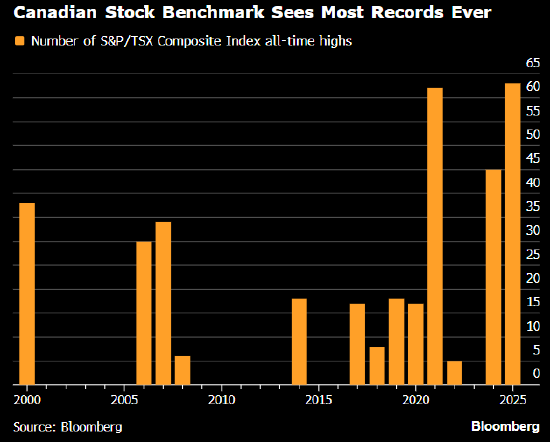
Core Viewpoint - The Canadian stock market delivered its second-best annual performance of the century, surprising many given the initial market conditions in April, which were marked by significant political and trade tensions [1][9]. Market Performance - The S&P/TSX Composite Index rebounded over 40% from its low on April 8, ultimately closing the year up 28%, marking its best annual performance since 2009 [1][9]. - The index set a record with 63 closing highs during the last seven months of the year [1][9]. Key Drivers of Growth - Mining and banking stocks were the primary drivers of the market's rise, with the materials sector index nearly doubling and the financial sector increasing over 30% [2][9]. - Major technology stocks, such as Shopify and THL Electronics, also contributed to the index's growth [2][9]. Economic Factors - The rise in precious metal prices, driven by three interest rate cuts from the Federal Reserve, has been beneficial for non-yielding assets like gold and silver [4][11]. - Geopolitical uncertainties and trade policy unpredictability have led traders to view gold and silver as safe-haven assets [4][11]. Financial Sector Insights - Canadian banks, including Toronto-Dominion Bank and Bank of Montreal, exceeded market expectations with an average adjusted earnings per share growth of about 15% [5][11]. - The financial sector, which comprises 33% of the Canadian benchmark index, benefited from the interest rate cuts and robust lending performance [5][11]. Valuation Concerns - Canadian bank stocks saw a cumulative increase of 40% in 2025, significantly outperforming U.S. bank stocks [6][13]. - However, there are concerns regarding high valuations in the financial sector, with the banking index's price-to-earnings ratio exceeding 14, compared to less than 10 in 2022 [6][13]. Oil and Energy Outlook - Despite a weak performance in oil prices throughout the year, the Canadian benchmark index reached historical highs [6][13]. - The outlook for oil remains uncertain, with demand growth lagging behind supply, making investments in oil and gas stocks a contrarian strategy [6][13]. Investment Strategies - Some investment firms have adopted a partial underweight strategy for the Canadian benchmark index, primarily for profit-taking after three years of excess returns [7][14]. - Analysts believe that if oil prices exceed expectations in 2026, stocks listed on the Toronto Stock Exchange could become attractive to international investors [7][14].
官宣!巴菲特正式退休!
天天基金网· 2026-01-01 02:19
Core Viewpoint - Warren Buffett officially announced his retirement as CEO of Berkshire Hathaway, effective December 31, 2025, while continuing as chairman of the board and retaining a significant number of shares [3]. Financial Performance - Berkshire Hathaway reported third-quarter revenue of $94.972 billion, a year-on-year increase of 2.13% [3]. - The net profit attributable to shareholders for the third quarter was $30.796 billion, reflecting a 17% year-on-year growth [3]. - Operating profit for the third quarter reached $13.49 billion, a substantial increase of 34% compared to $10.09 billion in the same period last year [3]. - As of the end of the third quarter of 2025, the company's cash reserves hit a record high of $381.67 billion, with no stock buybacks for nine consecutive months [3]. Investment Portfolio Changes - Berkshire's 13F report revealed a total stock portfolio value of $267 billion, up 3.4% from the previous quarter's $258 billion [3]. - Apple remains the largest holding with a market value of approximately $60.66 billion, although Berkshire has reduced its stake from 280 million shares to 238.2 million shares, selling nearly three-quarters of its original 905 million shares [4]. - The company also reduced its holdings in Bank of America by 37.19 million shares and increased its position in Chubb Limited by 4.29 million shares [4]. - Berkshire completely exited its position in D.R. Horton, one of the four major U.S. homebuilders [4]. New Investments - In the third quarter, Berkshire established a new position with 17.84 million shares in Alphabet, making it the tenth largest holding [5]. Buffett's Legacy and Future Outlook - Buffett expressed confidence in the future leadership of Greg Abel and the company's prospects in his farewell letter, while also accelerating the pace of his $149 billion legacy donations to family foundations [6]. - He reflected on the transformation of Berkshire Hathaway from a struggling textile company into a $1 trillion investment conglomerate since taking over in 1965 [6]. - Buffett reassured stakeholders about the company's resilience, stating it can withstand various economic conditions and emphasized the stock's potential to recover from volatility [7].


体系化学理化研究阐释 | 经济改革理论的创新和突破
Xin Lang Cai Jing· 2026-01-01 02:18
Group 1 - The core purpose of economic reform is to adjust production relations to stimulate endogenous social development dynamics and enhance overall economic efficiency [2][3] - Since the 18th National Congress, the focus has been on deepening economic reforms to promote high-quality development, with a series of new ideas and viewpoints proposed by Xi Jinping [2][4] - The establishment of a socialist market economy system has been a significant milestone in China's economic reform journey, transitioning from a highly centralized planned economy to a vibrant market economy [3][4] Group 2 - The current economic development phase in China emphasizes high-quality growth, which faces deep-seated institutional issues that require further reform for sustainable development [4][16] - The construction of a unified national market is a strategic deployment by the central government to support high-quality development and the new development pattern [8][16] - The need for a new type of national governance system is highlighted as a way to leverage the advantages of centralized efforts in addressing key technological challenges [19][20] Group 3 - The relationship between government and market is crucial for resource allocation, and the successful reform in China has been characterized by finding an optimal combination of both [13][14] - Economic reform must be tailored to national conditions, avoiding the replication of foreign models, and should be guided by the realities of China's historical and cultural context [12][14] - The reform process should focus on enhancing the efficiency of resource allocation and ensuring fair competition in the market [16][21]
