外汇

Search documents
欧元汇率重返1.20背后的美元体系失序
Xin Hua She· 2026-01-30 05:54
相似数据背后并非历史的简单重复。如果说欧元汇率此前的高点体现了欧洲经济内生动力的复苏,那么 如今的欧元则折射出全球资本的避险"迁徙"。 回望2021年,欧洲一体化的财政刺激政策的落实与欧元区经济前景"拨云见日",加之全球贸易逐步回 暖,欧元汇率上行是经济基本面改善的"顺势而为"。 进入2026年,欧元对美元汇率在最近两周内节节攀升,从1比1.16到突破1比1.20。这一趋势背后,是市 场对美国政策走向的深度焦虑:从地缘政治的持续紧张,到四处挥舞关税大棒,再到对格陵兰岛等地主 权问题恣意表态。 近年来,以纽约为源头,一场围绕货币信用的博弈在全球金融市场蔓延。本周,欧元对美元汇率强势突 破1比1.20关口。时隔四年多,欧元重回这一高位。 相似数据背后并非历史的简单重复。如果说欧元汇率此前的高点体现了欧洲经济内生动力的复苏,那么 如今的欧元则折射出全球资本的避险"迁徙"。 回望2021年,欧洲一体化的财政刺激政策的落实与欧元区经济前景"拨云见日",加之全球贸易逐步回 暖,欧元汇率上行是经济基本面改善的"顺势而为"。 进入2026年,欧元对美元汇率在最近两周内节节攀升,从1比1.16到突破1比1.20。这一趋势背后, ...
借力“美国威慑”未动分毫?日本短暂打赢日元保卫战,但风险犹存
Jin Shi Shu Ju· 2026-01-30 03:44
Core Viewpoint - Japan has successfully gained some breathing room for the yen without any evidence of large-scale intervention, indicating a short-term success of its strategy relying on "U.S. deterrence" [1] Group 1: Yen Exchange Rate Dynamics - The yen has rebounded from the edge of 160 to around 153 against the dollar, primarily due to market concerns about potential joint actions between Tokyo and Washington [1] - The upcoming monthly intervention data will clarify how much Japan has spent to support the yen, if at all [1] - The recent comments from U.S. President Trump regarding the dollar's decline have contributed to the yen's strength, but the sustainability of this trend remains uncertain [1][2] Group 2: Government Strategy and Market Reactions - Japan's approach has been relatively successful, with the Finance Minister indicating that the cost of intervention has not been significant [2] - The market consensus suggests that authorities conducted currency checks before the yen's rise rather than direct intervention, which can serve as a tactic to intimidate speculators [2][3] - Reports of the New York Fed conducting currency checks have significantly impacted the yen's movement, highlighting the greater effectiveness of joint actions compared to unilateral measures [3] Group 3: Future Implications and Political Context - If Prime Minister Kishi Sema wins the upcoming election, she may be more inclined to authorize stronger actions regarding the yen [2] - The government’s current strategy has provided time for Kishi's administration as inflation from a weak yen is a major voter concern [5] - Concerns about Japan's fiscal situation could pose risks for the yen's recovery, with potential implications for global investors [5]
大类资产早报-20260130
Yong An Qi Huo· 2026-01-30 01:21
1. Report Information - Report Title: "Big Asset Morning Report" - Report Date: January 30, 2026 - Report Team: Macro Team of the Research Center [2] 2. Global Asset Market Performance 2.1 Bond Market - **10 - year Treasury Bonds**: Yields of 10 - year Treasury bonds in major economies vary, with the US at 4.233, the UK at 4.510, France at 3.418, etc [3]. - **2 - year Treasury Bonds**: The US 2 - year Treasury bond yield is 3.561, the UK's is 3.706, and Germany's is 2.078 [3]. 2.2 Exchange Rate Market - **Dollar against Major Emerging Economies' Currencies**: The exchange rate of the dollar against the Brazilian real is 5.190, against the South African rand is 15.738, etc [3]. - **Renminbi**: The on - shore RMB is at 6.952, the off - shore RMB is at 6.945, and the RMB central parity rate is 6.977 [3]. 2.3 Stock Market - **Major Economies' Stock Indices**: The S&P 500 is at 6969.010, the Dow Jones Industrial Average is at 49071.560, and the Nasdaq is at 23685.120 [3]. 2.4 Credit Bond Index - The euro - zone investment - grade credit bond index is at 267.857, and the euro - zone high - yield credit bond index is at 413.160 [3]. 3. Stock Index Futures Trading Data 3.1 Index Performance - **Closing Prices**: The A - share index closes at 4157.98, the CSI 300 at 4753.87, the SSE 50 at 3110.91, etc [4]. - **Price Changes (%)**: The A - share index rises 0.16%, the CSI 300 rises 0.76%, the SSE 50 rises 1.65%, while the ChiNext falls 0.57% and the CSI 500 falls 0.97% [4]. 3.2 Valuation - **PE (TTM)**: The PE (TTM) of the CSI 300 is 14.31, the SSE 50 is 11.82, the CSI 500 is 38.58, etc [4]. - **Quarter - on - Quarter Changes**: The PE (TTM) of the CSI 300 has a 0.11 quarter - on - quarter change, the SSE 50 has 0.15, and the CSI 500 has - 0.37 [4]. 3.3 Risk Premium - **1/PE - 10 - year Interest Rate**: The risk premium of the S&P 500 is - 0.64, and that of the German DAX is 2.46 [4]. - **Quarter - on - Quarter Changes**: The risk premium of the S&P 500 has a 0.02 quarter - on - quarter change, and the German DAX has 0.12 [4]. 3.4 Fund Flows - **Latest Values**: The net fund outflow of A - shares is - 952.92, the main board is - 653.65, and the ChiNext is - 134.31 [4]. - **Average of the Past 5 Days**: The average net fund outflow of A - shares in the past 5 days is - 1146.55, the main board is - 874.95, and the ChiNext is - 205.36 [4]. 4. Transaction Amount and Basis 4.1 Transaction Amount - **Latest Values**: The total trading volume of the Shanghai and Shenzhen stock markets is 32300.08, the CSI 300 is 9179.66, and the SSE 50 is 2948.88 [5]. - **Quarter - on - Quarter Changes**: The total trading volume of the Shanghai and Shenzhen stock markets has a 2645.98 quarter - on - quarter change, the CSI 300 has 885.52, and the SSE 50 has 422.65 [5]. 4.2 Basis of Main Contracts - **Basis**: The basis of IF is 30.13, IH is 19.49, and IC is - 0.24 [5]. - **Basis Ratio**: The basis ratio of IF is 0.63%, IH is 0.63%, and IC is - 0.00% [5]. 5. Treasury Bond Futures Trading Data - **Closing Prices**: The T2303 closes at 108.25, TF2303 at 105.88, T2306 at 108.26, and TF2306 at 105.91 [5]. - **Price Changes (%)**: T2303 rises 0.04%, T2306 rises 0.06%, while TF2303 has no change and TF2306 has a - 0.00% change [5]. 6. Capital Interest Rate - **Interest Rates**: R001 is 1.4381%, R007 is 1.6245%, and SHIBOR - 3M is 1.5910% [5]. - **Daily Changes (BP)**: R001 has a - 17.00 BP daily change, R007 has a 1.00 BP change, and SHIBOR - 3M has no change [5].
上海涉外经济创新高,北证50下跌1.69%
Soochow Securities· 2026-01-30 00:46
证券研究报告·北交所报告·北交所定期报告 北交所定期报告 20260130 执业证书:S0600520090004 zhujieyu@dwzq.com.cn 证券分析师 易申申 执业证书:S0600522100003 yishsh@dwzq.com.cn 证券分析师 余慧勇 执业证书:S0600524080003 yuhy@dwzq.com.cn 研究助理 武阿兰 执业证书:S0600124070018 wual@dwzq.com.cn 研究助理 陈哲晓 执业证书:S0600124080015 sh_chenzhx@dwzq.com.cn 上海涉外经济创新高,北证 50 下跌 1.69% 2026 年 01 月 30 日 证券分析师 朱洁羽 相关研究: 《沪深北交易所提高融资保证金最低 比例,北证 50 上涨 0.98%》 2026-01-14 《工信部印发<推动工业互联网平台 高质量发展行动方案(2026—2028 年)>,北证 50 下跌 2.50%》 2026-01-13 东吴证券研究所 1 / 8 请务必阅读正文之后的免责声明部分 [Table_Tag] [Table_Summary] ◼ 资本市场新 ...

韩国称美国外汇报告表明韩元单边走势是不适当的
Xin Lang Cai Jing· 2026-01-29 23:25
Group 1 - The South Korean Ministry of Finance stated that the U.S. Treasury report indicates the depreciation of the Korean won by the end of 2025 is "inconsistent with South Korea's strong economic fundamentals," suggesting that the U.S. Treasury acknowledges the inappropriate unilateral trend of the won [1][2] - The South Korean government will continue to maintain close communication with the U.S. Treasury to enhance mutual understanding and trust regarding the foreign exchange market, aiming to ensure stability in the foreign exchange market [1][2]
聚焦全球能源 | 油价将触底60美元?
彭博Bloomberg· 2026-01-28 06:06
本文来自彭博终端,终端用户可运行NSN T98JZ6KIP3LA 阅读原文。非终端用户可点击文末 "阅读原文" 预约演示。 伴随行业飞速发展、地缘政治博弈、供需天平摇摆…全球能源市场时刻处于动荡之中。彭博行 业研究(Bloomberg Intelligence)为您及时传递行业动态,并基于高质量数据、模型与分析 助您解读市场变化,看见全局、看向前景。 扫描二维码 立即订阅 彭博能源行业研究双周报 本期主题: 石油交易员预计油价短期内触底 部分由于美国对伊朗采取军事行动 (彭博行业研究)——尽管OPEC+尚未完全解除减产措施,但在全球地缘政治冲突的背景 下,石油市场充满不确定性。美国商品期货交易委员会(CFTC)数据显示,WTI原油期货净 多头头寸触底,美元净空头头寸持续收窄,表明市场对避险资产的需求正在上升。短期内, WTI原油价格可能在每桶6 0美元附近触底。 CFTC数据显示WTI原油期货净多头头寸在15年低点附近见底 CFTC数据显示,截至1月1 6日当周,纽约商品交易所WTI原油期货非商业净多头合约降至 5 8 , 1 2 8张,较7月4日减少7 5 . 3%。受OPEC+增产预期及全球需求疲软影响, ...


交投活跃 人民币对美元汇率反弹走强
Jin Rong Shi Bao· 2026-01-28 00:51
Core Viewpoint - In 2025, the interbank foreign exchange market in China operated smoothly under comprehensive regulatory measures, with a steady increase in trading volume and active market participation, achieving a record high in transaction scale and daily average turnover [1][2]. Group 1: Foreign Exchange Market Performance - The cumulative transaction volume in the interbank foreign exchange market reached 48.52 trillion USD in 2025, with a daily average turnover of 199.66 billion USD, marking a year-on-year growth of 6.54% [1]. - The daily average transaction volume for the RMB foreign exchange market was 14.87 billion USD, with all varieties except for forwards showing an increase in daily average transaction volume [1]. - By the end of 2025, the RMB to USD exchange rate was reported at 6.9890, appreciating by 4.43% compared to the end of the previous year [2][3]. Group 2: RMB Exchange Rate Dynamics - Throughout 2025, the RMB to USD exchange rate experienced fluctuations, initially under pressure but later showing signs of strengthening and significant appreciation [2][3]. - The CFETS RMB exchange rate index ended the year at 97.99 points, reflecting a decline of 3.43% for the year [2]. - The annualized volatility of the exchange rate was recorded at 2.53%, a decrease of 0.51 percentage points from 2024 [2]. Group 3: Influencing Factors on RMB Exchange Rate - The RMB exchange rate faced pressure in April 2025 due to heightened trade tensions between China and the US, with the onshore RMB briefly falling below the 7.35 mark [3]. - Factors contributing to the RMB's subsequent rebound included easing trade tensions and a weakening US dollar due to concerns over the US economic outlook and fiscal issues [4]. - By the end of 2025, both onshore and offshore RMB broke through the significant psychological level of 7.0, driven by improved domestic economic fundamentals and stabilizing market expectations [4]. Group 4: Swap Market Trends - In 2025, the RMB swap curve shifted upward, reaching a three-year high, influenced by narrowing interest rate differentials between China and the US [5][6]. - The one-year RMB to USD swap points showed a significant upward trend, particularly in the second half of the year, with the spread against interest rate parity stabilizing in positive territory [6]. - The People's Bank of China issued a total of 300 billion RMB in offshore central bank bills throughout the year, maintaining tight liquidity in the offshore RMB market [6]. Group 5: Dollar Market Liquidity - The domestic dollar borrowing rates remained low throughout 2025, with the overnight borrowing rate fluctuating between 4.25% and 4.33% [7]. - The interest rate differential between domestic and foreign dollar markets widened in the second half of the year, reaching a three-year low of -40 basis points [7]. - By the end of 2025, domestic overnight rates and SOFR were recorded at 3.62% and 3.87%, respectively, both showing declines from the previous year [7].
美元指数大跳水
第一财经· 2026-01-28 00:30
2026.01. 28 本文字数:1472,阅读时长大约2分钟 作者 | 第一财经 胡弋杰 当地时间1月27日,美国总统特朗普在美国艾奥瓦州出席经济政策相关活动期间接受媒体采访时表示,并不 担心美元出现明显贬值,称美元"表现良好",并认为汇率回归"自身应有的水平"是合理现象。 当被问及是否担心美元走软时,特朗普回应称:"不,我认为美元表现很好。我希望回归自身应有的水平, 这是合理的做法。"他还暗示自己具备影响美元走势的能力,称"我可以让它像悠悠球一样涨跌"。 特朗普言论发布后,美元指数(DXY)短线一度小幅拉升,但随后快速转跌,盘中跌超50点,刷新2022年2 月以来新低。衡量美元对六种主要货币的美元指数当天下跌0.84%,在纽约尾盘报96.219。截至纽约汇市尾 市,1欧元兑换1.1979美元,高于前一交易日的1.1875美元;1英镑兑换1.3780美元,高于前一交易日的 1.3679美元。 "抛售美国"交易升温 本月以来,美元持续承压。市场普遍认为,特朗普的贸易政策不确定性,以及围绕美联储独立性的争议,是 压制美元的重要因素。 支付公司科佩支付(Corpay)首席市场策略师卡尔·沙莫塔(Karl Scha ...

日元危局难解?高市早苗“政治豪赌”拉响财政警报
Jin Shi Shu Ju· 2026-01-27 13:28
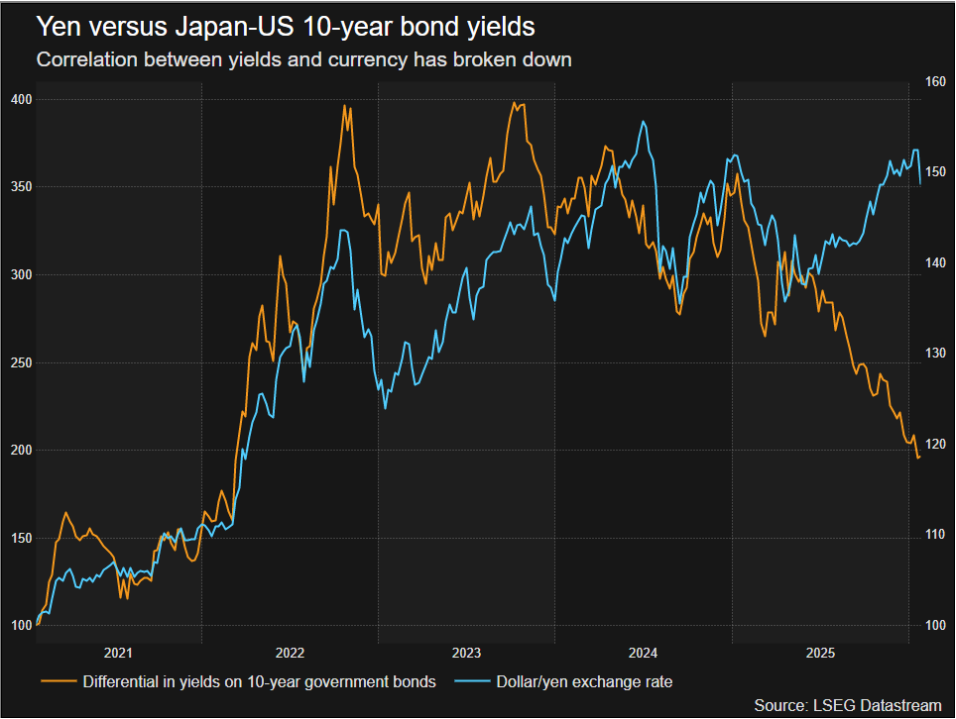
Core Viewpoint - The Japanese yen is under significant pressure due to concerns over Japan's fiscal health, despite expectations of coordinated buying by the US and Japan to support the currency. The upcoming elections and the government's economic stimulus plans further complicate the situation [1][5]. Group 1: Economic Context - The Japanese government debt now accounts for approximately 230% of GDP, the highest among developed countries [5]. - Prime Minister Sanae Takaichi's campaign for early elections is based on expanding economic stimulus measures, which may weaken the effectiveness of any currency intervention [1][5]. - The market's concern over Japan's fiscal management has intensified, leading to a significant sell-off in the stock market and a decline in the yen against the euro and Swiss franc [5]. Group 2: Currency Intervention - Historical experience suggests that actual market interventions may have limited impact, especially in the context of Japan's fiscal crisis concerns [1][6]. - The yen's depreciation has prompted discussions of potential intervention, with expectations that a breach of the 160 yen per dollar mark could trigger the first round of intervention [4]. - Despite the potential for US-Japan coordinated intervention, the effectiveness is expected to be limited, primarily due to a lack of investor confidence in Japan's fiscal management capabilities [4][6]. Group 3: Market Reactions - Fund manager Toshinobu Chiba indicated that if Takaichi wins decisively and pushes for more stimulus, the yen could fall to 180 per dollar, a level not seen since 1986 [3]. - The recent spike in Japanese government bond yields has not supported the yen as expected, indicating a disconnect between bond yields and currency value [2][5]. - The upcoming elections are seen as a critical moment for Takaichi's economic agenda, with the potential for significant market reactions based on the election outcome [1][5].
日元暴涨未掀风暴:美股抗跌的套利密码
Xin Lang Cai Jing· 2026-01-27 05:32
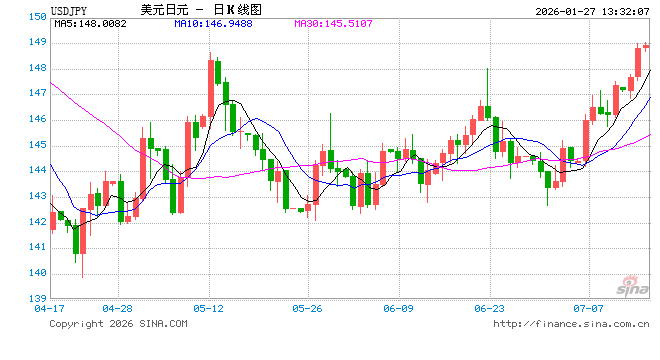
Core Viewpoint - The recent surge in the Japanese yen against the US dollar has sparked speculation about potential direct intervention by Japanese authorities to support the yen, with the yen reaching its highest point in two months, rising approximately 1.1% to surpass the 154 yen mark [2][14]. Group 1: Market Dynamics - The narrative surrounding the reversal of yen carry trades has resurfaced, highlighting the potential impact of Japanese monetary policy changes and US interest rate expectations on global risk assets [3][15]. - Despite the recent volatility in the yen, there has not been a corresponding systemic sell-off in US equities or a typical liquidity withdrawal in global risk assets, raising questions about the actual impact of carry trade reversals [15][22]. Group 2: Carry Trade Conditions - The current market environment shows that while the interest rate differential between the US and Japan remains, its marginal attractiveness has decreased, with a nominal interest rate differential of 2.89% (289 basis points) as of January 22, 2026 [17]. - The actual interest rate in Japan remains negative when adjusted for inflation, providing a cushion for carry trades, which means that significant losses would only occur if the yen appreciates more than 2.9% annually [17][19]. Group 3: Structural Changes in Trading - Modern carry trades have become "invisible," with many transactions executed through currency swaps and cross-currency basis, allowing for risk adjustments without the need for visible actions like selling US equities [18]. - The current speculative positions indicate that traders are still short on the yen, with a net short position of 44,800 contracts as of January 23, 2026, suggesting that a large-scale withdrawal of carry trade funds is not imminent [20]. Group 4: Market Sensitivity and Future Risks - The sensitivity of US equities to interest rate and policy signals has increased, with recent fluctuations in US Treasury yields having a more pronounced impact on growth and technology stocks [21]. - The market appears stable, but this stability is underpinned by mathematical thresholds rather than macroeconomic narratives, indicating that risks may accumulate without immediate visible consequences [22].