
新能源车整车制造

Search documents
0.7%
Shang Hai Zheng Quan Bao· 2025-12-10 04:32
Group 1 - In November, the Consumer Price Index (CPI) increased by 0.7% year-on-year, marking the highest level since March 2024, with a 0.5 percentage point increase from October [1][3] - The rise in CPI was primarily driven by a turnaround in food prices, which shifted from a 2.9% decline in October to a 0.2% increase in November, positively impacting the CPI by 0.04 percentage points [3] - Fresh vegetable prices saw a significant increase, rising by 14.5% year-on-year in November after nine consecutive months of decline, while pork and poultry prices experienced a narrowing of their decline [3] Group 2 - The Producer Price Index (PPI) rose by 0.1% month-on-month in November, continuing the upward trend for the second consecutive month, driven by seasonal demand increases in coal and gas [5][6] - The PPI year-on-year decreased by 2.2%, with the decline slightly widening compared to October, primarily due to high comparison bases from the previous year [6] - Key industries such as coal mining, photovoltaic equipment manufacturing, and lithium-ion battery manufacturing saw a narrowing of their year-on-year price declines, indicating effective capacity management policies [7] Group 3 - The core CPI, excluding food and energy, rose by 1.2% year-on-year, maintaining a level above 1% for three consecutive months, with service prices and industrial consumer goods prices also showing positive growth [3][4] - Seasonal factors led to a decrease in service prices, with significant declines observed in accommodation, airfares, and travel-related costs [4] - Emerging industries are experiencing rapid growth, with notable year-on-year price increases in sectors such as external storage devices (13.9%), graphite and carbon products (3.8%), and integrated circuit manufacturing (1.7%) [7][8]
1.2%↑!创2024年3月以来新高!
Zheng Quan Shi Bao Wang· 2025-12-10 03:53
Group 1: Consumer Price Index (CPI) Trends - In November, the Consumer Price Index (CPI) increased by 0.7% year-on-year, with the growth rate expanding by 0.5 percentage points compared to the previous month, marking the highest increase since March 2024 [2] - Food prices contributed to the CPI increase, with fresh vegetable prices rising by 14.5% after a decline of 7.3% in the previous month, significantly impacting the CPI [2] - The core CPI, excluding food and energy, rose by 1.2% year-on-year, maintaining a growth rate above 1% for three consecutive months [3] Group 2: Producer Price Index (PPI) Trends - The Producer Price Index (PPI) decreased by 2.2% year-on-year in November, with the decline rate expanding by 0.1 percentage points compared to the previous month, influenced by a high comparison base from the previous year [4] - The PPI showed signs of improvement in specific industries, with price declines narrowing in coal mining, photovoltaic equipment manufacturing, and lithium-ion battery manufacturing [4][5] - Emerging industries are driving price increases, with external storage devices and components rising by 13.9% year-on-year, and other sectors like integrated circuit manufacturing and carbon product manufacturing also showing positive trends [5]


11月CPI同比升至20个月新高,发生了什么
Di Yi Cai Jing· 2025-12-10 03:45
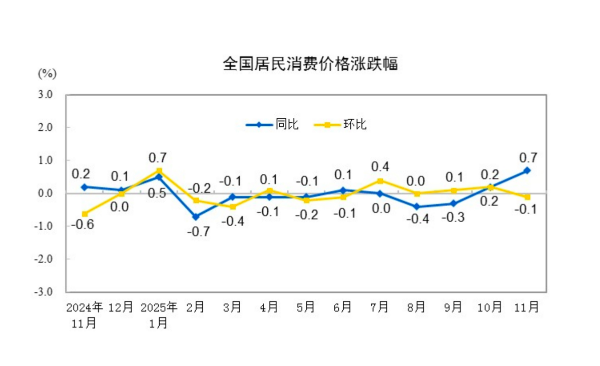
扣除食品和能源价格的核心CPI同比上涨1.2%。 国家统计局12月10日发布最新居民消费价格指数(CPI)和工业生产者出厂价格指数(PPI)数据。 随着扩内需政策持续落地见效,居民消费持续恢复,11月份CPI同比上涨0.7%,为2024年3月份以来最 高。受国内部分行业供需结构优化、国际大宗商品价格传导等因素影响,PPI环比上涨0.1%,同比下降 2.2%。 国家统计局城市司首席统计师董莉分析,11月CPI同比上涨0.7%,涨幅比上月扩大0.5个百分点,同比涨 幅扩大主要是食品价格由降转涨拉动。食品价格由上月下降2.9%转为上涨0.2%,对CPI同比的影响由上 月下拉0.54个百分点转为上拉0.04个百分点。 食品中,鲜菜价格由上月同比下降7.3%转为上涨14.5%,为连续下降9个月后首次转涨,对CPI同比的上 拉影响比上月增加约0.49个百分点;鲜果价格由上月下降2.0%转为上涨0.7%;猪肉和禽肉类价格分别同 比下降15.0%和0.6%,降幅均有收窄。 PPI同比下降2.2%,降幅比上月扩大0.1个百分点,主要受上年同期对比基数走高影响。 董莉娟表示,我国各项宏观政策不断显效,价格呈现积极变化。综合整治" ...
1.2%↑!创2024年3月以来新高!
券商中国· 2025-12-10 03:32
Core Viewpoint - In November, consumer spending continued to recover, and the effectiveness of comprehensive rectification of "involution-style" competition became evident, with notable changes in price trends across various industries [2][7]. Consumer Price Index (CPI) - In November, the CPI increased by 0.7% year-on-year, with the growth rate expanding by 0.5 percentage points compared to the previous month, marking the highest increase since March 2024 [3][4]. - Food prices rose by 0.2% year-on-year, while non-food prices increased by 0.8%. Fresh vegetable prices turned from a decline of 7.3% last month to an increase of 14.5%, contributing approximately 0.49 percentage points to the CPI [3][4]. - Month-on-month, fresh vegetable prices rose significantly by 7.2%, far exceeding the average seasonal decline of 3.2%, impacting the CPI by about 0.17 percentage points [3]. Core CPI - The core CPI, excluding food and energy, rose by 1.2% year-on-year, maintaining a growth rate above 1% for three consecutive months [5]. - Prices for services and industrial consumer goods, excluding energy, increased by 0.7% and 2.1%, respectively, contributing approximately 0.29 and 0.53 percentage points to the CPI [5]. Producer Price Index (PPI) - The PPI decreased by 2.2% year-on-year, with the decline rate expanding by 0.1 percentage points compared to the previous month, primarily due to a high comparison base from the previous year [6]. - The PPI showed a month-on-month increase for two consecutive months, attributed to seasonal demand increases in certain domestic industries [8]. Industry Price Trends - The comprehensive rectification of "involution-style" competition has led to a narrowing of price declines in related industries, such as coal mining, photovoltaic equipment manufacturing, and lithium-ion battery manufacturing [7]. - Emerging industries are rapidly developing, driving price increases in sectors like external storage devices (up 13.9% year-on-year) and integrated circuit manufacturing (up 1.7%) [7]. - Consumer potential is being effectively released, reflected in price increases in sectors such as craft art and ceremonial supplies (up 20.6% year-on-year) and sports ball manufacturing (up 4.3%) [7].

国家统计局:综合整治“内卷式”竞争成效显现,相关行业价格同比降幅收窄
Bei Jing Shang Bao· 2025-12-10 02:49
北京商报讯(记者 和岳)12月10日,国家统计局城市司首席统计师董莉娟表示,综合整治"内卷式"竞 争成效显现,相关行业价格同比降幅收窄。重点行业产能治理持续推进,市场竞争秩序不断优化,今年 11月煤炭开采和洗选业、光伏设备及元器件制造、锂离子电池制造价格同比降幅比上月分别收窄3.8 个、2.0个和0.7个百分点,均已连续多个月收窄;新能源车整车制造价格降幅比上月收窄0.6个百分点。 ...
传楚能新能源将接手威马武汉工厂,实控人为中国第四大汽车经销商
Ju Chao Zi Xun· 2025-11-07 02:25
Group 1 - Chuangneng New Energy will take over Weima's Hubei Xinghui New Energy Smart Vehicle Co., marking its entry into the complete vehicle manufacturing market [2] - Chuangneng New Energy, established in August 2021 and headquartered in Wuhan, is controlled by Hengxin Automotive Group, the fourth largest automotive dealership group in China [2] - By October 2025, Chuangneng New Energy plans to have built three lithium battery production bases with an annual effective capacity exceeding 110 GWh, and a total planned capacity exceeding 500 GWh [2] Group 2 - Weima Xinghui Factory is the only complete vehicle manufacturing facility in Hubei with a total investment of 20.2 billion yuan, with a planned capacity of 150,000 vehicles [3] - The factory officially commenced production on January 8, 2020, and was Weima's second fully qualified intelligent manufacturing base [3] - Hengxin Automotive Group has prior experience in vehicle manufacturing, having collaborated with Zero One Automotive on pure electric heavy trucks before taking over Weima Xinghui Factory [3]

经济观察丨中国经济稳定增长护航民生基本盘
Zhong Guo Xin Wen Wang· 2025-10-21 01:39
Economic Growth and Employment - China's GDP grew by 5.2% year-on-year in the first three quarters, accelerating by 0.2 and 0.4 percentage points compared to the previous year and the same period last year respectively, providing a solid foundation for employment and income stability [1] - The average urban unemployment rate from January to September was 5.2%, with quarterly averages of 5.3%, 5.0%, and 5.2%, showing overall stability in the employment situation [1] - Economic growth serves as a "ballast" and "stabilizer" for the job market, encouraging businesses to invest and expand, thus creating more job opportunities [1] Policy Support and Employment Measures - China has implemented targeted support measures for key employment groups, including special subsidies and expanded employment channels, aiming to deliver policy benefits to those in need [2] - The country is actively guiding and supporting the development of industries related to new productive forces, such as high-tech manufacturing, digital economy, and green industries, to create new employment opportunities [2] Resident Income and Consumption - The per capita disposable income of residents reached 32,509 yuan, a nominal increase of 5.1% year-on-year, with a real growth of 5.2% after adjusting for price factors, aligning with economic growth [3] - The ratio of urban to rural residents' disposable income decreased from 2.46 to 2.43, indicating a slight improvement in income distribution [3] - The increase in wage income, net operating income, and net transfer income are the main factors supporting the growth of residents' income [3] Price Trends and Market Signals - The Consumer Price Index (CPI) slightly decreased by 0.1% year-on-year in the first three quarters, while the core CPI, excluding food and energy, rose by 0.6%, indicating the effectiveness of policies aimed at expanding domestic demand and promoting consumption [4] - The Producer Price Index (PPI) fell by 2.8% year-on-year, with a narrower decline of 2.9% in the third quarter compared to the second quarter, reflecting an improvement in domestic market competition and price recovery in certain industries [4]
三季度全社会用电量连续两月破万亿千瓦时 工业用电增长快
Sou Hu Cai Jing· 2025-10-20 14:31
Group 1 - In July and August, China's total electricity consumption exceeded 1 trillion kilowatt-hours for the first time, indicating strong economic activity in the third quarter [1] - Jiangsu's total electricity consumption reached 673.71 billion kilowatt-hours in the first three quarters, a year-on-year increase of 4.3%, with the third quarter accounting for nearly 40% of this total [7] - The manufacturing sector in Jiangsu showed significant growth, with electricity consumption in the computer, communication, and other electronic device manufacturing industries exceeding 60 billion kilowatt-hours, up 8.5% year-on-year [3] Group 2 - A fiber optic manufacturing company in Suzhou reported a 32% increase in overseas shipments and a 128% year-on-year growth in multimode fiber orders in the first three quarters [5] - In Guangdong, the advanced manufacturing sector's electricity consumption became a core growth driver, with photovoltaic equipment and components manufacturing increasing by 78.38% year-on-year [12] - Data centers in Guangdong consumed 2.049 billion kilowatt-hours from January to September, a year-on-year increase of 42.57%, reflecting the growth of the new energy vehicle industry [11] Group 3 - The strong growth in electricity consumption is attributed to high-temperature weather and the rapid development of computing infrastructure and intelligent manufacturing [9] - The manufacturing sector's electricity consumption in Anhui reached 112.7 billion kilowatt-hours in the third quarter, with a growth rate of 7.8%, particularly strong in the equipment manufacturing sector, which grew by 12.7% [15] - The combination of "anti-involution" and "stabilizing growth" strategies has effectively boosted market confidence and driven rapid recovery in the electricity consumption of the secondary industry [14]

前三季度核心CPI持续回升,PPI降幅有所收窄
Guo Jia Tong Ji Ju· 2025-10-20 02:18
Group 1: Consumer Price Trends - Consumer prices remained stable in the first three quarters, with CPI decreasing by 0.1% year-on-year, consistent with the first half and the first quarter [2] - Core CPI, excluding food and energy, has shown a continuous recovery since March, rising to 1% in September, the highest in nearly 19 months [4] - Food prices saw a year-on-year decline of 1.8%, with fresh vegetable prices averaging a drop of 7.9% and pork prices shifting from an increase of 3.8% in the first half to a decrease of 2.9% in the first three quarters [2] Group 2: Energy Price Trends - Energy prices decreased by 3.3% year-on-year in the first three quarters, with gasoline prices dropping by 7.3% due to international oil price fluctuations [3] Group 3: Producer Price Trends - PPI decreased by 2.8% year-on-year in the first three quarters, with a narrowing decline of 0.3 percentage points in the third quarter compared to the second quarter [5] - The domestic market's competitive order has improved, leading to a recovery in prices for certain industries, such as coal processing and black metal smelting, which saw a reduction in year-on-year price declines [5] Group 4: External Influences on Prices - International oil prices have generally trended downward, impacting domestic oil-related industry prices, with a 9.9% decline in the oil and gas extraction industry [6] - Conversely, international non-ferrous metal prices have risen, leading to a 5.6% year-on-year increase in domestic non-ferrous metal smelting and rolling industries [6] Group 5: High-Tech Industry Developments - The development of high-tech industries and effective macro policies have driven price increases in certain sectors, such as integrated circuit packaging and testing, which rose by 3.0% year-on-year [7] - Upgraded consumer demand has also contributed to price increases in sectors like arts and crafts manufacturing, which saw a 12.7% rise [7]
总理主持召开专家和企业家座谈会,哪些信息值得关注
Di Yi Cai Jing Zi Xun· 2025-10-15 00:47
Core Economic Policy - The Chinese government emphasizes the need for counter-cyclical adjustments and the continuous implementation of macroeconomic policies to enhance development momentum [1][3] - There is an expectation for new incremental measures in Q4, focusing on fiscal stimulus, interest rate cuts, and stronger support for the real estate market [1][3] Domestic Demand Expansion - Expanding domestic demand remains crucial for stabilizing growth, with efforts to enhance consumer spending and effective investment [4] - Recent data shows a decline in domestic demand indicators, with retail sales growth at 3.4% in August, the lowest this year [4] - The issuance of 400 billion yuan in long-term special bonds aims to support key projects and stimulate domestic demand [4] Foreign Trade and Investment - The government aims to stabilize foreign trade and investment by diversifying markets and enhancing overseas service systems [5] - In the first three quarters, China's total goods trade reached 33.61 trillion yuan, with a year-on-year growth of 4% [5] - September saw a significant increase in trade value, reaching 4.04 trillion yuan, marking the highest monthly growth rate this year [5] Industry Competition Governance - The government is focused on creating a favorable industrial ecosystem by addressing irrational competition and promoting cooperation among businesses [6] - Recent initiatives include the release of industry-specific growth plans to strengthen governance and regulate competition [6] - The National Development and Reform Commission has issued guidelines to maintain fair market pricing and competition [6] Industry Performance Improvement - Recent statistics indicate improvements in industry profits and pricing, with raw material manufacturing profits rising by 22.1% year-on-year from January to August [7] - The steel industry has returned to profitability, and the Producer Price Index (PPI) has shown signs of stabilization [7]