
贵金属

Search documents
帮主郑重收评:银行股午后为何暴拉?市场分化中看懂资金调仓
Sou Hu Cai Jing· 2026-02-05 08:57
Core Viewpoint - The market is experiencing a divergence characterized by "defensive reallocation" meeting "policy-driven support," with significant movements in the financial and consumer sectors while precious metals and tech hardware continue to decline [3][4][6] Group 1: Market Dynamics - The market's downturn is primarily affecting precious metals and certain tech hardware sectors due to external market sentiment and profit-taking, indicating a low risk appetite among investors [3] - Funds are reallocating towards large consumer and financial sectors, driven by the "Spring Festival effect" and supportive policies [3][4] Group 2: Financial Sector Insights - The surge in bank stocks is attributed to three main factors: policy support from the central bank, the defensive characteristics of high dividends and low valuations, and anticipatory positioning for economic stabilization [4][5] - The recent announcement of zero tariffs for residents in Hainan's free trade port is expected to boost consumer spending, particularly benefiting retail and film sectors [4] Group 3: Investment Strategies - Investors are advised to recognize the current market phase and adopt a "structural defense" approach, focusing on stable performance and policy-friendly sectors [5] - For strong financial and consumer sectors, it is recommended to follow trends cautiously and avoid chasing stocks that have seen excessive intraday gains [5] - Growth sectors undergoing adjustments should be closely monitored, with a focus on identifying strong industry leaders for potential long-term investment [5] - A balanced investment strategy is suggested, utilizing a "barbell" approach to allocate assets between defensive sectors and maintaining cash reserves for future opportunities [5][6] Group 4: Future Market Observations - Attention should be given to the sustainability of the financial sector's performance and whether market volume can increase effectively [6] - The response of the U.S. stock market to significant tech events, such as SpaceX's satellite system application, may influence the sentiment of the tech sector in the A-share market [6]


金银突发暴跌,急速跳水!
Sou Hu Cai Jing· 2026-02-05 08:42
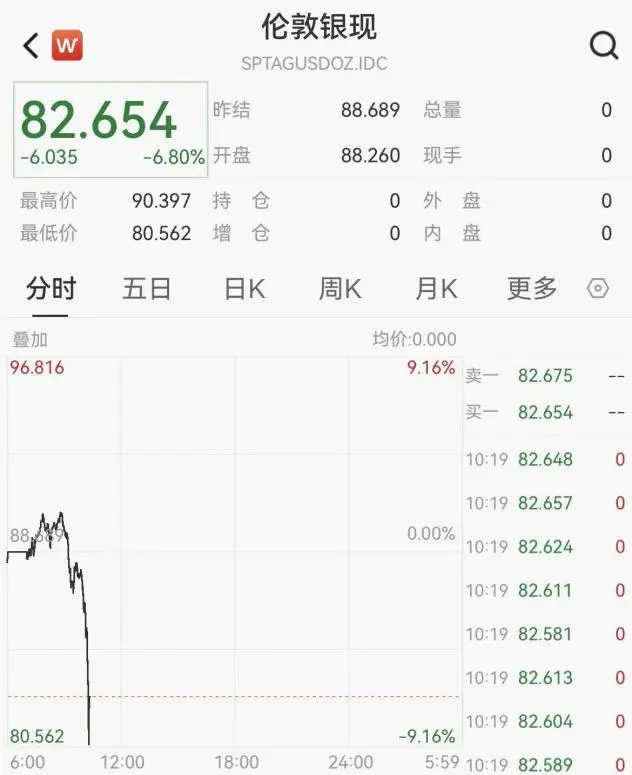
Group 1 - Spot gold prices experienced a significant drop, falling below $4900 per ounce, with a minimum price recorded at $4893.42 per ounce, reflecting a daily decline of over 1% [1][4] - Spot silver prices also plummeted, breaking the $81 per ounce mark, with a minimum price of $80.562 per ounce, resulting in a daily drop of more than 7% [2][4] - The overall precious metals market saw widespread declines, with various metals including platinum and palladium also experiencing significant price drops [5][6] Group 2 - In the A-share market, the precious metals sector opened with notable declines, with companies like Hunan Gold and Hunan Silver hitting the daily limit down of 10% [7][8] - Specific stock performances included: - Xiaocheng Technology down 10.20% with a market cap of 16.1 billion - Hunan Silver down 9.97% with a market cap of 39.2 billion - Hunan Gold down 9.60% with a market cap of 50.7 billion [8] - The Guotou Silver LOF fund hit the daily limit down for four consecutive days, with a premium rate dropping to 37.13% [8][9]
白银闪崩,贵金属板块直线跳水!消费股逆市大涨,贵州茅台4连阳,还有牛股6天5板!
雪球· 2026-02-05 08:16
Market Overview - The three major indices narrowed their declines in the afternoon, with the Shanghai Composite Index down 0.64%, the Shenzhen Component down 1.44%, and the ChiNext Index down 1.55% [3] - The total trading volume in the Shanghai and Shenzhen markets was 2.18 trillion yuan, a decrease of 304.8 billion yuan compared to the previous trading day, with over 3,700 stocks declining [4] Sector Performance Consumer Sector - The consumer sector saw significant gains, with food and beverage, retail, film and television, and tourism sectors being particularly active. Notably, Hengdian Film City recorded five consecutive trading days of gains [4][19] - Major stocks in the consumer sector, such as Kweichow Moutai, rose by 1.97%, bringing its market value to 1.95 trillion yuan [19][20] - The hotel and tourism sectors also performed well, with hotel bookings for long-distance travel increasing over 120% year-on-year as the Spring Festival approaches [21] Precious Metals - Precious metals experienced a sharp decline, with silver prices dropping over 16% at one point and gold prices falling over 3%. The precious metals sector fell more than 6%, leading the market decline [7][10] - Key stocks in the precious metals sector, such as Hunan Silver and Sichuan Gold, saw significant drops, with Hunan Silver hitting the daily limit down [9][10] Photovoltaic Sector - The photovoltaic sector opened with a sharp decline, with several leading stocks, including Junda Co. and Shuangliang Energy, hitting their daily limit down [12][14] - Companies like JinkoSolar and High Measurement Co. announced that they had not engaged in any collaboration with Elon Musk's team regarding space photovoltaic projects, which contributed to the sector's volatility [17] Conclusion - The market is currently characterized by significant volatility, particularly in the precious metals and photovoltaic sectors, while the consumer sector shows resilience and growth as the Spring Festival approaches [10][21]





A股三大指数低位窄幅震荡沪指跌0.64% 银行、零售板块逆势上涨
Xin Lang Cai Jing· 2026-02-05 07:52
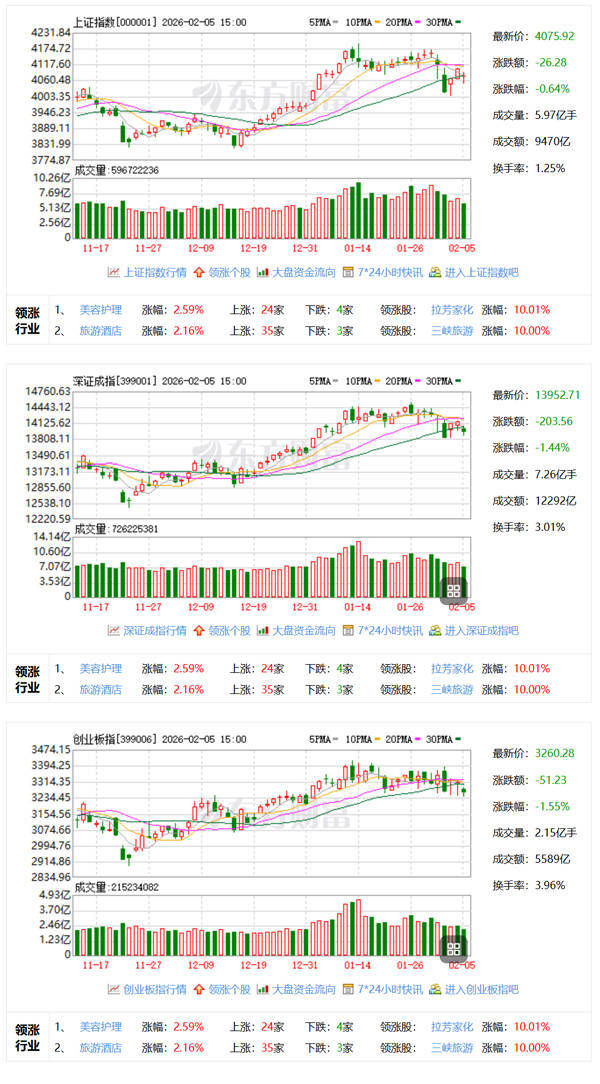
人民财讯2月5日电,2月5日,A股三大指数全天低位窄幅震荡,截至收盘,沪指跌0.64%,深证成指跌 1.44%,创业板指跌1.55%。盘面上,银行板块逆势上涨,厦门银行涨停。午后,零售板块异动拉升, 茂业商业、三江购物涨停。此外,林业、医疗美容、日用化工等板块涨幅居前。贵金属板块今日表现疲 软,湖南白银等多股跌停,多股大跌。光伏设备板块今日继续调整。光伏、CPO、煤炭等板块跌幅居 前。全市场超1600只个股上涨,全天成交额超2.1万亿元。 来源:人民财讯 作者:赖小风 ...
有色金属行业周报:大宗商品价格调整,继续看好后市机会
东方财富· 2026-02-05 07:45
Investment Rating - The report maintains an "Outperform" rating for the industry, indicating a projected increase in performance relative to the market index [2][15]. Core Insights - The report highlights a positive outlook for commodity prices, particularly in metals, driven by supply constraints and strong demand dynamics [1][7]. - It emphasizes the resilience of copper prices, with recent data showing a week-on-week increase of 3.5% for LME copper and 2.3% for SHFE copper, indicating strong market fundamentals [7]. - The aluminum sector is expected to maintain its strength, with a slight increase in SHFE aluminum prices despite a decrease in processing rates due to seasonal factors [7]. - The precious metals market is experiencing volatility, but there are opportunities for investment once price stability is achieved [7]. - The tungsten sector is noted for increased price fluctuations, while rare earth prices remain relatively stable, suggesting varied investment opportunities across different metal categories [7][11]. Summary by Sections Copper - Copper prices are showing strong resilience, with LME and SHFE prices at 133,370 and 103,680 USD/ton respectively, reflecting a week-on-week increase [7]. - Supply constraints are highlighted, particularly with declining grades in major mines in Peru, leading to expected production decreases in the coming years [7]. Aluminum - The report notes a slight decrease in LME aluminum prices but an increase in SHFE prices, indicating mixed market signals [7]. - Seasonal demand impacts are acknowledged, with a decrease in processing rates due to the Chinese New Year [7]. Precious Metals - The report discusses the recent fluctuations in precious metals, particularly gold, with SHFE gold prices at 1,161.4 CNY/gram and COMEX gold at 4,907.5 USD/ounce [7]. - The potential for investment is noted once the market stabilizes post-volatility [11]. Small Metals - Tungsten prices have increased by 12.3% week-on-week, while rare earth prices show stability, indicating diverse investment opportunities [7][11]. Steel - The report indicates that southern steel mills are proactively raising prices, with SHFE rebar and hot-rolled coil prices at 3,128 and 3,288 CNY/ton respectively [8]. - An increase in total inventory and consumption rates suggests a potential for profit improvement in the steel sector [8].
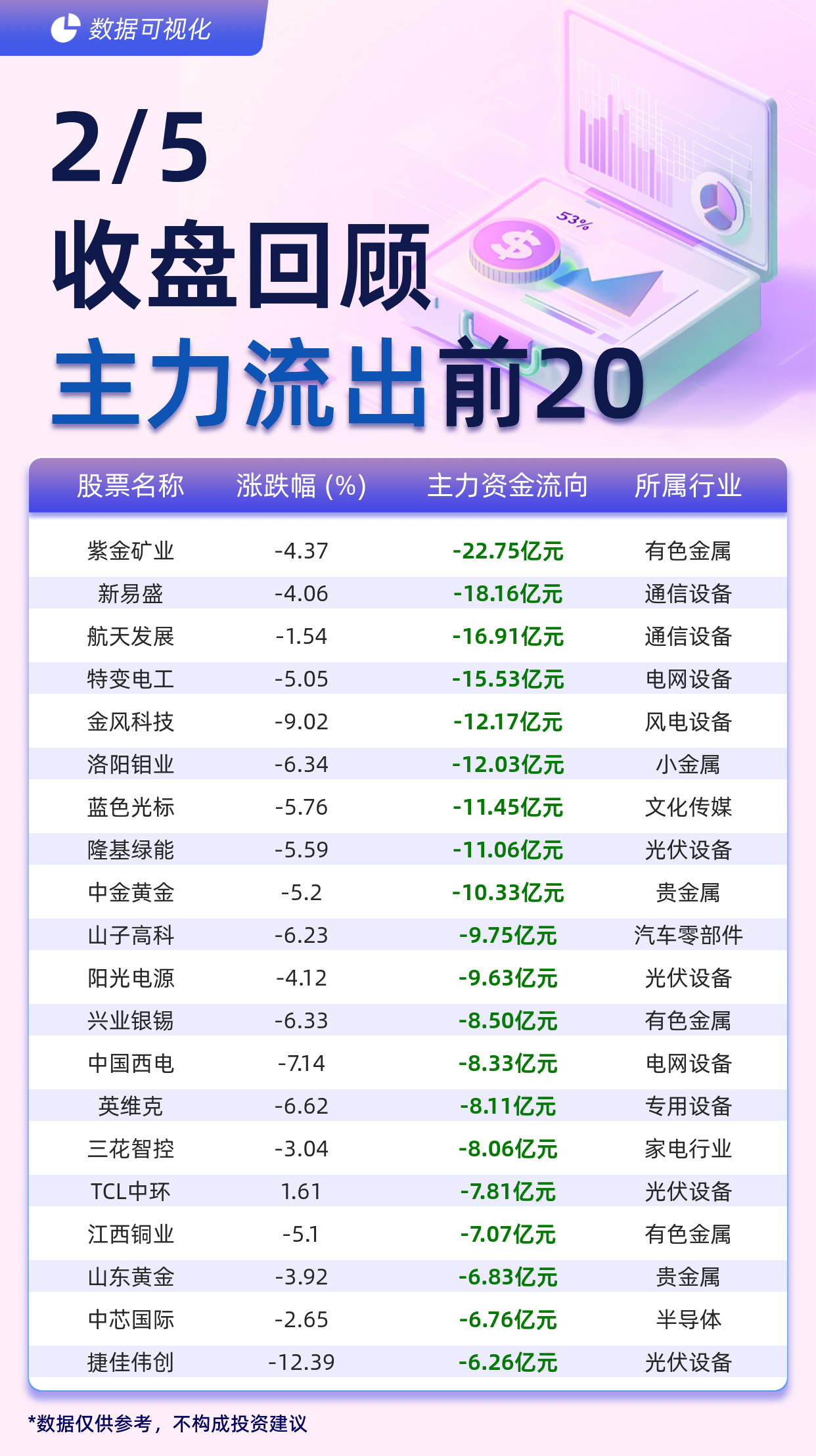
主力个股资金流出前20:紫金矿业流出22.75亿元、新易盛流出18.16亿元
Jin Rong Jie· 2026-02-05 07:43
Core Viewpoint - The data indicates significant outflows of capital from various stocks, with notable losses in both percentage and monetary terms across multiple sectors, particularly in metals, communication equipment, and renewable energy [1][2][3] Group 1: Stock Performance and Capital Outflow - Zijin Mining experienced a capital outflow of 2.275 billion, with a decline of 4.37% [2] - Xinyi Technology saw an outflow of 1.816 billion, with a decrease of 4.06% [2] - Aerospace Development had a capital outflow of 1.691 billion, reflecting a drop of 1.54% [2] - TBEA reported an outflow of 1.553 billion, with a decline of 5.05% [2] - Goldwind Technology faced a capital outflow of 1.217 billion, down by 9.02% [2] - Luoyang Molybdenum experienced an outflow of 1.203 billion, with a decrease of 6.34% [2] - BlueFocus Media saw an outflow of 1.145 billion, down by 5.76% [2] - Longi Green Energy had a capital outflow of 1.106 billion, with a decline of 5.59% [2] - Zhongjin Gold experienced an outflow of 1.033 billion, down by 5.20% [2] - Shanzhi High-Tech saw an outflow of 0.975 billion, with a decrease of 6.23% [2] - Sungrow Power Supply experienced an outflow of 0.963 billion, down by 4.12% [2] Group 2: Additional Stocks and Their Performance - Xinyi Silver experienced a capital outflow of 0.850 billion, with a decline of 6.33% [3] - China Western Power saw an outflow of 0.833 billion, down by 7.14% [3] - Inovance Technology had a capital outflow of 0.811 billion, with a decrease of 6.62% [3] - Sanhua Intelligent Control experienced an outflow of 0.806 billion, down by 3.04% [3] - TCL Zhonghuan saw an outflow of 0.781 billion, with a slight increase of 1.61% [3] - Jiangxi Copper experienced a capital outflow of 0.707 billion, down by 5.10% [3] - Shandong Gold saw an outflow of 0.683 billion, with a decline of 3.92% [3] - SMIC experienced a capital outflow of 0.676 billion, down by 2.65% [3] - Jiejia Weichuang faced an outflow of 0.626 billion, with a significant drop of 12.39% [3]



A股三大指数收跌,消费板块大涨,白银期货跌超10%
Sou Hu Cai Jing· 2026-02-05 07:39
Market Overview - The three major A-share indices collectively retreated, with the Shanghai Composite Index down 0.64% closing at 4075.92 points, the Shenzhen Component Index down 1.44% closing at 13952.71 points, and the ChiNext Index down 1.55% closing at 3260.28 points [1] - The trading volume in the Shanghai and Shenzhen markets was only 2.1945 trillion, a decrease of 309 billion compared to the previous day [1] Sector Performance - The financial sector showed strength in the afternoon, with Huayin Securities and Xiamen Bank hitting the daily limit [6] - The consumer sector experienced significant gains, with food and beverage, retail, film and television, and tourism hotel sectors being particularly active [7] - The beauty care and tourism hotel sectors led the gains, with the tourism hotel sector rising by 2.16%, featuring 35 gainers and only 3 losers, with Sanxia Tourism up by 10.00% [5] Individual Stock Highlights - Over 1600 stocks rose, with more than 50 stocks hitting the daily limit [7] - Notable stocks included Hengdian Film and Television with 6 gains in 5 days, Hangzhou Department Store with 2 consecutive gains, and several food and tourism stocks reaching the daily limit [7] - The commercial aerospace concept saw localized activity, with Shenjian Co. achieving 2 boards in 3 days [6]
国际金银价格持续震荡
新华网财经· 2026-02-05 07:37
Group 1 - The core viewpoint is that despite a recent rebound in gold and silver prices, they are still facing short-term selling pressure, and the outlook remains uncertain [2][3] - April gold futures are fluctuating between $4800 and $5000 per ounce, while March silver futures are in the range of $70 to $90 per ounce [2] - Analysts suggest that the recent sell-off in precious metals is more of a market adjustment rather than a trend reversal, indicating a potential for stable, non-linear price increases in the future [3] Group 2 - Key technical level for gold is identified at $5000 per ounce, which is considered a critical point [2] - Long-term fundamentals for gold remain solid, but short-term challenges persist [3] - The market is expected to experience volatility, making it premature to declare a bottom for gold prices [2]

A股收评:创业板指跌逾1.5%,贵金属重挫,旅游股逆市走强
Ge Long Hui A P P· 2026-02-05 07:28
Market Overview - The three major A-share indices collectively declined, with the Shanghai Composite Index down 0.64% to 4075 points, the Shenzhen Component Index down 1.44%, and the ChiNext Index down 1.55% [1][2] - The total market turnover was 2.19 trillion yuan, a decrease of 309 billion yuan compared to the previous trading day, with over 3700 stocks declining [1] Sector Performance - Precious metals stocks experienced significant declines, with Hunan Silver and Sichuan Gold dropping over 9%, and Xiaocheng Technology falling more than 10% [4][5] - The space photovoltaic concept stocks entered a "cooling period," with several stocks, including Junda Co. and Shuangliang Energy, hitting the daily limit down [2][6] - Lithium mining stocks also saw collective declines, with Ganfeng Lithium and Tianqi Lithium both dropping over 6% [7][8] - The tourism sector showed strength, with Sanxia Tourism hitting the daily limit up and Shaanxi Tourism rising over 8% [9][10] - New retail concept stocks were active, with companies like Huangting Hotel and Maoye Commercial hitting the daily limit up [11][12] - Bank stocks performed well, with Xiamen Bank hitting the daily limit up and Chongqing Bank rising over 5% [13] Key Stock Movements - Notable declines in precious metals included Xiaocheng Technology at -10.20%, Hunan Silver at -9.97%, and Sichuan Gold at -9.79% [5] - In the space photovoltaic sector, significant drops included Optech at -12.51% and Jiejia Weichuang at -12.39% [6] - Lithium stocks saw Ganfeng Lithium at -6.31% and Tianqi Lithium at -6.27% [8] - In the tourism sector, Sanxia Tourism rose by 10% and Shaanxi Tourism by 8.57% [10] - New retail stocks like Huangting International rose by 10.11% and Maoye Commercial by 10.04% [12] - Bank stocks showed strong performance with Xiamen Bank at +9.99% and Chongqing Bank at +5.73% [13]






1月资金行为跟踪:资金再平衡:公募和融资的预期差
ZHESHANG SECURITIES· 2026-02-05 07:28
- The report does not include any specific quantitative models or factors for analysis, construction, or testing results. It primarily focuses on market dynamics, fund flows, and sectoral trends without detailing quantitative methodologies or factor-based approaches[1][2][3]