有色金属

Search documents
3月金股报告:指数震荡,风格再平衡
ZHONGTAI SECURITIES· 2026-02-27 13:44
Core Insights - The report anticipates a fluctuating upward trend in the index, with a primary focus on style rebalancing [4][5] - The A-share market has shown signs of recovery after initial volatility, with significant performance differences among major indices [5][6] Domestic Policy and Market Liquidity - The People's Bank of China conducted a 600 billion MLF operation and net injected 300 billion, marking the 12th consecutive month of increased liquidity to ensure reasonable liquidity before and after the Spring Festival [2] - The strengthening of the RMB has stabilized expectations for cross-border capital flows [2] Sector Performance - In the technology sector, midstream high-end manufacturing has led the gains, particularly in defense, machinery, and power equipment, driven by geopolitical tensions and domestic equipment renewal cycles [2] - In the cyclical sector, building materials, steel, and coal have outperformed, with glass fiber leading due to supply-side optimization and demand from AI and new energy [3] - Conversely, the non-ferrous metals sector has seen a pullback due to fluctuating expectations around U.S. Federal Reserve interest rate cuts and geopolitical disturbances [3] Market Trends and Historical Context - Historical data from 2010 to 2025 indicates a high probability of the Shanghai Composite Index rising in the month following the Spring Festival, particularly after a month of adjustment or fluctuation [6] - The report suggests that the market is likely to follow a "diffusion" model of industry rotation rather than a dramatic style switch, with a focus on moderate rebalancing [6] Investment Strategy - The report recommends focusing on "supply constraints + visible profits" as dual main lines, particularly in midstream high-end manufacturing [6] - The core trading logic around the AI chain continues to revolve around profit visibility and supply shortages, with a cautious approach to market liquidity [6] - Opportunities for Chinese manufacturing to expand overseas are highlighted, particularly in sectors like power equipment and engineering machinery [6] Recommended Stocks - The March stock selection includes a mix of sectors such as central enterprise dividend ETFs, hospitality, electronics, military, machinery, beverages, and communications [10]





涨停复盘:今日全市场共92只股涨停,连板股总数10只,算力板块爆发,豫能控股、泰嘉股份涨停!
Jin Rong Jie· 2026-02-27 13:30
Market Overview - On February 27, the three major indices showed mixed results, with the Shanghai Composite Index rising by 0.39% and the ChiNext Index falling by 1.04% [1] - The total trading volume in the Shanghai and Shenzhen markets was 2.49 trillion yuan, a decrease of approximately 504.22 billion yuan compared to the previous trading day [1] - A total of 3,267 stocks rose in the market, with 92 stocks hitting the daily limit [1] Sector Performance - Rare metal concept stocks experienced a surge, leading to a wave of limit-up stocks, while sectors such as steel, gas, coal, and electricity also saw significant gains [1] - The cloud computing, AI applications, and computing power leasing themes were active, with notable stocks like Taijia Co., Ltd. and Tuo Wei Information hitting the limit [1] - The focus stocks included YN Holdings, which achieved a seven-day consecutive limit-up, and Jin Zheng Da in the chemical sector, which reached a four-day consecutive limit-up [1] Limit-Up and Limit-Down Stocks - A total of 75 stocks hit the daily limit (excluding ST and delisted stocks), with 10 stocks achieving consecutive limit-ups and 15 stocks failing to hit the limit, resulting in a limit-up rate of 83% [1] - Key stocks in the computing power sector included YN Holdings with seven consecutive limit-ups and Jiang Neng Co. with three consecutive limit-ups in the electricity sector [1] Related Hotspots - The fiber optic industry is experiencing high demand driven by global AI data centers and drones, while supply-side constraints are limiting rapid capacity increases [11] - The hard tool industry is facing a new round of price increases due to rising tungsten raw material prices, with tungsten powder exceeding 1,800 yuan per kilogram [11] - The computing power hardware sector is buoyed by Nvidia's performance guidance, alleviating market concerns about an "AI bubble" and demonstrating sustained demand for AI [11] - Huawei's CodeArts, an AI coding intelligent agent, was released for public testing, aimed at providing developers and enterprises with intelligent coding solutions [11]



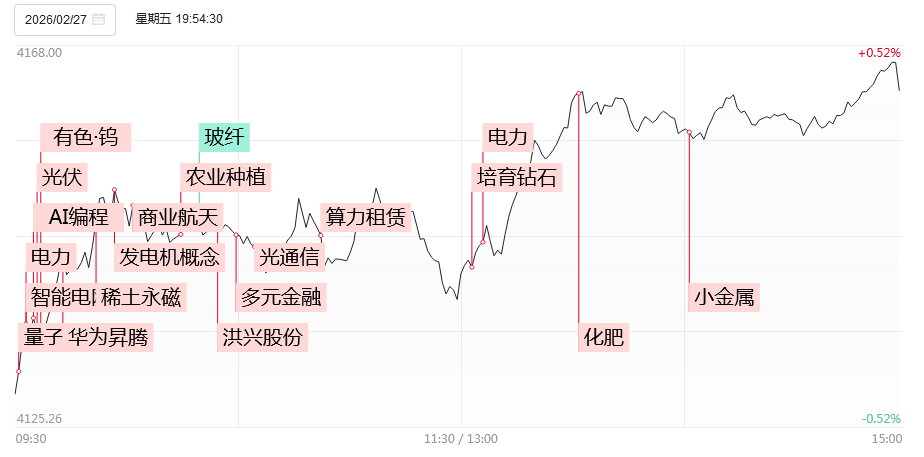
恐慌AI?近期科技股波动,基金业绩分化
Guo Ji Jin Rong Bao· 2026-02-27 13:19
Group 1 - The core concern among investors is the fear of AI technology replacing traditional industries, leading to a significant market adjustment, particularly in high-growth sectors [1][3] - Recent market data shows a notable decline in tech stocks, with the Nasdaq index dropping 1.18% and Nvidia's stock falling over 5% despite exceeding earnings expectations [1][3] - In contrast, traditional cyclical and resource stocks have performed well, with sectors like steel and non-ferrous metals leading gains in the A-share market [1][4] Group 2 - There is a divide in market sentiment regarding AI, with some fearing it will disrupt traditional industries, while others believe it will lead to iterative upgrades rather than outright disruption [3][6] - The performance of traditional sectors has outpaced high-growth sectors this year, with non-ferrous metals and construction materials showing significant gains of over 25% and 20%, respectively [4] - The recent volatility in the AI sector has led to a decline in the value of several funds heavily invested in AI applications and semiconductor sectors [4][7] Group 3 - Experts suggest that the current AI panic is a short-term risk release and does not alter the long-term trends of technological revolution and industrial upgrading [6][7] - The ongoing tech wave is expected to continue, driven by technological iteration and real industrial demand, with a distinction between structural bubbles and trend growth [7][8] - Investment opportunities in AI-driven computing power remain favorable, with expectations for significant market value increases in domestic computing power as companies adapt to new business models [8]

金丰来:地缘风险推动避险 黄金二月强劲反弹
Xin Lang Cai Jing· 2026-02-27 13:04
针对工业金属领域,铜价的表现则相对温和,正处于蓄势待发的阶段。铜价在二月的波动主要受到节假 日效应带来的库存增长影响,伦敦金属交易所铜期货本月仅小幅上涨1.2%至13333.0美元。然而,这并 不意味着基本面的转弱。随着人工智能建设的全球化提速,电力基础设施对铜的需求将呈现指数级增 长,当前的库存累积可能只是需求爆发前夕的短暂现象。 进入二月以来,黄金市场经历了从极度波动到重心稳步抬升的过程。金丰来认为,金价在月初曾一度下 探至4600美元的低位,但随后的一系列突发性地区冲突和外交博弈迅速激活了市场的避险买盘。同时, 世界主要经济体在贸易政策上的反复调整,以及法律裁决对关税框架的冲击,进一步加剧了市场对经济 增长前景的担忧。数据显示,四月黄金期货已攀升至5203.61美元,这不仅反映了实物需求的复苏,也 体现了资本市场对黄金对冲通胀及政策风险职能的高度认可。 在贵金属板块整体走强的带动下,白银与铂金也交出了亮眼的答卷。金丰来表示,现货白银本月累计上 涨6%至89.7785美元,而铂金则以8.4%的涨幅领跑。这种普涨格局说明,在当前的宏观语境下,贵金属 不仅扮演着单一的避险角色,更在流动性溢出的背景下成为了资产 ...

国投期货有色金属日报-20260227
Guo Tou Qi Huo· 2026-02-27 12:38
Report Industry Investment Ratings - Copper: な女女 [1] - Aluminum: ななな [1] - Alumina: なな☆ [1] - Cast Aluminum Alloy: 文文文 [1] - Zinc: な☆☆ [1] - Nickel and Stainless Steel: ☆☆☆ [1] - Tin: な女女 [1] - Lithium Carbonate: な女女 [1] - Industrial Silicon: ななな [1] - Polysilicon: な女女 [1] Core Viewpoints - The report provides investment ratings and market analyses for various non - ferrous metals, giving advice on trading strategies and market trends for each metal [1][2][3] Summaries by Metal Copper - On Friday afternoon, copper prices increased with the trading sentiment of small metals. This week, the trading range was stable above the dense moving averages. Before Trump's visit to China, his attitude towards Chinese tariffs was relatively lenient. The impact of the low - tariff implementation period on domestic exports is a key concern on the demand side. The SMM spot copper price is 101,980 yuan, and the Shanghai copper discount has widened to 260 yuan. Global exchange copper inventories are high. It is recommended to continue the inter - month reverse spread of near - month contracts. Copper prices may still face pressure from social inventory rhythms when approaching the upper end of the current shock range [1] Aluminum, Alumina and Aluminum Alloy - The Shanghai aluminum market oscillated today. The spot premiums and discounts in East China, Central China, and Foshan are - 180 yuan, - 290 yuan, and - 145 yuan respectively. Post - holiday inventory accumulation will continue for a long time, and the current inventory is at a high level in recent years. The short - term domestic fundamentals are weak, while the expected reduction in overseas supply supports prices, so it is treated as an oscillation for now. Cast aluminum alloy fluctuates with Shanghai aluminum. Driven by the macro - environment and with aluminum prices at a high level, the seasonal spread between cast aluminum alloy and Shanghai aluminum will continue to be weaker than in previous years. The operating capacity of domestic alumina has decreased, the over - supply situation has improved, and spot trading has rebounded slightly. However, with new production capacity approaching, continuous decline in ore prices, and rising warehouse receipts inventory, the driving force for the disk rebound is relatively limited, and alumina will mainly oscillate within a range in the near future [2] Zinc - Downstream consumption has not fully recovered, TC is at a low level, and the expected supply increase of overseas mines in 2026 is lower than expected. The fundamentals are both positive and negative. The Shanghai zinc market lacks a clear directional driver in the short term, and the disk is in a narrow - range consolidation at a high level. The trading enthusiasm of funds is mediocre. Wait for more macro - guidance and stay on the sidelines for now [3] Nickel and Stainless Steel - Shanghai nickel continued to rebound. In the short term, nickel is affected by the rebound of the metal periphery and continues to rise. In addition, the expected reduction in Indonesian ore production continues to support the price trend, but the extremely high level of spot inventory is a concern. The Jinchuan premium is 8,550 yuan, the imported nickel discount is 50 yuan, and the electrowinning nickel premium is 100 yuan. The short - term trend is unclear, mainly oscillating [6] Tin - Shanghai tin increased with large positions, resonating with the sentiment of small - metal stocks. The increase exceeded 450,000 yuan, and the royalty increased rapidly. Pay attention to the trading rhythm of small metals. NVIDIA's quarterly performance exceeded expectations, but its related stock price encountered selling pressure in the short term. Against the background of rising storage prices, the sales of electronic and digital products led by mobile phones face great pressure to cool down, and traditional industries are also difficult to actively absorb high tin prices. On the supply side, the production in Indonesia and Myanmar was basically stable in February. Wait for domestic social inventory, pay attention to the trading rhythm of the industrial end, and patiently monitor the changes in the royalty of out - of - the - money sell - call options [7] Lithium Carbonate - Lithium carbonate oscillated. The market trading was active. Zimbabwe stopped exporting lithium carbonate resources, causing concerns on the supply side. The performance of the non - ferrous and precious metal periphery was strong. Downstream enterprises had sufficient pre - stockpiles, and they were highly cautious and had weak trading willingness when the lithium carbonate price fluctuated. Spot trading was rather dull. Technically, lithium carbonate oscillates strongly, and risk management should be noted [8] Industrial Silicon - The industrial silicon futures closed slightly lower. After the holiday, the trading activity of the disk was average, and the prices of some spot grades decreased slightly. Downstream silicone enterprises maintained production - reduction measures. According to SMM data, the operating rate dropped slightly to about 60% compared with before the holiday. Most enterprises reduced production, suppressing the demand for industrial silicon. The inventory of downstream polysilicon continued to rise, spot trading was dull, and enterprises had price - cut expectations. Overall, the demand for industrial silicon is still weak. There were production - reduction actions in Xinjiang before the holiday, and the short - term market driver is more focused on the supply changes in the north. The market is likely to continue to oscillate at a low level [9] Polysilicon - Polysilicon futures closed slightly lower. The policy - end governance of the industry is more market - oriented and legalized. Leading enterprises issued acquisition announcements, and the market still has differences on the impact of production capacity. In February, the polysilicon production decreased significantly month - on - month, but the downstream silicon wafer production reduction exceeded expectations. Coupled with the continuous dull spot trading, the polysilicon inventory continued to accumulate. According to SMM, the current average price of V - type re - feed material is 52,000 yuan/ton, a decrease of 1,000 yuan/ton from yesterday. The short - term market trend may be weak [10]
长城基金:市场主线逐渐清晰,硬科技与顺周期机会凸显
Xin Lang Cai Jing· 2026-02-27 11:51
Core Viewpoint - The A-share market has shown a continuation of the risk appetite recovery observed before the Spring Festival, characterized by "increased volume and structural differentiation" in the first trading week after the holiday [1][3]. Market Performance - The overall market trend is influenced by rising overseas uncertainties, with geopolitical and tariff narratives resurfacing, leading to a pullback in the Hong Kong stock market while energy and resource sectors perform relatively well [1][3]. - A-shares exhibit a stronger internal momentum, maintaining high trading volumes with total turnover exceeding 2 trillion yuan [1][3]. Market Structure - The market style has shifted from a focus on "pure software/AI applications" to "hard technology + cyclical stocks" [1][3]. - The cyclical sector has shown a phase of strength, driven by geopolitical risk premiums pushing up energy prices and uncertainties around tariffs leading to "re-inflation trades" [1][3]. - The hard technology sector is characterized by a "discerning" approach, with funds favoring companies with verifiable orders and performance in the computing hardware chain (e.g., optical communication, PCB, liquid cooling), while being sensitive to AI software themes lacking performance validation [1][3]. Investment Strategy - The first week after the holiday has reinforced market risk appetite, but variables such as overseas geopolitical issues, tariffs, and interest rate expectations may amplify volatility [4]. - The current investment focus is clear, transitioning from narrative-driven to performance-driven, with attention on the following areas: - Emphasis on "performance verification" and "domestic substitution," particularly in AI computing hardware chains, semiconductor equipment, and materials, while avoiding high-volatility stocks without performance support [4]. - Focus on cyclical and resource sectors, leveraging the "hedging attributes" of geopolitical premiums and re-inflation, with potential value in energy, precious metals, and non-ferrous metals, while also considering traditional industries benefiting from "anti-involution" [4]. - Defensive and thematic directions, suggesting high-dividend sectors may offer some "anti-volatility" value amid increased fluctuations, with recommendations to base themes on policy documents and industry progress, avoiding purely conceptual extrapolations [4].
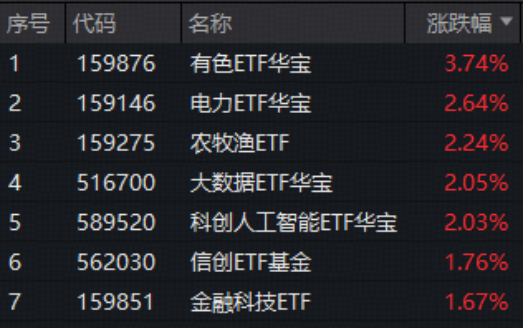
“HALO交易”火爆出圈!电力ETF(159146)再涨2.64%连创上市新高!涨价题材大放异彩!有色ETF最高上探3.82%
Xin Lang Cai Jing· 2026-02-27 11:45
Market Overview - A-shares concluded February with the Shanghai Composite Index achieving three consecutive monthly gains, and daily trading volumes exceeding 1 trillion yuan have become the norm [1][20] - On February 27, the three major indices showed mixed results, with over 3,200 stocks rising and a total trading volume of 2.51 trillion yuan, slightly down by 504 billion yuan from the previous day [1][20] Sector Performance - The small metals sector surged, with rare earth prices continuing to rise, leading to a wave of limit-up stocks including Hunan Gold [21][23] - The chemical sector also performed well, with the chemical ETF achieving four consecutive daily gains, reaching its highest point since January 2022 [21][23] AI and Technology Impact - China's AI token usage surpassed that of the US for the first time, indicating a potential benefit for domestic computing power [21][29] - The cloud computing sector is entering a price increase cycle, with the big data ETF seeing a significant price increase [21][29] Electricity Sector - The electricity sector experienced a strong rally, with the electricity ETF rising by 2.64%, reaching a new high since its listing [2][26] - The demand for electricity is expected to increase due to the growth of AI, making it a defensive investment in the current market environment [2][29] Medical Sector - The largest medical ETF in the market saw a price increase of 1.14%, recovering its annual line, with significant net subscriptions in the previous days [2][29] - The medical sector is expected to benefit from the growth of the CXO model, with strong performance from companies like WuXi AppTec [12][29] Investment Recommendations - Focus on cyclical commodities such as chemicals, non-ferrous metals, and agricultural products, as well as sectors related to technology and national strength, such as military and new energy [22] - The medical sector is recommended for investment, particularly in areas like AI healthcare and medical devices, which are expected to see significant growth [15][16]


上期所铜库存激增43.7% 创约10年来最高水平
Wen Hua Cai Jing· 2026-02-27 11:10
Group 1 - The core point of the articles highlights a significant increase in copper inventories in China, with Shanghai Futures Exchange reporting a rise of 119,054 tons or 43.7% to 391,529 tons, the highest level since March 2016, marking the 11th consecutive week of increase [2] - The increase in copper inventories is attributed to a decline in demand around the Chinese New Year holiday, which aligns with global trends as LME copper inventories also rose to 253,700 tons since January 12 [2] - Comex copper inventories are also on the rise, albeit at a slower pace, reaching 601,048 short tons (approximately 545,261.57 tons) as of Thursday [2] Group 2 - The Shanghai copper main contract saw a price increase of 1.19% to 103,920 yuan per ton, with a cumulative rise of 3.53% in the first trading week after the Chinese New Year [2] - LME three-month copper is expected to record a weekly increase of about 4% [3] Group 3 - The Chinese copper industry faces three major challenges: increasing reliance on foreign resources, overcapacity in the midstream processing sector, and suppressed downstream demand due to high copper prices [4] - To assist the industry in navigating these challenges, a bilingual version of the "2026 China Copper Industry Chain Distribution Map" has been compiled in collaboration with copper industry chain enterprises [4]
策略点评:低开高走,震荡上行
Tebon Securities· 2026-02-27 11:09
Market Analysis - The A-share market opened lower but closed higher, continuing the upward trend after the Spring Festival, with the Shanghai Composite Index fluctuating between 4130 and 4170 points, ultimately closing at 4162.88, a gain of 0.39% [2] - The Shenzhen Component Index showed relative weakness, closing at 14495.09, down 0.06%, while the ChiNext Index fell 1.04% to 3310.30 [2] - Overall market sentiment was positive, with 3267 stocks rising and 2066 falling, and trading volume remained high at 2.51 trillion yuan [2] Sector Performance - Cyclical stocks led the market, with indices for non-ferrous metals, steel, and coal rising by 3.24%, 3.18%, and 3.03% respectively, while rare metals and rare earth sectors surged by 7.81% and 7.45% [5] - The technology sector faced adjustments, particularly in hardware, with indices for copper-clad laminates, semiconductor silicon wafers, and circuit boards declining by 2.51%, 2.17%, and 2.01% respectively [5] Bond Market - The government bond futures market exhibited a mixed trend, with short-term contracts generally rising and the long-term 30-year contract slightly declining [10] - The People's Bank of China conducted a 269 billion yuan reverse repurchase operation, maintaining a net injection of liquidity, which supported short-term interest rates [10] Commodity Market - The commodity index rose by 0.46%, with the Shanghai tin contract leading the market with an 8.38% increase, reaching 453,240 yuan per ton, marking the largest single-day gain in 2026 [10][12] - Platinum futures rose by 5.34% to 623.75 yuan per gram, driven by potential supply constraints from new EU sanctions on Russia [12] Investment Opportunities - Key sectors to watch include AI applications, commercial aerospace, nuclear fusion, quantum technology, brain-machine interfaces, robotics, and consumer goods, all supported by government policies and market trends [13] - The bond market is expected to react to upcoming policy announcements during the National People's Congress, particularly regarding fiscal deficit rates and real estate support policies [16]
集团财务金融部开展节前防范非法集资系列宣传活动
Xin Lang Cai Jing· 2026-02-27 10:38
Core Viewpoint - The company is implementing a comprehensive campaign to prevent illegal fundraising activities, particularly ahead of the Spring Festival, by utilizing both online and offline strategies to enhance financial security awareness among employees and their families [1][5]. Online Multi-Dimensional Promotion - The company's WeChat public account "Baotai Qimingxing" has launched a special initiative to raise awareness about illegal fundraising, detailing common tactics, characteristics, and severe consequences, urging employees to adopt rational investment concepts and resist high-interest temptations [2][7]. - A well-produced promotional video on the WeChat account illustrates case studies and provides accessible risk warnings, aiming to deeply embed the concept of prevention in the minds of employees [2][7]. Offline Immersive Engagement - The campaign focuses on high-traffic areas where employees frequently gather, creating an environment where promotional materials are readily available and learning can occur during breaks [4][10]. - Digital displays in the lobby continuously show prevention videos, while informative displays at elevator entrances break down typical illegal fundraising scams, serving as a "mobile safety classroom" for employees [4][10]. - Financial department staff distribute brochures containing key information on identification techniques and reporting channels, significantly enhancing the reach and impact of the campaign [4][10]. Commitment to Financial Risk Prevention - The financial department prioritizes the prevention and resolution of financial risks, viewing this pre-festival campaign as a concrete action to fulfill regulatory requirements and a demonstration of corporate social responsibility to protect employees' interests [4][10]. - The multi-faceted promotional efforts effectively improve employees' ability to identify and prevent financial risks, fostering a culture where everyone is aware of and committed to prevention [4][10].