
机械设备

Search documents
超1100亿元,深市公司回购增持彰显信心,真金白银护航市场稳定
Zheng Quan Shi Bao· 2026-01-04 12:19
Core Insights - Since 2025, companies listed on the Shenzhen Stock Exchange have actively engaged in share buybacks and increases, with a total of 424 disclosed plans amounting to a maximum of 114.25 billion yuan, reflecting their confidence in long-term development and enhancing investor trust [1][3]. Group 1: Overall Trends - The overall trend in 2025 shows a significant increase in willingness for share buybacks and increases, characterized by high intent, considerable scale, and industry concentration [2][3]. - Out of the 424 disclosed plans, 288 were buyback plans with a maximum amount of 82.725 billion yuan, while 136 were increase plans with a maximum of 31.521 billion yuan [3]. Group 2: Industry Focus - Key industries leading the buyback efforts include electronics, biomedicine, machinery, and power equipment, accounting for 40.97% of total buybacks, while biomedicine, machinery, basic chemicals, and home appliances lead in increases, making up 37.78% [3]. - The buyback and increase activities are seen as mechanisms for companies to optimize their equity structure and enhance shareholder returns, contributing to market stability and liquidity [3]. Group 3: Leading Companies - Leading companies in various sectors have played a pivotal role in guiding market trends through substantial buybacks and increases, establishing benchmarks and stabilizing expectations [4][5]. - Midea Group has executed a buyback plan exceeding 10 billion yuan, aimed at reducing registered capital and implementing employee stock ownership plans, thereby enhancing shareholder equity [5]. - Contemporary Amperex Technology Co., Ltd. (CATL) plans to buy back shares totaling between 4 billion and 8 billion yuan, reflecting its commitment to value creation [5]. Group 4: Market Dynamics - The buyback activities of leading companies are seen as a reflection of rational recognition of their value and the gradual emergence of long-term investment value in the capital market [6]. - The ongoing market reforms and regulatory improvements are expected to sustain the positive momentum of buybacks and increases, providing robust support for the high-quality development of the capital market [6].
中信建投:多重利好推动港股大涨 A股有望迎来开门红行情
智通财经网· 2026-01-04 11:44
Group 1 - The A-share market is expected to experience a "New Year opening red" trend due to improved liquidity and exchange rate conditions compared to the previous two years [1][3] - Key sectors to focus on include semiconductors, AI, non-bank financials, new energy, and machinery equipment, with a long-term positive outlook on industrial metals, small metals, and innovative pharmaceuticals [1] - The market sentiment index has risen to 80, indicating high investor enthusiasm, and the "cross-year market" is likely to continue into January [2] Group 2 - The geopolitical tension from the U.S. military action in Venezuela is expected to lead to short-term increases in gold and oil prices, while the long-term impact on international oil prices may be negative [4] - China's heavy reliance on Venezuelan crude oil, which accounts for 80% of its imports, poses risks to certain chemical products due to potential instability in raw material supply [4] - The domestic technology sector, particularly semiconductors and AI chips, is positioned as a core driver of market performance, supported by government policies promoting smart devices and venture capital initiatives [4]

深市公司回购增持彰显信心 “真金白银”护航市场稳定
Zheng Quan Ri Bao Wang· 2026-01-04 10:32
Core Insights - Share buybacks and increases are important market mechanisms for listed companies to convey development confidence, stabilize stock prices, optimize capital structures, and protect shareholder rights [1] Group 1: Market Activity - In 2025, companies listed on the Shenzhen Stock Exchange (SZSE) disclosed a total of 424 buyback and increase plans, including 288 buyback plans with a maximum amount of 82.725 billion yuan and 136 increase plans with a maximum amount of 31.521 billion yuan [1] - Since the introduction of special loans for buybacks and increases, 383 companies and major shareholders have obtained commitment letters for these loans, with a total loan amount of 82.981 billion yuan [1] Group 2: Industry Trends - The electronics, biomedicine, machinery equipment, and power equipment sectors are the main contributors to buybacks, accounting for 40.97% of the total [1] - The biomedicine, machinery equipment, basic chemicals, and home appliances sectors lead in increases, making up 37.78% of the total [1] Group 3: Company Examples - Midea Group (000333), a leader in home appliances, has launched a second buyback plan based on confidence in its future development, with a total buyback exceeding 10 billion yuan [2] - Contemporary Amperex Technology Co., Ltd. (300750), a leader in power equipment, plans to buy back shares totaling no less than 4 billion yuan and no more than 8 billion yuan, with a cumulative buyback amount of 4.386 billion yuan [2] - CIMC Group (000039) has engaged in cross-border buybacks, simultaneously repurchasing A-shares and H-shares to demonstrate recognition of its value [2] Group 4: Market Outlook - The buyback and increase activities reflect a rational recognition of company value and the gradual emergence of long-term investment value in the capital market [3] - With ongoing market reforms and improved regulatory systems, leading companies are expected to continue driving positive trends in buybacks and increases, supporting high-quality development in the capital market [3]
深市上市公司回购增持活跃 2025年披露计划超400单
2 1 Shi Ji Jing Ji Bao Dao· 2026-01-04 09:37
Core Insights - The trend of share buybacks and major shareholder increases among Shenzhen-listed companies has become normalized due to policy support and corporate confidence in market development [2][4] - In 2025, a total of 424 buyback and increase plans were disclosed in the Shenzhen market, with buyback plans accounting for 288 and a maximum buyback amount of 82.725 billion yuan, while increase plans totaled 136 with a maximum amount of 31.521 billion yuan [2] - Since the launch of special loans for buybacks and increases, 383 companies and major shareholders have obtained loan commitment letters totaling 82.981 billion yuan [2] Industry Distribution - Companies in the electronics, biomedicine, machinery, and power equipment sectors have become the main force in buybacks, accounting for 40.97% of total activities [2] - The biomedicine, machinery, basic chemicals, and home appliances sectors lead in shareholder increases, making up 37.78% of the total [2] Company Actions - Leading companies are acting as "ballast stones" in the market through significant buybacks and continuous increases [2] - Midea Group (000333) has launched a second buyback plan based on confidence in its future development, with total buybacks exceeding 10 billion yuan, enhancing shareholder equity and binding core team interests [2] - Contemporary Amperex Technology Co., Ltd. (300750) plans to repurchase shares totaling between 4 billion and 8 billion yuan, with a cumulative buyback amount of 4.386 billion yuan, reflecting its industrial ambitions [3] - Mindray Medical (300760) saw its chairman increase shares by 200 million yuan, demonstrating recognition of the company's intrinsic value [3] Cross-Border Buybacks - Cross-border buybacks have emerged as a new highlight, with China International Marine Containers (000039) disclosing simultaneous buybacks of A-shares and H-shares, showcasing recognition of company value [3] Market Outlook - The buyback and increase activities of listed companies reflect a rational recognition of their own value and the gradual emergence of long-term investment value in the capital market [4] - With ongoing market reforms and regulatory improvements, leading companies are expected to continue exerting a strong "driving effect," supporting the sustained positive trend of buybacks and increases in the Shenzhen market [4]


春风送暖
Huaan Securities· 2026-01-04 09:32
Group 1 - The macro policy continues to strengthen, with a significant improvement in the construction PMI indicating that investment is expected to stabilize, and the possibility of a reserve requirement ratio cut is increasing, alongside currency appreciation and public fund allocation supporting micro liquidity, suggesting a gradual spring market may unfold [3][4][5] - The probability of a "good start" in the market is increasing, driven by continuous positive factors such as policy support in consumption and real estate, a significant improvement in construction PMI, and the potential for a reserve requirement ratio cut in January [4][5] - The economic fundamentals show marginal changes, with a focus on whether the investment sector can stabilize at the beginning of the year, as the construction PMI has rebounded significantly, indicating potential policy effectiveness in stabilizing investment [5][25][26] Group 2 - The industry configuration emphasizes "stories" and "performance" as key elastic opportunities, with the AI industry chain identified as the strongest mainline, focusing on computing power, supporting components, and key applications [6][40][41] - The first mainline is the AI industry chain, which is expected to continue its strong trend, with attention on computing power (CPO/PCB), supporting components (optical fibers/liquid cooling/power supply), and applications (robots/games/software) [40][41][43] - The second mainline focuses on sectors with high prosperity or significant event catalysts, including storage and energy storage chains, military industry, and machinery equipment, with expectations of long-term prosperity driven by AI demand and geopolitical events [41][42]
华金证券:节后春季行情进行中 聚焦成长
Xin Lang Cai Jing· 2026-01-04 08:42
Group 1 - The short-term performance of A-shares after the New Year is mainly influenced by policies, external events, liquidity, and overseas market trends [1][6] - Since 2010, in 16 years, the Shanghai Composite Index has risen in 11 instances during the 10 trading days before the holiday and has shown similar patterns after the holiday [1][6] - Positive policies and external events are core influencing factors for post-holiday A-share performance, with examples including the resolution of the "fiscal cliff" in the US in January 2013 and the easing of US-China trade tensions in early 2019 [1][6] Group 2 - Current observations suggest that the A-share spring market is ongoing, with potential for a strong but volatile performance post-New Year [1][6] - There is a likelihood of further positive policy implementation after the holiday, including the rollout of guidelines for equipment updates and trade-in policies, as well as local government meetings to stimulate consumption [1][6] Group 3 - External risks post-holiday are expected to be limited, with a high probability of a Federal Reserve rate cut in January and stable US-China relations, although tensions with Japan may persist [2][7] - Liquidity is anticipated to further loosen, with potential for accelerated capital inflow into the stock market [2][7] Group 4 - The economic recovery remains weak, with industrial profits continuing to decline, but there is potential for recovery in certain sectors, particularly in technology and cyclical industries [2][7] - Historical trends indicate that industries driven by upward policies and trends before the holiday are likely to maintain their strength afterward [3][8] Group 5 - Recommendations for post-holiday investment include focusing on technology, certain cyclical sectors, and consumer industries, with specific mention of machinery, military, new energy, media, computing, electronics, telecommunications, and pharmaceuticals [4][9] - Current PEG ratios for growth sectors like power equipment and media are relatively low, indicating potential for investment [4][9]
“转型牛”远远没有结束!国泰海通方奕:具备三大动力,2026年A股将迎新高度
券商中国· 2026-01-04 08:15
Core Viewpoint - The article discusses the ongoing "transformation bull market" in China's capital market, driven by structural economic changes and capital market reforms, with expectations for continued growth and opportunities in emerging technologies and industries [4][9][18]. Group 1: Market Performance - In 2025, China's assets led the world, with the Shanghai Composite Index breaking the 4000-point mark, closing the year up 18.41%, while the Shenzhen Component Index rose 29.87%, and the ChiNext Index surged 49.57% [2]. - After reaching 4000 points on October 28, 2025, the Shanghai Composite Index experienced a two-month fluctuation between 3800 and 4000 points, influenced by various factors including U.S.-China relations and domestic real estate market weakness [5]. Group 2: Economic and Market Dynamics - The "transformation bull market" reflects three significant marginal changes in China's economy: a reduction in the drag from traditional industries like real estate, accelerated expansion of new technologies and industries, and the global competitiveness of manufacturing sectors [4][17]. - The article emphasizes that the capital market's ability to consolidate social confidence and capital is unprecedented, marking a historical change in China's financial landscape [11]. Group 3: Future Outlook - The article expresses optimism for the spring market, predicting a "spring opening red" for the stock market, with expectations for policy support, liquidity, and improved fundamentals [6]. - The anticipated growth in 2026 is projected to be double-digit, with a forecast of 10.6% growth for non-financial A-shares, driven by the ongoing transformation of the economy [17][18]. Group 4: Key Drivers of the "Transformation Bull Market" - Three main drivers are identified for the "transformation bull market": the breaking of "guaranteed returns" and the decline of risk-free yields, capital market reforms enhancing investment confidence, and reduced uncertainty in economic development [13][14][16]. - The breaking of "guaranteed returns" has led to a significant drop in fixed-income product yields, prompting investors to seek higher returns in equities and diversified assets [14]. - Capital market reforms have improved the investment environment, increasing the attractiveness of the stock market and stabilizing market volatility [15].

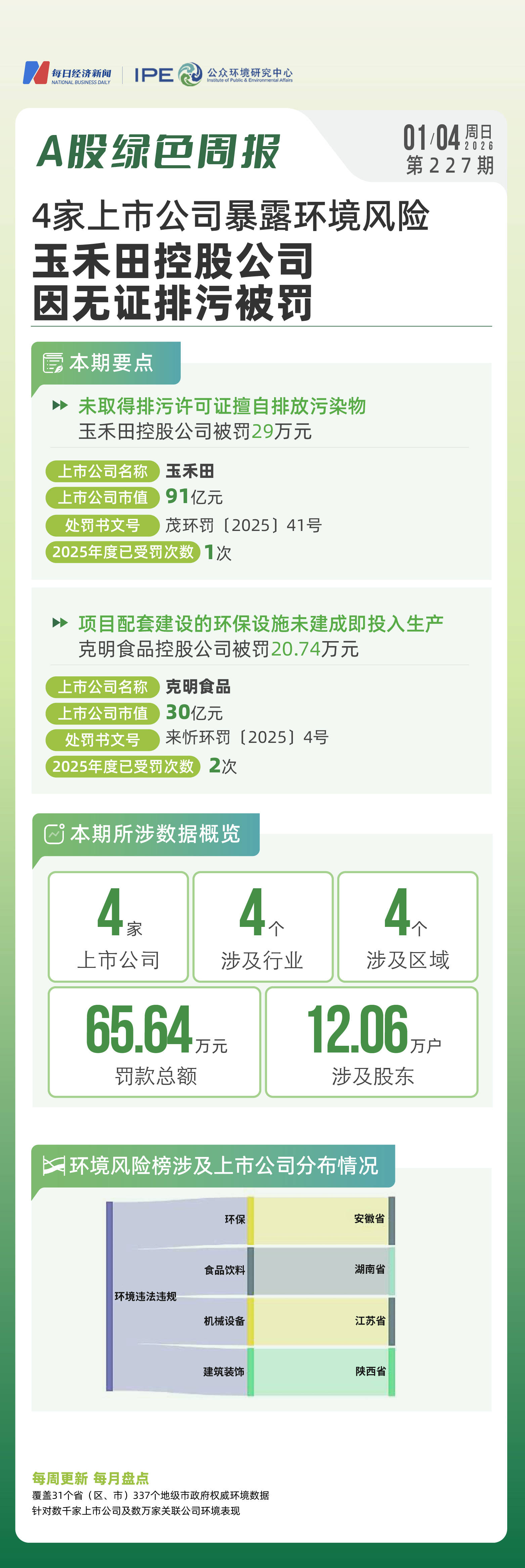
A股绿色周报|4家上市公司暴露环境风险 玉禾田控股公司因无证排污被罚
Sou Hu Cai Jing· 2026-01-04 08:05
Core Viewpoint - The article highlights the increasing environmental risks faced by publicly listed companies in China, with four companies recently penalized for environmental violations, emphasizing the importance of environmental responsibility in corporate governance and investment decisions [12][16]. Group 1: Environmental Violations and Penalties - Yuhua Tian Holdings (SZ300815) was fined 290,000 yuan for discharging pollutants without obtaining a pollution discharge permit [10][16]. - Kemin Food Holdings (SZ002661) received a penalty of 207,400 yuan for starting production without completing the necessary environmental protection facilities [10][18]. - New Sharp Co., Ltd. (SH688257) was fined 109,000 yuan for failing to properly label hazardous waste [17][18]. Group 2: Regulatory Context and Data Collection - The article discusses the collaboration between Daily Economic News and the Public Environmental Research Center (IPE) to analyze environmental data from thousands of listed companies in China since September 2020 [11][12]. - The environmental information is sourced from government records across 31 provinces and 337 cities, aiming to enhance transparency in corporate environmental practices [11][12]. - The increasing focus on ESG (Environmental, Social, and Governance) principles is driving investors to pay more attention to companies' sustainable development capabilities [19][20].



苏股2025复盘:IPO数量全国第一,苏州力压北上广深
Sou Hu Cai Jing· 2026-01-04 05:43
作者 | 深水财经社 倪大九 今天是2026年第一个工作日,首先祝大家今年都能收获满满、事业顺遂! 不声不响间,2025年已经过去。Wind数据显示,截至12月31日收盘,1400多家公司涨幅逾50%,近500家公司涨幅突破100%,更有120多家公司年涨幅超 200%,所以大家都赚到钱没? 最近,强哥会对2025年江苏A股上市公司进行一个全面的盘点,今天细说的是IPO情况。 2025年,A股共有116家企业成功上市,较2024年增长16%。其中江苏新增A股公司29家,数量位居全国第一。 其中的"领头羊"苏州更创下历史性突破——全年新增12家A股上市公司,数量首次登顶全国各大城市榜首。 2023年"827新政"以来,IPO持续收紧,2024年IPO数量和募资规模跌至十年最低。 2025年,IPO情况有所回暖。A股新上市公司数量116家,募资1318亿元,分别较上年增长16%和104%。 其中,江苏新增29家A股公司,数量位居全国第一,领先广东(21家)和浙江(17家),占全国新增总数的四分之一。 这样一来,江苏的A股公司总数就达到了721家,距离第二名浙江仅10家的差距,这样下去到明年很可能会追平浙江。 细数 ...

定期报告:节后春季行情进行中聚焦成长
Huajin Securities· 2026-01-04 02:01
1. Report Industry Investment Rating No relevant content provided. 2. Core Viewpoints of the Report - This year after the New Year's Day, the A - share spring market is underway and may be volatile and bullish, affected by factors such as policy implementation, liquidity, and the performance of the Hong Kong stock market [1][4][7]. - After the holiday, technology growth and some cyclical industries may be relatively dominant, with continuous upward industrial trends and policy support [1][26]. - After the holiday, it is recommended to continue to allocate industries such as technology, some cyclical and consumer sectors on dips [1][38][46]. 3. Summary by Relevant Catalogs 3.1 Post - holiday Spring Market is Underway 3.1.1 Factors Affecting Post - holiday A - share Movement - Since 2010, in 11 out of 16 years, the Shanghai Composite Index showed the same upward or downward trend in the 10 trading days before and after the holiday. The post - holiday short - term market performance is affected by policies, external events, liquidity, and the performance of the Hong Kong stock market [1][4]. - Positive policies and external events may lead to a short - term rise in the post - holiday A - shares, while tight policies or negative external events may result in weak performance. Liquidity also plays a key role, and the performance of the Hong Kong stock market during the holiday has a certain impact on the post - holiday A - shares [4]. 3.1.2 This Year's A - share Spring Market is Underway and May be Volatile and Bullish - Positive policies may continue to be implemented after the holiday, and external risks may be limited. The "two new" policies are accelerating implementation, local two - sessions may be held intensively, and consumption - stimulating policies may be introduced. Externally, the Fed may cut interest rates in January, Sino - US relations may remain stable, and geopolitical conflicts may ease [7][8]. - Post - holiday short - term liquidity may be further relaxed. Overseas, the Fed is likely to cut interest rates, and the RMB exchange rate may be strong. Domestically, the central bank may cut interest rates and reserve requirements. Also, stock market funds may accelerate inflow [9]. - The Hong Kong stock market performed strongly during the New Year's Day holiday, which may boost the post - holiday A - shares. The correlation coefficient between the Hong Kong stock market's rise and fall during the New Year's Day holiday and the Shanghai Composite Index's rise and fall in the 10 trading days after the holiday is about 0.5 [18][19]. - The post - holiday economy and corporate profits are still in weak recovery. The economy is in a weak recovery state, and corporate profits may continue to recover, although the industrial enterprise profits in November continued to decline [21]. 3.2 Industry Allocation: Focus on Growth after the Holiday 3.2.1 Technology Growth and Some Cyclical Industries May be Relatively Dominant after New Year's Day - Historically, policy and industrial trends drive pre - holiday strong industries to maintain their strength after the holiday. Pre - holiday leading industries may switch due to high sentiment or market adjustments. Industries with continuous strength around the New Year's Day usually have a relatively low historical quantile of trading volume [26]. - This year, the industrial trends of technology growth and some cyclical industries may continue to rise after the holiday. The pre - holiday leading cyclical industries have neutral - low sentiment, while the technology growth industries have high sentiment [26]. 3.2.2 Currently, the PEG of Electric Power, Media, and Automobile is Low - Among the primary growth industries, the predicted PEG of electric power equipment, media, and automobile is relatively low, at 0.64, 0.86, and 1.13 respectively. The historical quantiles of trading volume of medicine, computer, media, and automobile are low [40]. - Among the secondary growth industries, the sentiment of traditional Chinese medicine, biological products, automobile services, and chemical pharmaceuticals is low. The predicted PEG of nautical equipment, games, commercial vehicles, and wind power equipment is relatively low [44]. 3.2.3 After the Holiday, it is Recommended to Continue to Allocate Industries such as Technology, Some Cyclical and Consumer Sectors on Dips - It is recommended to allocate industries with upward policy and industrial trends, such as machinery (robotics), military (commercial aerospace), electric power (nuclear fusion, energy storage), media (AI applications, games), computer (AI applications, satellite Internet), electronics (semiconductors, AI hardware), communication (AI hardware), and medicine (innovative drugs) on dips [46]. - In the short term, it is recommended to allocate sectors that may make up for lost ground and have potentially improved fundamentals, such as securities and consumer sectors (food, retail, social services) on dips [56].