纺织

Search documents
长江期货市场交易指引-20250902
Chang Jiang Qi Huo· 2025-09-02 06:05
Report Industry Investment Ratings - **Bullish**: Index futures [1][5] - **Bearish**: Live pigs, eggs [1][40][42] - **Neutral**: Treasury bonds, double cokes, rebar, glass, copper, aluminum, nickel, tin, silver, gold, PVC, caustic soda, styrene, rubber, urea, methanol, polyolefins, cotton, cotton yarn, PTA, apples, dates, corn, soybean meal, oils [1][5][7][9][10][11][15][16][17][19][21][24][26][28][29][31][33][34][35][36][42][44][46] Core Views - A shares opened higher in September, with the Shanghai Composite Index recovering its August losses and the ChiNext Index hitting a new high. The market is expected to continue to strengthen in the medium to long term due to the Fed's expected interest rate cut in September, the approaching Fourth Plenary Session of the 20th CPC Central Committee, and the slight increase in the August PMI [5]. - The bond market is expected to remain stable in the short term, but the upside potential is limited due to the lack of strong support and the potential for an increase in risk appetite [5]. - The coal market is expected to remain under pressure in the short term due to weak downstream demand and a lack of clear supply - demand signals [7]. - The steel market is expected to be volatile in the short term, with prices likely to fall first and then rise in September. The market is waiting for signs of demand recovery [7]. - The glass market is expected to rebound in the short term due to improved demand and positive macro - sentiment. It is recommended to buy on dips [9]. - The copper market is expected to remain strong in the short term, with prices likely to rise due to the expected increase in demand during the peak season and the high level of domestic maintenance in September and October [10]. - The aluminum market is expected to remain stable in the short term, with prices likely to rise due to the approaching peak season and the improvement in downstream demand. It is recommended to buy on dips [11]. - The nickel market is expected to be volatile in the short term, with prices likely to fall due to the oversupply situation. It is recommended to wait and see or sell on rallies [16]. - The tin market is expected to remain stable in the short term, with prices likely to be supported by the tight supply of tin ore. It is recommended to trade within a range [16]. - The precious metals market is expected to remain stable in the short term, with prices likely to be supported by the expected interest rate cut by the Fed in September. It is recommended to buy on dips [17]. - The PVC market is expected to be weak in the short term, with prices likely to be under pressure due to the high inventory and the uncertain export situation. It is recommended to pay attention to the 5000 - level pressure [19]. - The caustic soda market is expected to be stable in the short term, with prices likely to be supported by the rigid demand from the alumina industry. It is recommended to pay attention to the 2650 - level support [21]. - The styrene market is expected to be weak in the short term, with prices likely to be under pressure due to the weakening supply - demand situation. It is recommended to pay attention to the 7200 - level pressure [24]. - The rubber market is expected to be strong in the short term, with prices likely to continue to rise due to the high raw material prices and the decline in inventory. It is recommended to pay attention to the 15600 - level support [26]. - The urea market is expected to be volatile in the short term, with prices likely to fall first and then rise. It is recommended to pay attention to the 1680 - 1720 support [28]. - The methanol market is expected to be stable in the short term, with prices likely to be limited by the high inventory. It is recommended to pay attention to the supply - demand situation [30]. - The polyolefin market is expected to be stable in the short term, with prices likely to be supported by the approaching peak season. It is recommended to pay attention to the specified price ranges [31]. - The cotton and cotton yarn market is expected to be stable in the short term, with prices likely to be affected by the global supply - demand situation and the macro - environment. It is recommended to hedge risks [34]. - The PTA market is expected to be strong in the short term, with prices likely to rise due to the good inventory reduction and the possible suspension of OPEC's production increase in September. It is recommended to pay attention to the 4900 - level pressure [34]. - The apple market is expected to be strong in the short term, with prices likely to remain high due to the limited supply of high - quality early - maturing apples [36]. - The date market is expected to be stable in the short term, with prices likely to remain stable due to the normal progress of the sugar - increasing stage and the stable demand [36]. - The live pig market is expected to be under pressure in the short term, with prices likely to be limited by the large supply. It is recommended to take corresponding short - selling and arbitrage strategies [38]. - The egg market is expected to be weak in the short term, with prices likely to be limited by the high supply. It is recommended to sell on rallies [41]. - The corn market is expected to be volatile in the short term, with prices likely to be affected by the new crop supply and the cost. It is recommended to sell on rallies [42]. - The soybean meal market is expected to have limited upside potential in the short term, with prices likely to be supported by the cost. It is recommended to pay attention to the 3030 - level support [44]. - The oil market is expected to be in a high - level adjustment phase in the short term, with prices likely to be affected by various factors. It is recommended to wait for the end of the adjustment and then buy [46]. Summary by Categories Macro - finance - **Index Futures**: The A - share market rose on Monday. The market is expected to strengthen in the medium to long term due to the Fed's expected interest rate cut, policy expectations, and economic data [5]. - **Treasury Bonds**: The bond market continued to recover on Monday, but the upside potential is limited due to the lack of strong support and the potential increase in risk appetite [5]. Black Building Materials - **Double Cokes**: The coal market is "mostly down and less up", with weak downstream demand. The price is expected to be under pressure in the short term, and it is recommended to trade within a range [7]. - **Rebar**: The rebar futures price fell on Monday. The market is expected to be volatile in September, with prices likely to fall first and then rise. It is recommended to trade in bands [7]. - **Glass**: The supply is stable, and the demand has improved. The market is expected to rebound in the short term, and it is recommended to buy on dips [9]. Non - ferrous Metals - **Copper**: The copper price is mainly affected by macro - factors and is expected to remain strong in the short term. It is recommended to hold a moderate long position at low levels [10]. - **Aluminum**: The price of bauxite has increased, and the demand for downstream products is improving. It is recommended to buy on dips [11]. - **Nickel**: The nickel market is in a state of oversupply, and the price is expected to be weak in the short term. It is recommended to wait and see or sell on rallies [16]. - **Tin**: The supply of tin ore is tight, and the demand for semiconductors is expected to recover. It is recommended to trade within a range [16]. - **Silver and Gold**: The prices of silver and gold are expected to be supported by the expected Fed interest rate cut. It is recommended to buy on dips [17]. Energy and Chemicals - **PVC**: The PVC market is expected to be weak in the short term due to high inventory and uncertain exports. It is recommended to pay attention to the 5000 - level pressure [19]. - **Caustic Soda**: The caustic soda market is expected to be stable in the short term, with prices likely to be supported by the alumina industry. It is recommended to pay attention to the 2650 - level support [21]. - **Styrene**: The styrene market is expected to be weak in the short term due to weak supply - demand fundamentals. It is recommended to pay attention to the 7200 - level pressure [24]. - **Rubber**: The rubber market is expected to be strong in the short term due to high raw material prices and declining inventory. It is recommended to pay attention to the 15600 - level support [26]. - **Urea**: The urea market is expected to be volatile in the short term, with prices likely to fall first and then rise. It is recommended to pay attention to the price support level [28]. - **Methanol**: The methanol market is expected to be stable in the short term, with limited upside potential due to high inventory. It is recommended to pay attention to supply - demand changes [30]. - **Polyolefins**: The polyolefin market is expected to be stable in the short term, with prices likely to be supported by the approaching peak season. It is recommended to pay attention to the specified price ranges [31]. - **Soda Ash**: It is recommended to conduct an arbitrage strategy of shorting the 01 contract and going long on the 05 contract [33]. Cotton Textile Industry Chain - **Cotton and Cotton Yarn**: The global cotton supply - demand situation is improving, but the new cotton output is expected to increase significantly. It is recommended to hedge risks [34]. - **PTA**: The PTA market has seen good inventory reduction, and the price is expected to be strong in the short term. It is recommended to pay attention to the 4900 - level pressure [34]. - **Apples**: The price of early - maturing apples is firm, and the market is expected to remain strong in the short term [36]. - **Dates**: The date market is expected to be stable in the short term, with prices likely to remain stable [36]. Agricultural and Livestock - **Live Pigs**: The live pig market is under pressure due to large supply. It is recommended to take corresponding short - selling and arbitrage strategies [38]. - **Eggs**: The egg market is expected to be weak in the short term due to high supply. It is recommended to sell on rallies [41]. - **Corn**: The corn market is expected to be volatile in the short term, with prices likely to be affected by new crop supply and cost. It is recommended to sell on rallies [42]. - **Soybean Meal**: The soybean meal market has limited upside potential in the short term, with prices likely to be supported by cost. It is recommended to pay attention to the 3030 - level support [44]. - **Oils**: The oil market is in a high - level adjustment phase in the short term. It is recommended to wait for the end of the adjustment and then buy [46].
江苏悦达投资股份有限公司关于2025年半年度业绩说明会召开情况的公告
Shang Hai Zheng Quan Bao· 2025-09-01 21:18
Group 1: Company Performance and Projects - The company held a half-year performance briefing on August 29, 2025, discussing key projects and financial results with investors [1] - The 378MW fish-solar complementary project generated revenue of 63.06 million yuan and a net profit of 17.23 million yuan in the first half of 2025, achieving an annualized capital return rate exceeding 10% [1] - The company is advancing multiple projects in the renewable energy sector, including a 150MW solar project that was completed and connected to the grid in August 2025, and a 100MW/200MWh energy storage project that began operations on June 24, 2025 [2] Group 2: Logistics and Smart Manufacturing - The logistics subsidiary, Yueda Changjiu Logistics, achieved revenue of 128 million yuan in the first half of 2025, focusing on automotive logistics and increasing its market share [3] - The smart manufacturing segment includes Yueda Intelligent Agricultural Equipment, Yueda Textile, and Yueda Special Vehicles, with the latter achieving a revenue of 167 million yuan, a year-on-year increase of 45.22% [4] Group 3: Industry Trends and Policy Impact - The transition to grid parity in the solar industry is expected to create new challenges and opportunities, with the company positioned to benefit from its strong resource advantages and project operation capabilities [6] - The company has established a solid foundation for green electricity trading, with over 2 million kilowatt-hours traded in 2024 and the successful operation of multiple microgrid projects [7] Group 4: Recent Acquisitions - The company acquired Yueda Energy Service, which focuses on electricity sales and energy management, signing contracts with 32 new users in the first half of 2025, with a total agency electricity scale of 2.55 billion kilowatt-hours [8]

悦达投资: 悦达投资关于2025年半年度业绩说明会召开情况的公告
Zheng Quan Zhi Xing· 2025-09-01 10:12
Group 1: Company Performance and Projects - The company held a half-year performance briefing on August 29, 2025, where executives addressed investor inquiries regarding new projects and performance metrics [1][2]. - The Yueda Huafeng 378MW fish-solar complementary project is expected to be operational by the end of 2024, generating revenue of 63.06 million yuan and a net profit of 17.23 million yuan in the first half of 2025, with an annualized capital return rate exceeding 10% [1]. - The logistics subsidiary, Yueda Changjiu, achieved revenue of 12.8 million yuan in the first half of 2025, with a 20% increase in market share for its Kia port business [2]. Group 2: Business Segments and Growth - The smart manufacturing segment, including Yueda Intelligent Agricultural Equipment and Yueda Textile, reported a 7.8% sales growth in emerging markets, with a 46.7% increase in orders for products over 100 horsepower [3]. - Yueda Specialized Vehicles achieved revenue of 16.7 million yuan, a 45.22% year-on-year increase, and turned a profit with a net profit of 254,400 yuan, marking a significant turnaround [3]. - The textile division also showed profitability with a net profit of 1.2125 million yuan, reflecting a growth of 3.75 million yuan compared to the previous year [3]. Group 3: Industry Trends and Strategic Positioning - The implementation of the photovoltaic grid parity policy is expected to benefit the industry by promoting healthy development across the supply chain, presenting opportunities for leading companies with resource advantages [4]. - The company is strategically positioned in Yancheng, Jiangsu, with over 90% completeness in the local photovoltaic industry chain, allowing for self-sufficient development [4]. - The company is actively involved in green electricity trading, with over 2 million kilowatt-hours traded in 2024 and 160,000 green certificates issued, laying a solid foundation for future business expansion [5]. Group 4: Renewable Energy Initiatives - The company is engaged in microgrid construction, successfully integrating distributed photovoltaic projects, and has launched several commercial microgrid projects [5]. - Collaboration with the Yancheng Economic Development Zone to establish a zero-carbon park is underway, exploring a synergistic development model of "energy + industry" [5]. - The company is also focusing on carbon asset management, building a comprehensive industry matrix involving photovoltaic, wind power, storage, and carbon trading [5]. Group 5: Energy Services - Yueda Energy Services focuses on electricity sales and energy management, having signed contracts with 32 new clients in the first half of 2025, with a total agency electricity scale of 255 million kilowatt-hours [6]. - The company is involved in the development of a zero-carbon park and has integrated resources from four renewable energy companies to create a comprehensive solution for electricity consumption [6].
中国宏观周报(2025年8月第4周)-20250901
Ping An Securities· 2025-09-01 08:08
Industrial Sector - Daily average pig iron production increased slightly, while glass production rates improved, indicating a mixed performance in industrial production[2] - Cement clinker capacity utilization rate showed a marginal adjustment, reflecting ongoing challenges in the construction materials sector[2] - Steel and building materials production and apparent demand saw a month-on-month increase, suggesting a recovery in construction activity[2] Real Estate - New home sales in 30 major cities increased by 0.3% year-on-year as of August 29, with a notable improvement from a -9.4% decline earlier in the month[2] - The four-week rolling index for second-hand home listing prices decreased by 0.44% as of August 18, indicating ongoing price pressures in the housing market[2] Domestic Demand - Movie box office revenue averaged 152.4 million yuan per day, up 32.2% year-on-year, reflecting strong consumer interest in entertainment[2] - Retail sales of home appliances grew by 4.7% year-on-year as of August 22, showing a recovery in consumer spending[2] - The volume of postal express deliveries increased by 12.9% year-on-year, although it showed a slight decline from previous weeks[2] External Demand - Port cargo throughput increased by 4.7% year-on-year as of August 24, indicating resilience in external trade[2] - Container throughput at ports rose by 5.9% year-on-year, reflecting a recovery in shipping activities[2] - South Korea's exports grew by 7.6% year-on-year in the first 20 days of August, indicating a positive trend in regional trade[2] Price Trends - The South China industrial product index fell by 0.4%, while the black raw materials and non-ferrous metals indices rose by 0.4% and 0.5%, respectively, indicating mixed price movements in commodities[2] - Rebar futures prices dropped by 0.9%, while spot prices fell by 0.3%, reflecting ongoing volatility in the steel market[2]
面对美国50%高关税,最“受伤”的不是印度经济,挨了特朗普的关税闷棍,莫迪转头赴华参会
Sou Hu Cai Jing· 2025-09-01 02:31
Core Viewpoint - The trade conflict between the US and India, particularly the imposition of a 50% tariff by the US, is not just a straightforward trade issue but is deeply rooted in complex geopolitical dynamics, with India adopting a flexible diplomatic stance while facing pressure from the US [1][3]. Group 1: Economic Impact - Indian exporters are projected to lose between $25 billion to $30 billion due to the new tariffs, significantly affecting labor-intensive sectors such as textiles, jewelry, shrimp, furniture, and carpets, with export volumes potentially slashed by 70% [3]. - Despite the tariff impacts, India's economy is not as vulnerable as perceived; the GDP growth rate may drop by 1 percentage point, but this is not catastrophic for the Modi administration, which has implemented various supportive policies like tax reforms and export subsidies [3][8]. - Key sectors such as pharmaceuticals, energy, and electronics remain unaffected by the tariffs, indicating that India still has strategic advantages and reserves [3]. Group 2: Geopolitical Dynamics - Modi's upcoming visit to China for the Shanghai Cooperation Organization summit is strategically timed amidst escalating US-India trade tensions, signaling a potential shift in India's diplomatic focus [4][6]. - The recent thaw in Sino-Indian relations, marked by small diplomatic gestures and a mutual understanding of the need to resolve border issues, suggests that India is looking for opportunities rather than choosing sides in the US-China rivalry [6]. - The narrative of Modi's close relationship with Trump has been undermined, leading to political challenges domestically as opposition parties and even factions within Modi's party question his judgment and approach to US relations [7][8]. Group 3: Trust and Future Outlook - The most significant damage from the tariff situation may not be economic but rather the erosion of trust between India and the US, as well as the disillusionment of Indian elites regarding the benefits of aligning closely with the US [8]. - Modi's response to the crisis indicates a shift towards a more autonomous foreign policy, suggesting that India is willing to explore new partnerships and opportunities beyond its traditional alliances [8].


宏观点评:企业加大预防性“备采”力度-20250901
CAITONG SECURITIES· 2025-09-01 01:40
企业加大预防性"备采"力度 证券研究报告 宏观点评 / 2025.09.01 分析师 张伟 SAC 证书编号:S0160525060002 zhangwei04@ctsec.com 联系人 连桐杉 liants@ctsec.com 相关报告 1. 《特朗普降息再施压——全球经济观察 第 10 期》 2025-08-30 2. 《以价换量结束了吗?》 2025-08-27 3. 《 美 国 就 业, 到 底是 好还 是 坏 ? 》 2025-08-25 ❖ "备采"来源于"反内卷"涨价预期而非经济基本面大幅改善: 从历史经验来看,2024 年下半年经济上行,GDP 读数从三季度的 4.6%上升 至四季度的 5.4%,同期 BCI 企业投资前瞻指数自 53.0 点上升至 54.9 点,同 期企业采购量(PMI)自 50.6%上升至 51.0%,规上工业企业利润滞后一个 月同比上升,由此可以看出,经济基本面修复情境下的企业采购量(PMI)短 期回升,常伴随 BCI 企业投资前瞻指数的同期回升和工业企业利润滞后回升。 而 2025 年二季度 GDP 同比 5.2%,仍然处于下行区间,一是考虑到经济的 惯性和年度目标, ...
华胜天成上半年扭亏 论上市公司投资收益现象
Xin Lang Cai Jing· 2025-09-01 00:10
Group 1 - The core viewpoint of the articles highlights the increasing attention on investment returns of listed companies, particularly focusing on their activities in the secondary market [1][4] - Jiangsu Guotai plans to use up to 12 billion yuan of idle funds for entrusted wealth management and up to 1.83 billion yuan for securities investment, raising concerns due to its market value of approximately 14 billion yuan and revenue of 18.6 billion yuan [1] - The negative impact of Jiangsu Guotai's investment performance is evident, with a reported cumulative fair value change of -71.96 million yuan, affecting shareholder equity [1] Group 2 - Similar to Jiangsu Guotai, other companies like Liao Co. plan significant investments in the stock market, with Liao Co. disclosing a plan to invest up to 3 billion yuan [2] - Seven Wolves, a clothing company, reported a revenue decline of 5.93% to 1.375 billion yuan and a net profit drop of 13.93% to 160 million yuan, while its trading financial assets increased from approximately 1.9 billion yuan to 1.956 billion yuan [2][3] - Huasheng Tiancheng, focusing on digital services, achieved a revenue of 2.262 billion yuan, a 5.11% increase, and a net profit of 140 million yuan, with investment income of 238 million yuan significantly contributing to its profitability [3][4] Group 3 - Huasheng Tiancheng's investment strategy emphasizes industrial integration, aiming for synergy with invested companies, which has provided a competitive advantage [4] - The articles suggest that Jiangsu Guotai, Seven Wolves, and Huasheng Tiancheng represent three different investment attitudes, with Jiangsu Guotai needing to reassess its investment capabilities, Seven Wolves relying on investment income amidst poor core business performance, and Huasheng Tiancheng making progress in combining industry and finance [4]


特朗普50%关税将至,关键时刻中国大使力挺印度,莫迪敢对美强硬吗?
Sou Hu Cai Jing· 2025-08-31 10:13
Group 1 - The core issue revolves around the potential increase of tariffs on Indian goods to 50% by the US, primarily due to India's purchase of Russian oil, which could significantly impact India's labor-intensive export sectors such as textiles, jewelry, and footwear [1][3] - The Indian government faces a dilemma: raising prices could lead to a loss of orders, while absorbing costs could strain cash flow and affect workers' wages [1][5] - China's support for India against US tariff actions is highlighted, with Chinese officials emphasizing the importance of adhering to WTO rules and maintaining cooperative relations [3][7] Group 2 - India is strategically positioned to leverage its relationship with China, as evidenced by recent high-level visits and increased trade, indicating a shift towards partnership rather than rivalry [3][5] - The Indian government is cautious in its response to the US, balancing a strong stance with the need for strategic autonomy, as seen in Modi's participation in the Shanghai Cooperation Organization summit [5][7] - The ongoing military cooperation between the US and India suggests that a complete decoupling is unlikely, with both sides likely to find a compromise to mitigate the impact of the tariff increase [7]

访华前4次拒绝美电话,莫迪心灰意冷,特朗普又往印度伤口上撒盐
Sou Hu Cai Jing· 2025-08-31 07:29
Group 1 - The U.S. has raised tariffs on Indian goods to 50%, significantly impacting India's export-dependent industries such as textiles, gems, and automotive parts, which are crucial for the economy [1][2] - The tariff increase coincides with the holiday season, leading to a sharp decline in orders and putting pressure on factories that rely on this period for half of their annual revenue [1][2] - The Indian government faces a dilemma between supporting export businesses and protecting the interests of farmers and workers, which are both vital for Modi's political base [2] Group 2 - India's response to the U.S. tariffs has been cautious, labeling them as "unfair" but refraining from implementing equivalent retaliatory measures, indicating a desire to maintain negotiation space [2][4] - The U.S. is using both tariffs and media narratives to pressure India into aligning more closely with its strategic interests, challenging India's long-standing approach of maintaining a balanced foreign policy [4][7] - The potential for India to diversify its markets and reduce reliance on the U.S. is acknowledged, but this strategy requires time and investment, making it a longer-term solution [4][5] Group 3 - There are expectations that Modi's upcoming visit to China could provide an opportunity for India to strengthen economic ties and mitigate some of the pressures from the U.S. [5] - The concept of "strategic autonomy" is central to India's foreign policy, as it seeks to navigate the complexities of great power competition without fully aligning with any single nation [7] - The outcome of India's strategic decisions in response to U.S. pressures will significantly influence its economic and political landscape in the coming years [7]

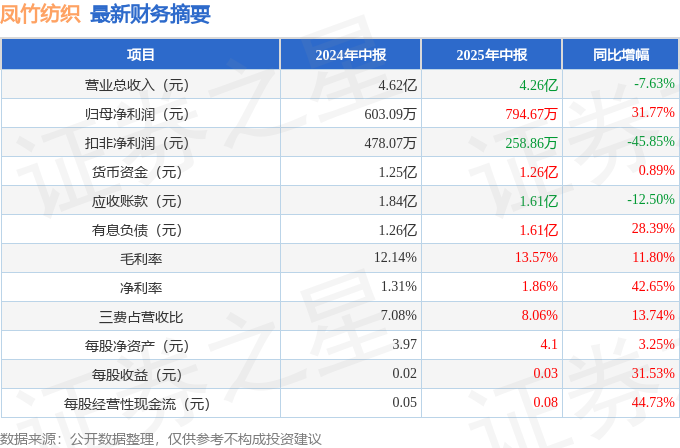
凤竹纺织2025年中报简析:净利润同比增长31.77%,盈利能力上升
Zheng Quan Zhi Xing· 2025-08-30 23:23
Core Viewpoint - Fengzhu Textile (600493) reported a decline in total revenue for the first half of 2025, but an increase in net profit, indicating improved profitability despite lower sales [1] Financial Performance Summary - Total revenue for the first half of 2025 was 426 million yuan, a decrease of 7.63% year-on-year [1] - Net profit attributable to shareholders was 7.95 million yuan, an increase of 31.77% year-on-year [1] - In Q2 2025, total revenue was 233 million yuan, down 7.99% year-on-year, while net profit was 5.12 million yuan, up 19.42% year-on-year [1] - Gross margin increased by 11.8% to 13.57%, and net margin rose by 42.65% to 1.86% [1] - Total expenses (selling, administrative, and financial) amounted to 34.36 million yuan, accounting for 8.06% of revenue, an increase of 13.74% year-on-year [1] Key Financial Ratios - Earnings per share (EPS) increased by 31.53% to 0.03 yuan [1] - Operating cash flow per share rose by 44.73% to 0.08 yuan [1] - Net asset value per share increased by 3.25% to 4.10 yuan [1] Business Evaluation - The company's return on invested capital (ROIC) was 4.24% last year, indicating weak capital returns [1] - Historical data shows a median ROIC of 3.71% over the past decade, with the lowest ROIC recorded at 2.81% in 2015 [1] - The company has reported a total of 20 annual reports since its listing, with one year of losses, suggesting a need for further investigation into underlying causes [1]