
消费

Search documents
宏观策略周报:8月核心CPI持续回升,进出口连续3个月实现双增长-20250912
Yuan Da Xin Xi· 2025-09-12 11:51
Key Points - The core consumer price index (CPI) in August increased by 0.9% year-on-year, marking the fourth consecutive month of growth, while the overall CPI decreased by 0.4% year-on-year [2][11][12] - The Producer Price Index (PPI) ended its eight-month decline, remaining flat month-on-month and decreasing by 2.9% year-on-year, with the rate of decline narrowing by 0.7 percentage points compared to the previous month [2][15][16] - In the U.S., the CPI rose by 2.9% year-on-year in August, aligning with market expectations, while the unemployment rate increased to 4.3%, leading to heightened expectations for interest rate cuts by the Federal Reserve [2][19] - China's total import and export value for the first eight months of the year reached 29.57 trillion yuan, a year-on-year increase of 3.5%, with August seeing a 3.5% growth in both imports and exports [2][21] - The National Development and Reform Commission and the National Energy Administration issued guidelines to promote the integration of artificial intelligence and energy sectors, aiming for significant breakthroughs in core technologies by 2030 [3][22][23] Market Overview - The domestic securities market showed mixed performance, with the Sci-Tech Innovation 50 index experiencing the highest increase of 5.5% [4][27] - The electronic industry led the sector gains with a rise of 6.15% [4][29] - The report highlights the resilience of foreign trade, with continuous growth in imports and exports over the past three months, indicating a stable economic environment [4][21] Investment Recommendations - Focus on new productive forces, particularly in sectors like artificial intelligence, semiconductor chips, and robotics, which are expected to yield excess returns [5][34] - Emphasize consumer spending to stimulate domestic demand, with potential investment opportunities in new consumption, home appliances, and automobiles [5][34] - Consider high-dividend assets for stable long-term returns [5][34] - Explore long-term investment opportunities in gold as a safe-haven asset amid geopolitical tensions and global economic uncertainties [5][34]
港股消费主题表现亮眼,港股消费ETF(159735)涨逾1.5%创近5个月新高,连续6周实现资金净流入
Mei Ri Jing Ji Xin Wen· 2025-09-12 02:08
Core Viewpoint - The Hong Kong stock market opened significantly higher, with the Hang Seng Index rising over 1%, driven by strong performance in consumer-related stocks, indicating a positive market sentiment and potential investment opportunities in the consumer sector [1] Group 1: Market Performance - The Hang Seng Index increased by more than 1%, with notable gains in Alibaba-W (approximately 7%), Tencent Holdings, XPeng Motors-W, Kuaishou-W, Li Auto-W, and Haier Smart Home, all rising over 2% [1] - The Hong Kong Consumer ETF (159735) rose over 1.5%, reaching a nearly five-month high in its secondary market price [1] - The Consumer ETF has seen continuous net inflows for six weeks, with the latest share count reaching 982 million, marking a historical high [1] Group 2: Economic Policies and Outlook - Current nationwide fertility stimulus policies are accelerating, with significant signals from central finance expected to encourage local governments to follow suit, which may help bolster consumer confidence [1] - The outlook for the Hong Kong stock market remains optimistic, with data indicating improved mid-year earnings and the highest earnings forecast rate in three years, suggesting that the profitability of "new economy" stocks in Hong Kong may improve ahead of A-shares [1] Group 3: ETF Details - The Hong Kong Consumer ETF (159735) tracks the CSI Hong Kong Stock Connect Consumer Theme Index, which selects 50 consumer-related securities with good liquidity and large market capitalization from the Hong Kong Stock Connect universe [1] - This index aims to reflect the overall performance of consumer-related listed companies within the Hong Kong Stock Connect [1] - Investors can utilize the Hong Kong Consumer ETF (159735) to gain exposure to upward opportunities in the Hong Kong consumer sector [1]
资金动向 | 北水净买入港股189.89亿港元,加仓阿里巴巴、信达生物
Ge Long Hui· 2025-09-11 12:36
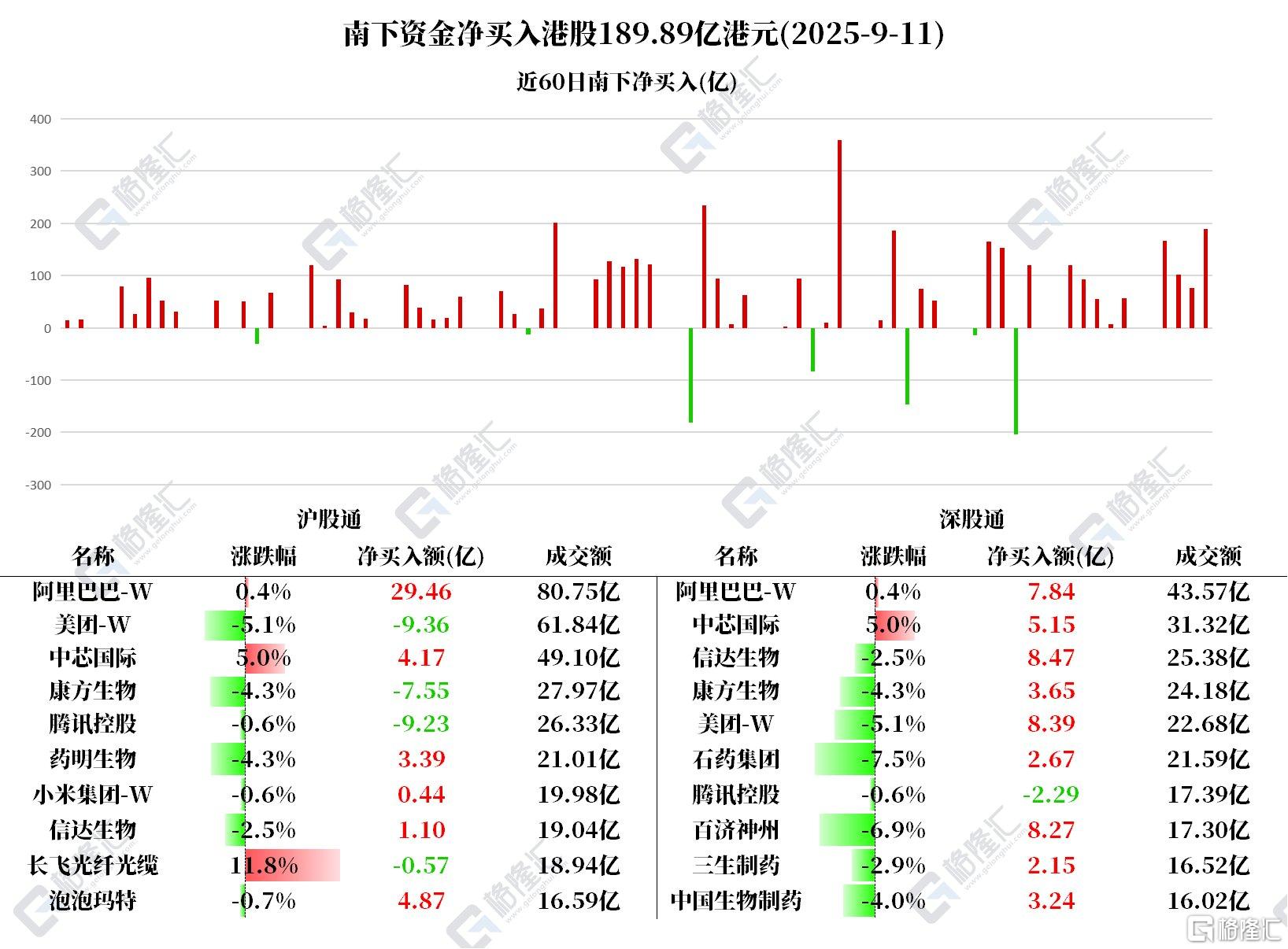
Group 1: Investment Trends - Significant net purchases were observed in Alibaba-W (37.3 billion), Innovent Biologics (9.56 billion), and SMIC (9.32 billion) among others, while Tencent Holdings saw a net sell-off of 11.51 billion [1][4] - Southbound funds have continuously net bought Alibaba for 15 days, totaling 371.4389 billion HKD, and have net sold Tencent for 3 days, totaling 14.6076 billion HKD [4] Group 2: Company Developments - Alibaba's "Gaode Street Ranking" launched on September 10, attracting over 40 million users, indicating a strategic move to enhance user engagement and monetization through local services [6] - Reports suggest that the Trump administration is drafting an executive order to impose strict restrictions on Chinese pharmaceuticals, which may impact companies like Innovent Biologics and BeiGene [7] - SMIC is benefiting from high demand in the semiconductor industry driven by AI computing needs and accelerated domestic substitution in equipment and materials [7] Group 3: Market Reactions - UBS reports that the recent price correction of Pop Mart is creating buying opportunities ahead of key product launches and the Christmas sales season, maintaining a "Buy" rating with a target price of 432 HKD [7] - Tencent has repurchased 874,000 shares for 5.5 billion HKD and is considering issuing offshore RMB bonds, marking its first bond issuance since April 2021 [8]


摩根士丹利:美国投资者对中国市场兴趣升至三年高位
天天基金网· 2025-09-11 10:57
Group 1 - Morgan Stanley reports that U.S. investors' interest in the Chinese market has reached a three-year high, with over 90% of investors expressing willingness to increase exposure, a level not seen since early 2021 [2] - Factors driving this trend include China's global leadership in humanoid robots, biotechnology, and drug development, as well as gradual policy measures aimed at stabilizing the economy and supporting capital markets [2] - Improved liquidity conditions and the need for diversified global asset allocation further support investment intentions [2] Group 2 - Wells Fargo emphasizes that the growth style remains in trend, with significant valuation gaps between Chinese companies and their overseas counterparts in high-end manufacturing, indicating substantial growth potential [4] - Huabao Fund suggests an investment strategy of "digging deep for Alpha while waiting for Beta," reflecting a focus on active management to achieve excess returns beyond market benchmarks [5] Group 3 - Guotai Fund identifies three main investment directions: innovative drugs, AI healthcare, and low-valuation leading companies in new cycles, with expectations that the current innovative drug market will see greater market capitalization growth than previous cycles [6] - The manager notes that the recognition of efficient R&D and clinical innovation in the pharmaceutical industry is driving this trend [6] Group 4 - Xingyin Fund highlights that product strength has become the core competitiveness of consumer companies, as consumers increasingly favor "self-satisfying" scenarios, reshaping the industry landscape [9] - The ability to continuously launch innovative products that meet precise consumer needs is crucial for corporate growth [9] Group 5 - Quanguo Fund points out that major global model manufacturers have released significant upgrades, emphasizing China's indispensable role in autonomous hardware and model capabilities, with substantial potential in domestic computing power and application-related fields [11]
北水动向|北水成交净买入189.89亿 北水无惧利空抢筹创新药概念股 加仓信达生物(01801)超9亿港元
智通财经网· 2025-09-11 10:06
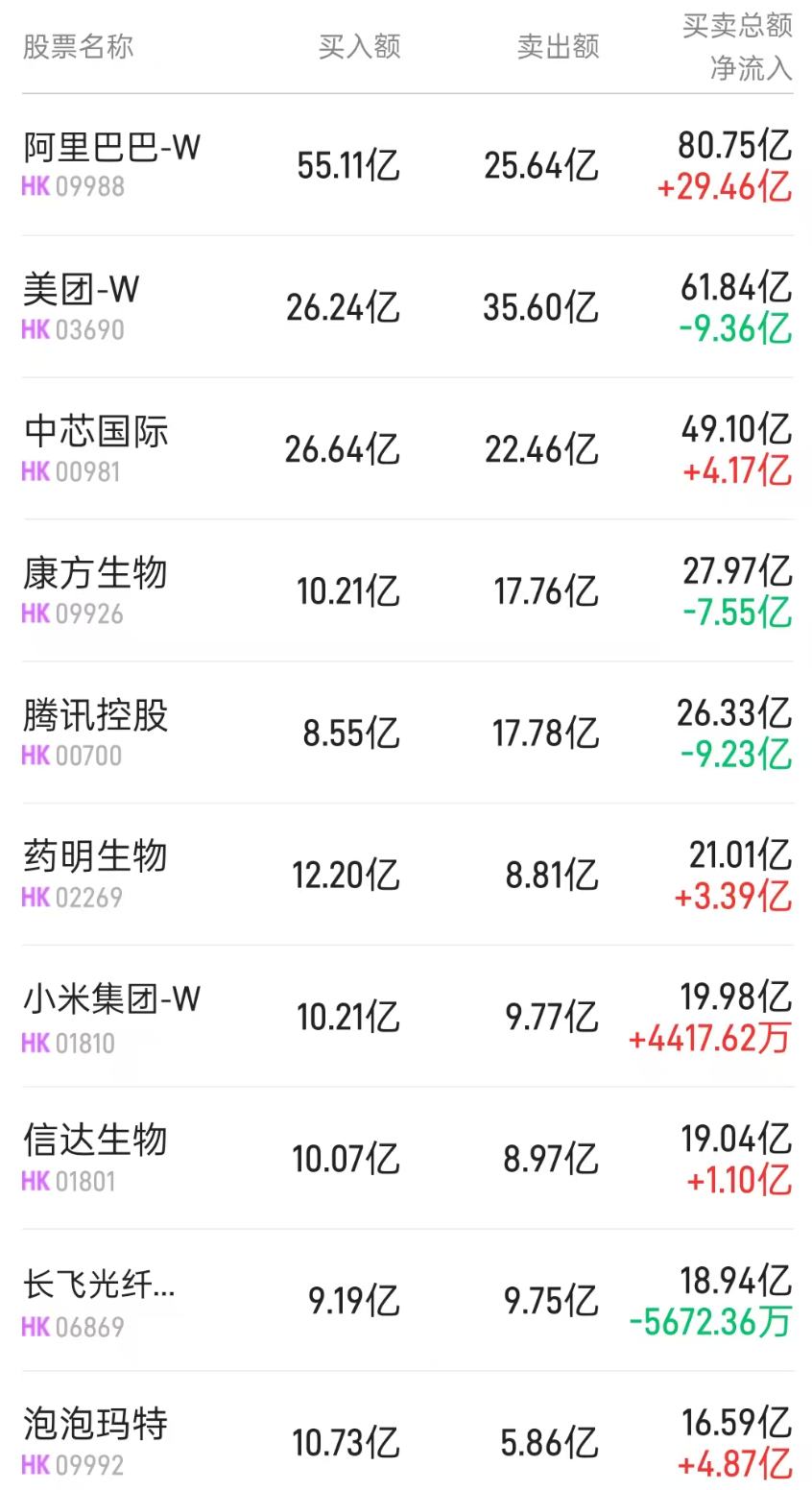
Summary of Key Points Core Viewpoint - The Hong Kong stock market experienced significant net buying from Northbound funds, totaling HKD 189.89 billion on September 11, with notable net purchases in specific stocks like Alibaba and Xinyi Biological. Group 1: Northbound Fund Activity - Northbound funds recorded a net purchase of HKD 189.89 billion, with HKD 80.73 billion from the Shanghai Stock Connect and HKD 109.16 billion from the Shenzhen Stock Connect [1] - The most purchased stocks included Alibaba-W (09988), Xinyi Biological (01801), and SMIC (00981) [1] - The most sold stocks were Tencent (00700) and Changfei Optical Fiber (06869) [1] Group 2: Individual Stock Performance - Alibaba-W saw a net inflow of HKD 55.11 billion, with total transactions amounting to HKD 80.75 billion [2] - Xinyi Biological had a net inflow of HKD 10.07 billion, with total transactions of HKD 19.04 billion [3] - SMIC recorded a net inflow of HKD 26.64 billion, with total transactions of HKD 49.10 billion [2] - Tencent experienced a net outflow of HKD 8.55 billion, with total transactions of HKD 26.33 billion [2] Group 3: Market Sentiment and News Impact - The positive sentiment towards pharmaceutical stocks was driven by net purchases in companies like Xinyi Biological, BeiGene, and WuXi Biologics, amid reports of potential regulatory changes from the Trump administration [5] - SMIC's net inflow was influenced by TSMC's strong revenue report, indicating growth in the semiconductor sector [5] - Alibaba's strategy to enhance its local services through the Gaode app was highlighted as a significant move to increase user engagement and monetization [4]



A股大牛市:真正的慢牛
Guotou Securities· 2025-09-11 10:05
Group 1 - The report emphasizes the concept of a "true slow bull market" in the A-share market, highlighting that the current market environment is not solely supported by fundamentals, and caution is advised against blindly following past models from 2014-2015 [1][8][9] - Three core characteristics of a slow bull market are identified: minimal contribution from valuation, a structure driven by industrial fundamentals rather than broad market rallies, and the presence of long-term patient capital [1][9][10] - The macroeconomic logic behind the US slow bull market includes liquidity easing providing valuation flexibility, leading companies offering fundamental support through large-scale stock buybacks, and a capital market system ensuring long-term operational stability [1][9][10] Group 2 - Historical analysis shows that from 1980 to 2024, only 20% of stocks in the S&P 500 contributed to 80% of the returns, indicating a significant internal differentiation in long-term investments [2][10] - The annualized return for US equity investments from 1980 to present is estimated to be between 8% and 10% (excluding dividend reinvestment), with the Nasdaq at around 12% (including dividends) [2][10] - The report breaks down the sources of returns, indicating that from 1980 to 2024, earnings growth contributed approximately 6.5% annualized return, accounting for about 65% of total returns, while valuation changes had a minimal impact [2][10] Group 3 - The report suggests that the current A-share market is entering a "systematic slow bull" phase, supported by the establishment of market stabilization funds and the influx of long-term capital from various sources [11][12] - It highlights the importance of a structural shift in the market ecology, where long-term capital gains pricing power, and the concept of "residents' savings moving" is not merely a transfer from bank accounts to securities accounts but involves a more complex mechanism [11][12] - The report categorizes historical A-share bull markets into three types: slow bulls driven by industrial fundamentals, fast bulls based on broad market rallies, and rare "crazy bulls" driven by excessive liquidity [13][14] Group 4 - The report outlines that the A-share market's true slow bull is supported by policy measures aimed at deepening capital market reforms, enhancing market ecology, and increasing the attractiveness of the stock market for residents' savings [24][25] - It notes that since 2024, reforms have followed a path of "strong regulation - expanded openness - attracting long-term capital - promoting innovation - reducing costs," which collectively aim to stabilize the market [24][25] - The report also discusses the shift in residents' savings, indicating that excess savings are gradually being redirected into the stock market, particularly as real estate investment declines [31][32]
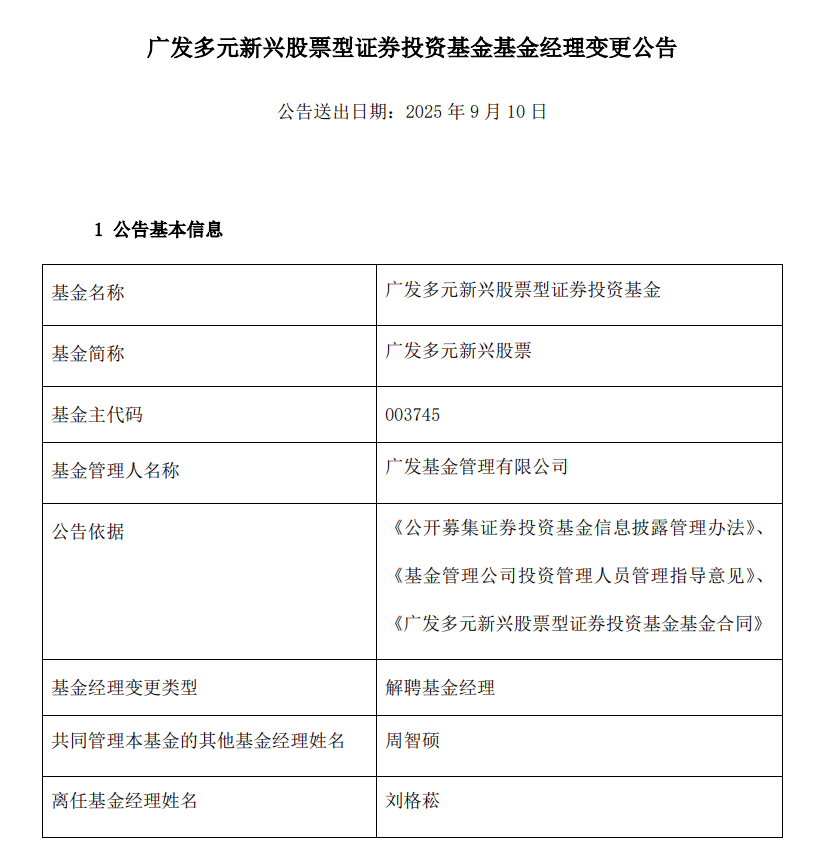
广发基金刘格菘卸任一产品基金经理,上半年在管基金遭内部员工减持1774.47万份
Sou Hu Cai Jing· 2025-09-11 08:40
Core Viewpoint - The announcement of the resignation of Liu Gesong as the fund manager of the GF Multi-Asset Emerging Stock Fund, with Zhou Zhishuo taking over as the sole manager, reflects a normal adjustment within the company [1][2]. Fund Management Changes - Liu Gesong has left the management of the GF Multi-Asset Emerging Stock Fund, which he co-managed with Tang Xiaobin earlier this year, and Zhou Zhishuo is now the sole manager [1][2]. - Liu Gesong remains with GF Fund Management as the Deputy General Manager and continues to manage five other funds, totaling approximately 29.463 billion yuan in assets under management [3][4]. Fund Performance - The GF Multi-Asset Emerging Stock Fund has achieved a year-to-date return of 34.14% and a cumulative net value return of 98.87%, with a current net value of 1.9887 yuan [3]. - As of the end of Q2 2025, the fund's scale is approximately 1.832 billion yuan [3]. Investment Strategy - The fund has focused on sectors such as defense, electronics, new energy, smart driving, banking, and artificial intelligence, with its top holding being Seres [3]. - Liu Gesong's investment strategy has shifted towards Hong Kong stocks, emphasizing new economy and internet companies, as reflected in the top holdings of his other managed fund, which includes companies like Xiaomi and Tencent [4][6]. Fund Holdings and Adjustments - The GF Multi-Asset Emerging Stock Fund has seen significant changes in its holdings, with new investments in companies like Xinyisheng and Guangdong Hongda [3]. - Liu Gesong's other managed funds have experienced a decline in employee holdings, indicating potential concerns among internal stakeholders [4][6].
含“新”量十足 打开服贸会的方式已是next level
Yang Shi Xin Wen· 2025-09-11 08:26
Core Viewpoint - The 2025 Service Trade Fair has officially opened, serving as a significant platform for China to expand openness, deepen cooperation, and lead innovation, allowing domestic and foreign enterprises to perceive the Chinese market and share development opportunities [1] Group 1: Event Highlights - The fair features nearly 180 forums and meetings, with 41 activities scheduled for today alone, running from 9 AM to 5 PM [1] - Key reports, including the "China Service Trade Development Report," were released during the Service Trade Development Forum, highlighting important research outcomes related to service trade [1] Group 2: Industry Focus - The World Tourism Cooperation and Development Conference included discussions on smart technology empowering tourism development, with over 300 international guests exploring new paths for global tourism cooperation [2] - The E-commerce Conference hosted three specialized sessions focusing on consumer e-commerce, industrial e-commerce, and cross-border e-commerce, releasing several important research outcomes and rankings [2] Group 3: New Developments - Financial institutions introduced multiple digital service solutions aimed at supporting international trade development [3] - Industry associations released various consumption indices and industry standards to promote high-quality development in the catering and accommodation sectors [4]
国证国际港股晨报-20250911
Guosen International· 2025-09-11 03:22
Group 1: Core Insights - The report highlights a significant decline in the US Producer Price Index (PPI), which strengthens expectations for interest rate cuts [2][5] - The Hong Kong stock market has shown a structural trend with technology and financial sectors driving gains, while pharmaceuticals and new consumption sectors face downward pressure [3][4] Group 2: Company Overview - The specific company, Health 160 (2656.HK), is a leading wholesaler of pharmaceutical health products and a digital healthcare service provider in China [7] - Health 160's revenue projections for 2022 to 2025 are estimated at 530 million, 630 million, 620 million, and 100 million RMB respectively, with adjusted net losses decreasing over the same period [7] Group 3: Industry Status and Outlook - The Chinese healthcare industry is projected to grow from 8,232.6 billion RMB in 2019 to 12,023.2 billion RMB by 2024, with a CAGR of 7.9%, and is expected to reach 19,647.8 billion RMB by 2030 [8] Group 4: Advantages and Opportunities - Health 160 has over 18 years of experience and a strong brand presence, providing extensive services that enhance customer loyalty and reduce acquisition costs [9] - The company offers a comprehensive range of healthcare services that cater to various patient needs throughout the medical process [9] Group 5: Fundraising and Use of Proceeds - The IPO proceeds will be allocated as follows: approximately 40% for expanding medical resource coverage, 30% for enhancing R&D capabilities, 10% for diversifying products and services, 10% for strategic partnerships and acquisitions, and 10% for operational funds [12]
港股通(沪)净买入25.36亿港元
Zheng Quan Shi Bao Wang· 2025-09-10 14:39
Market Overview - On September 10, the Hang Seng Index rose by 1.01%, closing at 26,200.26 points, with a total net inflow of southbound funds through the Stock Connect amounting to HKD 75.66 billion [1][3] - The total trading volume for the Stock Connect on the same day was HKD 1,393.07 billion, with a net buy of HKD 75.66 billion [1] Stock Performance - In the Shanghai Stock Connect, the total trading volume was HKD 867.41 billion, with a net buy of HKD 25.36 billion; in the Shenzhen Stock Connect, the trading volume was HKD 525.66 billion, with a net buy of HKD 50.30 billion [1] - The most actively traded stock in the Shanghai Stock Connect was Alibaba-W, with a trading volume of HKD 1,090.16 million and a net buy of HKD 242.57 million, closing up by 0.63% [2] - In the Shenzhen Stock Connect, Alibaba-W also led with a trading volume of HKD 589.33 million and a net buy of HKD 208.56 million, closing up by 0.63% [2] Notable Stocks - The stock with the highest net sell was Pop Mart, with a net sell of HKD 129.84 million, closing down by 4.51% [2] - Other notable stocks included Semiconductor Manufacturing International Corporation (SMIC) with a net buy of HKD 11.94 million and a closing increase of 3.61%, and Tencent Holdings with a net buy of HKD 2.32 million, closing up by 1.04% [2]


