电子等

Search documents
模型切换提示小盘风格占优,外部冲击下韧劲较强:——量化择时周报20251010-20251013
Shenwan Hongyuan Securities· 2025-10-13 10:46
Group 1 - Market sentiment indicators showed a slight decline, with the sentiment score at 1.75 as of October 10, down from 1.85 on September 26, indicating a bearish outlook [8][11] - The trading volume for the entire A-share market increased slightly compared to the previous week, with a peak trading volume of 26,718.18 billion RMB on October 9, indicating improved market activity [14][16] - The financing balance ratio continued to rise, reflecting an increase in market leverage sentiment and improved trading atmosphere among investors [24][26] Group 2 - The model indicates a preference for small-cap value style, with a weak signal strength due to a slight decline in the 5-day RSI relative to the 20-day RSI, suggesting further observation is needed [30][41] - The short-term trend scores for industries such as banks, steel, public utilities, and construction decoration have shown upward trends, with non-ferrous metals currently having the highest short-term score of 98.31 [30][32] - High trading congestion in sectors like non-ferrous metals and coal, alongside lower price increases in sectors like automobiles and electronics, suggests potential volatility risks and opportunities for gradual allocation in low-congestion sectors like pharmaceuticals and beauty care [37][36]
股指周报:贸易风云再起,预计避险情绪升温,但影响弱于4月-20251013
Xin Da Qi Huo· 2025-10-13 09:22
1. Report Industry Investment Rating - Short - term: Oscillation - Medium - short - term: Bullish [1] 2. Core Viewpoints of the Report - Last week, the stock index market rose first and then fell. After the holiday, the capital enthusiasm recovered, but the high - level divergence continued. The growth styles such as the ChiNext and the Science and Technology Innovation Board declined, and the four major broad - based indexes closed slightly down. - The US announced a 100% new tariff on Chinese imported goods last Friday, which will transmit bearish sentiment to the domestic A - share market this week. High - position stocks and the ChiNext and Science and Technology Innovation Board with front - running characteristics are expected to continue the downward trend, and small - cap styles such as the CSI 1000 need key defense. However, the direct impact of overseas sentiment transmission on the market is limited, and the indirect impact is more short - term and phased. In the long - term, market adjustments can be regarded as a new layout opportunity. [1][2] 3. Summary According to the Directory 3.1 Last Week's Stock Index Operation Situation 3.1.1 Trade Tensions Resurfaced, and Most Global Stock Indexes Fell - The four major broad - based indexes in the domestic stock index market closed slightly down last week. The weekly gains and losses of the four major stock indexes were: CSI 500 (- 0.19%) > SSE 50 (- 0.47%) > CSI 300 (- 0.51%) > CSI 1000 (- 0.54%). - Overseas, affected by the US government shutdown and the new 100% tariff on Chinese imports, the international risk - aversion sentiment generally increased last week. The VIX fear index rose 25% on Friday, and the three major US stock indexes generally fell. The Nasdaq Index dropped 3.56% on Friday and 2.53% for the week. [1][8] 3.1.2 Non - ferrous Metals and Coal Led the Gains, and the Trading Volume Rebounded Compared with Before the National Day - From the performance of the Shenwan primary industry classification, sectors were significantly differentiated last week. Non - ferrous metals (+ 4.44%) and coal (+ 4.41%) led the gains, while media (- 3.83%) and electronics (- 2.63%) lagged behind. The growth style adjusted, and the cycle and stable styles were relatively strong. - In terms of capital, the A - share trading volume rebounded last week, fluctuating between 2.5 - 2.6 trillion yuan during the week, and the capital entry willingness remained at a relatively strong historical level. [2][9] 3.1.3 The Basis of Stock Index Futures Changed Little, and the Option Volatility Fell Rapidly - In the futures market, the basis (spot - futures) of each stock index futures changed little last week. The far - month discounts of IC and IM slightly expanded compared with before the holiday, while IF and IH basically remained unchanged. The sentiment in the derivatives market was more cautious than that in the spot market. - In the options market, the implied volatility of stock index options fell last week. After the long - holiday effect ended, the average IV of the CSI 300 current - month contract reached the 15 - 16% level, which was at a relatively low historical level. [10] 3.2 Fundamental Elements and Outlook for the Future 3.2.1 The Central Bank Conducted a Net Withdrawal of 152.63 Billion Yuan in the Open Market Last Week - In terms of inter - bank liquidity, the central bank achieved a net withdrawal of 152.63 billion yuan in the open market last week, with open - market reverse repurchase operations of 113.7 billion yuan and a cumulative reverse repurchase maturity amount of 266.33 billion yuan. - In terms of inter - bank interest rates, interest rates at various tenors generally declined last week. The overnight Shibor decreased by 6.50bp, the one - week Shibor decreased by 0.20bp, the two - week Shibor decreased by 22.00bp, R001 decreased by 21.57bp, R007 decreased by 19.98bp, and R014 decreased by 18.49bp. [70] 3.2.2 The Tariff Shock Resurfaced, but the Impact is Expected to be Weaker than in April - The US announced a 100% new tariff on Chinese imported goods last Friday, which led to a spread of panic in the international market. For the A - share market, bearish sentiment is expected to spread this week. High - position stocks and the ChiNext and Science and Technology Innovation Board are expected to continue to decline, and small - cap styles need key defense. However, the direct impact of overseas sentiment on the A - share market is limited. - Futures operation: If there are unclosed long - term trend orders, short positions can be opened on Monday for hedging or temporarily exit the market for observation. For speculators, if the market falls this week, there may be rebound opportunities near the 20 - day moving average and the position on September 4th, and intraday long positions can be used for short - term trading based on these two points. - Options operation: It is very likely that the volatility will increase this week, but the increase is expected to be smaller than that in early April. Short - term participation in buying far - month CSI 1000 put options is recommended, and exit the market in time if there is a profit during the week. For SSE 50 and CSI 300 options, it is recommended to wait for the volatility to rise before entering the double - selling strategy. [2][71] 3.3 Economic Data and Financial Event Forecast 3.3.1 Macroeconomic Data Release No specific data release information was provided in the report. 3.3.2 Key Financial Events - October 13 (to be determined): China's import and export volume in September. - October 13 (20:30): The number of new non - farm payrolls and the unemployment rate in the US in September. - October 15 (to be determined): Financial data such as new social financing and M2 in China in September. - October 15 (20:30): CPI and core CPI in the US in September. - October 16 (20:30): PPI and core PPI in the US in September. - October 18 (10:00): Real estate data (new construction, completion, and construction area of houses) in China in September. [102]
股指周报:关税政策升级,A股受创-20251013
Guo Mao Qi Huo· 2025-10-13 05:52
1. Report Industry Investment Rating No relevant content provided. 2. Core Viewpoints of the Report - After the holiday, the escalation of Sino - US tariff policies and Trump's threat to impose a 100% tariff on China from November 1st led to a significant decline in Sino - US equity markets. High - tech stocks in A - shares that had strong previous gains fell significantly. The short - term investment strategy should focus on risk - aversion, and large - cap stocks may show more resilience [3]. 3. Summary by Related Catalogs PART ONE: Main Viewpoints and Strategy Overview - **Influence Factors and Driving Forces** - Economic and corporate earnings: Slightly bearish. The manufacturing PMI slightly rebounded but remained below the threshold. In September, the manufacturing PMI was 49.8, the non - manufacturing business activity index was 50.0, and the composite PMI output index was 50.6 [3]. - Macroeconomic policy: Slightly bullish. On the first trading day after the holiday, the central bank conducted an over - subscribed reverse repurchase operation of 11000 billion yuan for 91 days, with a net injection of 3000 billion yuan. There are also expectations for future policies [3]. - Overseas factors: Bearish. After the holiday, the escalation of Sino - US tariff policies led to a sharp decline in Sino - US equity markets. Trump threatened to impose a 100% tariff on China from November 1st [3]. - Liquidity: Neutral. As of October 9th, the margin trading balance in A - shares increased, and the proportion of margin trading purchases in the total market turnover was at a high level. The average daily trading volume last week increased compared to the previous week [3][31]. - **Investment Viewpoints and Strategies** - Short - term investment should focus on risk - aversion. High - tech small - and medium - cap stocks may face greater shocks, and risk - hedging tools such as put options on the CSI 1000 can be considered. Large - cap blue - chip stocks in the CSI 300 and SSE 50 are expected to show more resilience [3]. - Trading strategy: Focus on risk - aversion in the single - side trading, and large - cap stocks may be more resilient [3]. PART TWO: Stock Index Market Review - **Stock Index Performance** - Last week, the CSI 300 fell 0.51% to 4616.8, the SSE 50 fell 0.47% to 2974.9, the CSI 500 fell 0.19% to 7398.2, and the CSI 1000 fell 0.54% to 7533.8 [5]. - **Industry Index Performance** - In the Shenwan primary industry index, non - ferrous metals (4.4%), steel (4.2%), public utilities (3.5%), building decoration (2.8%), and building materials (2.7%) led the gains, while media (-3.8%), electronics (-2.6%), power equipment (-2.5%), computer (-1.8%), and communication (-1.6%) led the losses [9]. - **Futures Volume and Open Interest** - The trading volume of CSI 300 futures was 297998 lots, with a 7.68% increase; the trading volume of SSE 50 futures was 133649 lots, with a 0.34% increase; the trading volume of CSI 500 futures was 325864 lots, with a 12.76% increase; the trading volume of CSI 1000 futures was 447179 lots, with a 10.83% decrease [11]. - The open interest of CSI 300 futures was 278581 lots, with a 6.27% increase; the open interest of SSE 50 futures was 105743 lots, with a 6.60% increase; the open interest of CSI 500 futures was 260074 lots, with a 5.40% increase; the open interest of CSI 1000 futures was 356927 lots, with a 1.50% increase [11]. - **Spread Performance** - The spread of CSI 300 - SSE 50 was at the 95.9% historical quantile level; the spread of CSI 1000 - CSI 500 was at the 31.4% historical quantile level; the ratio of CSI 300/CSI 1000 was at the 35.7% historical quantile level; the ratio of SSE 50/CSI 1000 was at the 28.1% historical quantile level [18]. PART THREE: Stock Index Influence Factors - Liquidity - **Central Bank Operations** - This week, the central bank conducted 11370 billion yuan of reverse repurchase operations and 11000 billion yuan of 91 - day outright reverse repurchase operations. With 26633 billion yuan of reverse repurchases maturing, the central bank achieved a net withdrawal of 4263 billion yuan in the open market [25]. - Next week, 10210 billion yuan of reverse repurchases will mature, along with 1500 billion yuan of treasury cash fixed - deposits and 8000 billion yuan of 91 - day outright reverse repurchases [25]. - **Market Liquidity Indicators** - As of October 9th, the margin trading balance in A - shares was 24380.3 billion yuan, an increase of 14.3 billion yuan from the previous week. The proportion of margin trading purchases in the total market turnover was 14.8%, at the 100% quantile level in the past decade [31]. - Last week, the daily trading volumes of A - shares were 23334 billion yuan and 22454 billion yuan, and the average daily trading volume increased by 3497 billion yuan compared to the previous week [31]. - As of October 10th, the risk premium rate of the CSI 300 was 5.17, at the 47.4% quantile level in the past decade [31]. PART FOUR: Stock Index Influence Factors - Economic Fundamentals and Corporate Earnings - **Macroeconomic Indicators** - In September, the manufacturing PMI was 49.8, up 0.4 from August; the non - manufacturing PMI was 50.0, down 0.3 from August [41]. - In terms of demand, new orders, new export orders, and production all showed marginal improvements, while in terms of price, the main raw material purchase price and ex - factory price decreased marginally [41]. - **Industry - Specific Data** - In the consumer sector, the retail sales of enterprises above the designated size showed different trends in various categories. For example, the sales of gold and silver jewelry, sports and entertainment products, and household appliances and audio - visual equipment had relatively high growth rates [37]. - In the manufacturing sector, different industries had different growth rates. For example, the automobile manufacturing, railway, ship, aerospace, and other industries had relatively high growth rates, while the pharmaceutical manufacturing and electrical machinery and equipment manufacturing industries had negative growth rates [38]. - **Earnings of Major Indexes** - The year - on - year growth rates of net profit attributable to the parent company and the return on net assets (TTM) of major broad - based indexes showed different trends. For example, the growth rate of the GEM index was relatively high, while the growth rate of the Science and Technology Innovation 50 index was negative [45]. PART FOUR: Stock Index Influence Factors - Policy Driving - **Recent Macro - Policy Trends** - Multiple policies have been introduced, including policies to promote service consumption, real estate policies, consumer loan discount policies, and policies to support the capital market [50][51][52]. - The government has also increased the issuance of special bonds and provided funds for consumer replacement [50]. PART FIVE: Stock Index Influence Factors - Overseas Factors - **US Economic Indicators** - In September, the US manufacturing PMI was 49.1%, up 0.4 from the previous value; the non - manufacturing PMI was 50%, down 2 from the previous value [60]. - The US consumer confidence index in October was 55, up 0.1 from the previous value [60]. - In August, the US seasonally - adjusted unemployment rate was 4.3%, and the number of new non - farm payrolls was 2.2 million [64]. - In August, the US PCE increased by 2.74% year - on - year, and the core PCE increased by 2.91% year - on - year; the CPI increased by 2.9% year - on - year, and the core CPI increased by 3.1% year - on - year [66]. - **Trump Team's Statements and Actions** - Trump has made a series of statements and actions regarding tariffs, including threatening to impose tariffs on imports from Mexico, Canada, and China at different times [68].
工信部发布《关于开展2025年度绿色工厂推荐工作的通知》
Zhong Guo Neng Yuan Wang· 2025-10-10 01:35
Core Viewpoint - The Ministry of Industry and Information Technology (MIIT) has announced the 2025 Green Factory Recommendation Work, focusing on energy conservation and carbon reduction to enhance the green competitiveness of industries, supporting enterprises in 53 key sectors [1][4]. Group 1: Overall Requirements - The recommendation work includes green factories and green industrial parks, with enterprises or parks meeting the requirements voluntarily conducting self-evaluations based on new evaluation criteria [2][4]. - Provincial industrial and information departments will select enterprises or parks based on the principle of "choosing the best among the best" and ensuring that recommended entities meet or exceed the average level of existing national green factories and parks in their regions [2][4]. Group 2: Specific Requirements - New applicants for national green factories and industrial parks must register on the management platform, complete self-evaluations, and provide supporting materials without needing third-party evaluation reports [3][4]. - Existing national green factories and parks must also log onto the management platform for self-evaluation against new criteria, with those scoring in the bottom 5% for three consecutive years being removed from the list [5][6]. Group 3: Work Requirements - Provincial departments are required to enhance the verification of data and supporting materials for enterprises or parks to ensure the quality of recommendations, with a deadline for submission set for November 7, 2025 [6]. - Experts from MIIT will review the recommended lists, ensuring a rigorous selection process, and any entity found to have falsified data will be removed from the list and barred from reapplying for three years [6]. Group 4: Key Industry List - The key industries supported in this initiative include steel, petrochemical, non-ferrous metals, building materials, machinery, light industry, textiles, and electronics [12].

成交额超42亿居同类第一,A500ETF基金(512050)涨超1.6%,机构称节后A股有望延续稳健表现
Xin Lang Cai Jing· 2025-10-09 05:42
Group 1 - The core viewpoint indicates a strong performance of the CSI A500 Index, with a notable increase of 1.74% and significant gains in constituent stocks such as Western Superconducting (20.00%) and Maiwei Co. (16.74%) [1] - The A500 ETF Fund has shown active trading with a turnover rate of 22.89% and a transaction volume of 4.27 billion, reflecting a vibrant market [1] - Morgan Stanley reported a rebound in foreign capital inflow into the Chinese stock market, reaching 4.6 billion in September, the highest monthly figure since November 2024, primarily driven by passive fund inflows of 5.2 billion [1] Group 2 - Huazhong Securities anticipates a continued upward trend in the market post-holiday, driven by optimistic overseas risk appetite and expectations from the Fourth Plenary Session [2] - The report emphasizes the establishment of a new growth cycle in AI computing infrastructure, suggesting that while adjustments and fluctuations may occur, the core position of this growth trend remains unshaken [2] - The CSI A500 Index comprises 500 securities selected for their large market capitalization and liquidity, reflecting the overall performance of representative listed companies across various industries [2]
9月第4期:延续分化
Tai Ping Yang Zheng Quan· 2025-09-29 14:12
Group 1 - The market shows valuation differentiation, with the Sci-Tech 50 and ChiNext Index performing the best, while consumer and stable indices lag behind [9][12] - The overall market ERP has decreased and is near the negative one standard deviation level since 2021 [2][18] - The performance of major indices is mixed, with the Sci-Tech 50 and ChiNext Index leading, while the consumer sector and the National 2000 Index show the weakest performance [9][12] Group 2 - Valuation changes across industries are evident, with power equipment and non-ferrous metals leading in gains, while social services and retail sectors perform the weakest [12][33] - The relative PE of the ChiNext Index to the CSI 300 has increased, indicating a rise in growth expectations [17] - The overall valuation of major indices is at a high percentile compared to the past year, with the Sci-Tech 50 showing particularly high valuations [24][25] Group 3 - The current valuation of the financial and real estate sectors is above the 50% historical percentile, while materials, equipment manufacturing, and technology sectors are at or below the 50% level [26] - The lowest valuations are found in the non-bank financial, agriculture, and food and beverage sectors, which are at their lowest in the past year [33][36] - The semiconductor and technology sectors are experiencing high valuations, with many sub-sectors at three-year historical highs [44] Group 4 - Profit expectations across industries have seen slight changes, with non-ferrous metals experiencing the largest upward adjustment and construction materials the largest downward adjustment [46]
【固收】信用债发行量环比增长,各行业信用利差整体上行——信用债周度观察(20250922-20250926)(张旭/秦方好)
光大证券研究· 2025-09-28 02:22
Group 1 - The core viewpoint of the article highlights the trends in the credit bond market, including issuance volume, types of bonds, and interest rates [4][5][6] Group 2 - In the primary market, a total of 501 credit bonds were issued, with a total issuance scale of 584.5 billion yuan, reflecting a week-on-week increase of 0.79% [4] - Among the types of bonds issued, industrial bonds accounted for 45.28% of the total issuance, with 200 bonds issued and a scale of 264.68 billion yuan, marking a 30.71% increase week-on-week [4] - Local government bonds (城投债) made up 27.36% of the total issuance, with 253 bonds issued and a scale of 159.94 billion yuan, increasing by 13.21% week-on-week [4] - Financial bonds saw a decrease of 32.29%, with 48 bonds issued and a scale of 159.88 billion yuan, representing 27.35% of the total issuance [4] - The average issuance term for credit bonds was 2.71 years, with industrial bonds averaging 2.22 years and financial bonds averaging 1.88 years [4] - The overall average coupon rate for credit bonds was 2.33%, with industrial bonds at 2.19% and financial bonds at 1.91% [4] Group 3 - In the secondary market, the credit spread for AAA-rated industries saw the largest increase in the machinery sector, rising by 9 basis points, while the media sector experienced a decrease of 3.1 basis points [5] - For AA+ rated industries, the steel sector had the largest increase in credit spread, up by 44.2 basis points, while the chemical sector saw a decrease of 1 basis point [5] - The total trading volume of credit bonds reached 1617.515 billion yuan, reflecting a week-on-week increase of 10.61% [6] - The top three types of credit bonds by trading volume were commercial bank bonds, corporate bonds, and medium-term notes, with trading volumes of 487.807 billion yuan, 496.120 billion yuan, and 323.965 billion yuan respectively [6]

稳居同类第一!A500ETF基金(512050)成交额超42亿,机构称短期回调提供了进场契机
Xin Lang Cai Jing· 2025-09-19 06:12
Group 1 - The A500 index has shown a slight increase of 0.02% as of September 19, 2025, with notable gains from stocks such as Wanda Film (+10.04%) and Ganfeng Lithium (+10.00) [1] - The A500 ETF fund has demonstrated active trading with a turnover rate of 26.52% and a transaction volume of 4.237 billion yuan, indicating a vibrant market [1] - According to Everbright Securities, despite a recent pullback, the upward trend of the index remains intact, with expectations for continued oscillation upwards due to favorable domestic policies [1] Group 2 - The A500 index consists of 500 securities selected from various industries, reflecting the overall performance of the most representative listed companies [2] - As of July 31, 2025, the top ten weighted stocks in the A500 index account for 19.83% of the index, including major companies like Kweichow Moutai and Ningde Times [2] - The A500 ETF fund and its enhanced version closely track the A500 index, with various related index funds available for investors [2]
新疆乌苏市市场监管局开展知识产权保护专项执法检查
Zhong Guo Shi Pin Wang· 2025-09-12 04:16
Core Viewpoint - The Xinjiang Uygur Autonomous Region's Urumqi Market Supervision Bureau has intensified its enforcement actions against intellectual property rights violations, focusing on various sectors and locations to enhance legal awareness among market operators and businesses [1] Group 1: Enforcement Actions - The bureau conducted special enforcement inspections, checking 60 business entities and sampling over 30 products, resulting in the investigation of 3 cases of suspected intellectual property violations [1] - Key areas of focus included food and drug products, household goods, clothing, children's toys, and electronic products, with inspections carried out in large supermarkets, specialized markets, areas around schools, and offline experience stores of e-commerce [1] Group 2: Methods and Strategies - The enforcement methods included on-site inspections, sampling for testing, verifying sales records, and checking patent and trademark markings to identify violations such as trademark infringement, patent counterfeiting, false advertising, and geographical indication infringement [1] - The bureau also engaged in public education by distributing promotional materials and providing on-site guidance to enhance the legal knowledge of market operators regarding patents, trademarks, and geographical indications [1] Group 3: Encouragement of Compliance - The initiative aims to encourage market operators to establish a system for verifying intellectual property rights of products and to strengthen the awareness of intellectual property laws among businesses [1]
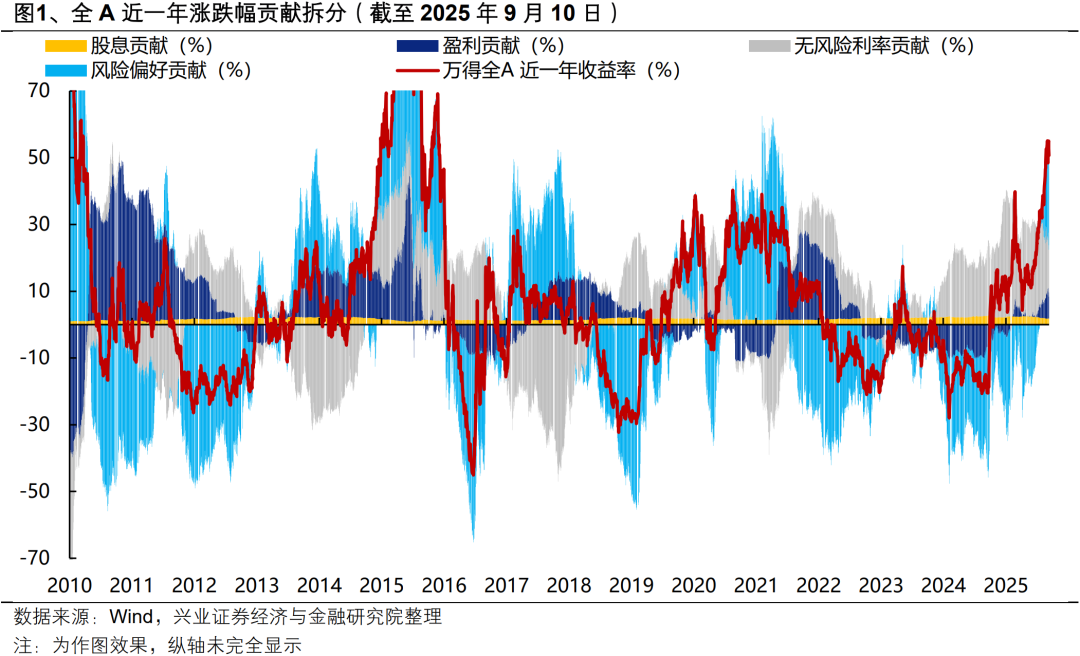
兴业证券:本轮A股和港股上涨由何贡献?
智通财经网· 2025-09-10 12:44
Core Viewpoint - The report from Industrial Securities analyzes the contribution of profit, valuation, and dividends to the recent performance of A-shares and Hong Kong stocks, highlighting the breakdown of valuation contributions into risk-free rate and risk preference [1]. A-shares Performance Breakdown - In the past year, the total increase of A-shares was 50.66%, with dividend contribution at 1.85%, profit contribution at 6.5%, risk-free rate contribution at 14.1%, and risk preference contribution at 28.2% [1]. Hong Kong Stocks Performance Breakdown - The Hang Seng Index increased by 55.47% over the past year, with dividend contribution at 2.99%, profit contribution at 10.56%, risk-free rate contribution at 25.34%, and risk preference contribution at 16.59% [4]. Industry Performance Analysis - A-shares - Among A-shares, sectors such as telecommunications, non-ferrous metals, media, machinery, and electronics showed positive profit contributions, while sectors like coal, petrochemicals, food and beverage, utilities, and construction faced declines due to limited valuation increases alongside profit downturns [6]. Industry Performance Analysis - A-shares (Secondary Level) - In the secondary industry analysis of A-shares, sectors with significant increases generally had positive profit contributions, while sectors like ground weaponry, glass fiber, new metal materials, automation equipment, auto parts, small appliances, and rubber had negative profit contributions driven mainly by valuation [7]. Industry Performance Analysis - Hong Kong Stocks - For Hong Kong stocks, leading sectors such as agriculture, light industry, non-ferrous metals, pharmaceuticals, steel, and electronics had positive profit contributions, while sectors like social services, construction, petrochemicals, and coal were negatively impacted by profit declines and limited valuation increases [11]. Industry Performance Analysis - Hong Kong Stocks (Secondary Level) - In the secondary industry analysis of Hong Kong stocks, leading sectors generally had positive profit contributions, while sectors like automation equipment, semiconductors, medical devices, and communication equipment faced negative profit contributions primarily due to valuation [13].