白酒

Search documents
飞天茅台四连涨!白酒市场终端零售价格正显现出回暖迹象
Zhong Guo Zheng Quan Bao· 2026-02-08 12:17
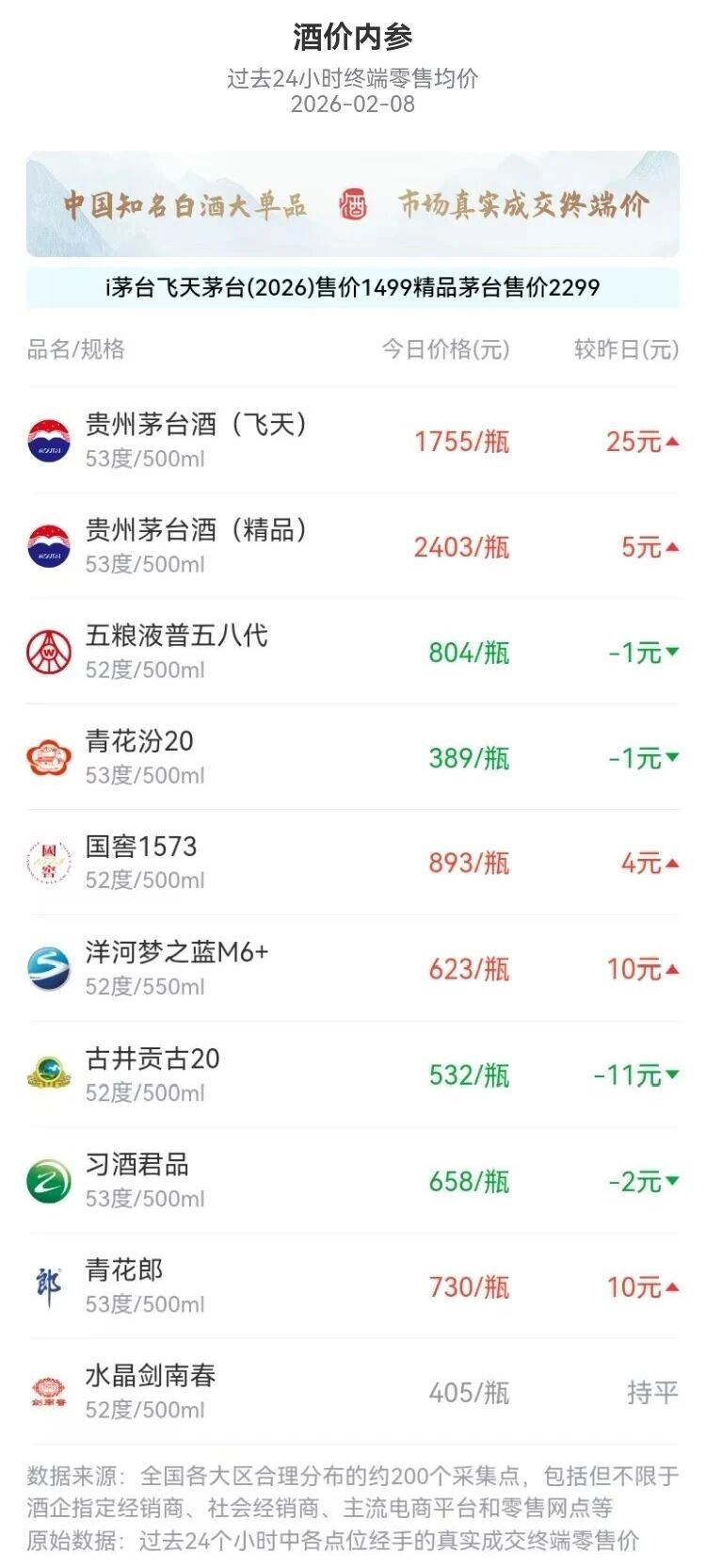
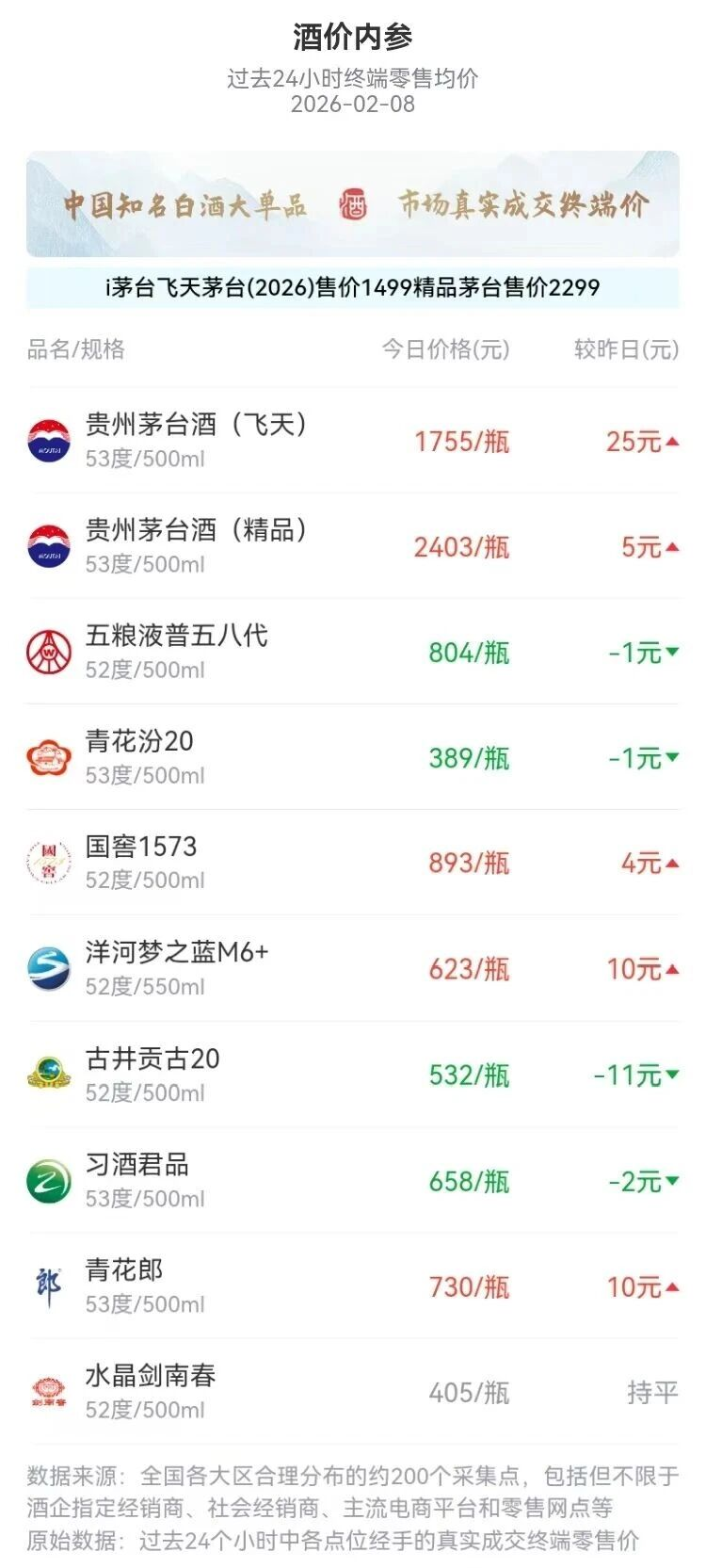
Core Viewpoint - The Chinese liquor market is showing signs of recovery in retail prices, particularly driven by premium products like Moutai, with the overall packaged price of the top ten liquor products reaching a new high since 2026 [1][5]. Price Movements - Moutai's Feitian liquor price increased by 25 yuan per bottle, marking its fourth consecutive price rise, while other premium products like Yanghe Dream Blue M6+ and Qinghua Lang also saw price increases [2][5]. - The overall packaged price for the top ten liquor products reached 9192 yuan, up by 39 yuan from the previous day [1]. Market Dynamics - The price recovery is characterized by structural features, with premium products experiencing significant price increases while some mid-tier products have seen slight declines [5][6]. - The market is witnessing a clear differentiation, with high-end brands like Moutai performing well, while mid-tier brands are struggling with demand [6][8]. Strategic Adjustments - Leading liquor companies are implementing strategies such as "controlling volume to maintain price" to counter previous market pressures, with Moutai actively promoting market reforms [5][8]. - Companies are shifting their marketing focus from merely pushing inventory to encouraging actual consumption through promotional activities [6]. Capital Market Response - The positive signals from the terminal market have led to a notable valuation recovery in the liquor sector, with Moutai's stock price surpassing 1500 yuan per share [7]. - Analysts suggest that the liquor industry is at a "five-bottom stage," indicating potential opportunities for bottom-fishing in the capital market [7]. Future Outlook - The liquor market's recovery is expected to be structural, with strong brands likely to emerge from the adjustment phase first, while mid-tier and regional brands may need to innovate and market more effectively to find opportunities [8].


国信策略:持股过节,还是持币过节?
智通财经网· 2026-02-08 12:06
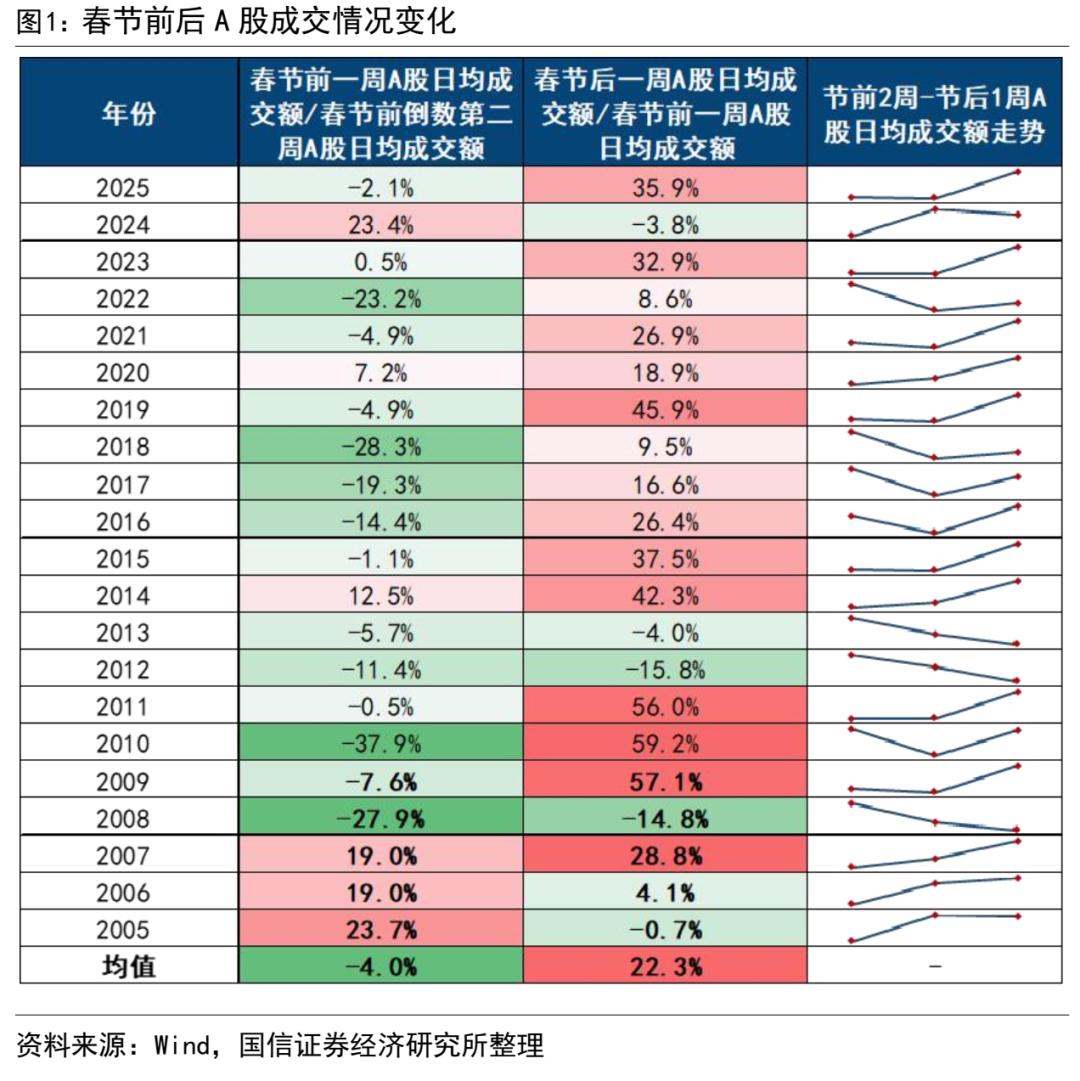
Core Viewpoint - The current market is in a bullish atmosphere, with historical spring market trends indicating a potential index increase of around 20%. The maximum increase of the Shanghai Composite Index since December 17, 2025, is 9.8%, suggesting further room for growth in the current spring market [1]. Market Trends - The A-share market typically experiences a reversal in trading volume after the Spring Festival, with a 22.3% increase in trading volume in the week following the holiday compared to the week before [1][5]. - Historical data shows an 81% probability of the Shanghai Composite Index rising in the week before the Spring Festival, with an average increase of 1.8%, and a 76% probability of rising in the week after, with an average increase of 1.3% [1][4]. Style Performance - Growth and value styles perform evenly before and after the Spring Festival, while large-cap and small-cap styles show distinct performance differences. Large-cap stocks outperform small-cap stocks before the festival, while small-cap stocks dominate after [2][4]. - In the week following the Spring Festival, the probability of the National 2000 Index (small-cap) rising is 87.5%, with an average increase of 4.1%, compared to the 71.4% probability and 0.8% increase for the CSI 300 Index (large-cap) [2]. Fund Flows - Leverage funds typically see significant outflows before the Spring Festival, with an average net buy of -6.69 billion yuan, while they experience inflows after the holiday, averaging a net buy of 1.42 billion yuan [5][6]. - ETF funds show a net inflow before the Spring Festival, averaging 21.43 billion yuan, but experience a decrease in net inflow after the holiday, averaging 17.19 billion yuan [5][6]. Sector Allocation - The technology sector, particularly driven by AI applications, remains a focal point for investment. There is also a potential for traditional value sectors, such as undervalued real estate and liquor, to perform well [7]. - The cyclical sector is expected to benefit from new demand driven by AI and renewable energy, with a focus on upstream resources [7]. Policy Environment - The macroeconomic policy remains positive, with government initiatives aimed at enhancing fiscal spending and project execution, which may support market performance [6][7].
食品饮料周观点:白酒茅台持续引领,大众品关注春节催化-20260208
GOLDEN SUN SECURITIES· 2026-02-08 12:04
Investment Rating - The report suggests a positive investment outlook for the liquor and beverage industry, particularly highlighting the strong performance of leading brands like Moutai during the upcoming Spring Festival season [1][2]. Core Insights - The report emphasizes that the liquor sector is experiencing a recovery driven by seasonal demand, with Moutai leading the way in sales and pricing improvements. The anticipated increase in social consumption due to the extended Spring Festival holiday in 2026 is expected to further boost demand [2]. - In the beer and beverage segment, Chongqing Beer is projected to achieve stable growth in 2025, with revenue expected to reach 14.72 billion yuan, a year-on-year increase of 0.5%. The company is actively expanding its product offerings and optimizing its market strategy [3]. - The report notes that the food sector is benefiting from a delayed Spring Festival, which is likely to enhance sales of snacks and dairy products, particularly those with gifting attributes [4]. Summary by Sections Liquor Sector - The Spring Festival season is expected to catalyze sales, with Moutai showing strong performance and leading the market recovery. The brand's effective customer engagement strategies have resulted in significant user growth and order volume [2]. - The report anticipates that the overall liquor market will see a positive turnaround, supported by favorable policies and improved consumer sentiment [2]. Beer and Beverage Sector - Chongqing Beer reported a revenue of 14.72 billion yuan for 2025, with a net profit of 1.23 billion yuan, reflecting a 10.4% increase year-on-year. The company is focusing on expanding its non-alcoholic beverage channels and enhancing its product mix [3]. - East Peng Beverage's recent IPO and its strategic partnership for international expansion are highlighted as significant developments in the beverage sector [3]. Food Sector - The report indicates that the delayed Spring Festival in 2026 will create opportunities for growth in the snack and dairy product categories, particularly those with gifting potential. The low base effect from the previous year is expected to facilitate a strong start for these products [4][7].
市场风险偏好将进入修复期
Changjiang Securities· 2026-02-08 11:52
- The report highlights the monthly performance of strong stocks, indicating that despite the adjustment of heavyweight stocks, small-cap stocks provided a hedge, but the overall market profitability was weak, with total market turnover dropping from 3.99 trillion yuan on January 14 to 2.16 trillion yuan on February 6[6] - The top 20 stocks with the highest gains in February are listed, including sectors such as space photovoltaics, batteries, copper connections, innovative drugs, real estate, and more, with the highest gain reaching 80.52% for *ST立方[6] - The report provides a detailed analysis of the maximum gains in various sectors since the start of the bull market, with telecommunications and metal materials/mining sectors achieving the highest gains of 218% and 217%, respectively, from February 5, 2024, to February 7, 2026[9]
一周观点:美元体系裂痕出现或将难以修复,美股易跌难涨-20260208
Huafu Securities· 2026-02-08 11:49
Key Insights - The global macro pricing logic is shifting from "demand-driven" to "supply-constrained pricing," with China's supply order strengthening and entering a phase of validating profit and price data, leading to a gradual concentration of asset pricing power on the supply side [2][3][9] - The narrative of long-term pressure on dollar credit remains unchanged, as the path for the U.S. to maintain demand through the household sector is weakening, posing structural risks to global demand expansion mechanisms [2][3][9] - Global capital allocation logic continues to evolve into a "short-term shield and long-term spear," with commodities and gold still supported by safe-haven funds, but their upward logic is more about credit risk aversion than demand expansion, indicating potential mid-term limitations [3][9] - The rise of U.S. assets increasingly relies on AI investments and fiscal drivers rather than household sector leverage, with a long-term downward trend in the return on equity (ROE) central tendency [3][9] - Chinese pricing assets are expected to become the main style line for the year, focusing on the strengthening of supply constraints and the trend of ROE recovery, with cyclical heavy asset industries beginning to release profit elasticity [3][9] - Mid-term investment opportunities are favored around the recovery of China's Producer Price Index (PPI), particularly in cyclical industries such as coal, steel, chemicals, construction materials, and agriculture, with a positive outlook on leading heavy asset companies in China [3][9] - Long-term preferences include insurance, central state-owned enterprises, anti-involution strategies, and Chinese concept internet companies [3][9] Group 1 - The U.S. labor market data shows weakness, reinforcing the supply pricing logic, with January's non-farm payrolls adding only 22k jobs, down from 37k, indicating a slowdown in labor market momentum [8] - The manufacturing sector continues to drag down overall employment, with only 1k jobs added in January and a reduction of 8k in manufacturing jobs, reflecting low manufacturing sentiment [8] - The service sector remains a core support for employment, adding 21k jobs in January, but the growth rate has significantly slowed from 42k [8] Group 2 - The report highlights a significant decline in the Hong Kong stock market, with the Hang Seng Index dropping by 3.02% and the Hang Seng Technology Index falling by 6.51% [10] - In the A-share market, the broad index experienced a decline of 1.27%, with the technology sector and cyclical stocks seeing substantial losses, while consumer sectors led the gains [18][25] - The report notes a divergence in foreign capital index futures positions, with a contraction in net short positions for IC, while IF and IM remained stable, and IH saw a slight expansion in net short positions [36]
同样打生肖噱头,茅台为什么不如马年农夫山泉?
Sou Hu Cai Jing· 2026-02-08 11:47
Core Viewpoint - The strong rebound of Moutai has ignited the entire liquor sector, with significant price movements and market reactions indicating a potential recovery in the industry after a prolonged adjustment period [1][2][4]. Group 1: Moutai's Market Performance - Moutai's stock price surged by 8.61% on January 29, marking the highest single-day increase since February 2025, and its market capitalization returned to 1.8 trillion yuan with a trading volume exceeding 26.3 billion yuan [2]. - The stock price of Moutai has rebounded over 18% from its low, approaching a critical technical bull market position, which could influence the extent of its price increase and the nature of the rebound [4]. - The price of Moutai's 53-degree 500ml flying Moutai is psychologically anchored at 1499 yuan, and if the market price falls below this level, Moutai may implement strategies to stabilize prices [4]. Group 2: Industry Trends and Consumer Behavior - The upcoming Spring Festival is traditionally a peak consumption period for liquor, and the introduction of iMoutai has helped stabilize prices after a previous decline [1][4]. - There is a notable increase in demand for flying Moutai during the Spring Festival, but post-holiday, consumer purchasing behavior may revert to more rational levels, potentially affecting prices [4]. - The overall liquor industry is showing signs of recovery, with first-tier brands like Moutai indicating a gradual exit from the adjustment phase, which could positively impact the pricing structure across the sector [7]. Group 3: Collectible Liquor Market - The collectible value of Moutai's zodiac-themed products is under scrutiny, with some experts advising caution regarding their investment potential, as past releases have shown significant price fluctuations [5]. - The market for zodiac-themed Moutai has seen substantial price adjustments, with the latest batch experiencing a drop from 2750 yuan to 2280 yuan per bottle [4][5]. - Comparatively, other collectible products, such as the zodiac water from Nongfu Spring, have demonstrated even higher premium rates, raising questions about Moutai's relative value in the collectible market [1]. Group 4: Economic Context and Future Outlook - The liquor industry has experienced multiple adjustment cycles since 1999, with the current cycle, which began in 2022, being notably prolonged, reflecting broader economic challenges and shifts in consumer demand [8][9]. - The recovery of the liquor sector is closely tied to macroeconomic indicators, with expectations for a turning point in the industry by the second half of 2026 as inventory levels normalize [9].


A股收评:小幅下跌,消费板块领跌!不出意外,下周行情该这样走
Sou Hu Cai Jing· 2026-02-08 11:47
Market Dynamics - A significant market turnaround occurred around 10 AM, with a surge in trading volume for major ETFs, indicating the presence of "mysterious funds" that quickly lifted indices from a downturn [2] - By 11 AM, all three major indices recovered losses and turned positive, with over 2,800 stocks rising from a previous state where more than 4,300 stocks were down [2] Sector Performance - The solar equipment sector showed strong performance, with leading stocks experiencing sharp increases, followed by a rally in gold-related stocks due to rising international gold prices [2] - Technology stocks, particularly in semiconductors and AI applications, also began to rebound after a period of adjustment [2] Afternoon Market Behavior - After a strong morning, the market entered a stagnant phase in the afternoon, with the Shanghai Composite Index fluctuating within a narrow range, indicating a balance between bullish and bearish forces [3] - Financial stocks, including banks, insurance, and brokerages, did not participate in the rally, contributing to the market's inability to sustain upward momentum [3] Consumer Sector Impact - The consumer sector, particularly the liquor industry, emerged as a significant bearish force, with major stocks like Kweichow Moutai and Wuliangye experiencing declines, which negatively impacted overall market performance [5] - The collective drop in consumer stocks limited the potential for further market rebounds, as profit-taking occurred after previous gains [5] Trading Volume Insights - The total trading volume for the day was 2.14 trillion yuan, a decrease of 305 billion yuan compared to the previous trading day, signaling a lack of new capital entering the market [5] - The absence of incremental capital raised concerns about the sustainability of the morning's rebound, as existing funds merely shifted between sectors without attracting new investors [5] Market Sentiment - Market sentiment shifted from initial panic to surprise and then to hesitation and doubt as the day progressed, reflecting a lack of confidence despite the morning's recovery [7] - By the end of the trading day, all three major indices closed slightly down, with the Shanghai Composite Index failing to maintain the 4,100-point level, indicating a retreat from earlier gains [7]
飞天茅台,四连涨!
Zhong Guo Zheng Quan Bao· 2026-02-08 11:00
分析人士认为,这波价格上行主要由飞天茅台等头部产品带动,而部分中腰部产品价格则出现小幅回调, 市场分化格局依然明显。 春节市场现分化 2月8日,贵州茅台飞天酒大幅上涨25元/瓶,实现价格四连涨,延续春节前需求支撑的强势表现;洋河梦之 蓝M6+和青花郎均上涨10元/瓶;精品茅台上涨5元/瓶,突破2400元关口;国窖1573小幅上涨4元/瓶。古井 贡古20下调11元/瓶;习酒君品回落2元/瓶;五粮液普五八代与青花汾20均小幅下调1元/瓶;水晶剑南春价 格保持稳定,与前一日持平。 春节假期临近,白酒市场终端零售价格正显现出回暖迹象。 "酒价内参"2月8日发布的数据显示,中国白酒市场十大单品的整体打包售价达到9192元,较前一日上涨39 元,创2026年以来新高。贵州茅台飞天酒上涨25元/瓶,实现价格四连涨。 尽管高端酒价格有所提振,但白酒市场的整体动销感受并不均衡。北京朝阳区某渠道商对记者表示:"最 近飞天(茅台)确实'走得快',问的人多,货也紧俏,价格自然就上去了。但次高端价格带的酒,问的人 相对少,价格也不太稳得住。"他表示,今年节前备货更谨慎,主要精力都放在周转快、有确定需求的一 线品牌上。 这种感受,与整体 ...
量化择时周报:缩量信号近在咫尺,重回科技与周期-20260208
ZHONGTAI SECURITIES· 2026-02-08 10:43
Quantitative Models and Construction Methods Model Name: Industry Trend Allocation Model - **Model Construction Idea**: This model aims to identify industry trends and allocate investments accordingly[5][8][10] - **Model Construction Process**: - The model uses various indicators to assess industry trends, including market performance, valuation levels, and risk appetite. - It incorporates signals from different sub-models such as the Mid-term Distress Reversal Expectation Model, TWO BETA Model, and Performance Trend Model. - The Mid-term Distress Reversal Expectation Model waits for reversal signals in industries like liquor and real estate. - The TWO BETA Model recommends the technology sector and monitors opportunities in commercial aerospace. - The Performance Trend Model focuses on the computing power industry chain and oversold sectors like non-ferrous metals and chemicals. - **Model Evaluation**: The model is effective in identifying industry trends and making allocation recommendations based on various market signals[5][8][10] Model Name: Timing System - **Model Construction Idea**: This model aims to distinguish the overall market environment and provide timing signals for investment decisions[5][8][9] - **Model Construction Process**: - The model uses the distance between the long-term moving average (120 days) and the short-term moving average (20 days) of the WIND All A Index. - The latest data shows the 20-day moving average at 6787 and the 120-day moving average at 6338, with a difference of 7.08%. - The model also considers the market trend line, which is currently around 6780 points, and the profitability effect, which is -1.44%. - The model suggests that the market is in a shock pattern and monitors short-term risk appetite changes. - **Model Evaluation**: The model provides clear signals for market timing based on moving averages and other indicators[5][8][9] Model Backtesting Results - **Industry Trend Allocation Model**: - **PE Valuation Level**: 90th percentile, indicating a high level[8][10] - **PB Valuation Level**: 50th percentile, indicating a medium level[8][10] - **Position Recommendation**: 70% for absolute return products with WIND All A as the stock allocation subject[8][10] - **Timing System**: - **Moving Average Distance**: 7.08%, greater than the absolute value of 3%[5][8][9] - **Market Trend Line**: Around 6780 points[5][8][9] - **Profitability Effect**: -1.44%, indicating a temporary end to the upward trend[5][8][9] Quantitative Factors and Construction Methods Factor Name: Mid-term Distress Reversal Expectation Model - **Factor Construction Idea**: This factor aims to identify potential reversal signals in distressed industries[5][8][10] - **Factor Construction Process**: - The model monitors industries like liquor and real estate for reversal signals. - It uses various market indicators to assess the likelihood of a reversal. - **Factor Evaluation**: The factor is useful for identifying potential investment opportunities in distressed industries[5][8][10] Factor Name: TWO BETA Model - **Factor Construction Idea**: This factor aims to recommend sectors with high growth potential, such as technology[5][8][10] - **Factor Construction Process**: - The model focuses on the technology sector and monitors opportunities in commercial aerospace. - It uses market performance and other indicators to make recommendations. - **Factor Evaluation**: The factor is effective in identifying high-growth sectors and making investment recommendations[5][8][10] Factor Name: Performance Trend Model - **Factor Construction Idea**: This factor aims to identify sectors with strong performance trends[5][8][10] - **Factor Construction Process**: - The model focuses on the computing power industry chain and oversold sectors like non-ferrous metals and chemicals. - It uses performance indicators to make recommendations. - **Factor Evaluation**: The factor is useful for identifying sectors with strong performance trends and making investment recommendations[5][8][10] Factor Backtesting Results - **Mid-term Distress Reversal Expectation Model**: - **PE Valuation Level**: 90th percentile, indicating a high level[8][10] - **PB Valuation Level**: 50th percentile, indicating a medium level[8][10] - **TWO BETA Model**: - **PE Valuation Level**: 90th percentile, indicating a high level[8][10] - **PB Valuation Level**: 50th percentile, indicating a medium level[8][10] - **Performance Trend Model**: - **PE Valuation Level**: 90th percentile, indicating a high level[8][10] - **PB Valuation Level**: 50th percentile, indicating a medium level[8][10]
避险情绪升温科技板块深度调整,节前A股风格显著切换
第一财经· 2026-02-08 10:35
Core Viewpoint - The A-share market has experienced a significant style switch in early February, with the technology sector facing deep adjustments, while defensive sectors like liquor and real estate have shown resilience [3][4]. Group 1: Market Performance - In the first week of February, the electronic industry saw a market value decline of approximately 890 billion yuan, with leading stocks like Zhongji Xuchuang and Xinyi Sheng dropping over 13% [3]. - The technology sector's representative index, the Sci-Tech Innovation 50 Index, recorded a weekly decline of 5.76%, marking the largest drop since November 2025, with a cumulative decline of 8.45% over two weeks [6]. - The electronic industry had a trading volume of 313.9 billion yuan, the highest this year, while the communication sector fell by 6.94% [5]. Group 2: Individual Stock Performance - Major technology stocks experienced significant declines, with Zhongji Xuchuang and Xinyi Sheng down 16.79% and 13.2%, respectively, and Hanwujing falling 17.3% [6]. - The storage chip sector faced collective pressure, with stocks like Xiangnong Xinchuan dropping 18.25%, and several others exceeding 12% declines [6]. - New GPU companies like Muxi Co. and Moer Thread hit new lows since their listings, with Muxi Co. down 44.8% from its peak [7]. Group 3: Factors Behind the Adjustment - The technology sector's deep correction is attributed to multiple factors, including pre-holiday market caution, high valuations prompting profit-taking, and increased volatility from external macroeconomic conditions [9][10]. - The electronic industry's price-to-earnings ratio (TTM) reached 69.76, significantly above the five-year average, indicating substantial internal adjustment pressure [9]. - The market's high sentiment earlier in the year, combined with liquidity tightening and profit-taking behavior, contributed to the sector's phase adjustment [10]. Group 4: Market Reallocation - Funds exiting the technology sector have not left the market but have shifted towards more resilient sectors like consumer goods and real estate, indicating a potential phase shift in market style [11]. - The liquor index rose by 2.24%, with stocks like Kweichow Moutai and Wuliangye increasing by 8.14% and 1.9%, respectively, while the real estate sector became active due to expectations of policy optimization [11].