
服务业

Search documents
工业生产较快增长 消费潜能继续释放
Shang Hai Zheng Quan Bao· 2025-09-15 19:09
Group 1: Consumer Market Trends - Consumer spending continues to expand and improve, with retail sales of consumer goods increasing by 4.6% year-on-year from January to August, and a 3.4% increase in August alone [1] - The "trade-in for new" policy has shown positive effects, with retail sales of furniture, home appliances, and communication equipment increasing by 18.6%, 14.3%, and 7.3% respectively in August [1] - Service consumption is growing rapidly, with service retail sales increasing by 5.1% year-on-year from January to August, outpacing the growth of goods retail sales [1][2] Group 2: Real Estate Market Developments - The decline in new housing sales has narrowed, with a 4.7% year-on-year decrease in sales area from January to August, a reduction of 13.3 percentage points compared to the same period last year [3] - New home prices are also seeing a reduced decline, with most cities experiencing a smaller year-on-year price drop in August compared to July [3] - The inventory reduction in the real estate market is progressing steadily, with a decrease of 3.17 million square meters in unsold housing inventory from July to August [3] Group 3: Macroeconomic Policy Outlook - Overall, macroeconomic policies are expected to strengthen, with potential new measures aimed at stabilizing employment, businesses, and market expectations [4][5] - Analysts suggest that new fiscal measures and possible interest rate cuts from the central bank may be introduced in the fourth quarter to counter external demand slowdowns [4]
宏观政策协同发力 8月份国民经济运行总体平稳
Qi Huo Ri Bao Wang· 2025-09-15 18:51
Economic Overview - In August, the national economy showed overall stability with coordinated macro policies, steady progress in transformation and upgrading, and new achievements in high-quality development [1][2] - The industrial production and service sectors experienced rapid growth, with industrial added value increasing by 5.2% year-on-year and service production index rising by 5.6% [1] Market Performance - Retail sales and fixed asset investment maintained steady growth, with total retail sales of consumer goods reaching 39,668 billion yuan, a year-on-year increase of 3.4% [1] - From January to August, fixed asset investment (excluding rural households) totaled 326,111 billion yuan, up 0.5% year-on-year, while investment excluding real estate development grew by 4.2% [1] - The total import and export value in August was 38,744 billion yuan, a year-on-year increase of 3.5%, with exports at 23,035 billion yuan (up 4.8%) and imports at 15,709 billion yuan (up 1.7%) [1] Employment and Inflation - The employment situation remained generally stable, with the urban surveyed unemployment rate averaging 5.2% from January to August and at 5.3% in August [1] - The Consumer Price Index (CPI) decreased by 0.4% year-on-year in August, while the core CPI, excluding food and energy, rose by 0.9%, indicating a slight increase in inflationary pressure [1] Real Estate Market - The real estate market showed signs of stabilization, with new residential sales area declining by 4.7% year-on-year, a reduction in the decline compared to the previous year [2] - In August, the inventory of unsold commercial housing decreased by 3.17 million square meters, marking six consecutive months of reduction [2] Future Economic Outlook - The economic foundation remains strong, with macro policies showing effectiveness and ongoing reforms supporting stable growth [4] - Despite external challenges, the economy is expected to maintain a steady and improving development trend, bolstered by new growth drivers and enhanced market vitality [4]
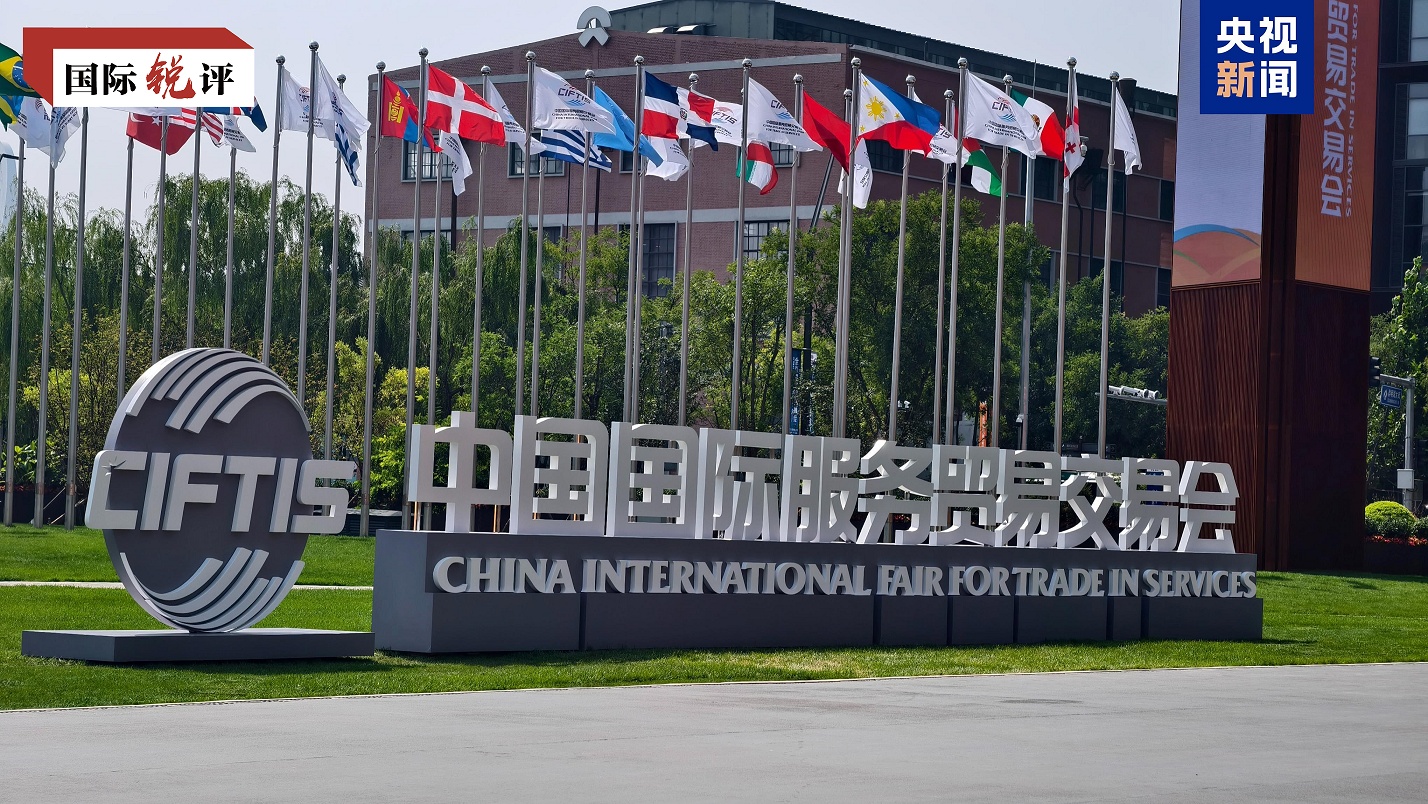
国际锐评丨服贸焕新,外资看到“中国遍地是机遇”
Yang Shi Xin Wen Ke Hu Duan· 2025-09-15 12:48
Group 1 - The service trade has become a new engine for global economic growth, with the 2025 China International Service Trade Fair attracting 85 countries and nearly 500 Fortune 500 companies, resulting in over 900 achievements [3][4] - In 2024, China's service trade total is expected to exceed $1 trillion for the first time, marking a historical high and positioning China as the second-largest service trade country globally [3][6] - Knowledge-intensive service trade, characterized by digitalization, intelligence, and greening, has seen a 38% increase compared to 2020, highlighting "smart" innovation as a key theme of the fair [3][4] Group 2 - Traditional service industries are undergoing transformation, with artificial intelligence and digitalization emerging as significant trends, presenting opportunities for foreign enterprises [4][6] - China has become a major trading partner for 157 countries and regions, being the world's largest goods trader and the second-largest service trader, which enhances its attractiveness as a trade partner [6][7] - The Chinese government announced measures to accelerate service market openness and promote high-quality service trade development, boosting foreign enterprises' confidence in the market [6][8] Group 3 - Companies like Meituan are leveraging technology to create new business models and enhance service experiences globally, such as launching the Keeta food delivery brand in Saudi Arabia [7][8] - Consulting firms are providing human resource services to Chinese companies expanding overseas, contributing to employment and economic growth in Belt and Road Initiative countries [8] - International exhibitions, including the service trade fair, demonstrate the global community's preference for open cooperation over unilateralism and protectionism, showcasing China's commitment to building an open world economy [8]

投资和消费增速回落,更多政策将落地
Ge Lin Qi Huo· 2025-09-15 12:39
Report Industry Investment Rating No relevant content provided. Core View of the Report - In August, China's economic performance was below expectations, with fixed - asset investment, social consumption, industrial added value, export, and service production index all showing less - than - expected growth, and the real estate market continuing to decline. To maintain rapid economic growth, domestic demand needs to continue to play a key role. The government will introduce policies to expand service consumption, promote private investment, and launch new policy - based financial tools [1][2][3]. Summary by Related Content Fixed - Asset Investment - From January to August, national fixed - asset investment increased by 0.5% year - on - year, lower than the market expectation of 1.3% and the 1.6% in January - July. General infrastructure investment (including electricity) increased by 5.4% year - on - year, narrow infrastructure investment (excluding electricity) increased by 2.0%, manufacturing investment increased by 5.1%, and real estate development investment decreased by 12.9%. Private fixed - asset investment decreased by 2.3%. In August, manufacturing investment decreased by 1.3% year - on - year, and narrow infrastructure investment decreased by 5.9% year - on - year [1][4]. Real Estate Market - From January to August, the sales area of new commercial housing decreased by 4.7% year - on - year, and the sales volume decreased by 7.3%. In August, the sales prices of second - hand residential properties in first - tier cities decreased by 1.0% month - on - month for the fifth consecutive month, and those in second - and third - tier cities also continued to decline. The funds in place for real estate development enterprises decreased by 12.5% year - on - year, and the newly - started and completed floor areas also showed year - on - year declines [2][5][7]. Industrial Added Value - In August, the value - added of large - scale industries increased by 5.2% year - on - year, lower than the market expectation of 5.8%. From January to August, it increased by 6.2% year - on - year. High - tech manufacturing maintained rapid growth, with an 8 - month growth of 9.5% year - on - year. The product sales rate of large - scale industrial enterprises was 96.6%, a year - on - year decrease of 0.1 percentage points [9]. Exports - In August, China's exports in US dollars increased by 4.4% year - on - year, lower than the expected 5.9%. From January to August, exports increased by 5.9% year - on - year. Exports to ASEAN and the EU increased, while exports to the US decreased significantly. Due to the low base in September last year, export growth is expected to be rapid in September, but may decline in the fourth quarter [2][10][11]. Social Consumption - In August, the total retail sales of social consumer goods increased by 3.4% year - on - year, lower than the market expectation of 3.8%. From January to August, it increased by 4.6% year - on - year. The growth rate of consumer goods related to the trade - in policy decreased, while the growth of improved consumption accelerated. The retail sales of the automobile category increased by 0.8% year - on - year [14][15]. Service Industry - In August, the national service industry production index increased by 5.6% year - on - year, lower than the 5.8% in July. From January to August, it increased by 5.9% year - on - year. Information transmission, software and information technology services, finance, and leasing and business services had faster growth rates [16]. Unemployment Rate - In August, the national urban survey unemployment rate was 5.3%, an increase of 0.1 percentage points from the previous month, the same as the same month last year. The unemployment rate of migrant workers decreased slightly [16]. Policy Measures - The Ministry of Commerce will introduce policies to expand service consumption in September. On September 12, the State Council executive meeting deployed measures to promote private investment. New policy - based financial tools will be launched to support emerging industries and infrastructure projects [3][18].
长春高新:9月15日召开董事会会议
Mei Ri Jing Ji Xin Wen· 2025-09-15 12:22
Group 1 - The core point of the article is that Changchun High-tech (SZ 000661) announced the convening of its 12th meeting of the 11th Board of Directors on September 15, 2025, to discuss the appointment of a new deputy general manager [1] - For the first half of 2025, the revenue composition of Changchun High-tech is as follows: pharmaceutical industry accounts for 92.83%, real estate for 6.81%, and service industry for 0.36% [1] - As of the time of reporting, the market capitalization of Changchun High-tech is 51.7 billion yuan [1] Group 2 - A significant breakthrough has been reported regarding a new drug from China, which has been recognized by both Chinese and American officials for its breakthrough efficacy, generating excitement at the World Lung Cancer Conference [1]

8月经济数据点评:8月经济:“反内卷”影响开始显现
Shenwan Hongyuan Securities· 2025-09-15 11:15
Economic Data - In August, the year-on-year growth of social retail sales was 3.4%, lower than the expected 3.8% and previous 3.7%[1] - Fixed asset investment showed a cumulative year-on-year increase of 0.5%, down from the previous value of 1.6%[1] - Real estate development investment decreased by 12.9% year-on-year, compared to the expected decline of 12.4% and previous decline of 12%[1] - The industrial added value in August grew by 5.2% year-on-year, below the expected 5.8% and previous 5.7%[1] Production and Investment - Industrial added value fell by 0.5 percentage points to 5.2% in August, indicating a slowdown in downstream production due to "anti-involution" effects[2] - Fixed asset investment dropped by 1.0 percentage points to -6.3% in August, with construction and installation investment declining significantly by 5 percentage points to -11.1%[2] - Real estate investment saw the largest decline, down 2.4 percentage points to -19.4%[2] Real Estate Market - In the real estate sector, the sales area of new commercial housing decreased by 4.7% year-on-year, while the sales amount fell by 10.6%[3] - The credit financing growth rate for real estate companies remained negative at -8.1%, with new construction down 4.8 percentage points to -20.3%[3] Consumer Behavior - The year-on-year growth of social retail sales in August was 3.4%, with significant declines in home appliances (-14.4 percentage points to 14.3%) and communication equipment (-7.6 percentage points to 7.3%) sales[3] - Service consumption remained relatively stable, with restaurant income slightly increasing by 1.0 percentage points to 2.1%[3] Economic Outlook - The report anticipates that external demand will continue to contribute to economic resilience, while internal demand remains weak, particularly due to the impacts of "anti-involution" and the ongoing decline in real estate new construction projects[4] - The need for policies to stabilize consumption and investment in services and infrastructure is emphasized, with ongoing monitoring of policy changes recommended[4]
数据点评 | 8月经济:“反内卷”影响开始显现(申万宏观·赵伟团队)
申万宏源宏观· 2025-09-15 11:12
Core Viewpoint - The impact of "anti-involution" on mid- and downstream production and investment is beginning to manifest [2][71] Production - Upstream production remains strong, but the influence of "anti-involution" is starting to show in mid- and downstream sectors. In August, industrial added value year-on-year decreased by 0.5 percentage points to 5.2%. Upstream sectors like coal mining performed well, while mid- and downstream sectors such as transportation equipment (-1.7 percentage points to 12%), metal products (-1.4 percentage points to 2.8%), and food production (-1.8 percentage points to 2%) saw declines [2][8][71] Investment - Fixed asset investment continued to decline in August, primarily due to the impact of "anti-involution" on mid- and downstream investments, compounded by the ongoing contraction in new projects affecting current real estate investments. Fixed asset investment year-on-year fell by 1.0 percentage points to -6.3%, with construction and installation investment dropping significantly (-5 percentage points to -11.1%). Real estate investment saw the largest decline (-2.4 percentage points to -19.4%), while manufacturing investment also decreased (-0.9 percentage points to -1.2%) [2][13][71] Real Estate - On the demand side, sales and housing prices continue to decline, while the supply chain of "new starts-restarts-investment-completion" remains weak. In August, the sales area of commercial housing fell by 2.7% year-on-year, and the sales amount decreased by 14.0%. The credit financing growth rate for real estate companies remains negative (-8.1%), with new starts down (-4.8 percentage points to -20.3%) and real estate investment continuing to decline (-2.4 percentage points to -19.5%) [3][22][72] Consumption - Some "trade-in" products are showing signs of decline, while service consumption remains relatively stable. In August, the year-on-year growth of social retail sales was 3.4%, down 0.3 percentage points from the previous month. Notably, household appliances (-14.4 percentage points to 14.3%) and communication equipment (-7.6 percentage points to 7.3%) experienced significant declines [3][29][55] Summary - The effects of "anti-involution" on domestic supply and demand are becoming evident, but external demand is expected to continue contributing to economic resilience. The economic landscape in September shows weak domestic demand and strong external demand. Future focus should be on the pressures of internal demand, including the impact of "anti-involution" on production and investment, as well as the lagging effects of previous real estate project contractions [4][33][73]
宏观经济宏观月报:8月经济超预期回落,政策加码窗口打开-20250915
Guoxin Securities· 2025-09-15 08:26
Economic Performance - In August, the industrial added value above designated size grew by 5.2% year-on-year, a decline of 0.5 percentage points from July[1] - The total retail sales of consumer goods reached 39,668 billion yuan, with a year-on-year growth of 3.4%, down 0.3 percentage points from July[1] - From January to August, fixed asset investment (excluding rural households) totaled 326,111 billion yuan, with a year-on-year growth of 0.5%, down 1.1 percentage points from January to July[1] - The unemployment rate in urban areas rose to 5.3%, an increase of 0.1 percentage points from the previous month[1] GDP and Economic Drivers - The monthly GDP year-on-year growth rate for August is approximately 3.8%, a further decline of 0.5 percentage points from July, significantly below the annual growth target[2][3] - The construction sector contributed a drag of about 0.3 percentage points to GDP growth, while industrial and service sectors each contributed a drag of 0.1 percentage points[2][3] - The decline in economic growth is characterized by a simultaneous slowdown in consumption, investment, and exports, indicating a broad-based cooling of demand[3] Policy Outlook - The current economic situation presents a critical policy window, necessitating more aggressive macroeconomic responses to prevent further economic decline[4][15] - Key measures include accelerating the expenditure of accumulated fiscal deposits, increasing the issuance and utilization of local government special bonds, and enhancing support for infrastructure projects through policy financial tools[4][15] Risks and Challenges - The rising unemployment rate may suppress consumer income expectations and confidence, potentially undermining the effectiveness of consumption stimulus policies[3][15] - There is a risk of policy measures being ineffective if consumers choose to save rather than spend any subsidies received, leading to a "policy hollowing out" effect[3][15]
三季度经济发展趋势如何 国家统计局最新研判
Di Yi Cai Jing· 2025-09-15 04:38
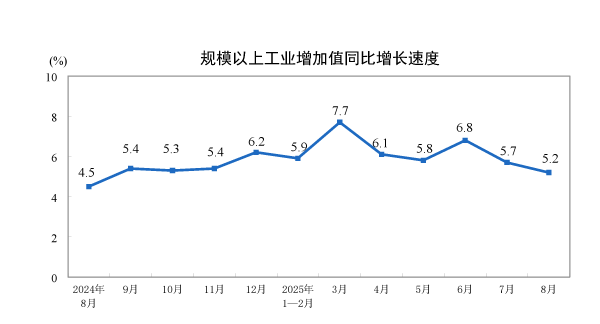
Economic Overview - In August, China's economy showed short-term fluctuations but demonstrated strong resilience and vitality despite a complex external environment and weak domestic demand [1] - The National Bureau of Statistics reported that the industrial added value above designated size grew by 5.2% year-on-year in August, a slight decrease of 0.5 percentage points from July [1] - Retail sales of consumer goods increased by 3.4% year-on-year in August, down 0.3 percentage points from July [1] - From January to August, fixed asset investment grew by 0.5% year-on-year, slowing down by 1.1 percentage points compared to the first seven months of the year [1] Industrial Development - The high-end development of industries is progressing positively, with technological and industrial innovations continuously merging [3] - From January to August, the added value of high-tech manufacturing industries increased by 9.5%, with integrated circuit manufacturing and aerospace equipment manufacturing growing by 22.3% and 14.6%, respectively [3] - The production of industrial robots and civilian drones surged by 29.9% and 53.7%, respectively, indicating steady progress in intelligent and green transformation [3] Consumer Market - The scale of commodity consumption continues to expand, with market sales steadily recovering due to various measures aimed at boosting consumption [5] - From January to August, retail sales of consumer goods increased by 4.6%, while service retail sales grew by 5.1% [6] - The implementation of policies such as trade-in programs has stimulated consumer demand, leading to significant growth in related product sales [6] Investment Trends - Fixed asset investment (excluding rural households) reached 326.111 billion yuan from January to August, with a year-on-year growth of 0.5% [9] - Manufacturing investment grew by 5.1% year-on-year, although this represents a decline of 1.1 percentage points compared to the previous seven months [10] - Infrastructure investment (excluding power, heat, gas, and water production and supply) increased by 2.0% year-on-year, but the growth rate slowed by 1.2 percentage points compared to the first seven months [10] Future Outlook - Despite external challenges, China's economy is expected to maintain a stable and progressive development trend, supported by macroeconomic policies and the construction of a unified national market [11] - The potential for high-quality development remains strong, with new growth drivers emerging and market vitality increasing [11]
三季度经济发展趋势如何,国家统计局最新研判
Di Yi Cai Jing· 2025-09-15 04:31
消费能力信心有待提升,内生动能仍需增强。 面对复杂严峻的外部环境和供强需弱的国内市场,8月份中国经济出现短期波动,但依然展现出较强的 韧性和活力。 国家统计局9月15日发布的经济数据显示,8月份,规模以上工业增加值同比增长5.2%,比7月小幅回落 0.5个百分点;社会消费品零售总额同比增长3.4%,比7月回落0.3个百分点。1-8月份,全国固定资产投 资同比增长0.5%,比1-7月放缓1.1个百分点。 国家统计局新闻发言人付凌晖在国务院新闻办发布会上表示,一系列宏观政策持续发力,工业和服务业 保持较快增长,消费、进出口规模仍然在扩大,就业物价总体稳定,新质生产力培育壮大,三季度经济 运行有望保持稳中有进发展态势。 产业高端化发展向好 随着创新引领作用不断增强,科技创新和产业创新不断融合,新质生产力培育壮大,经济新的增长点持 续涌现。 商品消费规模继续扩大 从需求端来看,在提振消费专项行动各项措施作用下,市场销售稳步回升,以旧换新相关商品销售增势 较好,网络直播带货、即时零售等新型消费快速增长,服务消费持续扩大。 1-8月份,社会消费品零售总额同比增长4.6%,服务零售额增长5.1%,市场销售呈现持续扩大态势。 ...