债券

Search documents
ETF日报:当前储能行业呈现供需两旺态势,国内外需求共振,头部电池企业持续满产,关注新能源车ETF
Xin Lang Cai Jing· 2025-12-08 11:45
Market Overview - A-shares experienced a rebound with the Shanghai Composite Index rising by 0.54% to close at 3924.08 points, and the Shenzhen Component Index increasing by 1.39% to 13329.99 points. Over 3400 stocks rose, with total trading volume reaching 2.05 trillion yuan, significantly higher than the previous trading day [1][11]. Economic Policy - The Central Committee of the Communist Party of China held a meeting emphasizing the need for a stable yet progressive economic approach for the upcoming year, advocating for a more proactive fiscal policy and moderately loose monetary policy. This is expected to support the resilience of the A-share market and maintain a slow bull market trend [1][13]. Sector Performance - The communication and non-bank financial sectors led the market, while the coal industry saw the largest declines. The meeting highlighted the importance of domestic demand, suggesting a shift towards high elasticity and growth sectors, particularly in cyclical stocks like chemicals and non-ferrous metals [1][3][13]. Investment Recommendations - Investors are advised to focus on the CSI A500 ETF (159338) as a core holding to enhance exposure to new productive forces, aligning with the anticipated slow bull market supported by fiscal and monetary policies [4][14]. Bond Market - The bond market has seen significant fluctuations, with the yield on the 30-year active bond rising over 10 basis points. The 10-year government bond yield is approaching the upper limit of the central bank's target range of 1.75% to 1.85%. A seasonal trend in the bond market is expected once disturbances in the long-end stabilize [5][15]. Technology Sector - The computing power sector showed strong performance, with the AI ETF (159388) rising by 5.51% and the communication ETF (515880) increasing by 5.49%. The ongoing development of Google's AI ecosystem is expected to drive demand for computing power, benefiting related A-share companies [6][16]. Energy Storage and Electric Vehicles - Domestic energy storage installations maintained high growth rates, with a year-on-year increase of 19.3% in power and 28.41% in capacity. The electric vehicle market also showed robust growth, with an estimated 1.72 million units sold in November, reflecting a 20% increase year-on-year [8][18]. Lithium and Energy Metals - The demand for lithium is expected to rise due to stable downstream power demand and increasing energy storage needs. The supply-demand dynamics are improving, with rising prices for lithium battery materials. Investors are encouraged to monitor the performance of the new energy vehicle ETFs (159806) and the entrepreneurial board new energy ETF (159387) [9][19].


12月8日大盘简报
Mei Ri Jing Ji Xin Wen· 2025-12-08 09:53
Group 1 - A-shares experienced a rebound with the Shanghai Composite Index rising by 0.54% to 3924.08 points and the Shenzhen Component Index increasing by 1.39% to 13329.99 points, indicating a positive market sentiment [1] - The Central Political Bureau meeting emphasized the need for a more proactive fiscal policy and moderately loose monetary policy for the upcoming year, which is expected to support the resilience of the A-share market and maintain a slow bull trend [1] - The fiscal deficit rate for next year is projected to be no less than 4% of GDP, with fiscal policies continuing to play a crucial role in stabilizing growth, expanding domestic demand, and improving people's livelihoods [1] Group 2 - The yield on long-term bonds has seen a significant increase, with the active bond 2500006 rising over 10 basis points, leading to a slight pullback in the ten-year government bond ETF [2] - The current ten-year government bond yield is at the upper end of the central bank's acceptable range, and a new round of reserve requirement ratio cuts and interest rate reductions is anticipated as the "14th Five-Year Plan" begins [2] - Investors are advised to consider diversifying their portfolios by including the ten-year government bond ETF (511260) to enhance stability [2] Group 3 - The computing power sector showed strong performance, with the AI ETF (159388) rising by 5.51% and the communication ETF (515880) increasing by 5.49%, reflecting ongoing growth in the industry [3] - Google's full-stack AI ecosystem is advancing, with expectations for increased shipments of Google TPU, which is likely to drive overall demand for computing power [3] - The market anticipates that the shipment volume of 1.6T optical modules will reach 20-30 million by 2026, indicating a significant supply-demand imbalance in the future [3]
债市收盘| 万科债券反弹,30年国债收益率盘中最高上行超2BP
Xin Lang Cai Jing· 2025-12-08 09:52
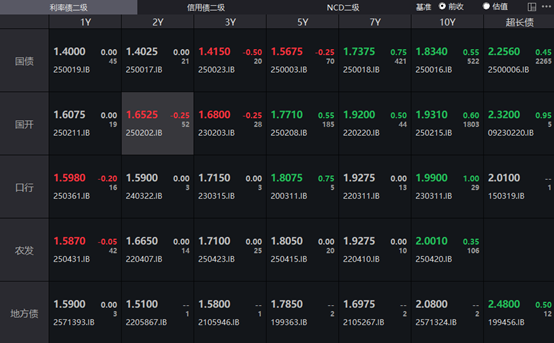
Core Viewpoint - The yield on 30-year government bonds continues to rise, with fluctuations observed throughout the day, indicating a bearish trend in the bond market [1][3]. Group 1: Government Bond Market - The yield on the 30-year government bond active coupon rose by over 2 basis points during the day, with a slight narrowing of the increase in the afternoon [1]. - The closing prices for government bond futures showed a mixed performance, with the 30-year main contract down by 0.29% to 112.240, while the 10-year main contract increased by 0.02% to 107.910 [1]. - As of 16:30, the yield on the 10-year government bond active coupon rose by 0.55 basis points to 1.834%, while the 30-year government bond yield increased by 0.45 basis points to 2.256% [1][2]. Group 2: Market Sentiment and Technical Analysis - Analysts indicate that the 30-year government bond futures have technically broken down, confirming a downward trend, with trading firms continuing to follow this trend [3]. - The market sentiment was slightly calmed by a political bureau meeting, but the bond market still lacks direction, suggesting potential further weakness influenced by upcoming news [3]. Group 3: Central Bank Operations - The central bank conducted a reverse repurchase operation of 122.3 billion yuan at a fixed rate of 1.40%, with a net injection of 14.7 billion yuan for the day [4]. - Short-term Shibor rates have collectively risen, with the overnight rate up by 0.1 basis points to 1.302% and the 7-day rate up by 1.0 basis points to 1.426% [4]. Group 4: Secondary Market Performance - In the secondary market, Vanke bonds showed significant rebounds, with "21 Vanke 04" rising over 31% and "21 Vanke 02" increasing over 23% [2]. - Conversely, some bonds like "22 Vanke 06" and "24 Industrial Integration 08" experienced declines of over 4% [2].

泓德基金:上周权益市场震荡反弹,主要宽基指数涨幅1%左右
Xin Lang Cai Jing· 2025-12-08 08:47
上周国内权益市场震荡反弹,主要宽基指数涨幅在1%左右,全市场日均成交量稳定在1.7万亿元附近, 周五下午开盘后,保险板块大幅上涨,部分上市保险公司的涨幅超过5%,有效提振了当日的市场人 气。 12月5日,国家金融监督管理总局发布通知,下调保险公司相关业务风险因子,进一步提升险资配置权 益资产的资本使用效率,为加大险资持续入市力度,培育壮大险资耐心资本,支持科技创新打开空间。 泓德基金表示,风险因子下调直接降低保险资金权益投资的最低资本占用,释放的资本额度若全部用于 增配股票,理论上可为A股带来约千亿元增量资金。政策通过资本占用折扣机制,显著提升险资对高股 息蓝筹股及科技创新板块的配置意愿,同时抑制短期交易行为,推动投资策略向长期价值型转变。 上周国内权益市场震荡反弹,主要宽基指数涨幅在1%左右,全市场日均成交量稳定在1.7万亿元附近, 周五下午开盘后,保险板块大幅上涨,部分上市保险公司的涨幅超过5%,有效提振了当日的市场人 气。 12月5日,国家金融监督管理总局发布通知,下调保险公司相关业务风险因子,进一步提升险资配置权 益资产的资本使用效率,为加大险资持续入市力度,培育壮大险资耐心资本,支持科技创新打开空间 ...
宏观经济和债券市场一周观点:本周信用债发行只数、规模环比下降均超10%,平均发行成本上行8.18BP-20251208
Da Gong Guo Ji· 2025-12-08 07:02
Report Summary 1. Industry Investment Rating - Not mentioned in the provided content 2. Core View - In the week from 2025.11.24 - 2025.11.30, the issuance volume and scale of credit bonds decreased by over 10% week - on - week, and the average issuance cost increased by 8.18BP. The 11 - month composite PMI fell below the boom - bust line, with the non - manufacturing PMI being the main drag on the economy. The central bank's open - market operations led to a net withdrawal of 642 billion yuan, but the end - of - month liquidity was ample and capital prices were stable. There were new bond types issued, and 2 issuers had their main body ratings downgraded [1][4] 3. Summary by Directory 3.1 Macroeconomic Dynamics - **Economic Data**: The November composite PMI output index dropped 0.3 percentage points to 49.7%, the lowest of the year. The manufacturing PMI rose 0.2 percentage points to 49.2%, showing a "weak stabilization" pattern. The non - manufacturing PMI declined 0.6 percentage points to 49.5%, mainly due to the fading of the "National Day" holiday effect and the drag of the real - estate chain [6] - **Funding Situation**: From November 24th to 28th, the central bank conducted 7 - day reverse repurchase operations of 15,118 billion yuan, with 16,760 billion yuan of large - scale reverse repurchases maturing. The MLF was net - injected with 1,000 billion yuan, and the central bank's open - market operations had a net withdrawal of 642 billion yuan. The end - of - month funding was looser, and the DR001 and DR007 averaged 1.31% and 1.46%, respectively, down 11.69BP and 3.5BP from the previous week [7][8] 3.2 Bond Market Observation - **Bond Issuance**: A total of 1,084 bonds were issued in the primary market this week, with a total issuance scale of 18,812.79 billion yuan and a net financing of 4,990.95 billion yuan. The number and scale of credit bond issuances decreased by 13.47% and 11.93% week - on - week respectively, but the net financing remained positive at 2,643.19 billion yuan. The average issuance cost of most bond types increased by 8.18BP [9][10] - **New Bond Types**: On November 28th, Zhejiang Erqing successfully issued the country's first special science - innovation bond to support intelligent ships, with a total issuance scale of 10 billion yuan and a current issuance of 3 billion yuan at a coupon rate of 2.00%. Recently, the science - innovation bond market has been actively innovating, with multiple first - of - its - kind bonds issued [12] 3.3 Risk Warning - **Main Body Rating Downgrade**: This week, the main body ratings of 2 issuers, Vanke Enterprise Co., Ltd. and Vanke Real Estate (Hong Kong) Co., Ltd., were downgraded by S&P [14] - **Main Body Outlook Downgrade**: No issuer's rating outlook was downgraded this week [15]
大类资产早报-20251208
Yong An Qi Huo· 2025-12-08 05:27
Global Asset Market Performance - The latest yields of 10 - year government bonds in major economies: US 4.136, UK 4.476, France 3.523, Germany 2.797, Italy 3.484, Spain 3.259, Switzerland 0.157, Greece 3.391, Japan 1.939, Brazil 6.197, China 1.831, South Korea 3.376, Australia 4.684, New Zealand 4.349 [3] - The latest yields of 2 - year government bonds in major economies: US 3.561, UK 3.776, Germany 2.093, Japan 1.043, Italy 2.228, China (1Y yield) 1.400, South Korea 2.833, Australia 3.946 [3] - The latest exchange rates of the US dollar against major emerging - economy currencies: Brazil 5.451, Russia (not provided), South Africa zar 16.934, South Korean won 1472.050, Thailand baht (not provided), Malaysian ringgit 4.111 [3] - The latest exchange rate - related data of the RMB: on - shore RMB 7.071, off - shore RMB 7.069, RMB central parity rate 7.075, RMB 12 - month NDF 6.934 [3] - The latest stock indices of major economies: S&P 500 6870.400, Dow Jones Industrial Average 47954.990, Nasdaq 23578.130, Mexican stock index 63378.300, UK stock index 9667.010, French CAC 8114.740, German DAX 24028.140, Spanish stock index 16688.500, Russian stock index (not provided), Nikkei 50491.870, Hang Seng Index 26085.080, Shanghai Composite Index 3902.808, Taiwan stock index 27980.890, South Korean stock index 4100.050, Indian stock index 8632.761, Thai stock index (not provided), Malaysian stock index 1616.520, Australian stock index 8926.127, emerging - economy stock index 1385.480 [3] - The latest credit - bond indices: US investment - grade credit - bond index 3535.540, euro - zone investment - grade credit - bond index 265.875, emerging - economy investment - grade credit - bond index 289.560, US high - yield credit - bond index 2901.450, euro - zone high - yield credit - bond index 409.330, emerging - economy high - yield credit - bond index 1806.999 [3] Stock Index Futures Trading Data - Index performance: A - share closing price 3902.81, up 0.70%; CSI 300 closing price 4584.54, up 0.84%; SSE 50 closing price 3002.01, up 0.93%; ChiNext closing price 3109.30, up 1.36%; CSI 500 closing price 7097.84, up 1.21% [4] - Valuation: PE(TTM) of CSI 300 is 14.02 with a 0.06环比 change; SSE 50 is 11.86 with a 0.04环比 change; CSI 500 is 32.35 with a 0.41环比 change; S&P 500 is 27.33 with a 0.05环比 change; German DAX is 18.61 with a 0.11环比 change [4] - Risk premium: 1/PE - 10 - year interest rate of S&P 500 is - 0.48 with a - 0.05环比 change; German DAX is 2.58 with a - 0.05环比 change [4] - Fund flow: The latest value of A - share fund flow is 759.67, the main board is 443.70, the ChiNext is 260.14, and CSI 300 is 197.37. The 5 - day average of A - share fund flow is - 395.38, the main board is - 294.49, the ChiNext is - 74.98, and CSI 300 is 17.56 [4] - Transaction amount: The latest transaction amount of the Shanghai and Shenzhen stock markets is 17257.71 with a 1768.11环比 change; CSI 300 is 4121.47 with a 633.80环比 change; SSE 50 is 1104.47 with a 218.25环比 change; small - and - medium - sized board is 3269.66 with a 132.41环比 change; ChiNext is 4717.40 with a 600.12环比 change [5] - Main contract basis and spread: IF basis is - 10.14, amplitude - 0.22%; IH basis is - 4.61, amplitude - 0.15%; IC basis is - 14.64, amplitude - 0.21% [5] Treasury Bond Futures Trading Data - Closing prices and price changes: T2303 closing price is 108.06, up 0.06%; TF2303 closing price is 105.72, up 0.10%; T2306 closing price is 107.87, up 0.19%; TF2306 closing price is 105.76, up 0.15% [5] - Fund interest rates: R001 is 1.3719% with a - 12.00 BP daily change; R007 is 1.4963% with a 1.00 BP daily change; SHIBOR - 3M is 1.5800% with a 0.00 BP daily change [5]
利率月报:12月债市,乍暖还寒-20251208
HUAXI Securities· 2025-12-08 05:25
[Table_Title] 12 月债市,乍暖还寒 [Table_Title2] 利率月报 [Table_Summary] ► 11 月债市,风浪再起 回顾 11 月债市,长端利率经历了短期筑底回升的过程。 10 年国债收益率起步于 1.80%,月末收于 1.84%,12 月初再 遇调整,高点达到1.87%。从市场定价内容来看,随着股市行 情进入上涨后的休整阶段,11 月风险偏好对于债市的扰动明 显减弱;经济的弱现实与低于预期的宽货币,令债市多空力量 均衡,陷入低波状态;最后则是基金销售新规迟迟未能落地, 其中的不确定性或成为机构避险的理由。 ►年末季节性下行,或在今年弱化 复盘过往五年的 12 月债市表现,长端利率多经历下行行 情,虽然背后的直接理由各不相同,但或许可以总结为四个共 同的底层逻辑,市场基于经济年末冲刺或年初开门红的"宽货 币"预期、交易盘的冲刺需求、配置盘的抢跑行为、央行年末 惯例的维稳倾向。规律能否重现,我们可以从以上四个变量 着手,进行预判。 2025 年 12 月债市面临的状况或是,央行鹰派态度下,机 构对于年末降息的一致预期或难凝聚;交易盘缺乏稳定负债, 年末进行业绩冲刺的能力及意愿 ...
日本国债收益率午后再次走高,10年期创2007年7月来最高水平
Hua Er Jie Jian Wen· 2025-12-08 05:24
Group 1 - Japan's 5-year government bond yield has risen to 1.44%, the highest level since June 2008 [1] - The 10-year government bond yield in Japan has increased to 1.955%, marking the highest level since July 2007 [1] - The 30-year government bond yield in Japan has risen by 2.5 basis points to 3.380% [1] Group 2 - The November economic outlook index for Japan is at 50.3, significantly below the expected 53.1 [1] - Japan's third-quarter GDP has contracted more than expected [1]
美债,这次还能稳住吗
Sou Hu Cai Jing· 2025-12-08 02:48
Group 1 - The total U.S. debt has reached a milestone of $30.20 trillion, doubling from $15 trillion in 2018, with total federal liabilities nearing $41.10 trillion [1] - The annual interest payment on this debt is approximately $1.2 trillion, equivalent to New Zealand's annual GDP, driven by a long-term imbalance between government spending and revenue [2] - The IMF warns that U.S. debt as a percentage of GDP has reached 125%, exceeding the recommended 100% threshold for developed economies, and is projected to rise to 143.4% by 2030 [2] Group 2 - Three main factors contribute to the current situation: economic stagnation outweighing inflation concerns, the Treasury's preference for short-term debt issuance, and foreign investors continuing to buy U.S. debt despite bearish sentiments [3] - By 2026, political factors are expected to dominate economic policies, with potential fiscal measures aimed at addressing voter dissatisfaction over cost of living issues [4] - Economic conditions may lead to a gradual decrease in the 10-year U.S. Treasury yield from the current 4.1% to around 3.8% [5] Group 3 - If public sentiment does not improve, more aggressive stimulus measures may be necessary, potentially leading to a federal deficit rate exceeding 8% by 2026, which could result in rising long-term interest rates [6] - ING's interest rate strategists predict that a breakout above 4.1% in the 10-year Treasury yield could signal a new upward trend for 2026 [7] Group 4 - The Treasury is considering increasing the issuance of medium- to long-term debt to cover deficits and refinance maturing debt, which could disrupt the current supply-demand balance [8] - The current debt level indicates that U.S. fiscal policy is deeply entrenched in a cycle of borrowing to pay off existing debt, raising concerns about future stability in the bond market [8]
华西刘郁:12月债市,乍暖还寒
Xin Lang Cai Jing· 2025-12-08 02:19
Group 1 - In November, the bond market experienced a short-term bottoming and recovery process, with the 10-year government bond yield starting at 1.80% and ending at 1.84%, reaching a high of 1.87% in early December [3][57] - The risk appetite for the bond market decreased significantly as the stock market entered a consolidation phase, leading to a balance of bullish and bearish forces in the bond market [3][57] - The uncertainty surrounding the delayed implementation of new fund sales regulations has become a reason for institutions to seek hedging [3][57] Group 2 - The seasonal downward trend in December may weaken this year, as past five years' data shows that long-term rates typically decline, driven by expectations of "loose monetary policy" and year-end performance needs [4][54] - The bond market in December 2025 may face challenges due to the central bank's hawkish stance, limited performance improvement from institutions, and ample supply in the primary market at the beginning of the next year [4][54][35] - The characteristics of year-end rate declines may weaken marginally, with the trend still needing to wait for adjustments and corrections [4][35] Group 3 - Attention should be paid to marginal changes in the fundamentals, as the market has formed new trading habits since 2025, where data that does not meet expectations may be selectively ignored [5][55] - Inflation changes could pose short-term risks to the bond market, with November CPI expected to rise to around 0.6% due to food prices and a low base effect [5][55][36] - The demand side showed signs of recovery in November, with state-owned and policy banks net buying only 55 million yuan in bills, significantly lower than the same period in 2023-2024 [5][55][39] Group 4 - The market may return to a high volatility state in mid to late December, where it is essential to avoid net value adjustments caused by fluctuating interest rates and seize potential profit opportunities from market volatility [6][41] - The current yield curve is relatively steep, suggesting ample room for flattening, and a barbell strategy may be a better response tool [6][41][56] - For defensive positions, stable valuation or high coupon yield options should be considered, while the 5-year government bonds offer good value after the institutional profit-taking in late November [6][56]