能源

Search documents
半导体ETF收跌超4.5%,领跌美股行业ETF
Sou Hu Cai Jing· 2025-12-12 21:24
Group 1 - The semiconductor ETF declined by 4.53% on Friday, December 12, indicating a negative trend in the semiconductor sector [1] - The global technology stock index ETF fell by 2.92%, reflecting broader challenges in the technology industry [1] - The technology sector ETF decreased by 2.89%, showing a consistent downturn in tech-related investments [1] Group 2 - The banking sector ETF rose by 3.58% this week, marking its fourth consecutive week of gains, driven by interest rate trends during the "Federal Reserve rate cut week" [1] - The semiconductor index experienced a cumulative decline of 2.83% over the week, highlighting ongoing struggles within the semiconductor market [1]
经济财政实力与债务研究
新世纪评级· 2025-12-12 05:27
Economic Performance - Heilongjiang Province's GDP reached 1.65 trillion yuan in 2024, ranking 25th among all provinces in China, with a year-on-year growth of 3.2%, which is 1.8 percentage points lower than the national average[2] - The province's primary industry added value was 320.3 billion yuan, growing by 2.9%, while the secondary industry saw a decline of 0.2% to 414.7 billion yuan, and the tertiary industry grew by 4.7% to 912.6 billion yuan[2][22] - In the first three quarters of 2025, Heilongjiang's GDP was 1.15 trillion yuan, with a year-on-year growth of 4.8%, still below the national growth rate of 5.2%[2] Fiscal Strength - Heilongjiang's general public budget revenue was 145.2 billion yuan in 2024, a 4.0% increase, ranking 25th among provinces, with a tax ratio of 60.0%, down 1.5 percentage points from the previous year[5][35] - The province's budget self-sufficiency rate was only 22.5% in 2024, indicating a high reliance on upper-level subsidies, which accounted for 45.6% of total fiscal revenue[5][33] - In the first half of 2025, the general public budget revenue was 77.3 billion yuan, a 3.4% increase, with a self-sufficiency rate improving to 27.7%[5][44] Debt Situation - By the end of 2024, Heilongjiang's government debt reached 962.8 billion yuan, an increase of 113.0 billion yuan from the previous year, ranking 24th nationally[8] - The ratio of local government debt to general public budget revenue was 6.63 times, placing it 7th highest in the country, indicating a heavy debt burden relative to fiscal capacity[8] - As of September 2025, the total government debt had risen to 1.063 trillion yuan, maintaining its 24th position among provinces[8] Regional Economic Disparities - Harbin and Daqing are the leading cities, with GDPs of 601.6 billion yuan and 281.6 billion yuan respectively, together accounting for 53.6% of the province's total GDP[3][49] - In 2024, 10 cities experienced economic growth while 3 cities (Qitaihe, Hegang, and Jixi) faced declines, with Qitaihe's GDP dropping by 7.2%[3][50] - The economic structure is increasingly dominated by the tertiary sector, with 8 cities having over 50% of their GDP from services in 2024[3][53]
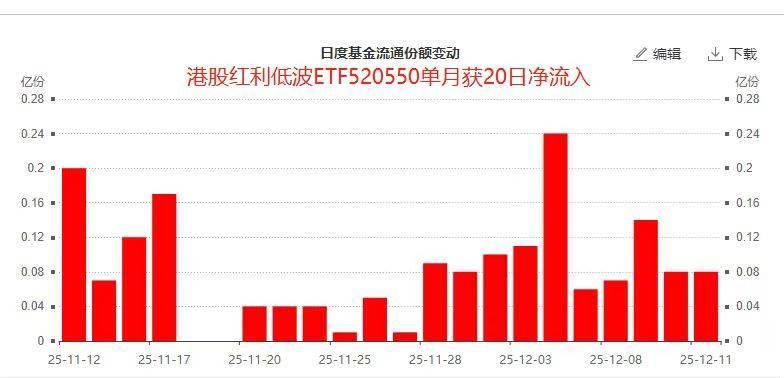
单月20日汹涌净流入!港股红利低波ETF(520550)“压舱石”效应尽显
Sou Hu Cai Jing· 2025-12-12 02:49
Group 1 - The core viewpoint is that as market volatility increases towards year-end, funds are rapidly flowing into defensive assets, with the Hong Kong Dividend Low Volatility ETF (520550) experiencing significant net inflows over 20 trading days [1][3] - The fund's share size has expanded dramatically, with a year-to-date increase of 441.96%, reaching a historical high [1] - In the context of recent adjustments in domestic risk assets, stable and high-dividend Hong Kong stocks have shown remarkable resilience, becoming a key choice for funds seeking stable returns [3] Group 2 - The current policy environment aims to guide long-term capital into the market and maintain capital market stability, which is a clear directive [3] - Analysis from Huatai Securities indicates that policies are focused on promoting long-term capital from public funds, insurance, and pensions, providing multi-layered support for the market [3] - The ETF's core appeal lies in its high dividend yield, with the tracked index showing a 12-month dividend yield of 6.5%, significantly higher than the 10-year government bond yield of 1.85% [3] Group 3 - The fund is designed with a low comprehensive fee rate of 0.2% and employs a monthly dividend assessment mechanism and T+0 trading to enhance capital efficiency [3] - The fund's holdings are primarily in mature sectors such as finance and energy, with a 5% weight limit on individual stocks to diversify risk and dynamically exclude stocks with significant declines to avoid "dividend traps" [3] - Investors can participate in the fund through linked funds (Class A: 024029/Class C: 024030) [3]

能源化工期权:能源化工期权策略早报-20251212
Wu Kuang Qi Huo· 2025-12-12 02:03
Report Summary 1. Report Industry Investment Rating There is no information provided regarding the industry investment rating in the report. 2. Core Viewpoints - The energy - chemical sector is divided into energy, alcohols, polyolefins, rubber, polyesters, alkalis, and others. - Strategies suggest constructing option portfolios mainly as sellers and using spot hedging or covered strategies to enhance returns [4]. 3. Summary by Related Catalogs 3.1 Futures Market Overview - The report presents the latest prices, price changes, price change percentages, trading volumes, volume changes, open interests, and open interest changes of various energy - chemical futures contracts, such as crude oil (SC2602 with a latest price of 437, down 6 or - 1.45%), LPG (PG2602 with a latest price of 4,040, down 139 or - 3.33%), etc. [5] 3.2 Option Factors - **Volume - Open Interest PCR**: It shows the volume and open - interest PCR and their changes for different option varieties. For example, the volume PCR of crude oil is 0.80 with a change of 0.17, and the open - interest PCR is 0.61 with a change of - 0.02 [6]. - **Pressure and Support Levels**: The pressure and support levels of option underlying assets are analyzed. For instance, the pressure level of crude oil is 540 and the support level is 430 [7]. - **Implied Volatility**: The report provides data on the at - the - money implied volatility, weighted implied volatility, its change, annual average, call and put implied volatilities, historical 20 - day volatility, and the difference between implied and historical volatilities for each option variety. For example, the at - the - money implied volatility of crude oil is 23.42%, and the weighted implied volatility is 27.47% with a change of - 0.25% [8]. 3.3 Strategy and Recommendations - **Crude Oil Options**: - **Fundamentals**: US crude oil production is 13.815 million barrels per day, up 0.01% month - on - month; refinery throughput is 16.876 million barrels per day, up 2.63% month - on - month; global floating storage has risen to 108.411 million barrels, up 10.2% month - on - month [9]. - **Market Analysis**: Crude oil prices showed a weak trend in recent months, with significant fluctuations [9]. - **Option Factors**: Implied volatility is below the average; the open - interest PCR is below 0.70, indicating a weak market; the pressure level is 540 and the support level is 430 [9]. - **Strategies**: Construct bear spread strategies for put options; sell call and put option combinations with a short - bias; use long collar strategies for spot hedging [9]. - Similar analyses and strategy recommendations are provided for other option varieties such as LPG, methanol, ethylene glycol, PVC, rubber, PTA, caustic soda, soda ash, and urea, including fundamentals, market trends, option factor analysis, and corresponding option strategies [10][11][12]
A股:黑天鹅突袭,下跌原因找到了!超4300家放量下跌,周五大盘这么走
Sou Hu Cai Jing· 2025-12-12 01:33
又一个"黑色星期四",指数调整叠加个股普跌 截至周四收盘,A股三大指数全线回落: 沪指收报 3873.32点,跌0.70% 深证成指收报 13147.39点,跌1.27% 创业板指收报 3163.67点,跌1.41% 盘中曾一度高开上行,创业板指数早盘涨幅一度超过1%,但午后走势明显转弱,尾盘快速下挫,形成典型的"高开低走、 诱多转杀跌"形态。 个股层面更具冲击感: 下跌个股近4400只,上涨约千余只,普跌特征明显 沪深北三市成交额约 1.88万亿元,较上一交易日放量约 936亿元 市值分化显著: 微盘股指数跌幅约 2.56% 中证2000跌 1.7%、中证1000跌 1.3%、中证500跌 1.02% 沪深300跌 0.86%、上证50仅跌 0.39% 资金显然在主动回避高估值、小市值标的,向头部资产与权重蓝筹回流,呈现出"以大抗跌、以小出清"的典型资金防御格 局。 结构上仍有少数主题发散:可控核聚变、商业航天等高景气赛道局部活跃;而地产、区域概念(福建、海南)持续承压, 说明市场更倾向交易"中长期确定性"而非"短期政策博弈"。 表象是A股单日大幅调整,实质却是一轮全球风险资产同步再定价在国内的集中反映。 ...

把中国式现代化底色擦得更亮 ——加快经济社会发展全面绿色转型,建设美丽中国
Ren Min Ri Bao· 2025-12-11 22:03
Core Viewpoint - Green development is a prominent feature of Chinese-style modernization, emphasizing the importance of ecological environment protection and a comprehensive green transformation of economic and social development [2][4]. Group 1: Green Transformation Initiatives - The 14th Five-Year Plan emphasizes accelerating the comprehensive green transformation of economic and social development, with a focus on building a beautiful China [2]. - The central economic work conference has prioritized "dual carbon" goals, promoting a comprehensive green transformation as a key task for the upcoming year [2]. - The ecological environment department highlights that achieving carbon peak and carbon neutrality is a strategic decision made by the central government, requiring a planned and step-by-step implementation of carbon peak actions [3]. Group 2: Energy System and Carbon Market - The construction of a new energy system is underway, with projects like the hydrogen-electric coupling demonstration in Ningbo, which has already consumed over 8.6 million kilowatt-hours of clean energy [3]. - The national carbon market has expanded to include industries such as steel, cement, and aluminum, covering over 60% of national CO2 emissions [5]. - The carbon market aims to stimulate internal motivation for carbon reduction, promoting a low-carbon development awareness across society [5]. Group 3: Energy Consumption and Efficiency - By the end of the 14th Five-Year Plan, the majority of new electricity demand will be met by new clean energy generation, with a significant reduction in coal consumption [4]. - Jiangsu's Nanjing Steel Group has implemented a smart energy management platform, achieving energy savings of over 80 million yuan in 2024 and a 4.7% reduction in energy consumption per ton of steel [7]. Group 4: Green Production and Lifestyle - The establishment of a green manufacturing system is progressing, with over 6,430 national green factories contributing to more than 20% of production value [9]. - The adoption of green lifestyles is increasing, with over 90% of urban residential communities implementing waste sorting and over 60% of consumers opting for new energy vehicles [10]. Group 5: Pollution Prevention and Ecosystem Optimization - Continuous efforts are being made to combat pollution and optimize ecosystems, with a focus on integrated protection of natural resources [12]. - The construction of a natural protection area system is advancing, with the implementation of the National Park Law marking a new phase in ecological protection [13]. Group 6: Large-scale Afforestation and Green Initiatives - Large-scale afforestation efforts have been initiated, with significant progress in ecological construction in regions like Inner Mongolia, achieving an 80% governance rate of desertified land [14]. - The 14th Five-Year Plan period is critical for accelerating the green transformation of economic and social development, with a commitment to achieving carbon peak goals [14].
中央经济工作会议擘画高质量发展新蓝图 以新质生产力引领现代化产业体系建设
Zhong Guo Zheng Quan Bao· 2025-12-11 20:32
Group 1: Artificial Intelligence Development - The meeting emphasizes the importance of deepening and expanding "Artificial Intelligence+" initiatives, aiming for broader and deeper integration across key sectors to enhance productivity [1] - Emerging industries represented by "Artificial Intelligence+" are expected to drive a transformative technological revolution, focusing on domestic production, deep integration with application scenarios, and global competition [2] - State-owned enterprises are encouraged to strategically integrate AI into their operations to foster innovation and technological advancement [2] Group 2: Energy Transition and Green Development - The meeting outlines a comprehensive plan for energy transition, including the establishment of a national carbon trading market and the promotion of green electricity applications [3] - A systemic approach is highlighted, integrating energy transition with market mechanisms and governance structures to maximize overall efficiency [3] - The development of new green products, supported by innovative financial tools, is essential for traditional industries to adapt and grow in a low-carbon economy [4] Group 3: Real Estate Market Stabilization - The meeting focuses on stabilizing the real estate market through targeted policies, including inventory reduction and the promotion of affordable housing [5] - Strategies such as reforming the housing provident fund and enhancing the quality of housing aim to address long-term housing needs and improve living standards [5] - The overall goal is to transition the real estate sector towards high-quality, people-oriented development, ensuring a stable market and improved supply structure [5]
以新质生产力引领现代化产业体系建设
Zhong Guo Zheng Quan Bao· 2025-12-11 20:17
Group 1: Artificial Intelligence Development - The meeting emphasizes the importance of deepening and expanding "Artificial Intelligence+" initiatives, aiming for broader and deeper integration across key sectors, positioning AI as a core driver of new productive forces [1][2] - The transformation driven by AI is expected to follow three clear paths: localization and democratization of technology, deep integration of application scenarios, and global competition through value reconstruction in the industrial ecosystem [2] - State-owned enterprises are encouraged to strategically integrate AI into their operations to foster innovation and drive digital transformation [2][3] Group 2: Energy Transition and Green Development - The meeting outlines a comprehensive approach to promoting green and low-carbon development, emphasizing the need for a new energy system and the expansion of green electricity applications [3][4] - The construction of a national carbon emissions trading market is highlighted as a crucial mechanism for pricing and facilitating the flow of "reduction" assets, which is essential for supporting green transformation [3][4] - The transition to green products, such as energy-saving glass and new eco-friendly materials, is expected to create growth opportunities for traditional industries, necessitating innovative financial tools to mitigate risks [3][4] Group 3: Real Estate Market Stabilization - The meeting sets clear objectives for stabilizing the real estate market, focusing on city-specific policies to control supply, reduce inventory, and improve housing quality [4][5] - Measures such as encouraging the acquisition of existing homes for affordable housing aim to accelerate inventory reduction and alleviate financial pressures on real estate companies [4][5] - The reform of the housing provident fund system and the promotion of quality housing construction are intended to enhance living standards and purchasing power in the long term [4][5]
巴菲特交棒阿贝尔倒计时:光环褪去后,伯克希尔面临派息呼声与收购难题
智通财经网· 2025-12-11 13:27
Core Viewpoint - Warren Buffett, the iconic figure of Berkshire Hathaway, is set to pass the CEO role to Greg Abel on January 1, 2024, while remaining as chairman, raising questions about the company's future direction and management style post-Buffett [1][3]. Group 1: Transition of Leadership - Greg Abel, who has been vice chairman for four and a half years, will take over as CEO, marking a significant leadership change for the company [1]. - Abel has already begun restructuring management by assigning direct oversight of 32 consumer, service, and retail companies to Adam Johnson and promoting Nancy Pierce to lead Geico [1][2]. - Analysts believe Abel may adopt a more hands-on approach compared to Buffett, focusing on operational efficiency and growth strategies [2]. Group 2: Company Performance and Strategy - Berkshire Hathaway has transformed from a struggling textile company into a $1.07 trillion conglomerate with nearly 200 subsidiaries, including BNSF Railway and Geico [2]. - Despite a remarkable 60-year stock price increase of approximately 60,000%, recent performance has plateaued, with stock returns aligning more closely with the S&P 500 [3]. - The company holds a substantial cash reserve of $381.7 billion, which presents both opportunities and challenges for investment returns [3]. Group 3: Shareholder Expectations - Investors are increasingly calling for Berkshire to adopt a more traditional corporate structure, including the introduction of dividends, which have not been issued since 1967 [3]. - Analysts predict that shareholders will demand clearer capital allocation strategies and more transparency in financial disclosures [3]. - There is a tension between maintaining Berkshire's unique culture and addressing shareholder demands for changes in dividend policy and operational transparency [3]. Group 4: Succession and Governance - The future of key executives, such as Ajit Jain and Ted Weschler, remains uncertain, raising questions about the continuity of leadership and investment strategies [4]. - Buffett retains 29.8% of the voting power, which will continue to influence company decisions and potentially limit aggressive shareholder actions [4]. - Abel is seen as having ample time to shape Berkshire's future, with a transitional period allowing him to establish his leadership style [4].
Oxford Industries, Ur-Energy, Oracle And Other Big Stocks Moving Lower In Thursday's Pre-Market Session - Constellium (NYSE:CSTM), CapsoVision (NASDAQ:CV)
Benzinga· 2025-12-11 13:04
Core Insights - U.S. stock futures are lower, with Nasdaq 100 futures down approximately 150 points [1] Group 1: Oxford Industries, Inc. - Oxford Industries reported a quarterly loss of 92 cents per share, which was better than the analyst consensus estimate of a loss of 95 cents per share [2] - The company reported quarterly sales of $307.344 million, exceeding the analyst consensus estimate of $304.642 million [2] - Shares of Oxford Industries fell 25.6% to $30.17 in pre-market trading following the earnings report and lowered guidance [2] Group 2: Other Stocks - CapsoVision Inc shares dropped 16.6% to $9.86 in pre-market trading after a previous gain of 33% [3] - Ur-Energy Inc fell 12.1% to $1.20 after announcing a $100 million offering of 4.75% convertible senior notes due 2031 [3] - Oracle Corporation shares dipped 11.3% to $197.70 after posting mixed second-quarter financial results for fiscal 2026 [3] - T1 Energy Inc. fell 10.8% to $5.50 after announcing proposed offerings of $120 million in convertible senior notes and $140 million in common stock [3] - Rezolute Inc dropped 5.8% to $10.30 after announcing Phase 3 study results [3] - NovaBay Pharmaceuticals Inc declined 5.8% to $2.28 after a previous jump of 34% [3] - Constellium SE fell 3% to $17.62 after gaining 4% [3]