AI算力

Search documents
AI算力方向强势收官2025!云计算ETF(159890)午后上攻强势冲击6连阳
Sou Hu Cai Jing· 2025-12-31 06:27
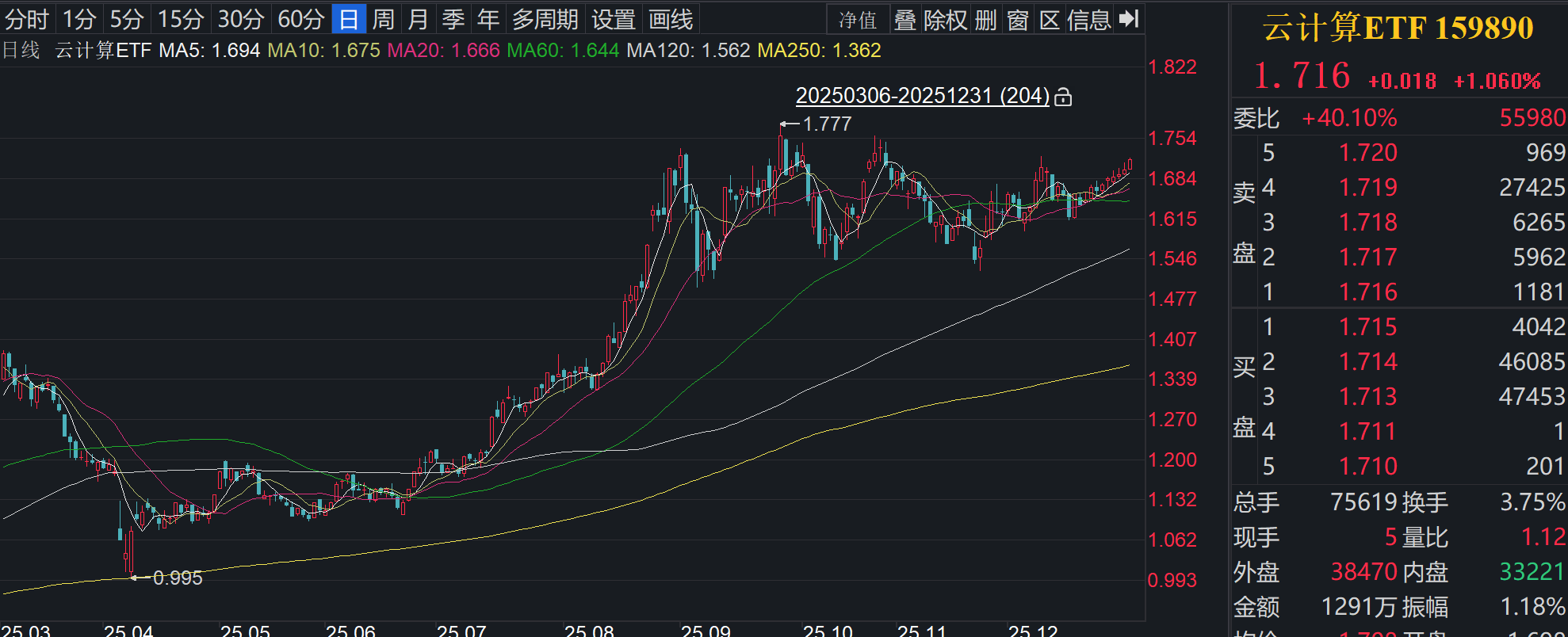
Core Viewpoint - The AI computing power sector is experiencing significant growth, driven by government initiatives and increasing demand for domestic AI chips, particularly the H200 chip, which is set to be delivered to Chinese customers soon [3][4][5]. Group 1: Market Performance - On the last trading day of 2025, AI computing stocks saw a strong afternoon rally, with the cloud computing ETF (159890) rising over 1% and achieving a six-day winning streak [1]. - Notable stock performances included a rise of 11.46% for Yidian Tianxia, over 8% for Hand Information, and more than 4% for companies like Zhongke Xingtai and Wanxing Technology [1]. Group 2: Policy and Industry Developments - A key government official announced the implementation of the "AI+" initiative, which aims to create extensive application scenarios for AI computing power chips, leading to rapid growth in demand and innovation within the sector [3]. - The conditional opening of the H200 chip to China is seen as a positive development, with major tech companies like Alibaba and ByteDance planning significant purchases to enhance their AI capabilities [4]. Group 3: Domestic Chip Strategy - Domestic companies are adopting varied strategies in response to the H200 chip's availability, with Alibaba and ByteDance pursuing large-scale purchases, while Baidu focuses on self-developed Kunlun AI chips to reduce reliance on external suppliers [4]. - Tencent is exploring indirect methods to acquire advanced computing power, aiming to secure over $1.2 billion in usage rights for the latest B200/B300 chips [4]. Group 4: Growth Projections - According to IDC and Inspur, China's intelligent computing power is projected to reach 1,037.3 EFLOPS by 2025, with a compound annual growth rate of 46.2% from 2023 to 2028 [6]. - The general computing power in China is expected to grow to 85.8 EFLOPS by 2025, with a compound annual growth rate of 18.8% during the same period [6]. Group 5: Investment Opportunities - The current landscape of the AI computing market presents numerous opportunities for investment, with a focus on domestic chip development and technological innovation [5][6]. - The cloud computing ETF (159890) tracks a diverse range of companies involved in AI infrastructure and applications, indicating a comprehensive approach to the AI computing era [6].


中信建投证券:A股跨年行情已经启动
Xin Hua Cai Jing· 2025-12-29 05:38
Core Viewpoint - The recent eight consecutive days of gains in the Shanghai Composite Index signal a positive outlook, indicating that the A-share year-end rally has commenced [1] Group 1: Market Drivers - Three main expectations are driving the initiation of the year-end rally: a consensus of optimism among institutional investors, the anticipated early arrival of the spring market, and the conclusion of adjustments in overseas AI models, leading to improved liquidity and risk conditions [1] - Recent announcements of the 15th Five-Year Plan policies and events have heightened investor expectations regarding policy [1] Group 2: Sector Focus - Key sectors to watch for the year-end rally include non-ferrous metals and AI computing power, which are expected to experience significant catalytic growth [1] - The primary market focus remains on commercial aerospace, with secondary themes including the Hainan Free Trade Zone, controllable nuclear fusion, and humanoid robots [1]

【点金互动易】商业航天+光通信,公司聚焦低轨星载路由与星间激光通信布局,拓展空天地海一体化光网络
财联社· 2025-12-29 00:53
Group 1 - The article emphasizes the importance of timely and professional information interpretation in investment, focusing on extracting investment value from significant events and analyzing industry chain companies [1] - The company is developing low-loss hollow-core optical fibers to support ultra-high-speed transmission, targeting the integration of air, space, and sea communication networks through low-orbit satellite routing and inter-satellite laser communication [1] - The company provides GB300 liquid cooling plates made from specialized materials and high-speed connector copper alloys, penetrating the AI server and smart terminal markets, positioning itself as a comprehensive supplier of cooling solutions [1]

恒越基金吴海宁:把握科技轮动锚定高景气赛道机遇
Shang Hai Zheng Quan Bao· 2025-12-28 13:28
Core Viewpoint - The article discusses the investment strategies of Wu Haining, a fund manager at Hengyue Fund, focusing on capturing opportunities in the technology sector amidst rapid shifts in sub-sector hotspots [1]. Group 1: Investment Strategy and Performance - Wu Haining's management of Hengyue Advantage Select has yielded significant returns, with a one-year return of 142.56%, ranking sixth among similar funds [2]. - The investment strategy involved a focus on high-growth technology sectors, including smart driving, domestic computing power, and the Apple supply chain, with a notable increase in AI computing targets [2]. - In the second quarter, adjustments were made by reducing positions in smart driving and increasing exposure to the PCB sector and upstream materials, while also investing in sectors like military, gaming, and new energy [2]. Group 2: Market Outlook for 2026 - Wu Haining anticipates continued opportunities in 2026, driven by a likely ongoing interest rate reduction cycle across major economies, which will maintain a relatively loose liquidity environment [4]. - Key sectors for investment in 2026 include energy storage, storage chips, AI computing power, semiconductor equipment materials, and lithium solid-state batteries, with a focus on companies with global competitiveness [4][5]. - The investment logic will involve selecting companies with significant performance elasticity and adjusting portfolio allocations based on market conditions and the certainty of factors [4]. Group 3: Specific Sector Insights - The energy storage sector is expected to see increased demand, with predictions of shortages and price increases in domestic storage by 2026, driven by the economic viability of independent storage and increased foreign electricity shortages [5][6]. - The storage chip market is entering a price increase cycle, with AI-driven data storage demand expected to surge, particularly due to the high demand from AI video generation [6]. - The domestic semiconductor equipment sector is also viewed positively, as domestic storage chip production capabilities have reached international standards, with a high certainty of continued expansion during the upcycle [6].
新产业造富记:富豪榜里的三个广东老板
2 1 Shi Ji Jing Ji Bao Dao· 2025-12-27 01:15
Core Viewpoint - Xiaopeng Motors reported impressive Q3 financial results, achieving a revenue of 20.38 billion yuan, marking a 101.8% year-on-year increase and an 11.5% quarter-on-quarter growth, with total vehicle deliveries reaching 116,000 units, a 149.3% increase year-on-year [1] Group 1: Company Performance - Xiaopeng Motors' revenue for Q3 2025 reached 20.38 billion yuan, the first time it surpassed 20 billion yuan in a single quarter [1] - The total vehicle delivery for Xiaopeng Motors in Q3 was 116,000 units, reflecting a significant year-on-year growth of 149.3% [1] - Xiaopeng Motors' total market capitalization is currently 156.558 billion HKD [8] Group 2: Wealth and Rankings - Xiaopeng Motors' CEO, He Xiaopeng, ranked 114th on the 2025 Hurun Rich List with a wealth of 48 billion yuan, a 50% increase from the previous year [1] - The combined wealth of He Xiaopeng, Chen Tao from Shenghong Technology, and Liu Jingkang from Yingshi Innovation exceeds 100 billion yuan [1] - Liu Jingkang's company, Yingshi Innovation, achieved a market capitalization of over 100 billion yuan, with a global market share of 67.2% in the panoramic camera sector [5][8] Group 3: Industry Trends - The rise of Xiaopeng Motors, Shenghong Technology, and Yingshi Innovation reflects the rapid development of new industries such as AI computing, smart mobility, and smart imaging [10] - In the first three quarters of this year, Guangdong's new product output saw significant growth, with industrial robots increasing by 33.7% and civilian drones by 44.8% [11] - Guangdong's R&D expenditure reached approximately 510 billion yuan last year, surpassing that of manufacturing powerhouses like Japan and Germany [11]

每日投行/机构观点梳理(2025-12-22)
Jin Shi Shu Ju· 2025-12-22 11:25
Group 1 - UBS analysts predict that the US stock market will remain tense in 2024 due to investor concerns about missing out on AI gains and fears of a potential bubble, with volatility expected to continue until 2026 [1] - Goldman Sachs forecasts a 14% growth in Chinese corporate earnings in 2024, which could boost stock market performance, with a potential 10% valuation re-rating and a projected 38% increase in the Chinese stock market by 2027 [1] - JPMorgan expects the Bank of Japan to continue raising interest rates to address concerns over the weak yen, predicting two rate hikes in 2024, reaching a policy rate of 1.25% by the end of 2026 [1] Group 2 - Nomura's report indicates uncertainty regarding the specific level that would trigger intervention by Japanese authorities, but bold actions may be imminent as the yen strengthens [2] - Danske Bank analysts suggest that the euro may strengthen against the dollar in the medium term due to anticipated Fed rate cuts and stable ECB rates, with a narrowing gap in real interest rates benefiting the euro [2] Group 3 - CICC emphasizes the importance of policy measures to boost consumption, noting that the macroeconomic backdrop has weakened consumer recovery, but signals of support for domestic demand could lead to a turnaround [3] - China Merchants Bank reports that Japan's interest rate hike may exert pressure on global financial conditions, with a potential long-term impact on liquidity and bond markets [4] - CITIC Securities highlights the need to focus on changes in consumer structure for long-term investment, with an emphasis on new products, technologies, channels, and markets [5][6] Group 4 - CITIC Securities anticipates a mild reduction in policy rates in 2026, with a potential decrease of 10 basis points in one to two instances, which could stabilize bank net interest margins [7] - CITIC Securities continues to favor the AI computing sector, noting strong demand for computing power as AI models evolve [8] - CITIC Securities reports that the US CPI has unexpectedly cooled, which may lead to an upward revision of Fed rate cut expectations, positively impacting precious and industrial metal prices [9] Group 5 - China Securities expects listed insurance companies to achieve double-digit growth in core premium income and value in 2026, driven by asset reallocation and a favorable equity market [10] - Huatai Securities suggests continuing to position for a spring market rally, focusing on sectors like AI, batteries, and consumer goods that are expected to improve [11]
陈果:春季行情演化论与内需机会探讨
Xin Lang Cai Jing· 2025-12-21 13:25
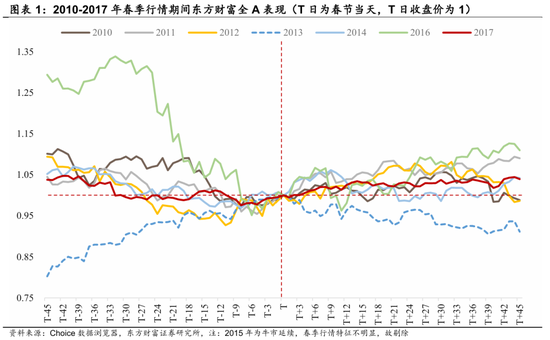
炒股就看金麒麟分析师研报,权威,专业,及时,全面,助您挖掘潜力主题机会! 来源:陈果投资策略 摘要 上周周报我们提示美债利率呈现上升迹象,日本央行加息在即,需留意外部扰动,从本周市场表现来 看,A股有扰动,但增量资金抢跑春季行情意愿也较强烈,结构上内需板块尤其是非耐用品消费明显占 优。我们认为,春季行情经历长时间高胜率演绎,已经从日历效应迈过抢跑博弈,进入反身性阶段,后 续除可能的1月业绩预告扰动外,利空因素能见度不高,可顺应抢跑,逢低布局。结构上具备足够赔率 吸引力且胜率在上升的内需板块重视程度上移,重点关注:保险、券商、有色、AI算力/半导体、零售/ 美护/社服/乳品、航空、新能源、创新药等。 春季行情演化论 随着市场参与者结构变化、信息传播速度加快、投资者学习效应增强、经济新旧动能转换,春季行情经 历了深刻的演化,可以划分为三个阶段:第一阶段,2017年及以前,日历效应阶段。行情发酵于春节 后,依赖政策驱动和流动性回流;第二阶段,2018-2023年,抢跑博弈阶段。行情启动时点明显前移至 12月,源于学习效应与市场参与结构变化;第三阶段,2024-2025年,反身性阶段。"抢跑"消耗增量资 金,遇利空易 ...
机构论后市丨市场进入跨年布局关键窗口,关注元旦前后小躁动行情
Di Yi Cai Jing· 2025-12-21 09:51
短期关注防御性板块配置机会,同时布局明年政策红利与产业景气方向。(1)主线一:全球百年未遇 之大变局加速演进,国内经济底层逻辑转向新质生产力,人工智能、具身智能、新能源、可控核聚变、 量子科技、航空航天等"十五五"重点领域值得关注。(2)主线二:反内卷政策温和推进,供需结构优 化叠加价格回升预期带动下,制造业、资源板块盈利修复路径清晰。(3)辅助线一:扩大内需政策导 向下消费板块迎来布局窗口。(4)辅助线二:出海趋势将带动企业盈利空间进一步打开。 ②光大证券:市场有望震荡上行,关注成长及消费两个方向 光大证券指出,历史来看,A股市场中几乎每年都存在"春季躁动"行情。本周三市场的强力上涨或许标 志着2026年跨年行情已经开启。一方面,政策有望持续发力,经济增长有望保持在合理区间,进一步夯 实资本市场繁荣发展的基础。另一方面,政策红利释放,有望提振市场信心,进一步吸引各类资金积极 流入。政策有望持续发力,叠加各类资金有望积极流入,市场有望震荡上行。 A股后市怎么走?看看机构怎么说。 沪指本周累计涨0.03%,深证成指累计跌0.89%,创业板指跌2.26%。A股后市怎么走?看看机构怎么 说: ①银河证券:市场进入跨 ...
复盘本周美股-映射AI电力/算力出海逻辑辨析(HRSG、液冷、光模块、PCB)
傅里叶的猫· 2025-12-20 12:43
Market Overview - The US stock market showed mixed performance this week, with the Dow Jones index declining by 0.67%, while the Nasdaq and S&P 500 indices increased by 0.48% and 0.1% respectively [3] - The fluctuations in the AI power and computing sectors were significant, driven by key events related to Oracle and OpenAI [4] Key Events Impacting AI Power and Computing - The core event causing volatility was the financing situation involving Oracle and OpenAI, particularly the news that Blue Owl Capital would not fund a $10 billion deal for Oracle's new data center [6][7] - Conversely, OpenAI reportedly secured $100 billion in funding led by a UAE sovereign fund, raising its valuation by $80 billion and alleviating concerns about Oracle's financial stability [8] AI Power Sector Analysis - Key companies in the AI power sector, Bloom Energy (B.E) and GE Vernova (GE.V), experienced declines of 6.49% and 2% respectively over the week, but rebounded significantly on Thursday and Friday, with B.E rising over 10.7% and GE.V over 2.9% [9] - The initial decline was attributed to lowered expectations for AI capital expenditures, leading to a decrease in power demand growth forecasts [9] - The recovery in the latter half of the week was driven by a reversal of negative sentiment regarding AI power sector valuations [10] AI Computing Sector Analysis - The AI computing sector showed a strong performance overall, with key stocks like Nvidia rising over 3.9%, Oracle over 6.6%, and Lumentum over 10% [10] - The initial weakness was linked to increased uncertainty regarding AI capital expenditures, which negatively impacted growth expectations for AI hardware and software [10] - The subsequent recovery was a result of a reversal in negative market sentiment, leading to improved valuation expectations for the AI computing sector [10] AI Power and Computing Export Logic - The article discusses the export logic for AI power and computing, emphasizing the importance of tracking specific data points related to each segment [11][12] - For instance, the HRSG (Heat Recovery Steam Generator) market is highlighted, with a significant supply gap of over 30% in North America, leading to strong price increases [13][14] - The demand for SOFC (Solid Oxide Fuel Cells) is also noted, with major tech companies like Meta and Google showing interest in large-scale orders [15] Industry Information - The liquid cooling market is expected to see optimistic demand growth, with significant orders anticipated from major tech firms [18][19] - The PCB market is experiencing tight supply conditions, leading to price increases, while the optical module market is facing extreme capacity constraints [19]

帮主郑重:美股反弹的两颗“定心丸”,A股科技板块能接住吗?
Sou Hu Cai Jing· 2025-12-19 00:51
首先看美光的财报,它就像一束光,照亮了近期被"AI资本开支过高"疑云笼罩的科技板块。美光的核心 表述是:AI存储需求飙升,产品已全面售罄。这有力地证实了AI浪潮带来的硬件需求是真实且强劲 的,而不仅仅是蓝图和想象。这对于整个全球科技产业链,包括A股相关的半导体、存储和AI算力公 司,都是一个积极的情绪提振。它说明产业趋势的根基依然牢固。 再看CPI数据,同比2.7%的涨幅,显著低于市场预期的3.1%。这份迟到的数据,尽管因为统计问题存在 瑕疵,但它至少暂时缓解了市场对"通胀顽固、加息重启"的最大恐惧。它为美联储在未来维持甚至进一 步偏向宽松的货币政策,提供了更多空间。这对全球成长股估值都是一个潜在支撑。 所以,我的核心观点是:美股的这轮反弹,修复的是对"产业趋势"和"流动性环境"的双重信心。 它未 必意味着科技股将立刻重回单边上涨,但它很可能标志着由甲骨文事件引发的恐慌性抛售告一段落,市 场情绪进入一个震荡企稳、重新评估的阶段。 那么,这对我们A股投资者的操作有什么启示?我认为,外部的积极变化,为我们优化策略、聚焦主线 提供了一个更好的外部环境窗口。 朋友们,昨晚美股市场,尤其是科技股,算是喘了一口气。在连续 ...