
证券业

Search documents
前三季度社融增量超30万亿元;现货黄金突破4200美元/盎司 | 金融早参
Mei Ri Jing Ji Xin Wen· 2025-10-15 23:23
Group 1 - The total social financing increment in China for the first three quarters of 2025 reached 30.09 trillion yuan, with RMB loans accounting for only 48.32% of this increment, indicating a shift towards more diversified financing channels [1] - Government and corporate bond financing has increased its share to 43.3% of the total social financing increment, compared to 28.95% in the first quarter of this year [1] - Experts suggest that the financial system's support for the real economy extends beyond loans, advocating for a broader perspective on financing metrics [1] Group 2 - Spot gold prices have surged by 1.4%, surpassing the 4200 USD/ounce mark for the first time in history, reflecting heightened demand for safe-haven assets [2] - The rise in gold prices is driven by geopolitical tensions, global economic uncertainties, and inflation expectations, prompting potential reallocation of investments towards precious metals [2] Group 3 - China Pacific Insurance has indicated a strategy to increase equity asset allocation in response to macroeconomic trends, aiming to enhance investment returns while adhering to asset-liability matching requirements [3] - This move reflects the insurance sector's growing confidence in equity markets amid a prolonged low-interest-rate environment [3] Group 4 - The insurance industry has paid out 1.41 billion yuan in compensation for various losses related to autumn grain in disaster-affected areas, demonstrating efficient emergency response capabilities [4] - The industry has established a green channel for claims processing, which is expected to expedite compensation as coordination among parties improves [4] Group 5 - China Gold has announced that CITIC Securities has completed its plan to reduce its stake by 0.83%, selling 1,391,940 shares at prices ranging from 8.23 to 9.00 yuan per share, totaling approximately 118 million yuan [5] - The reduction in stake reflects strategic adjustments by institutional investors in the company [5]
呵护中期流动性 央行月内二次开展买断式逆回购
2 1 Shi Ji Jing Ji Bao Dao· 2025-10-15 23:14
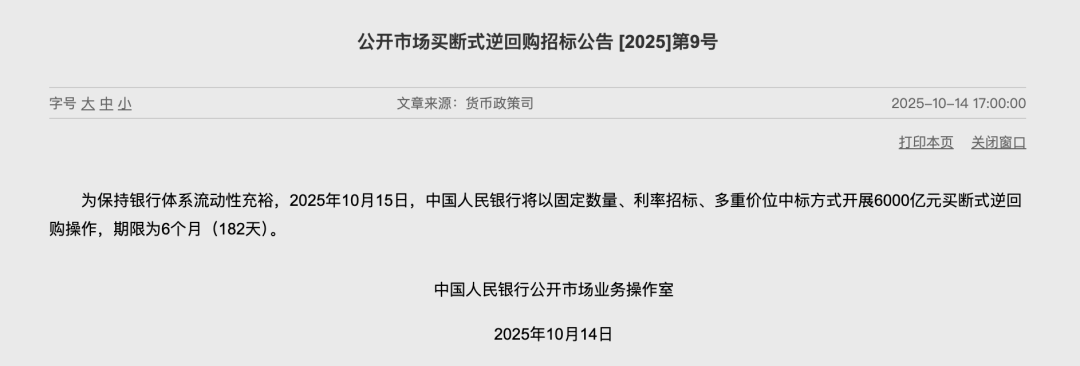
Core Viewpoint - The People's Bank of China (PBOC) is actively using the buyout reverse repurchase operation to inject medium-term liquidity into the banking system, aiming to stabilize the financial market and manage liquidity effectively [1][2][3]. Group 1: Buyout Reverse Repo Operations - On October 14, the PBOC announced a buyout reverse repo operation of 600 billion yuan with a term of 6 months, marking the second such operation in October [1][2]. - The buyout reverse repo, introduced in October 2024, has become a key tool for the PBOC's medium-term liquidity management, filling the gap in short to medium-term liquidity tools [1][2]. - The PBOC has conducted multiple buyout reverse repo operations since its introduction, with terms ranging from 3 months to 1 year, providing longer-term funding support compared to traditional operations [1][2]. Group 2: Market Conditions and Liquidity Management - The government bond issuance in October remains substantial, contributing to potential liquidity tightening, prompting the PBOC to inject liquidity through buyout reverse repos [2][3]. - Factors such as tax payments, high-interest deposits maturing, and the introduction of new policy financial tools are expected to exert pressure on liquidity, necessitating PBOC's intervention [2][3]. - The PBOC's recent operations are aimed at maintaining a stable and ample liquidity environment, especially in light of upcoming government bond issuances and market demands [3][4]. Group 3: Monetary Policy Tools and Future Outlook - The PBOC is utilizing a variety of monetary policy tools, including short-term reverse repos, medium-term lending facilities (MLF), and buyout reverse repos, to ensure liquidity in the market [5][6]. - The PBOC's recent adjustments in policy language indicate a focus on maintaining policy continuity and flexibility, with an emphasis on effectively utilizing existing tools [5][6]. - Analysts suggest that the PBOC may resume government bond trading in the fourth quarter to inject long-term liquidity, aligning with growth stabilization policies [6][7].
M1、M2“剪刀差”刷新年内低值 多项金融数据释放积极信号
Shang Hai Zheng Quan Bao· 2025-10-15 18:35
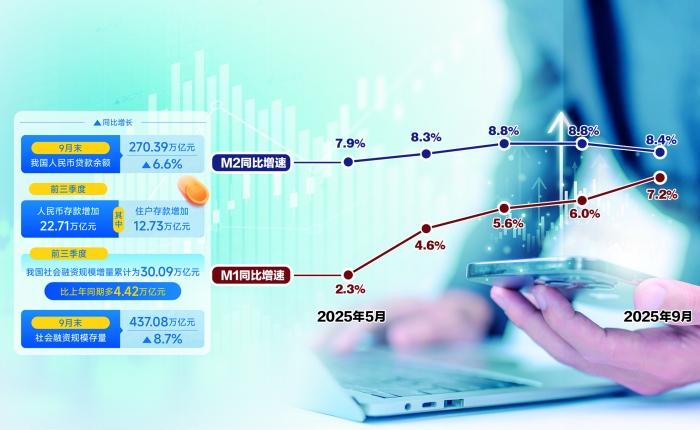
Core Insights - The central bank's financial statistics for the first three quarters indicate that key financial indicators continue to grow faster than the economy, demonstrating solid support for the real economy [2][3] Financial Indicators - As of the end of September, the stock of social financing, M2 (broad money), and RMB loan balances grew by 8.7%, 8.4%, and 6.6% year-on-year, respectively [2] - The M1 (narrow money) and M2 "scissors difference" narrowed to 1.2 percentage points, reflecting increased business activity and a recovery in personal investment and consumption demand [2][4] Social Financing - The cumulative social financing increment for the first three quarters reached 30.09 trillion yuan, an increase of 4.42 trillion yuan compared to the same period last year [3] - Government bond issuance played a significant role in boosting social financing, with net financing of government bonds amounting to 11.46 trillion yuan, up by 4.28 trillion yuan year-on-year [3] Loan Structure - By the end of September, the RMB loan balance was 270.39 trillion yuan, reflecting a year-on-year growth of 6.6% [6] - The proportion of RMB loans to the real economy in the total social financing stock decreased by 1.3 percentage points to 61.1%, while the government bond balance's share increased by 2.1 percentage points to 21.2% [3] Deposit Trends - In the first three quarters, household deposits increased by 12.73 trillion yuan, while non-bank financial institution deposits rose by 4.81 trillion yuan [5] - The growth in household deposits has slowed from previous highs, while non-bank deposits continue to grow rapidly, indicating a potential shift of household funds into the capital market [5] Interest Rates - The weighted average interest rate for newly issued corporate loans was approximately 3.1%, down about 40 basis points year-on-year, while the rate for personal housing loans was also around 3.1%, down about 25 basis points [7] - The sustained low interest rates indicate a generally ample supply of credit resources, meeting the financing needs of the real economy effectively [7] Economic Outlook - Analysts expect that the moderately loose monetary policy will continue to support the real economy strongly in the fourth quarter, alongside active fiscal policies [7]

前三季度新增社融超30万亿元,背后信号很大
2 1 Shi Ji Jing Ji Bao Dao· 2025-10-15 13:54
Core Insights - The People's Bank of China reported that the total social financing increased by 4.42 trillion yuan year-on-year, reaching 30.09 trillion yuan in the first three quarters of 2025, indicating a robust financial support for the real economy [1][11] - Government bond issuance has accelerated, significantly contributing to the social financing scale, with net financing of government bonds reaching 11.46 trillion yuan, an increase of 4.28 trillion yuan year-on-year [1][12] - The structure of financing shows that loans to the real economy accounted for 61.1% of the total social financing stock, while government bonds represented 21.2%, reflecting a shift towards more diversified financing channels [2][11] Financing Structure - By the end of September, the balance of RMB loans to the real economy was 61.1% of the total social financing stock, down 1.3 percentage points year-on-year [2] - The balance of corporate bonds accounted for 7.7%, down 0.3 percentage points year-on-year, while government bonds increased to 21.2%, up 2.1 percentage points year-on-year [2] - Non-financial corporate stock financing reached 316.8 billion yuan, an increase of 1.463 billion yuan year-on-year, indicating a growing reliance on equity financing [1] Deposit and Loan Trends - By the end of September, the balance of RMB deposits was 324.94 trillion yuan, growing by 8% year-on-year, with household deposits increasing by 12.73 trillion yuan [4][6] - The balance of loans was 270.39 trillion yuan, with a year-on-year growth of 6.6%, and the average interest rate for new loans was approximately 3.1%, down 40 basis points from the previous year [7][11] - The phenomenon of "deposit migration" is observed, where residents shift their savings into higher-yielding assets, influenced by changing interest rates [4][6] Monetary Policy and Economic Outlook - The M2 money supply reached 335.38 trillion yuan, growing by 8.4% year-on-year, supported by proactive fiscal policies and moderately loose monetary policies [9][11] - The narrowing gap between M1 and M2 indicates increased business activity and consumer demand, suggesting a recovery in the economy [9][11] - Experts predict that the fourth quarter will see continued monetary support for the real economy, with fiscal policies also playing a significant role in sustaining economic growth [12]

前三季度新增社融超一半来自非贷款渠道 金融支持实体经济更多元
2 1 Shi Ji Jing Ji Bao Dao· 2025-10-15 13:23
Core Viewpoint - The People's Bank of China (PBOC) reported that the total social financing scale increased significantly in the first three quarters of 2025, indicating robust financial support for the real economy, with government bonds playing a crucial role in this growth [1][3][12]. Financing Data - The total social financing scale increased by 30.09 trillion yuan in the first three quarters of 2025, which is 4.42 trillion yuan more than the same period last year [1]. - The balance of social financing stock reached 437.08 trillion yuan by the end of September, reflecting a year-on-year growth of 8.7% [3]. - The net financing from government bonds was 11.46 trillion yuan, an increase of 4.28 trillion yuan year-on-year, highlighting the government's active role in financing [1][3]. Loan and Deposit Trends - By the end of September, the balance of loans in both domestic and foreign currencies was 274.33 trillion yuan, with a year-on-year growth of 6.5% [9]. - The balance of RMB deposits was 324.94 trillion yuan, growing by 8% year-on-year, with household deposits increasing by 12.73 trillion yuan [5][6]. - The phenomenon of "deposit migration" was noted, where residents shifted their savings into other assets due to changing return rates, indicating a reallocation of household assets [6][8]. Monetary Policy and Economic Impact - The M2 money supply reached 335.38 trillion yuan, growing by 8.4% year-on-year, supported by proactive fiscal policies and moderately loose monetary policies [10][12]. - The M1-M2 gap has narrowed significantly, suggesting increased business activity and consumer demand [10]. - Experts suggest that the financial system's support for the real economy extends beyond loans, emphasizing the importance of observing a broader range of financing channels [4][12]. Future Outlook - The internal and external environments are stabilizing, with positive changes in corporate operations, consumer spending, and trade, providing a foundation for achieving economic and social development goals [13]. - The PBOC aims to maintain ample liquidity and guide financial institutions to increase credit supply, ensuring that the growth of social financing aligns with economic growth targets [12][13].
央行重磅数据发布
Zhong Guo Ji Jin Bao· 2025-10-15 13:06
Group 1 - The People's Bank of China reported that the total social financing scale exceeded 30 trillion yuan in the first three quarters of the year, reaching 30.09 trillion yuan, an increase of 4.42 trillion yuan compared to the same period last year [1] - The growth rates of social financing and broad money (M2) remained high, indicating that monetary finance continues to create a favorable environment for economic recovery [1] - The narrow money (M1) growth rate showed a significant rebound, reaching 7.2% by the end of September, reflecting increased business activity and consumer demand [1][8] Group 2 - Government bonds and corporate bonds contributed over 40% of the new social financing, with net financing from government bonds at 11.46 trillion yuan, an increase of 4.28 trillion yuan year-on-year [4] - The proportion of new social financing from RMB loans decreased to 48%, indicating a shift towards more diversified financing channels [4] - The average proportion of bonds in bank assets is around 25%, with banks being major participants in both credit issuance and bond investments [4] Group 3 - The growth of RMB loans remained stable, with new loans in September amounting to approximately 1.29 trillion yuan, despite a decrease in growth rate to 6.6% [6] - The structure of loans continued to optimize, with inclusive small and micro loans growing by 12.2% year-on-year [6] - Loan interest rates remained low, with the weighted average interest rate for new corporate loans at about 3.1%, down approximately 40 basis points from the previous year [6] Group 4 - The M1 growth rate has been rising, with a notable increase of 7.1 percentage points from the year's low in February, indicating a recovery in economic activity [9] - The "scissors difference" between M1 and M2 has narrowed, suggesting improved business operations and consumer investment [9] - The concept of "deposit migration" reflects a reallocation of residents' assets based on changes in return rates, rather than a direct impact on the stock market [10]
测绘股份斥5000万元闲置募集资金购买理财产品,年化收益率0.40%-2.30%
Xin Lang Cai Jing· 2025-10-15 12:48
Core Viewpoint - The company has announced the use of part of its idle raised funds for cash management to improve fund efficiency and increase returns [1][4]. Group 1: Details of Investment - The company purchased a structured deposit from Huaxia Bank with an amount of 50 million RMB, with an interest start date of October 15, 2025, and a maturity date of April 13, 2026. The expected annual yield ranges from 0.40% to 2.30% [2]. - The structured deposit is categorized as a capital-protected product with a minimum yield [2]. Group 2: Risk Management and Control - There is no related party relationship between the company and Huaxia Bank. Although the purchased financial products are low-risk, the company acknowledges potential market fluctuations and unpredictability of returns [3]. - The company has implemented several risk control measures, including purchasing capital-protected products, signing written contracts, tracking product investments, conducting audits, and accepting supervision from independent directors and the supervisory board [3]. Group 3: Impact on Company Operations - Utilizing idle raised funds for cash management is beneficial for improving fund efficiency and increasing company returns, without altering the intended use of raised funds or harming shareholder interests [4]. - Over the past twelve months, the company has frequently used idle raised funds for cash management, involving multiple financial institutions and various financial products, with a total balance of 300 million RMB in outstanding financial products as of the announcement date [4][5].

央行月内两次买断式逆回购,4000亿中期流动性呵护资金面
2 1 Shi Ji Jing Ji Bao Dao· 2025-10-15 12:18
Core Viewpoint - The People's Bank of China (PBOC) is actively using the buyout reverse repurchase (reverse repo) tool to inject medium-term liquidity into the banking system, aiming to maintain a stable and ample liquidity environment amid potential tightening pressures in October [6][8][10]. Group 1: Buyout Reverse Repo Operations - On October 14, 2025, the PBOC announced a buyout reverse repo operation of 600 billion yuan with a term of 6 months [1]. - The buyout reverse repo, introduced in October 2024, enhances liquidity management and fills the gap in medium to short-term liquidity tools, offering terms from 3 months to 1 year [3][6]. - This operation marks the second buyout reverse repo in October, following a previous operation of 1.1 trillion yuan for 3 months on October 9 [6][8]. Group 2: Market Conditions and Liquidity Management - The government bond issuance in October remains substantial, contributing to potential liquidity tightening due to factors like tax payments and high-interest deposits maturing [6][8]. - The PBOC's actions are aimed at countering these tightening pressures and ensuring liquidity remains stable, which is crucial for supporting government bond issuance and encouraging financial institutions to increase credit [8][10]. - Analysts suggest that the PBOC's recent operations will help maintain liquidity through the end of the year, particularly around the New Year period [9][10]. Group 3: Monetary Policy Tools - The PBOC is diversifying its liquidity injection methods, utilizing various tools such as medium-term lending facilities (MLF) and buyout reverse repos, reducing reliance on MLF [7][10]. - The central bank's recent policy adjustments indicate a focus on maintaining liquidity stability while being responsive to market conditions [10][11]. - Future monetary policy may involve a combination of tools to support economic growth and stabilize the financial market, with an emphasis on data-driven decision-making [12][13].
央行月内两次买断式逆回购,4000亿中期流动性呵护资金面
21世纪经济报道· 2025-10-15 12:08
Core Viewpoint - The People's Bank of China (PBOC) is actively using the buyout reverse repurchase operation to inject medium-term liquidity into the banking system, aiming to maintain a stable and ample liquidity environment amid potential tightening pressures in October [4][8][11]. Group 1: Buyout Reverse Repo Operations - On October 14, 2025, the PBOC announced a buyout reverse repo operation of 600 billion yuan with a 6-month term [1]. - The buyout reverse repo, introduced in October 2024, enhances liquidity management capabilities for terms under one year and has become a key tool for medium-term liquidity management [4]. - The PBOC has conducted multiple buyout reverse repo operations since its introduction, filling the gap in medium to short-term liquidity management tools [4]. Group 2: Market Conditions and Liquidity Management - The PBOC's recent operations include a 1.1 trillion yuan buyout reverse repo on October 9, 2025, with a 3-month term, indicating a proactive approach to liquidity management [8]. - Factors such as large government bond issuances, tax payments, and high-interest deposits maturing are contributing to tightening liquidity conditions, prompting the PBOC to inject liquidity [8][11]. - The buyout reverse repo operations are intended to support government bond issuance and encourage financial institutions to increase credit lending [11]. Group 3: Monetary Policy Tools and Future Outlook - The PBOC has a diverse set of monetary policy tools, including medium-term lending facilities (MLF) and various structural tools, to manage liquidity effectively [10][14]. - The recent shift in the PBOC's policy language suggests a focus on maintaining policy continuity while enhancing flexibility and predictability in monetary policy implementation [12]. - Future monetary policy may involve a combination of tools to ensure liquidity remains ample, particularly in response to government bond market conditions and economic indicators [15][16].
英华号周播报|资源和科技引领节后开门红!黄金涨疯了,还能上车吗?
Zhong Guo Ji Jin Bao· 2025-10-15 11:28
Group 1 - The article discusses the recent surge in gold prices and questions whether it is still a good time to invest in gold [1] - It highlights the performance of the resource and technology sectors, which have led the A-share market's positive momentum after the holiday [1] - The article mentions the long-term investment potential of the CSI 2000 index, particularly benefiting from technological upgrades in AI, semiconductor innovation, and high-end manufacturing [2] Group 2 - The article emphasizes the long-term opportunities in the biotechnology sector, driven by demographic trends such as population aging and the engineer dividend [2] - It notes that the valuation attractiveness of the biotechnology sector is gradually becoming evident, presenting a favorable environment for long-term investments [2]