非银金融

Search documents
开源晨会-20251111
KAIYUAN SECURITIES· 2025-11-11 14:43
Core Insights - Institutional attention has rebounded, particularly in the construction decoration, automotive, and non-bank financial sectors, indicating a shift in market focus [3][8][11] - The report highlights a significant improvement in the profitability of A-shares in Q3 2025, driven by capacity clearance and price stabilization, suggesting a positive outlook for various industries [14][15][16] Institutional Research Tracking - The report notes a decrease in total institutional research activity across all A-shares, with a notable decline in October 2025, likely due to the earnings disclosure period [8][9] - However, specific sectors such as construction decoration, automotive, and non-bank financial services have seen an increase in research activity, indicating growing interest [8][11] Industry Performance - The report provides a detailed analysis of industry performance, with the retail trade sector showing a 1.426% increase, while telecommunications experienced a decline of 2.200% [4][6] - The construction decoration and automotive sectors are highlighted as areas of increased institutional focus, suggesting potential investment opportunities [8][11] Capacity Cycle and Profitability - The report emphasizes the importance of capacity cycles in determining industry profitability, with a focus on sectors that are experiencing capacity clearance and price recovery [14][15][16] - It suggests that industries such as coal, steel, and electrical equipment are likely to benefit from improved profit margins due to ongoing capacity adjustments [16][17] Inflation and Fixed Income - The report discusses the potential for rising inflation, with October 2025 CPI showing a 0.2% increase, which is higher than market expectations [24][25][28] - It highlights the implications of inflation on bond yields, suggesting that if inflation trends upward, bond market dynamics may shift significantly [28][30] Banking Sector Insights - The report analyzes the impact of deposit non-bankization on liquidity risk indicators within the banking sector, noting a trend of increasing non-bank deposits among major banks [32][33] - It concludes that while the impact on liquidity coverage ratios (LCR) and net stable funding ratios (NSFR) is manageable, banks may need to enhance their liquidity management strategies [33][35]
Wind Talk | 广发基金曹世宇:港股非银投资逻辑分析
Xin Lang Cai Jing· 2025-11-11 13:10
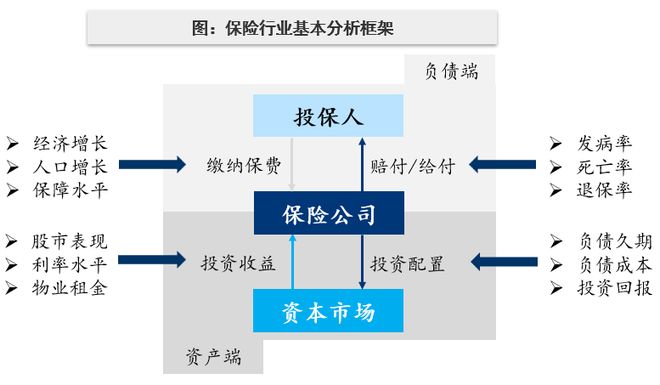
Core Viewpoint - The Hong Kong non-bank sector is currently in a favorable environment characterized by "valuation trough, recovery in prosperity, and macro-friendly" conditions, making it suitable for medium to long-term allocation [1] Group 1: Sector Characteristics and Investment Logic - The CSI Hong Kong Stock Connect Non-Bank Index is a significant sub-index in the Hong Kong market, selecting no more than 50 non-bank financial stocks, with over 65% of its composition in the insurance sector [2] - Understanding the business model of the insurance industry is crucial for grasping the investment value of this index, which has a highly concentrated industry distribution [2][4] Group 2: Long-term Development Drivers and Short-term Catalysts - Three long-term drivers support the continuous growth of the insurance industry: the low insurance penetration in China compared to developed markets, the advantages of savings-type insurance products in a declining yield environment, and the ability of insurance funds to enhance investment returns through diversified asset allocation in a low-interest-rate environment [5] - In the short term, the insurance industry is experiencing positive improvements in fundamentals, with regulatory measures guiding a reasonable reduction in liability costs and an increase in the proportion of participating insurance products [6] Group 3: Market Characteristics and Valuation Analysis - The Hong Kong non-bank sector has a unique dual attribute, being highly correlated with the domestic economic recovery while also sensitive to U.S. dollar liquidity and exchange rate changes [7] - The current market environment is favorable for the Hong Kong non-bank sector, with the onset of a U.S. interest rate cut cycle and a shift towards global liquidity easing, creating good conditions for valuation recovery [7][10] Group 4: Investment Tool Selection and Allocation Value - The Guangfa CSI Hong Kong Stock Connect Non-Bank Financial Theme ETF and its linked funds are among the most focused and scarce products in the Hong Kong non-bank index market, with a scale of approximately 21.5 billion [10] - This product offers several advantages, including concentrated exposure to high-quality stocks like AIA and the Hong Kong Stock Exchange, lower historical volatility, and a semi-annual adjustment of constituent stocks to maintain structural stability and operational transparency [10] Group 5: Overall Investment Opportunity - The Hong Kong non-bank sector is poised for a dual enhancement in fundamentals and valuations, with a favorable macro environment supporting this trend [11] - Investors can efficiently allocate to this undervalued and growth-resonant financial sub-sector through the Guangfa CSI Hong Kong Stock Connect Non-Bank Financial Theme ETF and its linked funds [11]

【11日资金路线图】农林牧渔板块净流入逾18亿元居首 龙虎榜机构抢筹多股
Zheng Quan Shi Bao· 2025-11-11 11:26
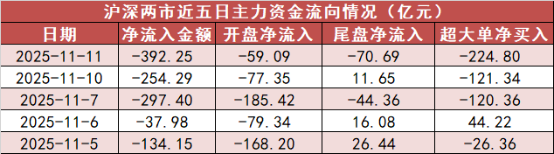
Market Overview - The A-share market experienced an overall decline on November 11, with the Shanghai Composite Index closing at 4002.76 points, down 0.39%, the Shenzhen Component Index at 13289.01 points, down 1.03%, and the ChiNext Index at 3134.32 points, down 1.4% [1] - The total trading volume in the A-share market was 20140.66 billion yuan, a decrease of 1805.65 billion yuan compared to the previous trading day [1] Capital Flow - The main capital in the A-share market saw a net outflow of 392.25 billion yuan, with an opening net outflow of 59.09 billion yuan and a closing net outflow of 70.69 billion yuan [2] - The CSI 300 index had a net outflow of 164.85 billion yuan, while the ChiNext saw a net outflow of 150.26 billion yuan, and the STAR Market recorded a net inflow of 3.62 billion yuan [4] Sector Performance - The agriculture, forestry, animal husbandry, and fishery sector led with a net inflow of 18.27 billion yuan, followed by the food and beverage sector with 12.51 billion yuan [6][7] - The electronics sector experienced the largest net outflow of 267.33 billion yuan, followed by the power equipment sector with 151.54 billion yuan [7] Notable Stocks - Xingsen Technology had the highest net inflow of 4.92 billion yuan among individual stocks [8] - Institutions showed significant interest in stocks such as Sifangda, which saw a net institutional buy of 109.86 million yuan, and Shengong Technology with a net buy of 95.08 million yuan [10][11] Institutional Focus - Recent institutional ratings highlighted stocks like Aofei Data with a target price of 29.78 yuan, indicating a potential upside of 56.57% from its latest closing price [12]
主力资金丨尾盘资金出逃19股超亿元
Zheng Quan Shi Bao Wang· 2025-11-11 10:37
Core Insights - The main point of the articles is the analysis of capital flow in various industries and individual stocks, highlighting significant net inflows and outflows of funds in the market. Industry Summary - Five industries experienced net inflows of main capital, with the banking and steel sectors leading, each exceeding 250 million yuan [1] - The retail trade industry had the highest increase at 1.43%, while the communication industry saw the largest decline at 2.2% [1] - Among the 26 industries with net outflows, the electronics sector had the highest outflow at 8.809 billion yuan [1] Company Summary - In the PCB sector, Xingsen Technology saw a net inflow of 492 million yuan, with its stock price increasing by 6.02% [2] - Juhua Technology also experienced significant inflow, with 483 million yuan, following a "20cm" price limit increase [2] - Other companies with notable net inflows included Dongshan Precision, GCL-Poly Energy, and Fangda Carbon [3] - Conversely, Oriental Fortune faced the largest net outflow at 1.235 billion yuan, followed by Shenghong Technology and Guiding Compass, each exceeding 1.1 billion yuan [4] - In the late trading session, 19 stocks had net outflows exceeding 1 billion yuan, with Xiangnong Xinchuan leading at 348 million yuan [7]
商贸零售行业资金流出榜:中国中免、王府井等净流出资金居前
Zheng Quan Shi Bao Wang· 2025-11-11 09:04
Core Viewpoint - The Shanghai Composite Index fell by 0.39% on November 11, with 15 industries experiencing gains, particularly in retail and real estate, which rose by 1.43% and 0.81% respectively [1] Industry Performance - The retail industry led the gains today, with a rise of 1.43% despite a net outflow of 7.17 billion yuan in main funds [1] - A total of 97 stocks in the retail sector were tracked, with 62 stocks rising and 4 hitting the daily limit up, while 28 stocks declined [1] Fund Flow Analysis - The main funds in the two markets experienced a net outflow of 56.242 billion yuan, with 5 industries seeing net inflows [1] - The banking sector had the largest net inflow, amounting to 808 million yuan, and it rose by 0.35% [1] - The electronic industry faced the largest net outflow, totaling 13.026 billion yuan, followed by the computer industry with a net outflow of 7.028 billion yuan [1]

“十五五”下金融发展机会暨2026年非银金融行业策略:新起点下的双向披荆斩棘
Guoxin Securities· 2025-11-11 07:33
Core Insights - The report emphasizes that the year 2026, marking the beginning of the "14th Five-Year Plan," will witness deeper interactions between the macro economy and capital markets, driven by policy guidance and industrial upgrades, leading to structural opportunities in technology innovation and green economy [2] - The capital market's funding structure is expected to become more balanced, with a shift from savings to investments as residents become more aware of asset allocation, benefiting asset management products like public funds and bank wealth management [2] - The report anticipates a gradual relaxation of refinancing, providing long-term opportunities for the securities industry to enhance ROE from the current average of 6% to 10% by focusing on innovative areas such as AI applications and cross-border business [2] - Insurance companies are shifting from investment-driven strategies to focusing on real customer needs, leading to product innovation and value enhancement in areas like dividend insurance, health insurance, and pension insurance [2] Section Summaries 01 Structure: A New Starting Point - The financial industry is entering a new phase characterized by the dual drive of policy and industrial upgrades, fostering a new ecosystem of mutual engagement between industry and finance [2] 02 Market: A New Balance of Funds - The report highlights a structural shift in capital allocation, with increased investment in asset management products and a steady entry of long-term, low-risk institutional investors like insurance and annuities [2] - The "national team" funds are expected to continue stabilizing the market, allowing for a gradual release of previously restricted activities such as shareholder reductions and refinancing [2] 03 Securities: New Transformation After Financing - The securities industry is poised for a long-term improvement in ROE as financing channels open up, enabling a focus on innovative fields that enhance service efficiency and asset pricing capabilities [2] - The report suggests that the industry will increasingly invest in AI technology and cross-border business, moving away from homogeneous competition [2] 04 Insurance: New Value After Stabilization - Insurance companies are expected to innovate products that meet genuine customer needs, reducing reliance on investment volatility and focusing on protection-oriented businesses [2] - This transition aligns with societal trends such as aging populations and health management needs, leading to steady growth in new business value and embedded value [2]
策略跟踪报告:A股三季报盈利能力延续修复
Wanlian Securities· 2025-11-11 07:14
Group 1 - The overall performance of A-share listed companies shows a recovery in profitability, with total revenue growth of 1% and net profit growth of 6% year-on-year for the first three quarters of 2025, marking a 5.0 percentage point increase compared to the same period in 2024 [3][8][12] - Small-cap stocks have demonstrated a strong recovery in net profit, with the ChiNext Index and Northbound A-shares showing revenue growth exceeding 10%, while the profitability of the technology sector, particularly in AI and biopharmaceuticals, has improved significantly [3][13][14] - More than half of the industries reported positive year-on-year growth in net profit, with notable performances in the computer, media, and electronics sectors, which saw net profit growth exceeding 30% [3][19] Group 2 - The report suggests focusing on opportunities in the technology growth sector, particularly in the AI industry chain, as well as in service consumption areas that are expected to benefit from domestic demand recovery [4][27] - The non-bank financial sector is anticipated to maintain its improving performance due to the recovery of the capital market and increased trading activity [4][27] - The report highlights the importance of companies with strong R&D capabilities and clear commercialization paths, which are expected to continue performing well and gaining market recognition [4][27]
今日沪指跌0.38% 煤炭行业跌幅最大
Zheng Quan Shi Bao Wang· 2025-11-11 04:08
Market Overview - The Shanghai Composite Index fell by 0.38% today, with a trading volume of 832.49 million shares and a turnover of 12,680.08 billion yuan, a decrease of 12.71% compared to the previous trading day [1][2] - A total of 2,924 stocks rose, with 61 hitting the daily limit up, while 2 stocks hit the daily limit down [1] Industry Performance - The best-performing sectors included: - Retail: Increased by 0.95% with a turnover of 220.30 billion yuan, down 14.02% from the previous day, led by Zhejiang Dongri with a rise of 9.99% [1] - Electric Equipment: Increased by 0.79% with a turnover of 2,084.15 billion yuan, down 15.66%, led by Zhonglai Shares with a rise of 20.06% [1] - Building Materials: Increased by 0.67% with a turnover of 117.19 billion yuan, up 11.18%, led by Anhui Conch with a rise of 10.00% [1] - The worst-performing sectors included: - Coal: Decreased by 2.13% with a turnover of 111.32 billion yuan, down 1.22%, led by Antai Group with a drop of 5.15% [2] - Communication: Decreased by 1.26% with a turnover of 640.33 billion yuan, down 1.84%, led by Tianfu Communication with a drop of 6.77% [2] - Non-bank Financials: Decreased by 1.10% with a turnover of 290.38 billion yuan, up 6.66%, led by Guosheng Securities with a drop of 2.78% [2]
A股资金温度计(第2期):资金偏好分化,情绪边际降温
Ping An Securities· 2025-11-11 02:41
Group 1: Institutional Funds - Public funds showed a decrease in new issuance since September, with significant increases in non-bank financials, technology, and non-ferrous metals, while reducing holdings in banks [9][10][15] - Private equity funds reached a peak in new issuance in Q3, with a focus on stable defensive positions, although new issuance has cooled down in October [16][19] - Insurance funds increased their holdings in banks during a market downturn, with a net inflow of 83.6 million shares in Q3 [22][23] - The national team slightly reduced their holdings but increased investments in TMT sectors, particularly in electronics and communications [24][27] Group 2: Retail Investor Funds - Retail investor activity peaked in Q3 with a total of 7.55 million new accounts, but saw a decline in October [29][30] - Financing funds saw a net inflow of 279.2 billion yuan in August, but this trend decreased in subsequent months [29][31] - The focus of retail investor financing has been on technology sectors such as electronics, power equipment, and pharmaceuticals [31][33] Group 3: Foreign Funds - Foreign capital reduced holdings in traditional industries, particularly banks, while increasing investments in emerging sectors like electronics [34] - The total value of foreign holdings in A-shares increased to 2.6 trillion yuan despite a reduction in the number of shares held [34]
线上回放|启航新征程·国泰海通2026年度策略会
国泰海通证券研究· 2025-11-10 15:07
Core Insights - The article summarizes the key discussions from the Guotai Junan Securities 2026 Strategy Conference, focusing on various sectors including technology, consumption, and finance [1][3]. Technology Forum - The forum featured discussions on strategies for communication investments in 2026, addressing the need for AI to fill gaps in the industry chain [6]. - Key presentations included insights from the chief analysts on communication, automotive, and technology sectors, emphasizing future investment opportunities [6]. Consumption Forum - The consumption forum highlighted growth trends in food and beverage, beauty, and home appliances, indicating a shift towards new consumption patterns and recovery in domestic demand [8]. - Analysts discussed the transformation of traditional consumption and the emergence of high-demand new consumption sectors, suggesting a positive outlook for the industry [8]. - The agricultural sector was also addressed, with insights into opportunities in pet-related markets and highlights in breeding and planting [8]. Finance Forum - The finance forum presented annual strategy reports for non-bank financial institutions and banks, focusing on the evolving landscape of the financial sector [10]. - Analysts provided insights into the performance and strategic direction of financial institutions, indicating potential areas for investment [10].