光伏设备

Search documents
2025年转债复盘:“攻守兼备”特征凸显
CAITONG SECURITIES· 2025-12-31 10:57
Report Industry Investment Rating - Not provided in the given content Core Viewpoints of the Report - In 2025, convertible bonds performed excellently, with equity characteristics contributing the main revenue. The convertible bond market's performance was the third - highest in terms of revenue since 2010 and the best since 2021. The contribution ratio of the underlying stocks and valuation to the rise and fall was about 7:4, similar to 2021. Compared with mainstream stock indices, the convertible bond index showed the property of "attack when the market rises and defend when the market falls", with Sharpe ratio and Calmar ratio second only to micro - cap stocks [2][6]. - In 2025, the supply of convertible bonds was in the ascendant. Over 230 billion yuan of convertible bonds were delisted, reaching the highest scale since 2018, with banks having the largest delisting scale. The primary market issuance process accelerated in the second half of the year, but the issuance of large - scale convertible bonds remained cautious. Listed companies were more inclined to issue private placements [2]. - In 2025, the demand for convertible bonds was differentiated, and the ETF share reached a new high. The logic of the "fixed - income asset shortage" continued, and the demand structure of institutions for convertible bonds changed significantly. The direct holding scale of convertible bonds by institutions such as insurance and annuities was at a historically low level, while the holding scale of convertible bonds by funds, especially ETFs, reached a historical high [2]. - In 2025, the game of convertible bond terms was characterized by "high return and high risk". The probabilities of downward revision and non - call of convertible bonds were at historically low levels, but the number of times of triggering call/downward revision was relatively high since 2019, indicating an increase in the intensity of the game. The odds of the downward revision game were at a historical high, with photovoltaic convertible bonds and near - maturity convertible bonds being the highlights of the whole year. The profit - loss ratio of the call game deteriorated compared with the previous year but was still at a historical high [2]. - In 2025, the risks of convertible bonds were better than expected, and the impact of ratings decreased. Only Zhongzhuangzhuan 2 in the Shanghai and Shenzhen stock markets triggered the substantial default risk, and the risk performance was better than investors' expectations. Although there were still many convertible bonds with rating adjustments, the impact on pricing was significantly weakened, and the market was generally "desensitized" to ratings [2]. Summary According to the Directory 2025, How Did the Convertible Bond Market Perform? 2021 - 2025: The Best - Performing Year Since 2021, with Equity Income as the Main Contributor - Vertically, the convertible bond holding experience in 2025 could rank among the top four years since 2010. As of December 30, 2025, the CSI Convertible Bond Index closed at 491.83 points, up 18.6% from the end of 2024. It was the third - highest revenue - earning year since 2010 and the best since 2021. The maximum drawdown was about 6%, the annualized volatility was less than 10%, and the Sharpe ratio was 1.92, the Calmar ratio was 3.01, achieving high returns with low drawdown and medium - low volatility [6]. - In terms of revenue decomposition, the contribution ratio of the underlying stocks and valuation to the rise and fall in 2025 was about 7:4. The change in the underlying stocks contributed 14 percentage points to the index return, and the change in valuation contributed about 8 percentage points, similar to 2021 [9]. - Horizontally, the return performance of the convertible bond index was slightly weaker, but the cost - performance was prominent. Compared with the stock indices in the same period, its return was only stronger than that of the Shanghai Composite Index, Juchao Large - cap Index, and Guozheng Value Index, but significantly weaker than that of the micro - cap and ChiNext Index. However, in terms of Sharpe ratio and Calmar ratio, it was only slightly weaker than the Wind Micro - cap Index, showing the property of "attack when the market rises and defend when the market falls" [13]. The Convertible Bond Market Rose Volatility Throughout the Year, and the Year - End Increase Converged - **First stage (Early 2025 - March 2025)**: Driven by the spring rally and supported by AI + robot innovation and low initial valuations, the convertible bond market had a dual - wheel - driven market of valuation and the underlying stocks, with a maximum index increase of 6.15% by the end of February. Low - price convertible bonds performed strongly, and the concern about credit risk events was reversed [19]. - **Second stage (March 2025 - Early April 2025)**: After the Two Sessions, the spring rally ended, and the market returned to the trading of annual report expectations. Market sentiment cooled down, and the convertible bond valuation peaked and declined. The intensification of Sino - US trade disputes led to a stock market correction on the first trading day after the Tomb - Sweeping Festival, and the CSI Convertible Bond Index fell 4.05%, with the automotive, communication, and computer industries leading the decline [19]. - **Third stage (Early April 2025 - Mid - June 2025)**: After the market correction on April 7, state funds such as Central Huijin entered the market, providing liquidity support. The Sino - US tariff issue was in a "tug - of - war", and the market expectation improved. The valuations of the overseas and export sectors rebounded, but concerns about the ratings of the photovoltaic and other sectors with weak performance emerged [20]. - **Fourth stage (End of June 2025 - End of August 2025)**: After the release of all rating results at the end of June, institutional funds increased their allocation of convertible bonds, and the convertible bond ETF share increased significantly. The anti - involution policy in the photovoltaic industry was implemented, and the photovoltaic convertible bonds rebounded. The A - share market was booming, driving the convertible bond market to its main uptrend. The convertible bond price and valuation reached new highs, and the market capacity decreased [20]. - **Fifth stage (End of August 2025 - Present)**: At the end of August, institutions' profit - taking demand led to a decline in the convertible bond market. The positions of insurance and annuity institutions in convertible bonds decreased significantly. The supply of convertible bonds improved in September, but it was difficult to offset the shrinkage caused by conversion. The convertible bond valuation stabilized and rebounded after the adjustment at the end of August and reached a high level again in December [21][22]. In 2025, the Supply of the Convertible Bond Market was in the Ascendant The Market Capacity Declined to Around 500 Billion Yuan, and the Delisting Scale Reached a Historical High - In 2025, the number of delisted convertible bonds reached a historical high, and the market capacity decreased rapidly. By December 30, 2025, a total of 163 convertible bonds were delisted, with a total delisting scale of over 230 billion yuan, the peak since 2018. The banking industry had the largest delisting scale of 101.323 billion yuan, followed by non - ferrous metals, basic chemicals, and power equipment and new energy [23]. The Primary Issuance Had Mixed Results, with Small - Ticket Issuance Accelerating and Large - Ticket Issuance Still Difficult - The good aspect was that the primary market issuance process accelerated in the second half of 2025. In the fourth quarter of 2025, the average time from the announcement of the convertible bond plan to listing was about 320 days, the lowest since 2023 [25]. - The regulatory authorities were still relatively cautious about the issuance of medium - and large - scale convertible bonds. As of now, no convertible bonds with a scale of over 2 billion yuan announced in 2025 have been listed, while 8 convertible bonds with a scale of less than 2 billion yuan have been listed [28]. Subjectively, the Trend of Listed Companies Preferring Private Placements was More Prominent - The ratio of the number of convertible bond plans to private placement plans has been declining sharply since the refinancing new regulations in 2023. In 2025, 53 listed companies announced private placement plans, while only 9 announced convertible bond plans, with a ratio of 16.98%, far lower than the average level before 2023 [29]. In 2025, the Demand for Convertible Bonds was Differentiated, and the ETF Share Reached a New High - In 2025, the logic of the "fixed - income asset shortage" continued, but the demand structure of institutions for convertible bonds changed significantly. As of November 2025, the direct holding of convertible bonds by insurance and annuity institutions was at a historically low level since 2021, while the holding of convertible bonds by funds, especially ETFs, reached a historical high [32]. In 2025, the Game of Convertible Bond Terms was Characterized by "High Return and High Risk" The Overall Probability of Downward Revision and Non - call of Convertible Bonds in 2025 was at a Historical Low - In 2025, it was a "big year" for call, and the call probability increased. There were 131 call announcements and 149 non - call announcements, and the call: non - call ratio was 88%, the highest since 2020. - The intensity of the downward revision of convertible bonds in 2025 was second only to 2024, but the downward revision probability decreased. There were 68 downward revision proposal announcements and 510 non - downward revision announcements, and the downward revision: non - downward revision ratio was 13%, at a historically low level [36]. Downward Revision: There were Odds, and Photovoltaic Convertible Bonds and Near - Maturity Convertible Bonds were the Highlights of the Whole Year - In terms of odds, the return performance of the convertible bond downward revision game in 2025 was at a relatively high level in history. The average return after a downward revision proposal was 2.02%, the best since 2023, and the average return after an actual downward revision was 0.63%, at a relatively high level since 2019 [41]. - In terms of influencing factors, the downward revision probability of near - maturity convertible bonds was significantly higher. The downward revision probability was highly correlated with the remaining term, showing obvious monotonicity. The new energy industry had the most downward revisions, and although some convertible bonds did not succeed in conversion by the end of 2025, they achieved good returns, and the downward revision increased the possibility of future call [42]. Call: The Profit - Loss Ratio of the Game Deteriorated Compared with the Previous Year but was Still at a Historical High - In 2025, the call game fluctuated greatly, and the non - call return was higher than the historical average. The average return on the first day after the non - call announcement of convertible bonds was 2.29%, higher than the historical average since 2019. The average return on the first day after the call announcement was - 2.54%, and the profit - loss ratio was about 0.9, which deteriorated significantly compared with 2024 but was still at a historical high [48]. In 2025, the Risks of Convertible Bonds were Better than Expected, and the Impact of Ratings Decreased - In 2025, there were no serious default events in the convertible bond market, which was significantly better than investors' expectations. Although Zhongzhuangzhuan 2 triggered default risk in the fourth quarter, its underlying stock had been ST before the restructuring, and its convertible bond rating had also fallen below the investment grade [48]. - In terms of ratings, although there were still many convertible bonds with rating adjustments, the impact on pricing decreased significantly. By December 30, 2025, 42 convertible bonds had their ratings downgraded and 40 were put on the rating watch list. However, the average decline of convertible bonds on the first trading day after the rating downgrade was only 0.01%, indicating that the market was generally "desensitized" to rating changes and the pricing was smoother [51].

光伏设备行业跟踪报告:太空光伏有望驱动行业长期需求,设备公司率先受益
GUOTAI HAITONG SECURITIES· 2025-12-31 09:36
Investment Rating - The report assigns an "Accumulate" rating for the photovoltaic equipment industry [1]. Core Insights - The low Earth orbit (LEO) satellites and space computing are expected to drive long-term demand in the photovoltaic industry, with equipment companies likely to benefit first [2]. - The report highlights that as LEO satellites enter a phase of intensive launches and the commercialization of space computing becomes evident, there will be a significant increase in demand for new photovoltaic technologies [4]. Summary by Sections Investment Recommendations - The report suggests that core equipment manufacturers are expected to benefit from the increasing demand driven by LEO satellites and space computing. Recommended stocks include Maiwei Co., Ltd., Jiejia Weichuang, Jing Shan Light Machine, and Laplace, with Di'er Laser identified as a beneficiary [4]. Market Dynamics - Elon Musk's plan to deploy 100GW of solar AI satellites annually is a key driver for space photovoltaic demand. The ability to harness solar energy in space offers longer generation times and higher stability and availability of energy [4]. - The report notes that the International Telecommunication Union (ITU) has regulations that allow for a maximum of about 60,000 satellites in LEO, with Starlink having applied for 42,000. This rapid expansion of satellite constellations is expected to increase demand for solar wings, battery cells, deployable array structures, and power management systems [4]. Technological Developments - The current main technology for space photovoltaics is gallium arsenide, with multi-junction gallium arsenide cells achieving a production efficiency of 30%. However, the complexity and cost constraints limit its scalability for LEO constellations [4]. - In the short to medium term, silicon-based P-type HJT technology is expected to penetrate low Earth orbit missions due to its lightweight potential and ongoing advancements in radiation resistance [4]. - Long-term prospects for perovskite tandem cells are promising due to their high efficiency and flexible film advantages, provided that breakthroughs in packaging lifespan and large-area consistency are achieved [4]. Industry Collaboration - The commercialization of the space photovoltaic industry is accelerating, with companies actively exploring opportunities in the space economy. For instance, Junda Co. and Shangyi Optoelectronics have signed a strategic cooperation agreement to integrate resources and collaborate on the application of perovskite battery technology in space energy [4].
TCL中环12月31日现1笔大宗交易 总成交金额390.05万元 溢价率为-9.10%
Xin Lang Cai Jing· 2025-12-31 09:27
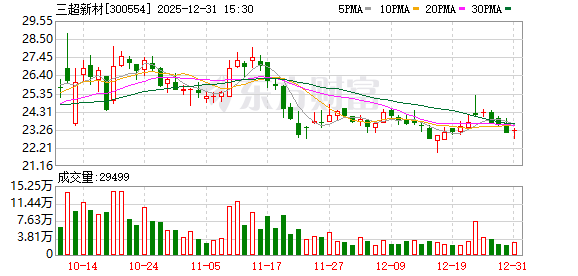
Group 1 - TCL Zhonghuan's stock closed down 1.04% at 8.57 yuan on December 31, with a significant block trade of 500,700 shares totaling 3.9005 million yuan [1] - The first transaction price was 7.79 yuan for 500,700 shares, resulting in a premium rate of -9.10%, with the buyer being Hu Long Securities and the seller being CITIC Jianhua Securities [1] - Over the past three months, TCL Zhonghuan has recorded two block trades with a total transaction value of 10.1818 million yuan, and the stock has increased by 0.59% over the last five trading days, with a net outflow of 154 million yuan from main funds [1]

三超新材:目前在钨丝线的生产布局上暂无较大调整
Mei Ri Jing Ji Xin Wen· 2025-12-31 08:53
Group 1 - The main difference between tungsten wire and photovoltaic wire lies in the base material used, with tungsten wire having a certain advantage in finished wire diameter compared to carbon steel wire [2] - The company currently has no significant adjustments planned for its production layout of tungsten wire [2]


每日报告精选(2025-12-30 09:00——2025-12-31 15:00)-20251231
国泰海通· 2025-12-31 07:53
Group 1: Strategy Observation - The report highlights that prices of cyclical resources are rising, driven by supply constraints and strong downstream demand in sectors like basic chemicals, new energy materials, and industrial metals [3] - The AI industry trend continues, with domestic electronic industry demand significantly boosted, leading to an increase in storage prices and sustained high growth in PCB exports [3][4] - Service consumption shows marginal improvement, with tourism in Hainan experiencing a price index increase due to travel demand, and pig prices stabilizing and rising towards the year-end [3] Group 2: Industry Tracking - Electronics - Mini LED technology is entering a rapid development phase, with increasing penetration in mid-to-high-end TV markets and expanding into lower-end markets and automotive applications [17] - The report anticipates that by 2025, Mini LED TV shipments in China will reach 9.23 million units, a year-on-year increase of 122%, with a penetration rate exceeding 25% [20] Group 3: Industry Monthly Report - Aviation - The Chinese aviation industry is expected to turn profitable in 2026, driven by a recovery in public and business demand, with significant growth in passenger traffic projected for 2025 [21][30] - The report suggests that the upcoming New Year holiday will see strong travel demand, with expectations for improved pricing and passenger volume [33] Group 4: Industry Deep Dive - Cultural Communication - The report emphasizes the ongoing progress of native large model companies in Hong Kong, highlighting the potential investment opportunities arising from the commercialization of AI technology [35] - Companies involved in AI algorithms and applications are recommended, including Meitu and Zhejiang Shuju, as they are well-positioned to benefit from the AI trend [35][36] Group 5: Industry Tracking - Automotive - The report notes the continuation of the "old-for-new" policy for automobiles in 2026, which includes subsidies for scrapping and replacing vehicles, aimed at boosting consumption [46][48] - The policy supports consumers who scrap their vehicles and purchase new energy or low-emission vehicles, with specific subsidy percentages outlined [49]




通威股份跌2.05%,成交额8.16亿元,主力资金净流出1.09亿元
Xin Lang Cai Jing· 2025-12-31 06:17
Core Viewpoint - Tongwei Co., Ltd. has experienced a decline in stock price and financial performance, with significant net outflows of capital and a decrease in revenue and profit year-on-year [1][2]. Group 1: Stock Performance - On December 31, Tongwei's stock price fell by 2.05%, reaching 20.58 CNY per share, with a trading volume of 816 million CNY and a turnover rate of 0.87% [1]. - The company's stock has decreased by 6.92% year-to-date, with a 2.19% drop over the last five trading days, 6.54% over the last 20 days, and 7.67% over the last 60 days [1]. Group 2: Financial Performance - For the period from January to September 2025, Tongwei reported a revenue of 646 billion CNY, a year-on-year decrease of 5.38%, and a net profit attributable to shareholders of -5.27 billion CNY, down 32.64% year-on-year [2]. - The company has distributed a total of 251.92 billion CNY in dividends since its A-share listing, with 169.23 billion CNY distributed in the last three years [3]. Group 3: Shareholder and Institutional Holdings - As of December 19, the number of shareholders for Tongwei increased to 293,500, a rise of 16.48%, while the average circulating shares per person decreased by 14.15% to 15,337 shares [2]. - Major institutional shareholders have reduced their holdings, with Hong Kong Central Clearing Limited holding 136 million shares, down by 27.91 million shares from the previous period [3].

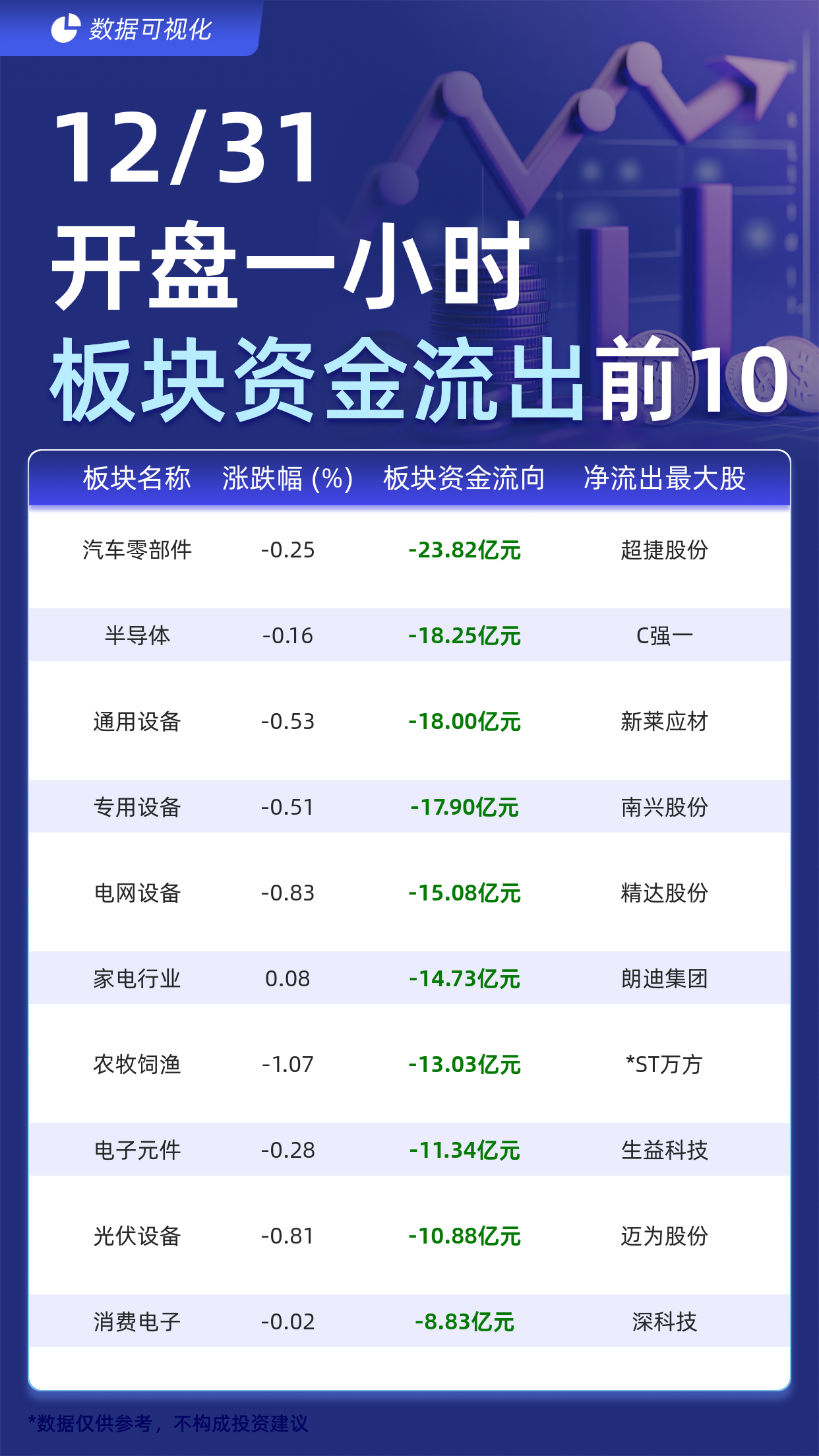
主力板块资金流出前10:汽车零部件流出23.82亿元、半导体流出18.25亿元
Jin Rong Jie· 2025-12-31 02:42
Core Viewpoint - The main market experienced a net outflow of 20.086 billion yuan in principal funds as of December 31, with significant withdrawals across various sectors [1]. Group 1: Sector Performance - The top ten sectors with the largest net outflows include: - Automotive Parts: -2.382 billion yuan [2] - Semiconductors: -1.825 billion yuan [2] - General Equipment: -1.800 billion yuan [2] - Specialized Equipment: -1.790 billion yuan [2] - Power Grid Equipment: -1.508 billion yuan [2] - Home Appliances: -1.473 billion yuan [2] - Agriculture, Animal Husbandry, and Fishery: -1.303 billion yuan [3] - Electronic Components: -1.134 billion yuan [3] - Photovoltaic Equipment: -1.088 billion yuan [3] - Consumer Electronics: -0.883 billion yuan [3]
阳光电源跌2.08%,成交额17.26亿元,主力资金净流出1.07亿元
Xin Lang Cai Jing· 2025-12-31 02:05
Group 1: Company Overview - Yangguang Electric Power Co., Ltd. is located in Hefei, Anhui Province, and was established on July 11, 2007, with its listing date on November 2, 2011 [2] - The company specializes in the research, production, sales, and service of renewable energy power equipment, including solar, wind, energy storage, and electric vehicles [2] - The revenue composition includes: energy storage systems (40.89%), photovoltaic inverters and other power electronic conversion devices (35.21%), new energy investment and development (19.29%), others (2.86%), and photovoltaic power station generation (1.75%) [2] Group 2: Financial Performance - For the period from January to September 2025, Yangguang Electric Power achieved a revenue of 66.402 billion yuan, representing a year-on-year growth of 32.95% [2] - The net profit attributable to shareholders for the same period was 11.881 billion yuan, showing a year-on-year increase of 56.34% [2] Group 3: Stock Performance and Market Activity - On December 31, the stock price of Yangguang Electric Power fell by 2.08%, trading at 175.35 yuan per share, with a total market capitalization of 363.538 billion yuan [1] - The stock has increased by 144.15% year-to-date, with a 5-day increase of 5.71%, a 20-day decrease of 1.00%, and a 60-day increase of 8.89% [1] - The company has appeared on the "Dragon and Tiger List" twice this year, with the most recent net purchase of 641 million yuan on October 29 [1] Group 4: Shareholder Information - As of September 30, 2025, the number of shareholders reached 235,500, an increase of 31.08% from the previous period [2] - The average circulating shares per person decreased by 23.71% to 6,748 shares [2] - Major shareholders include Hong Kong Central Clearing Limited and various ETFs, with notable changes in holdings among the top ten circulating shareholders [3]

帮主收评:指数红了,账户绿了!3400股下跌的“假反弹”怎么看?
Sou Hu Cai Jing· 2025-12-30 14:55
Core Viewpoint - The market is experiencing a significant structural divergence, with a stark contrast between hot and cold sectors, indicating a fierce competition for capital rather than a bullish trend reversal [3]. Group 1: Market Performance - The three major indices showed a rebound in the afternoon, particularly the ChiNext, but over 3,400 stocks declined, revealing a disparity between the index performance and individual stock results [1]. - The human-shaped robot sector emerged as a key highlight, driving related industries such as motors and film theaters, reflecting a concentrated investment in sectors with clear growth trends for the upcoming year [3]. Group 2: Sector Analysis - The human-shaped robot and film sectors are currently strong, but caution is advised against chasing highs during peak emotions; instead, investors should look for potential stocks within these sectors that have lagged behind [4]. - Conversely, sectors like solar equipment and insurance are experiencing significant declines, which may present long-term investment opportunities if the fundamental logic remains intact [4]. Group 3: Investment Strategy - In a market characterized by reduced trading volume, any potential upward movement in the market requires increased trading volume to be sustainable; otherwise, caution is warranted [4]. - Investors should either engage in short-term trading within the strongest sectors or focus on research in quieter areas to prepare for future market rotations, avoiding indecision that could lead to losses [5].

技术看市:A股罕见特征出现,老百姓的钱小心翼翼,2025年慢牛元年?
Jin Rong Jie· 2025-12-30 12:16
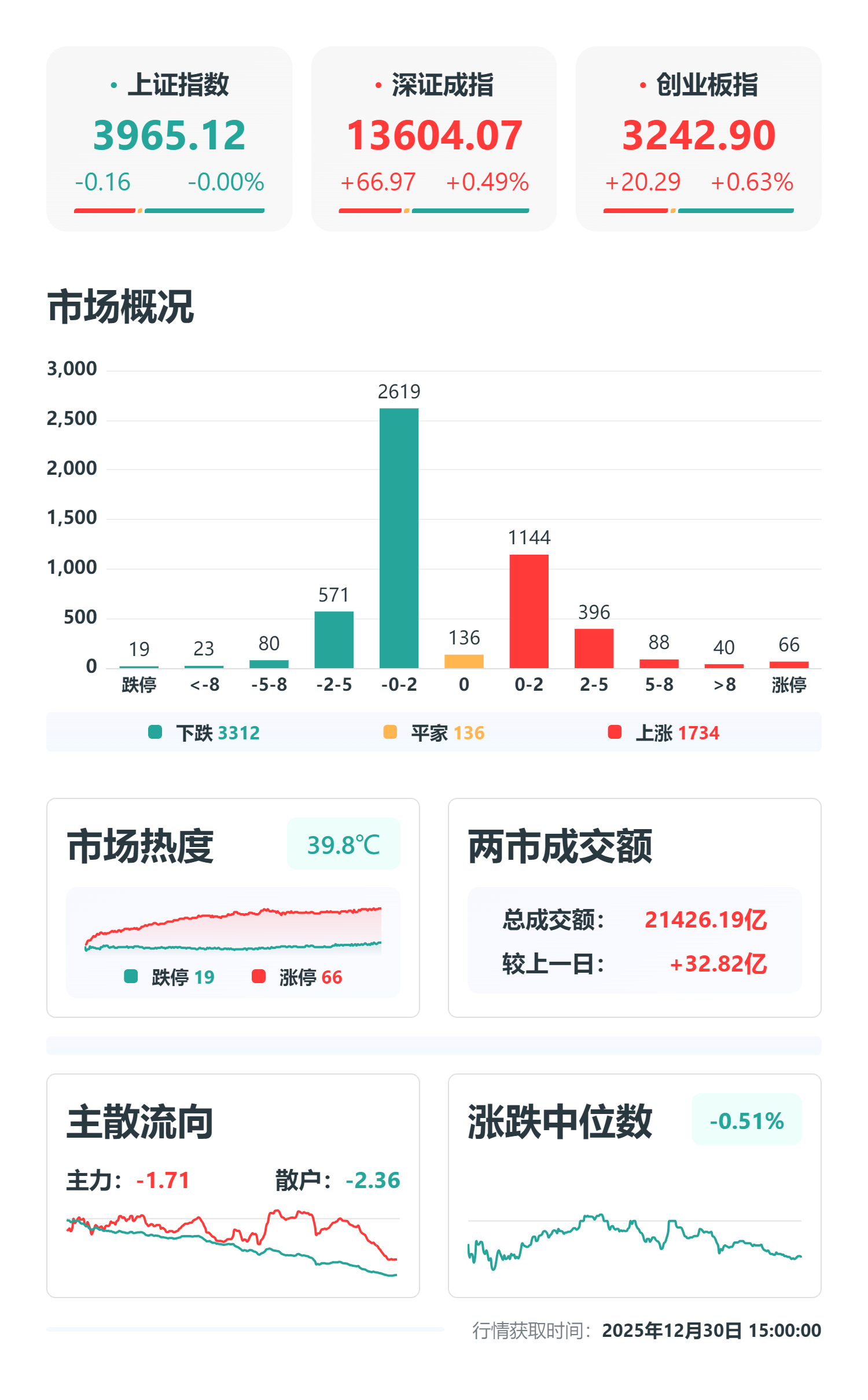
Group 1 - The core viewpoint of the articles highlights the performance of the stock market on the last trading day of the year, with 1,734 stocks rising, 3,306 falling, and 142 remaining unchanged, indicating a mixed market sentiment [5] - The total trading volume reached 2.14 trillion yuan, an increase of approximately 32.81 billion yuan compared to the previous trading day, reflecting heightened market activity [5] - The net outflow of main funds from the market was 38.772 billion yuan, with the automotive parts sector seeing the highest net inflow, followed by home appliances, general equipment, cultural media, and consumer electronics [5] Group 2 - The analysis indicates that 2025 has been characterized by a rare slow bull market, with significant fluctuations including a major drop on April 7, followed by a prolonged period of stability and growth over 148 trading days [5] - The market expert Xu Xiaoming emphasizes the importance of a slow bull market for long-term economic benefits, suggesting that a rational investment approach has emerged this year due to high household savings and reduced risks in the real estate and wealth management sectors [6] - Xu expresses optimism that 2025 could mark the beginning of a slow bull market for the Chinese stock market, which would positively impact the economy and consumer sentiment [6]