有色金属

Search documents
有色金属ETF基金(516650) 涨幅收窄至3.21%,中银国际:一季度为资源品重要配置时点
Mei Ri Jing Ji Xin Wen· 2026-02-25 07:09
Core Viewpoint - The non-ferrous metals sector has shown a remarkable annual growth of 94.73% in 2025, driven by a combination of supply-demand restructuring, technological revolution, and monetary changes, establishing itself as a cornerstone for new industries and providing investment value amidst economic fluctuations [1]. Group 1: Market Performance - As of February 25, major indices experienced a pullback, with the non-ferrous metals ETF (516650) narrowing its gains to 3.21%, while stocks such as Yunnan Zhenye, Anning Shares, Youyan New Materials, and Northern Rare Earth reached their daily limit [1]. - The recent performance of non-ferrous metals is influenced by geopolitical uncertainties, particularly the evolving situation between the U.S. and Iran, which significantly impacts oil and precious metal prices [1]. Group 2: Future Outlook - Analysts from Zhongyin International Securities reaffirm the view that the first quarter is a crucial time for resource allocation, with potential catalysts for the current resource market rally stemming from increased overseas uncertainties [1]. - The domestic operational conditions post-Spring Festival and the macroeconomic policies ahead of the Two Sessions are expected to significantly influence the sustainability of the coal and domestic resource market [1]. - Overall, the first quarter is deemed an opportune moment for resource allocation, with the non-ferrous sector anticipated to continue benefiting from the resonance of financial attributes and industrial trends throughout 2026 [1].
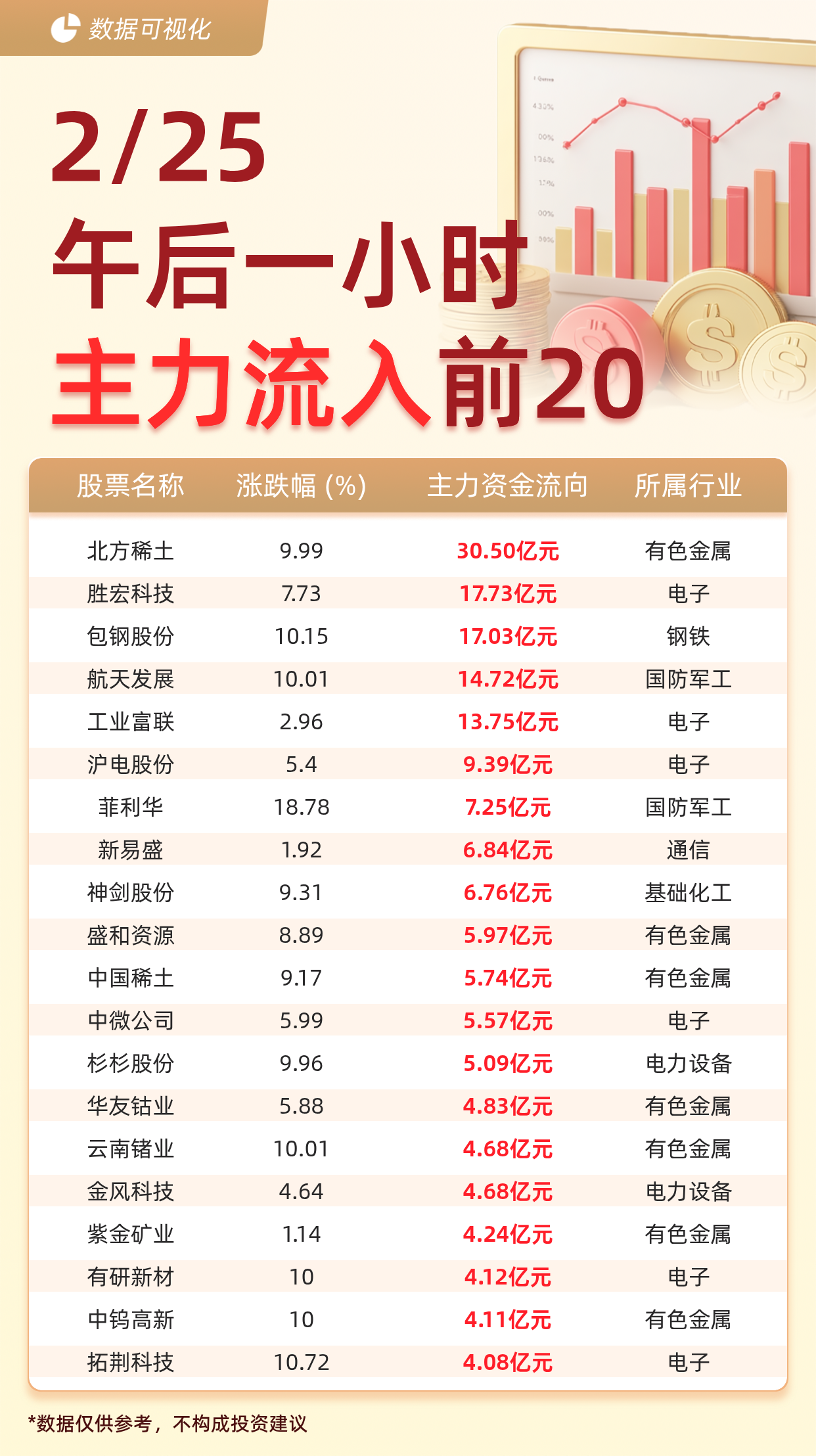
主力资金流入前20:北方稀土流入30.50亿元、胜宏科技流入17.73亿元
Jin Rong Jie· 2026-02-25 06:34
Group 1 - The main stocks with significant capital inflow include Northern Rare Earth (30.50 billion), Shenghong Technology (17.73 billion), and Baosteel (17.03 billion) [1] - Northern Rare Earth saw a price increase of 9.99%, while Baosteel increased by 10.15% [2] - Other notable stocks with substantial inflows are Aerospace Development (14.72 billion) and Industrial Fulian (13.75 billion) [1][2] Group 2 - The electronics sector is represented by companies like Shenghong Technology, Industrial Fulian, and Huadian Shares, with inflows of 17.73 billion, 13.75 billion, and 9.39 billion respectively [2] - The defense sector includes Aerospace Development and Feilihua, with inflows of 14.72 billion and 7.25 billion respectively [2] - The non-ferrous metals sector has significant representation with Northern Rare Earth, Shenghe Resources, and China Rare Earth, attracting inflows of 30.50 billion, 5.97 billion, and 5.74 billion respectively [1][3]







金属行业周报:静待国内需求复苏,关注宏观情绪影响-20260225
BOHAI SECURITIES· 2026-02-25 06:25
Investment Rating - The report maintains a "Positive" rating for the steel industry and a "Positive" rating for the non-ferrous metals industry. It also maintains an "Accumulate" rating for specific companies including Luoyang Molybdenum (603993), Zhongjin Gold (600489), Huayou Cobalt (603799), Zijin Mining (601899), and China Aluminum (601600) [11]. Core Insights - The steel market is expected to slowly recover post-holiday, with attention on actual demand recovery, raw material price trends, and macroeconomic news impacting steel prices [22][4]. - Copper prices are anticipated to remain high and fluctuate due to strong demand expectations from sectors like new energy and AI, despite a slow recovery in demand post-holiday [42][4]. - The aluminum sector is facing average fundamentals, with macroeconomic sentiment significantly influencing aluminum prices; actual demand recovery and macro news are key areas to watch [51][4]. - Gold prices may find support due to rising geopolitical risks, while long-term factors such as central bank gold purchases and the weakening of the US dollar will enhance gold's attractiveness [57][4]. - The rare earth sector is expected to maintain high prices for praseodymium and neodymium oxide due to ongoing supply shortages [3][4]. Summary by Sections Steel - The total production of five major steel products decreased due to most electric furnace enterprises halting production for the holiday, leading to an increase in inventory [22][24]. - As of February 13, the total steel inventory was 14.39 million tons, a 7.44% increase from February 6, but a 20.56% decrease year-on-year [30][41]. - The average price index for steel on February 13 was 3,409.51 CNY/ton, reflecting a 0.14% decrease from February 6 [40][41]. Copper - Copper inventory is on an upward trend, with the overall industry maintaining a weak operational pattern; however, market activity is expected to gradually recover post-holiday [42][49]. - On February 13, the LME copper spot price was 12,700 USD/ton, and the SHFE copper spot price was 100,400 CNY/ton, with respective changes of -0.94% and +0.24% from February 6 [49][49]. Aluminum - The supply of electrolytic aluminum is expected to remain low post-holiday, with domestic inventory likely to continue increasing in the short term [51][52]. - On February 13, the LME aluminum spot price was 3,000 USD/ton, and the SHFE aluminum spot price was 23,200 CNY/ton, with a decrease of 1.61% and an increase of 0.09% respectively from February 6 [52][52]. Gold - Geopolitical risks and US economic data are significant factors influencing gold prices, with the COMEX gold closing at 5,063.80 USD/ounce on February 13, a 1.51% increase from February 6 [57][57]. Rare Earths - The supply of praseodymium and neodymium oxide remains tight, supporting high prices in the short term [3][4].





有色ETF银华(159871)开盘涨0.35%,重仓股紫金矿业涨0.20%,洛阳钼业涨0.61%
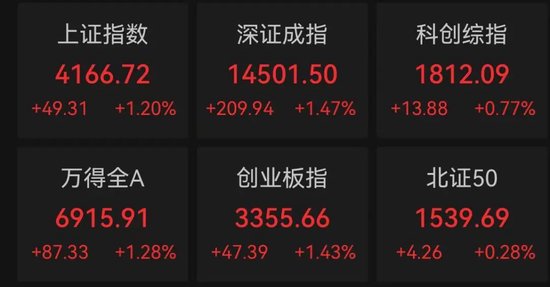
Xin Lang Cai Jing· 2026-02-25 06:04
Group 1 - The core viewpoint of the article highlights the performance of the Silver ETF (159871) and its major holdings in the non-ferrous metal sector, indicating a mixed performance among its key stocks [1] - The Silver ETF opened with a slight increase of 0.35%, priced at 1.145 yuan, reflecting a stable market interest in non-ferrous metals [1] - Major holdings within the ETF include Zijin Mining, which rose by 0.20%, and Ganfeng Lithium, which increased by 1.43%, showcasing a generally positive trend among several key stocks [1] Group 2 - The ETF's performance benchmark is the CSI Non-Ferrous Metals Index return, managed by Silver Fund Management Co., Ltd., with a return of 127.80% since its inception on March 10, 2021 [1] - Over the past month, the ETF has experienced a return of -1.72%, indicating some short-term volatility despite its strong long-term performance [1]
工业金属利好不断,有色金属ETF国泰(159881)大涨近5%
Mei Ri Jing Ji Xin Wen· 2026-02-25 05:45
Group 1 - The core viewpoint of the article highlights the positive momentum in industrial metals, particularly with the significant rise of the Cathay ETF (159881) by nearly 5% on February 25 [1] - According to Dongfang Securities, the recent tariff ruling does not affect steel and aluminum tariffs, meaning industrial product pricing remains anchored to its own supply and demand dynamics [1] - There has been an accumulation of copper and aluminum inventories in the week leading up to the Spring Festival, with decent operating rates during the off-season, indicating a potential increase in downstream acceptance as prices adjust [1] Group 2 - The focus is on the accumulation rate during the Spring Festival and the speed of inventory reduction post-holiday, which will determine the strength of industrial product prices after the holiday [1] - Over the long term, underpinned by domestic and international policy support expectations, there is strong support for industrial products, with increased price elasticity due to low inventory levels amid macroeconomic benefits and supply disruptions [1] - The Cathay ETF (159881) tracks the CSI Nonferrous Metals Index (930708), which selects listed companies involved in the mining, smelting, and processing of nonferrous metals, covering multiple sub-industries such as copper, gold, and aluminum [1]
美国拟设置小金属参考价格,有色ETF鹏华(159880)涨近4%
Xin Lang Cai Jing· 2026-02-25 05:40
Group 1 - The Trump administration plans to use an AI model developed by the U.S. Department of Defense to establish reference prices for global critical mineral trade, starting with germanium, gallium, antimony, and tungsten [1] - The reference prices are expected to have a limited impact on tungsten, which is already profitable for all, but may boost the prices of germanium, gallium, and antimony, which are currently undervalued [1] - The policy is anticipated to lead to an expansion in equity market value, with improvements in earnings per share (EPS) and price-to-earnings (PE) ratios due to higher expected prices and increased survival rates of companies [1] Group 2 - As of January 30, 2026, the National Securities Nonferrous Metals Industry Index (399395) has a strong performance, with a 4.15% increase, and notable gains in component stocks such as Chihong Zn & Ge and Huaxi Nonferrous, both up by 10.01% [1] - The index reflects the overall performance of listed companies in the nonferrous metals sector, comprising 50 securities with significant scale and liquidity, and the top ten weighted stocks account for 49.87% of the index [2]
资源周期板块依然亮眼
Xin Lang Cai Jing· 2026-02-25 05:38
Core Viewpoint - The A-share market is experiencing a high-level fluctuation with a clear trend of structural differentiation, indicating a "structure is king" theme for the Year of the Horse [1] Group 1: Market Trends - The market is shifting from "expectation-driven" to "performance verification," with a focus on earnings and policy as the main drivers [2] - The spring market is expected to continue, but with significant structural differentiation, particularly favoring hardware segments capable of commercializing AI applications [2] - The market logic is anticipated to transition from "policy expectations" to "earnings realization" after March, with annual and quarterly reports serving as key anchors for market movements [2] Group 2: Sector Performance - Resource cyclical stocks are performing strongly, driven by high international oil prices and geopolitical factors, with oil and gas, precious metals, and non-ferrous metals showing active performance [3] - The resource sector's performance is supported by rising commodity prices, with precious metals and oil prices influenced by geopolitical factors and fluctuations in U.S. dollar credit [3] Group 3: Market Sentiment - There is a stark contrast in market sentiment, with previously popular AI concept stocks facing significant declines, indicating a return to rationality regarding AI's commercial viability [4] - The market is characterized by a "broad rise masking differentiation," where funds are flowing into cyclical and hardware sectors with earnings support, while overvalued speculative stocks are being sold off [4] - Future investments in the Year of the Horse are expected to test investors' abilities to select stocks accurately between technology and resources, as well as value and growth [4]
比黄金还疯狂!这种“工业牙齿”一年暴涨220%,今年还可能接着涨
Xin Lang Cai Jing· 2026-02-25 05:29
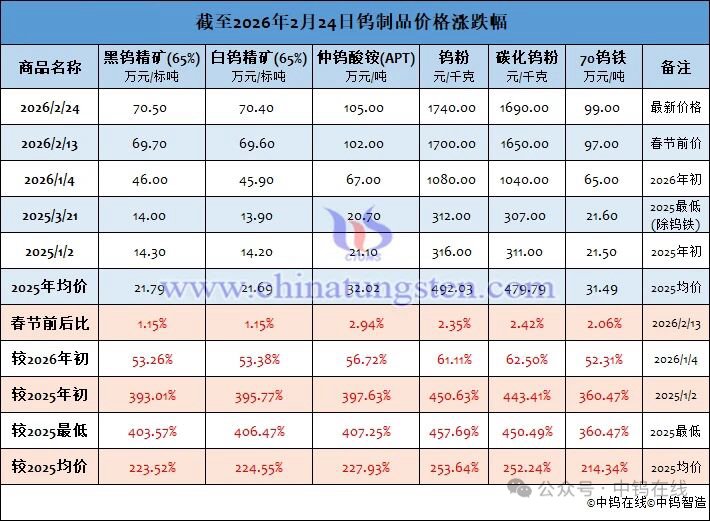
Core Viewpoint - The tungsten market is experiencing a significant surge, with prices increasing dramatically, outpacing gold, and is expected to continue this trend into 2026 and beyond [1][2]. Price Trends - Tungsten prices have risen over 220% in the past year, with specific products showing substantial increases: black tungsten concentrate (≥65%) at 705,000 CNY/ton (+53.26% YTD), ammonium paratungstate (APT) at 1,050,000 CNY/ton (+56.72% YTD), and tungsten powder at 1,740 CNY/kg (+61.11% YTD) as of February 24, 2026 [3][4]. Supply and Demand Dynamics - China's tungsten supply and exports are contracting, with a 6.5% decrease in the mining quota for 2025 and a 27.5% drop in exports [10]. The country holds 52% of global tungsten reserves and produces 83% of the world's tungsten, indicating a strong resource advantage [7]. - The demand for tungsten in sectors such as new energy, military, and semiconductors remains robust, driving prices higher despite supply constraints [11]. Strategic Importance - Tungsten is classified as a strategic metal in China, with protective mining policies in place since 1991 [6]. The recent export controls on tungsten products are aimed at ensuring resource security and supporting domestic industries [10]. Market Outlook - Analysts predict that the tungsten price will remain high and volatile due to ongoing supply constraints and strong demand, with a projected global supply-demand gap increasing from 18,500 tons in 2026 to 19,200 tons by 2028 [15]. The high prices are expected to support the domestic tungsten industry's transition to high-end products and international competitiveness [15].

有色金属延续强势表现,有色ETF富国(159168)盘中涨超5.3%
Mei Ri Jing Ji Xin Wen· 2026-02-25 05:21
Core Viewpoint - The non-ferrous metal sector has seen significant gains, with the non-ferrous ETF FuGuo (159168) rising by 5.32% at one point, driven by macroeconomic uncertainties and supply chain restructuring concerns [1] Group 1: Market Performance - The non-ferrous metal sector experienced a substantial increase, with key stocks such as Xiyegongsi, Beifang Rare Earth, and Chihong Zinc & Germanium hitting the 10% daily limit [1] - Over 90% of the stocks in the sector showed an upward trend, indicating strong market sentiment [1] Group 2: Macroeconomic Factors - Ongoing tensions between the US and Iran, along with the US government's announcement of a 10% to 15% alternative tariff on global goods, have heightened market concerns regarding policy uncertainty and supply chain restructuring [1] - This macro environment has reinforced the safe-haven attributes of key minerals and the logic of stagflation trading [1] Group 3: Future Outlook - Research institutions predict that by 2026, the market will enter a second phase of a bull market characterized by profit-driven growth, supported by domestic demand expansion and anti-involution narratives [1] - The strong cyclical nature of non-ferrous metals is expected to manifest, with financial attributes and industry trends providing opportunities for revaluation [1] Group 4: Investment Opportunities - Investors looking to enter the non-ferrous metal sector may consider the non-ferrous ETF FuGuo (159168), which closely tracks the Industrial Non-Ferrous Index (H11059.CSI) [1] - The ETF selectively includes 30 listed companies involved in industrial metals such as copper, aluminum, rare earths, lead, zinc, tungsten, and molybdenum, focusing on growth dividends from industrial upgrades [1]
A股主线逻辑爆发,掀起涨停潮!
Xin Lang Cai Jing· 2026-02-25 05:20
Core Viewpoint - The recent market trading logic is driven by price increases in electronic components and cyclical products, with a strong performance in cyclical sectors such as chemicals, non-ferrous metals, and port shipping [1][11]. Group 1: Market Performance - The Shanghai Composite Index rose by 1.2% to 4166.72, the Shenzhen Component Index increased by 1.47% to 14501.50, and the ChiNext Index gained 1.43% to 1812.09 [12][13]. - The All A-shares Index increased by 1.28% to 6915.91, while the North Exchange 50 Index rose by 0.28% to 1539.69 [12][13]. Group 2: Sector Performance - The cyclical product price increase led to significant gains in the chemical sector, with notable rises in phosphorous chemicals, titanium dioxide, fertilizers, and glyphosate [1][12]. - Key stocks in the chemical sector, such as Qing Shui Yuan and Chuan Jin Nuo, saw substantial price increases, with Chuan Jin Nuo rising by 20.01% to 37.30 and Qing Shui Yuan increasing by 19.97% to 18.98 [3][14]. Group 3: Chemical Sector Insights - The chemical sector is experiencing a supply-side pressure decrease, with capital expenditure growth significantly slowing down, while demand is gradually improving globally [5][16]. - Current operating rates in most sub-sectors of the chemical industry are maintained above 80%, with low inventory levels, indicating potential for significant price elasticity if demand improves [5][16]. Group 4: Non-Ferrous Metals Sector - The non-ferrous metals sector, including small metals, energy metals, and industrial metals, has shown strong performance, with significant price increases observed [6][17]. - Lithium carbonate futures have continued to rise, supported by low inventory levels and strong downstream production in the lithium battery supply chain [19]. Group 5: Port Shipping Sector - The port shipping sector has also seen strong gains, with companies like COSCO Shipping Energy and China Merchants Jinling experiencing notable stock price increases [9][20]. - The rental rates in the oil shipping market have continued to rise, with the TCE for the Middle East to China route reaching $157,358 per day, the highest since April 2020 [20][21].