
电力设备

Search documents
资金风向标 | 26日两融余额增加19.65亿元 有色金属行业获融资净买入居首
Sou Hu Cai Jing· 2026-01-27 01:52
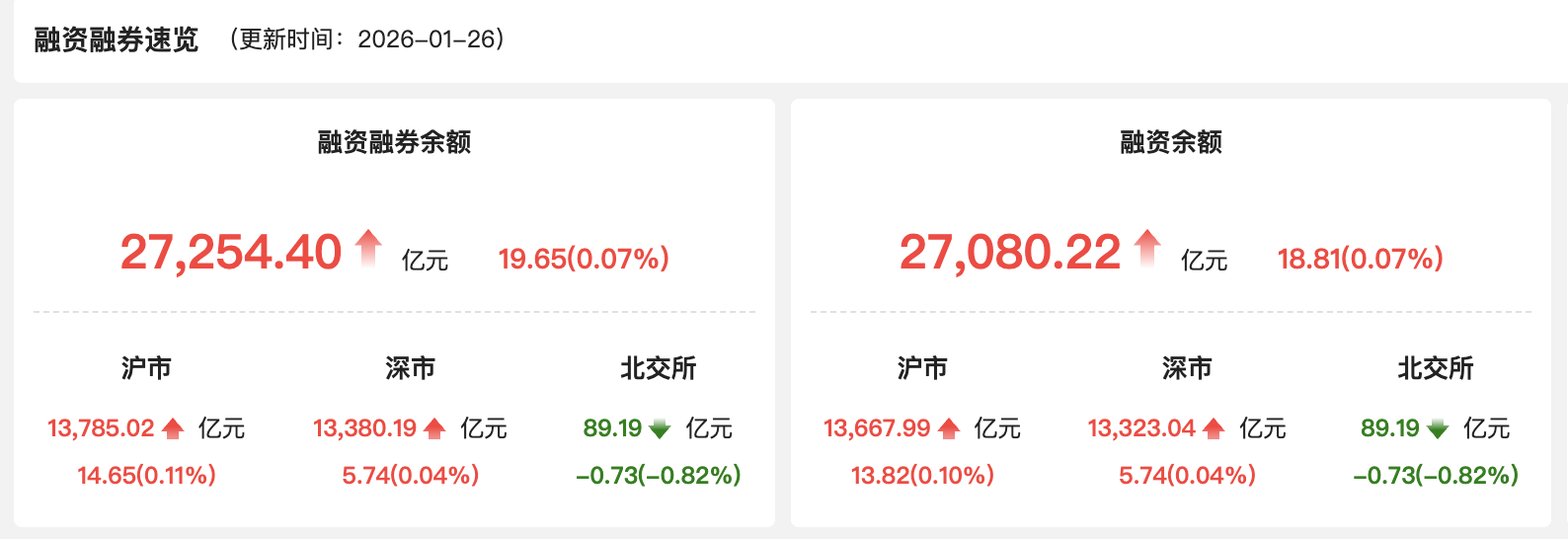
Group 1 - The total margin balance of A-shares reached 27,254.40 billion yuan on January 26, increasing by 19.65 billion yuan from the previous trading day, accounting for 2.62% of the A-share circulating market value [1] - The trading volume of margin transactions on the same day was 3,114.07 billion yuan, an increase of 79.37 billion yuan from the previous trading day, representing 9.48% of the total A-share trading volume [1] Group 2 - Among the 31 primary industries, 17 industries experienced net financing inflows, with the non-ferrous metals industry leading with a net inflow of 3.235 billion yuan [3] - Other industries with significant net financing inflows included electric power equipment, pharmaceutical biology, basic chemicals, and non-bank financials [3] Group 3 - A total of 53 stocks had net financing inflows exceeding 100 million yuan, with China Ping An leading at a net inflow of 444 million yuan [3] - Other notable stocks with high net financing inflows included Northern Rare Earth, China Aluminum, Western Mining, Maiwei Co., Oriental Fortune, Luoyang Molybdenum, Heng Rui Medicine, TBEA, and Industrial Bank [3][4]







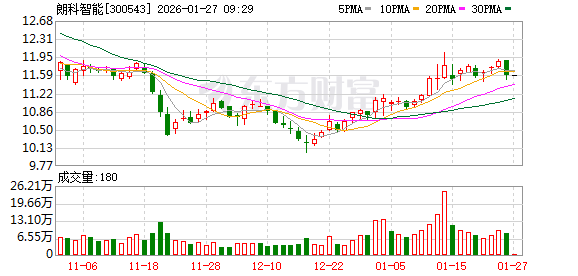
朗科智能:公司逆变器产品仍在合作研发测试阶段,没有研发可以应用于太空光伏的逆变器
Mei Ri Jing Ji Xin Wen· 2026-01-27 01:28
Core Viewpoint - The company is currently in the collaborative research and testing phase for its inverter products and does not have any inverters developed for space photovoltaic applications [2] Group 1 - The company responded to an investor inquiry regarding the development progress of high-power inverters [2] - The company confirmed that there are no inverters available for application in space photovoltaic systems at this time [2] - The company advised investors to be cautious regarding investment risks [2]

财信宏观深度|价格趋势确立,牛市行至中局——2026年物价走势与A股策略研判
Xin Lang Cai Jing· 2026-01-27 01:28
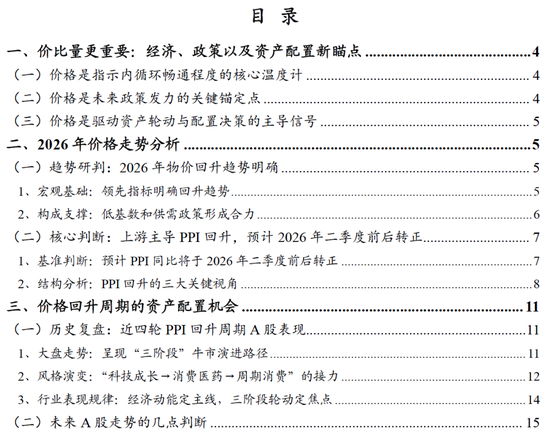
Group 1 - The focus of macroeconomic analysis is shifting from "quantity" to "price," with "price" becoming a key variable for observing the internal circulation of the economy, predicting policy directions, and driving asset rotation [9][10][14] - Price signals are crucial for activating the "price-profit-income-consumption" positive cycle, which is essential for understanding economic vitality and guiding policy [10][11][14] - The report predicts that the Producer Price Index (PPI) will enter an upward cycle in 2026, primarily driven by upstream industries, fundamentally reshaping profit patterns and market styles [8][15][28] Group 2 - The analysis indicates a clear upward trend in prices for 2026, supported by macroeconomic indicators such as narrowing supply-demand gaps and improving financial liquidity [17][18][19] - The report highlights that the PPI is expected to turn positive around the second quarter of 2026, with structural characteristics emphasizing the role of upstream industries [28][31][32] - The low base effect and supportive supply-demand policies are anticipated to create a combined force that will support moderate price increases in 2026 [25][26] Group 3 - Historical analysis shows that the PPI's transition from negative to positive corresponds with three stages of bull market evolution, with distinct patterns in market performance and sector rotation [49][52][58] - The report identifies a clear rotation in market styles during bull markets, transitioning from technology growth to consumer healthcare and then to cyclical consumption [58][66] - The report emphasizes that the leading sectors during these cycles reflect the core drivers of economic growth and strategic focus, with upstream industries like coal, oil, and metals expected to lead the recovery [36][66] Group 4 - The current market is in the second phase of a bull market, with expectations for reduced return forecasts for 2026, as historical trends indicate diminishing returns in later stages [69] - The focus for the first half of the year will remain on new productive forces, particularly in sectors like computing, electronics, military, and power equipment, driven by the AI technology revolution [70] - The report suggests that while the valuation of technology sectors is high, the potential for profit recovery remains a key driver for performance in these areas [70]
万联晨会-20260127
Wanlian Securities· 2026-01-27 01:22
Market Overview - The A-share market saw a collective decline on Monday, with the Shanghai Composite Index down by 0.09%, the Shenzhen Component down by 0.85%, and the ChiNext Index down by 0.91%. The total trading volume in the Shanghai and Shenzhen markets was 32,478.31 billion yuan [1][7] - In terms of industry performance, sectors such as power equipment, non-ferrous metals, and defense industry led the gains, while communication, banking, and coal sectors lagged behind. Concept sectors that performed well included avian influenza, lead, and zinc, while military information technology, terahertz, and military-civilian integration concepts saw declines [1][7] Important News - The precious metals market experienced significant volatility on Monday, with COMEX silver initially surging over 16% and spot silver nearly rising 14%, both surpassing the $117 per ounce mark before retreating. COMEX silver's gains narrowed to 2.5%, while spot silver turned negative. COMEX gold and spot gold also briefly crossed the $5,000 and $5,100 thresholds, respectively, but later saw their gains diminish, with both settling around the $5,000 mark [2][8] - Exchanges took measures to cool down the commodity futures market, with the Shanghai Futures Exchange and Shanghai International Energy Exchange announcing reductions in daily opening trading limits for silver and tin futures contracts to 800 lots and 200 lots, respectively. They also imposed restrictions on 16 clients regarding opening positions in tin and silver futures for one month and limited withdrawals. Additionally, the trading limits for copper, international copper, and aluminum futures contracts were adjusted to 9%, with margin ratios for hedging and general positions set at 10% and 11% [2][8]
MDI供给或受美国寒潮影响!化工ETF天弘(159133)近30日净流入超7亿元
Mei Ri Jing Ji Xin Wen· 2026-01-27 01:20
Group 1 - The A-share market showed a mixed performance on January 26, with the chemical sub-index declining. The Tianhong Chemical ETF (159133) closed down 0.46%, with a trading volume of 82.02 million yuan [1] - The Tianhong Chemical ETF has seen continuous capital inflow over the past 18 trading days, with a net inflow of 744 million yuan in the last 30 trading days, reaching a new high of 1.408 billion yuan as of January 23, 2026 [1] - The Tianhong Chemical ETF tracks the chemical sub-index, with over 93% of its holdings in three major industries: basic chemicals, petroleum and petrochemicals, and power equipment, including leading companies and quality SMEs across various segments [1] Group 2 - A cold wave began affecting the U.S. on January 23, causing snowfall in parts of Texas, Oklahoma, and Kansas, with extreme weather expected to impact two-thirds of the country, potentially leading to widespread power outages [2] - The U.S. has a high capacity share of MDI/TDI, and the extreme weather may significantly affect supply, as U.S. MDI/TDI prices are notably higher, with relatively high operating rates [2] - The chemical industry is entering a turning point of supply-demand improvement and high-end transformation, with structural differentiation expected to continue in 2026, particularly in oil chemicals and polyester sectors [2]
2025年报业绩预告前瞻:进入复苏的盈利周期
GUOTAI HAITONG SECURITIES· 2026-01-27 00:56
Group 1 - The core view of the report indicates that the economic growth center is shifting upwards, driven by AI and overseas expansion, with cyclical sectors benefiting from supply constraints and downstream demand transformation [1][3] - The report highlights four structural characteristics of profit growth in Q4 2025: 1) Emerging economies remain the main high-growth area; 2) Profit share of mid- and downstream manufacturing is increasing; 3) Large and mid-cap companies show greater earnings growth elasticity; 4) High-tech export remains robust [3][4][5] Group 2 - Macro signals show an increase in new economic activity, with inflation and PMI improving significantly in Q4 2025, indicating structural improvements in the economy [6][11] - The growth structure reveals an upstream recovery, resilient midstream, and strong performance in downstream service consumption, with profits in advanced manufacturing continuing to grow rapidly [25][26] - The report notes that the penetration of AI in emerging technologies is driving demand in various sectors, while Chinese companies are accelerating their overseas expansion [5][6][14] Group 3 - The report emphasizes the importance of focusing on low-crowded sectors with upward revisions in profit expectations, such as non-bank financials, batteries, electronics, machinery, and commercial vehicles [4][5][6] - It highlights that the CPI-PPI gap is widening, allowing for smoother cost transmission to mid- and downstream industries, which is expected to enhance profit margins [11][12] - The report also points out that high-tech product exports are showing strong growth, particularly in emerging markets, which are becoming increasingly significant for China's export landscape [14][15][18]
A股市场逐步切换向绩优方向 | 券商晨会
Sou Hu Cai Jing· 2026-01-27 00:20
Group 1 - Huatai Securities indicates that since mid-January, despite high outflows from broad-based ETFs, there remains incremental investment from insurance funds and an arbitrage demand from investors, suggesting continued market momentum [1] - The rotation of investment focus is expected to shift from thematic stocks to those with performance verification, particularly in industries with sustainable recovery capabilities, such as the price increase chain, high-end manufacturing, and AI chain [1] - Specific sectors to consider for allocation include electric equipment, basic chemicals, and semiconductor equipment, with a moderate increase in allocation towards cyclical dividends [1] Group 2 - CITIC Securities reports that the Indonesian government is expected to reduce nickel ore production quotas for 2026 to 250 million to 260 million tons, a significant decrease from 2025 [2] - If the 2026 production quota is implemented, Indonesia's nickel output may decline to 2.6 million to 2.7 million tons, leading to a global nickel supply shortage of 200,000 tons, which could push LME nickel prices up to $22,000 per ton [2] - The tightening regulatory stance of Indonesia towards the mining industry is likely to slow the growth rate of nickel production, indicating a gradual recovery in nickel prices from the bottom [2] Group 3 - Huatai Securities anticipates that the Federal Reserve is likely to pause interest rate cuts in January, maintaining its forward guidance for December 2025, with limited new information expected [3] - Attention is drawn to Powell's statements regarding the interest rate path, the independence of the Federal Reserve, and whether he will remain as a board member [3]


A股市场逐步切换向绩优方向
Mei Ri Jing Ji Xin Wen· 2026-01-27 00:16
Group 1 - Huatai Securities indicates that since mid-January, despite high outflows from broad-based ETFs, there remains incremental investment from insurance funds and arbitrage demand, suggesting continued market momentum [1] - The rotation of investment focus is expected to shift from thematic sectors to those with performance verification, particularly in industries with sustainable recovery capabilities, such as the price increase chain, high-end manufacturing, and AI chain [1] - Specific sectors to consider for allocation include electric power equipment, basic chemicals, and semiconductor equipment, with a recommendation for moderate allocation to cyclical dividends [1] Group 2 - CITIC Securities reports that the Indonesian government is expected to reduce nickel ore production quotas for 2026 to 250 million to 260 million tons, significantly lower than the 2025 quota [2] - If the 2026 production quota is implemented, Indonesia's nickel output is projected to decline to 2.6 million to 2.7 million tons, leading to a global nickel supply shortage of 200,000 tons, which may drive LME nickel prices up to $22,000 per ton [2] - The long-term regulatory stance of Indonesia towards the mining industry is becoming stricter, which is likely to slow the growth rate of nickel production and support a gradual recovery in nickel prices from the bottom [2] Group 3 - Huatai Securities anticipates that the Federal Reserve is likely to pause interest rate cuts in January, maintaining its forward guidance for December 2025, with minimal new information expected [3] - Attention is drawn to Powell's statements regarding the interest rate path, the independence of the Federal Reserve, and whether he will remain as a board member [3]
中泰证券:市场“降温”导向或延续 短期看好拥挤度相对低位板块
智通财经网· 2026-01-27 00:07
Group 1 - The current market sentiment is overheated, showing strong speculative inertia, leading to significant fund outflows from "Hui Jin" ETFs after the cooling guidance was implemented [1][2] - From January 15 to January 23, approximately 12 "Hui Jin" heavy ETFs experienced a total fund outflow of 559.09 billion yuan, averaging nearly 80 billion yuan per trading day [2][3] - The outflow was primarily from the CSI 300 index (59% of total outflow) and the CSI 1000 index (16%), while the ChiNext and STAR Market indices saw relatively less outflow [2][3] Group 2 - As of the end of 2025, "Hui Jin" held approximately 1.47 trillion yuan in 13 ETFs, with a significant portion (over 70%) of these ETFs being heavily held [3] - The share of these ETFs declined by approximately 13% to 54% during the specified period, with the CSI 1000 ETFs experiencing the most significant drop of over 40% [3] - Despite the unprecedented outflow, "Hui Jin" still retains a substantial remaining position of about 950 billion yuan, indicating no immediate risk of forced liquidation [3] Group 3 - The market structure shows that while large-cap stocks are under pressure, small-cap stocks are attracting more funds, indicating a shift in risk appetite towards smaller market cap segments [4] - Value stocks have been adversely affected, particularly in the CSI 50 index, which faced dual redemption pressures from both the CSI 300 and CSI 50 ETFs [4] - The overall market has not shifted towards low-volatility or defensive assets, with growth styles still prevailing despite the outflows [4]

常熟风范电力设备股份有限公司 第六届董事会第十九次会议决议公告
Zhong Guo Zheng Quan Bao - Zhong Zheng Wang· 2026-01-26 23:30
Group 1 - The company held its 19th meeting of the 6th Board of Directors on January 24, 2026, where several key resolutions were passed [2][4][8] - The meeting was attended by all 13 directors, and it was chaired by Chairman Wang Jianxiang [5][6] - The resolutions included changes in accounting estimates, acquisition of 51% equity in Beijing Yanling Jiaye Intelligent Technology Co., Ltd., and a capital reduction for a subsidiary [7][10][23] Group 2 - The accounting estimate change was approved, which will reduce fixed asset depreciation by approximately 21.58 million yuan and increase net profit attributable to shareholders by about 16.18 million yuan for 2026 [15][18] - The company plans to change the depreciation method for its galvanized scaffolding from a 5% residual value and 10-year lifespan to a 20% residual value and 20-year lifespan [16][18] - The change will take effect from February 1, 2026, and will not require retrospective adjustments to previous financial statements [18][19] Group 3 - The company approved a capital reduction of 40 million yuan for its subsidiary, Yueyang Jingying Optoelectronics Technology Co., Ltd., reducing its registered capital from 50 million yuan to 10 million yuan [23][24] - This decision was made to improve capital efficiency and address the current overcapacity in the photovoltaic industry [24][27] - The company retains 100% ownership of Yueyang Jingying after the capital reduction, and it will not affect the consolidated financial statements [23][27] Group 4 - The company will acquire 51% of Beijing Yanling Jiaye Intelligent Technology Co., Ltd. for 382.5 million yuan, with performance commitments for the next three years [30][32] - The target company is expected to achieve net profits of no less than 40 million yuan, 60 million yuan, and 80 million yuan in 2026, 2027, and 2028, respectively [30][55] - The acquisition is based on a valuation of 751 million yuan for the target company, with a significant increase in value compared to the company's book equity [30][39]
