
酒店

Search documents
【十大券商一周策略】告别单一叙事!人民币升值指引三条配置线索
券商中国· 2025-12-21 14:27
中信证券:如果人民币开始持续升值 推动人民币升值的因素逐渐增多,市场关注度也开始升温,投资者要逐步适应在一个人民币持续升值的环境下 去做资产配置。从过去20年间7轮人民币升值周期来看,汇率并不是主导行业配置的决定性因素。然而,部分 行业在持续升值预期形成的初期确实会有更好表现,市场可能会复制这样的肌肉记忆,同时从成本收入分析来 看,约19%的行业会因为升值带来利润率提升,这些行业也会逐步被投资者重视起来。此外,为抑制过快单边 升值趋势而做出的政策应对,反而是影响行业配置的更重要因素。 行业配置上,在人民币持续升值的背景下,可以关注短期肌肉记忆驱动(航空、燃气、造纸等行业)、利润率 变化驱动(上游资源品和原材料、内需消费品、服务业相关品种、制造设备等)以及政策变化驱动(免税、地 产开发商、券商、保险等)三条线索。 申万宏源:非主战场的春季躁动 2026年有春季行情,且启动在即。但机构重点关注的主线结构(AI产业链,顺周期)向上空间有限,而非主 战场上(产业和政策主题,博弈高股息,各种超跌反弹),市场可能非常活跃。2025年牛市1.0(科技结构 牛)已处于高位区域,当前处于季度级别的高位震荡阶段,后续还需关注触发 ...


海外周观点:拼多多聚焦供应链助力Temu再造拼多多,蚂蚁阿福发布新版-20251221
HUAXI Securities· 2025-12-21 14:08
Group 1 - Pinduoduo announced an organizational restructuring during its annual shareholder meeting on December 19, implementing a co-chairman system with Zhao Jiazhen and Chen Lei serving as co-chairmen and co-CEOs [1][8] - The management expressed optimism about Temu's future, stating that it has the potential to recreate Pinduoduo's success over the next three years, having already achieved significant market scale globally in just three years [1][8] - The company will focus on leveraging the Chinese supply chain as a core element of its business strategy moving forward, aiming for high-quality development and brand enhancement [1][8] Group 2 - Ant Group rebranded its AI health application AQ to "Ant Aifu" on December 15, launching a new version of the app that enhances features such as health companionship, health Q&A, and health services [2][10] - "Ant Aifu" has surpassed 15 million monthly active users, making it the largest AI health management app and ranking among the top five AI applications, with over 5 million health inquiries answered daily [2][10] - The app's monthly active user growth rate reached 83.4%, significantly outpacing industry growth, indicating strong market demand [2][10] Group 3 - The Hang Seng Index fell by 1.10% this week, while the Hang Seng Technology Index decreased by 2.82% and the Hang Seng China Enterprises Index dropped by 1.96% [12][17] - Among the 12 Hang Seng industry indices, the non-essential consumer sector saw the largest decline at -2.98%, while the essential consumer sector was the only one to gain, increasing by 1.59% [13][17] - In the US market, the Dow Jones Industrial Average decreased by 0.67%, while the S&P 500 rose by 0.10% and the Nasdaq Composite increased by 0.48% [20][22]

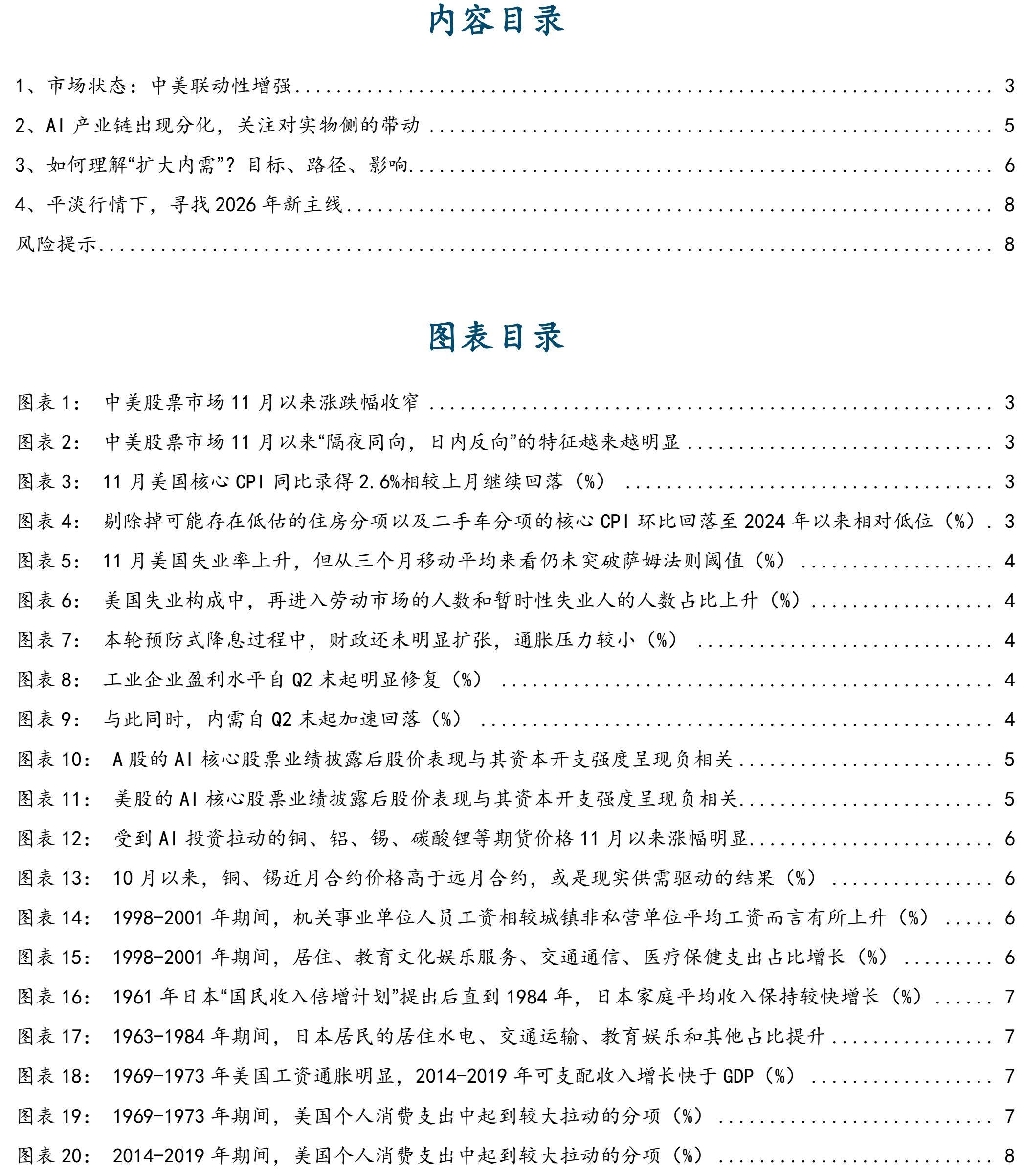
国金策略:单一产业叙事能够带来的收益已经越来越不稳定和难以把握 抓住行情的窄幅波动期布局2026年新主线
Sou Hu Cai Jing· 2025-12-21 12:44
Group 1 - The market status indicates an increased correlation between the US and Chinese markets, with the 20-day rolling correlation of the CSI 300 and S&P 500 rising above the 90th percentile, reflecting a new normal of "overnight alignment and intraday reversal" [2][10][13] - The US core CPI has decreased to 2.6%, the lowest in three and a half years, while the unemployment rate has risen to 4.6%, primarily due to increased labor participation and temporary unemployment, indicating a stable economic environment without significant inflationary pressures [2][10][13] - China's economic fundamentals show a combination of corporate profit bottoming out and a decline in domestic demand, which opens a window for further policy support [2][10][13] Group 2 - The AI industry chain is experiencing a divergence, with broader AI-related assets (copper, lithium, aluminum, energy storage, and electrical equipment) performing better than core AI assets (computing chips, optical modules, PCB) [3][24][25] - Investors are becoming less tolerant of the contradiction between aggressive capital expenditures and the lack of revenue growth in companies within the AI industry chain, leading to a negative correlation between stock performance and capital expenditure as a percentage of revenue [3][24][25] - Commodity prices for copper, aluminum, tin, and lithium carbonate have been rising since late October, driven by demand from AI investments, with near-term contracts for copper and tin outperforming longer-term contracts [3][24][25] Group 3 - The concept of "expanding domestic demand" is emphasized as a strategic move, with a focus on increasing consumer demand supported by income growth and effective investment [4][31][32] - The government plans to enhance the second distribution of income by increasing minimum pension standards and implementing childcare subsidies, while future efforts may focus on optimizing the first distribution through wage reforms [4][31][32] - Historical examples from Japan and the US illustrate that income growth leads to increased service and new-type consumption, suggesting that China's current income growth initiatives could similarly boost consumer spending [4][31][32] Group 4 - The current market environment, characterized by limited macro elasticity and increased industry differentiation, suggests a shift in investment strategy towards tangible demand and domestic policy benefits as the new focus for 2026 [5][42][43] - Recommendations include investing in industrial resource products (copper, aluminum, tin, lithium, crude oil) that benefit from AI investment and global manufacturing recovery, as well as sectors poised for recovery in consumer spending (airlines, hotels, duty-free, food and beverages) [5][42][43] - Non-bank financial institutions (insurance, brokerage) are expected to benefit from capital market expansion and a rebound in long-term asset returns, alongside opportunities in China's equipment export chain and manufacturing sectors [5][42][43]
国金证券:迎接2026:告别单一叙事
Xuan Gu Bao· 2025-12-21 10:21
Group 1: Market Status - The correlation between A-shares and U.S. stocks has increased, with the 20-day rolling correlation of the CSI 300 and S&P 500 rising above the 90th percentile for the year, indicating a new normal of "overnight alignment, intraday reversal" [1][5][38] - Both the U.S. and China are in a phase characterized by limited upward elasticity and reduced downward risk, akin to a "Goldilocks" scenario, with the U.S. core CPI dropping to 2.6%, the lowest in three and a half years [1][8][9] - In China, corporate profitability has bottomed out, and the weakening of domestic demand creates a favorable environment for subsequent policy support [1][8] Group 2: AI Industry Chain - The investment in the AI industry chain is showing two key characteristics: broader macro effects benefiting "pan-AI" assets (copper, lithium, aluminum, energy storage, and electrical equipment) outperforming core AI assets (computing chips, optical modules, PCB) [2][17] - Investors are becoming less tolerant of the contradiction between aggressive capital expenditures and the lack of revenue growth in companies within the AI industry chain, leading to a negative correlation between stock performance and capital expenditure as a percentage of revenue [2][17][18] Group 3: Understanding "Expanding Domestic Demand" - The "income increase" plan aims to enhance net transfer payments to residents by 2025, with a focus on improving initial distribution through wage reforms, particularly in state-owned enterprises [3][25] - The expansion of consumption tax and adjustments in corporate income tax rates are expected to be seen in 2026, which may further stimulate domestic consumption [3][25][28] Group 4: Investment Strategy for 2026 - The current market conditions suggest a shift from a single industry narrative to a dual focus on "physical demand stimulation" and "domestic policy benefits," with recommendations to invest in industrial resource products (copper, aluminum, lithium, oil) and sectors benefiting from consumer recovery (airlines, hotels, food and beverages) [4][38] - Non-bank financial institutions (insurance, brokerage) are expected to benefit from capital market expansion and a bottoming out of long-term asset returns [4][38] - Opportunities are identified in China's equipment export chain and sectors showing signs of recovery in domestic manufacturing [4][38]

栖霞山下藏“隐逸”,颐和新作诠释“一泊二食”养生旅居新体验
Xin Lang Cai Jing· 2025-12-21 07:18
近日,随着南京栖霞山层林尽染、枫韵犹存,位于栖霞古镇核心区域的颐和隐逸枫丹酒店正式开门迎 客。这不仅标志着颐和品牌在南京、苏州、盐城、大理、扬州五城十二店的布局再落一子,更以"隐于 古镇、融于自然"的独特姿态,为南京城东文旅市场注入了一股静谧而精致的新风。 酒店摒弃传统酒店的宏大叙事,选择"隐"入栖霞古镇的建筑肌理之中。步行至栖霞山景区主入口仅需三 分钟,却巧妙承接了栖霞山古称"摄山"、以草药摄生的历史文脉,将养生康养理念深度融入当代旅居体 验,打造出一个"非日常休闲度假空间"。作为安居集团文旅与城市更新板块的重要布局,隐逸枫丹坚 持"在地文化+高品质旅居"路径,以"清、静、养"为设计主线,引栖霞山景入室,化人文底蕴为空间语 言。 枫叶季已近尾声,但栖霞山的诗意四季仍将继续。隐逸枫丹的到来,不仅为南京市民与游客提供了一 处"隐于市、养于心"的旅居新选择,更以一场关于自然、文化与养生的深度对话,重新定义了城东度假 的打开方式。 图片来自酒店 早餐则注重多样性与营养均衡,为登山的客人储备充足能量。这种贯穿昼夜的"食养"安排,让客人在停 留间自然融入"观山而自宁,品味而自和"的慢生活节奏。 对于追求深度体验的游客而 ...

文旅“融”光焕发 共绘“诗与远方”
Xin Lang Cai Jing· 2025-12-20 19:01
Group 1 - The article highlights the growing tourism opportunities in the Eighty-Three Regiment, driven by the upcoming Jingyi Expressway and the increasing popularity of nearby attractions like Sailimu Lake [1][2] - Local entrepreneur Tan Ming has invested nearly 1 million yuan to convert his idle house into a boutique guesthouse, capitalizing on the expected influx of tourists [1] - The Xinjiang Licheng Hotel, a modern establishment with 108 rooms, has been built in the area with an investment of over 80 million yuan, reflecting confidence in the region's tourism potential [1] Group 2 - The Xinjiang 577 Jinsha Mountain Resort project has been launched in the Eighty-Three Regiment, aiming to create a comprehensive tourism destination that includes desert adventure sports and cultural experiences [2] - The integration of cultural and tourism industries in the Eighty-Three Regiment is being actively promoted, with efforts to enhance the business environment and attract investments [2] - The local government aims to develop the tourism sector as a key driver for high-quality economic and social development, focusing on improving service quality and expanding tourism product offerings [2]
商社行业周报(2025.12.15-2025.12.21):社零增速平稳,海南封关运作落地-20251220
国泰海通· 2025-12-20 15:05
Investment Rating - The report assigns an "Accumulate" rating for the industry [4]. Core Insights - The report highlights investment opportunities in the travel industry chain, gold and jewelry, and AI+ sectors [2]. - The upcoming New Year holiday is expected to boost travel and consumption, with specific recommendations for various companies in the travel and hospitality sectors [3][4]. - The retail sector showed a 6.58% increase last week, with the consumer services sector up 4.40%, ranking first and second among 30 industries [3]. Industry Summary - **Travel and Hospitality**: - Recommendations include Ctrip Group and Tongcheng Travel for OTA, Huazhu Group-S, Jinjiang Hotels, and Shoulv Hotels for hotels, and Changbai Mountain for scenic spots [3][4]. - **Gold and Jewelry**: - Recommended stocks include Lao Pu Gold, Caibai Shares, Luk Fook Holdings, Chow Tai Fook, and Chao Hong Ji, with a focus on Emperor Jewelry [3][4]. - **Dividend Stocks**: - Recommended stocks include Sumida, Action Education, and Chongqing Department Store [3]. - **AI+ Sector**: - Recommended stocks include Conant Optical, Chalk, Tianli International Holdings, and Core International, with a focus on Kevin Education and Dou Shen Education [3]. - **Stock Price Movements**: - Notable stock price increases include Hongqi Chain (+22.79%), Jiajiayue (+15.76%), Yonghui Supermarket (+15.20%), and Tianhong Shares (+13.85%) [3]. - **Key Industry Updates**: - Hainan Free Trade Port officially launched its island-wide customs closure operation, achieving sales of over 250 million yuan on the first day, a year-on-year increase of 90% [3]. - McDonald's China announced a price increase of 0.5 to 1 yuan for some menu items [3]. - Luckin Coffee and Dazhong Capital are evaluating the acquisition of Blue Bottle Coffee from Nestlé to enhance brand image and enter the high-end coffee market [3]. - **Retail Sector Data**: - November retail sales data showed a year-on-year increase of 1.3%, with a slowdown attributed to the early "Double Eleven" promotions [3]. - New store openings include JD's discount supermarket in Beijing and Meituan's Xiaoxiang Supermarket, with significant first-day revenues reported [3].




美股2026:继续狂欢还是撤退?
雪球· 2025-12-20 14:49
Group 1 - The current state of the US stock market, particularly in technology, is at a crossroads, with debates on whether to continue investing or to withdraw, reflecting a complex discussion beyond simple bullish or bearish sentiments [1][3] - The volatility in the tech sector has increased, prompting comparisons to the dot-com bubble of 2000, raising concerns about whether the market is nearing a bubble burst [3][4] - Investors are advised to analyze individual company financials to assess whether valuations are inflated, with some investors currently holding cash due to perceived overvaluation in certain stocks [4][6] Group 2 - The discussion includes the importance of understanding the business models of companies, with a focus on those that leverage network effects and have strong brand loyalty, such as Facebook and credit card companies [8][10] - The median price-to-earnings (P/E) ratio for the S&P 500 is around 21, indicating that the market is not excessively overvalued compared to historical averages [11][12] - The global stock markets, including the US and China, are viewed as reasonably priced, with P/E ratios slightly above historical averages, suggesting that there is no immediate bubble [12][13] Group 3 - AI is characterized as a long-term innovation wave rather than a cyclical trend, with significant implications for investment strategies [14][15] - The value chain in the AI sector is expected to shift from hardware providers to software and application developers, indicating a potential change in investment focus [16][17] - Companies that can demonstrate strong cash flow and sustainable business models in the AI space are likely to be more resilient and less risky investments [30][32] Group 4 - The importance of verifying company claims regarding future revenues and orders is emphasized, as investors should not take such statements at face value [23][29] - Business models that are asset-light and leverage partnerships, like Marriott's franchise model, are highlighted as superior compared to capital-intensive models [28][29] - The focus should be on companies that can effectively utilize AI to enhance productivity and efficiency, rather than those that merely rely on AI hype [33][34]

好书推荐 | 当“网红股”跌落神坛,什么才是穿越周期的投资真谛?
点拾投资· 2025-12-20 11:00
Core Viewpoint - The article emphasizes the importance of identifying companies with a sustainable economic moat that can withstand economic cycles and competition, providing long-term reliable returns for investors [1]. Group 1: Company Overview - Morningstar, founded in 1984, has grown from a small office to a trusted authority in financial data and research, focusing on creating value for investors [3]. - The company's stock research is rooted in a long-term ownership perspective, avoiding short-term noise and focusing on identifying companies with sustainable competitive advantages [3][4]. Group 2: Economic Moat Analysis - Morningstar defines the economic moat as a company's ability to maintain a competitive advantage over time, which is crucial for achieving returns above the cost of capital [6]. - The analysis framework includes five identifiable sources of economic moats: 1. Intangible assets, such as brand loyalty and patents [8]. 2. Cost advantages, allowing companies to offer products at lower costs [9]. 3. Switching costs that lock customers into a company's services [10]. 4. Network effects that enhance the value of a product as more users join [11]. 5. Efficient scale, where market conditions limit the number of profitable competitors [12]. Group 3: Investment Timing and Valuation - Identifying great companies is only part of the investment success; buying them at fair or undervalued prices is essential for generating excess returns [13]. - Morningstar employs a discounted cash flow model to estimate a company's intrinsic value, requiring deep analysis of industry trends and company strategies [14]. Group 4: Risk Management and Safety Margin - Acknowledging the limitations of human predictions, Morningstar incorporates a "margin of safety" principle to protect against unforeseen risks [15]. - The company uses an uncertainty rating system to assess the difficulty and risk of future cash flow predictions, assigning different safety margin requirements based on the level of uncertainty [19]. Group 5: Consumer Sector Insights - The consumer sector is highlighted as an ideal area for applying the economic moat theory, with strong brands and cost advantages being key factors [21]. - Specific examples include beverage companies like Coca-Cola, which leverage brand loyalty and distribution networks, and packaged goods companies like Nestlé, which benefit from scale economies [25][27].

我眼中的他们
Xin Lang Cai Jing· 2025-12-20 06:43
瑞秋 我总是默默地赞赏,当下年轻人做事的耐心和韧劲。 上周末我去银行办事,碰巧是午饭时间,营业窗口少。一位银发老人蹒跚而来,他从口袋里摸出一张折 叠印很深的纸,对大堂值班经理说,存单已到期,想取出一些,余额转存。从他的音容,还有那张存单 在他手中微微颤抖,可以推测出他年事已高。值班经理是位八零后的女生,她对老人说不用排队,直接 在机器上操作即可。老人让年轻人代替弄,年轻人说不可以,但宽慰他不用担心,会一步步教的。一个 个界面,一遍遍指导,老人的脑和手不协调,时不时出错,两分钟能搞定的事,他们在机器前操作了半 天。我坐得离他们很近,自问:如果每天接待这样的老人,会怎样?脸色,语气,姿态能否保持平和? 面对素不相识,反应已不灵敏的老人,能否始终和颜悦色?不敢保证,但年轻人做到了。 另一个场景浮现。那天和女友去看"古罗马艺术真迹"首日展,结束后女友意犹未尽,想去喝下午茶,再 续文艺。彬彬有礼的服务生,端来造型和色彩精美的茶点,摆放得像一束绽放的花,让人赏心悦目。当 我们纠结于多欣赏一会儿,还是即刻动刀动叉时,美女服务生又来了,问我们要不要拍照?我们被点 醒。服务生举着手机,一会儿半蹲,一会儿踮脚,揣摩着最佳的角度和 ...