有色

Search documents
私募施展“平衡术”:仓位高企 频频调研
Shang Hai Zheng Quan Bao· 2025-10-19 12:31
Core Insights - Private equity funds are maintaining high positions despite market adjustments, with an average position of 78% as of the end of September, indicating a slight increase in the proportion of funds with high positions [1][2] - The market sentiment is expected to shift towards structural opportunities in A-shares and Hong Kong stocks, focusing on technology, innovative pharmaceuticals, and traditional sectors like cyclical and consumer industries [1][2] Positioning and Strategy - As of the end of September, 94.1% of subjective long-biased private equity funds had positions above 50%, with 24.7% fully invested or leveraging, reflecting a stable investment approach [2] - The intention to increase positions is high, with a plan index value of 111.76 for October, indicating that 2.4% of fund managers plan significant increases, while 26.3% intend to increase positions [3] Market Trends and Focus - The focus of private equity research has shifted from technology to sectors such as electronics, communications, new energy, and non-ferrous metals, suggesting a broader investment strategy for the fourth quarter [4][5] - The ongoing economic recovery and supportive policies are expected to enhance corporate profitability, leading to a new cycle of earnings growth that will drive market performance [3][5]
博时基金曾豪:关注科技成长和周期品种
Shang Hai Zheng Quan Bao· 2025-10-19 12:31
Group 1 - The market has shown steady upward movement this year, driven by multiple factors including central bank liquidity and accelerated capital inflow, with expectations for a structural upward trend in the near future [1][2] - Positive market performance in recent months is attributed to robust macroeconomic growth, stable corporate earnings, particularly in the technology sector, and supportive policies aimed at capital market development [2] - Diverse funding sources are contributing to market inflows, including foreign capital returning, domestic institutions increasing positions, and residents investing in the stock market through funds [2] Group 2 - The outlook for the market remains optimistic, with ongoing policy benefits, economic resilience, and valuation advantages suggesting a potential structural upward trend [3] - Key investment areas include technology growth and resource sectors, with a focus on "new productive forces, self-control, and AI industry trends," as well as opportunities in cyclical commodities due to improved liquidity [3] - A balanced investment strategy is recommended, combining high-dividend, reasonably valued core assets with selective exposure to growth sectors, while being cautious of high valuations in certain segments [3]

国泰海通 · 晨报1020|宏观、策略、海外策略
国泰海通证券研究· 2025-10-19 10:43
Macro Insights - The pricing framework for gold based on USD real interest rates has become obsolete post-2022, driven by a significant global economic shift and changing trust levels among countries, leading to increased demand for gold from both residents and governments [3] - A quantitative model for gold pricing predicts optimistic scenarios where gold could exceed $3,800 per ounce, a neutral scenario around $3,200 per ounce, and a pessimistic scenario between $2,600 and $2,700 per ounce [3] Strategy Insights - Current market adjustments present opportunities for increasing allocations in A-shares, as external disturbances are not expected to end the upward trend [6] - The ongoing economic transformation in China is expected to accelerate, with a strong demand for quality assets, particularly in the technology sector [6] - The upcoming third-quarter earnings reports are crucial, with a focus on sectors showing high profit growth, particularly in AI, export resilience, and resource pricing [7] Industry Comparisons - The focus remains on emerging technologies, with a stable value in cyclical financial sectors, while the Hong Kong stock market is seen as entering a favorable zone [8] - The AI innovation and domestic production advancements are expected to drive a new capital expenditure cycle, with recommendations for sectors like internet, semiconductor, and defense [8] Thematic Recommendations - Key themes include the Hainan Free Trade Zone, domestic controllability in technology, robotics, and AI applications, with a focus on sectors benefiting from these trends [9] Overseas Strategy - The Hong Kong market is entering a new bull market phase, with historical data indicating that small pullbacks average around 7% and last about 12 trading days [13] - The current adjustments in the Hong Kong market are consistent with historical patterns, and positive factors such as successful negotiations and domestic policy support could mitigate further declines [15]


申万宏源:A股“高切低”的风格切换正在演绎但攻守有别
智通财经网· 2025-10-19 00:27
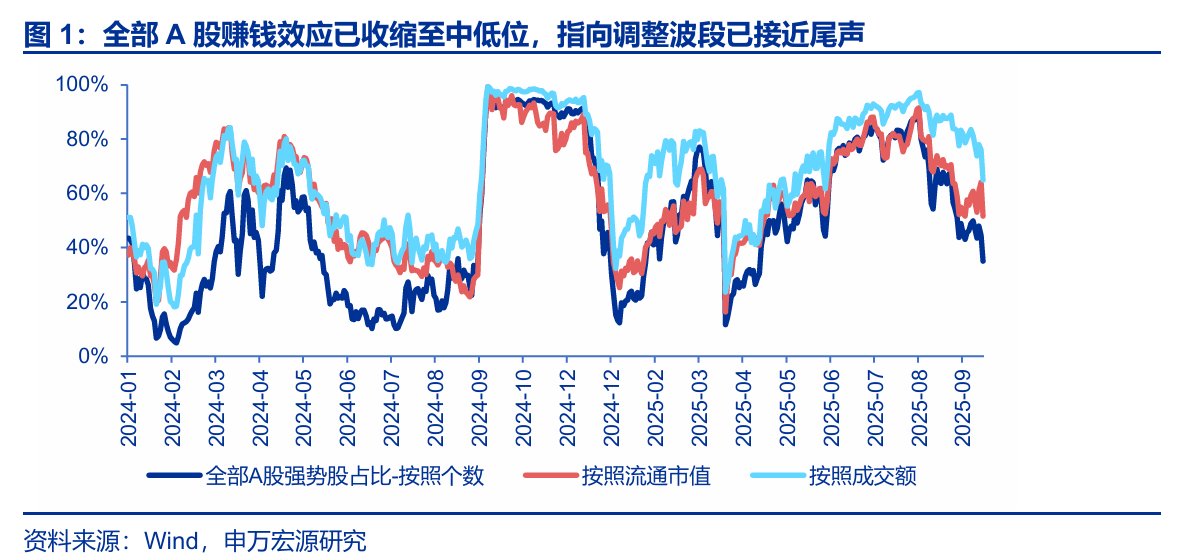
Group 1 - The market is currently experiencing a "high-cut low" style switch, but this defensive characteristic is not leading to an overall index increase, indicating a continued adjustment phase since early September [1][2] - The overall profitability effect in the A-share market has declined to a medium-low level, suggesting that the adjustment phase is nearing its end, while the "high-cut low" trading strategy is becoming less attractive [1][2] - Discussions about style switching in the fourth quarter are increasing, with a focus on technology leading the market recovery rather than cyclical sectors [1][8] Group 2 - The overseas environment is stabilizing, with recent events in the U.S. banking sector causing temporary risk aversion, but the VIX index has peaked and is now declining [7] - The potential for a significant market rally is anticipated in Q4 2025, driven by factors such as rising overseas AI capital expenditure and advancements in the domestic AI industry [8][9] - The mid-term market outlook remains unchanged, with expectations that technology sector catalysts will significantly outpace those of cyclical sectors until spring 2026 [8][9] Group 3 - The current market structure suggests that the transition from a structural bull market to a comprehensive bull market hinges on the effectiveness of anti-involution policies, particularly in high-market-share sectors like photovoltaics and chemicals [10] - The profitability diffusion indicators show a contraction in various sectors, with notable declines in metals, power equipment, and real estate, while coal and banking sectors continue to expand [14] - The financing sentiment index indicates a cautious approach among investors, reflecting the current market dynamics and potential for future growth [15]

申万宏源策略一周回顾展望(25/10/13-25/10/18):高切低进行时,但攻守有别
Shenwan Hongyuan Securities· 2025-10-18 13:42
Group 1 - The "high-cut low" style switch is currently unfolding, but there are differences in offense and defense. The market has shown that cyclical and value trends cannot lead the overall index higher, and the market continues its adjustment phase since early September. The key catalyst for cyclical trends has not yet arrived, and the trend of technology growth industries remains concentrated. A-shares will ultimately need to wait for technology to lead for effective breakthroughs [1][3][4] - Discussions about style switching in the fourth quarter have increased significantly. The current "high-cut low" market is defensive in nature, with intensified competition among offensive assets (such as non-ferrous metals and chemicals) within cyclical and value sectors, while defensive assets show absolute returns. The overall profit effect is declining, and technology rebounds show better profit effects [4][5][11] Group 2 - The overseas environment has become more stable. Recent credit risks in U.S. regional banks have created short-term disturbances in risk appetite. However, these risks are still considered isolated events, and the VIX index has peaked and started to decline. A potential turning point in overseas pressures may have passed [8] - The mid-term market judgment remains unchanged: before spring 2026, the catalytic effect of technology industries will significantly exceed that of cyclical industries. Although the long-term cost-effectiveness of technology is currently low, short-term cost-effectiveness issues have been sufficiently digested, allowing for the emergence of a new round of technology trends [8][9] Group 3 - Spring 2026 may represent a structural high point for the A-share market, but it is unlikely to be the peak for the entire year or the current bull market. The conditions for a comprehensive bull market will become increasingly sufficient over time [11] - In the short term, cyclical products (such as non-ferrous metals and chemicals) are not performing well, with a preference for defensive and hedging assets (such as banks and food and beverage). The outlook for 2026 is better than for 2025, with opportunities still available in Q4 2025, particularly in areas like overseas computing power, advanced manufacturing represented by new energy, and national defense and military industries [11][12]
以重点行业带动产业体系向“新”
2 1 Shi Ji Jing Ji Bao Dao· 2025-10-17 23:42
Core Viewpoint - The implementation of the "Ten Key Industries Stabilization Growth Plan" aims to provide a clear roadmap for the industrial economy's stability and transformation, focusing on ten key sectors that account for approximately 70% of the industrial economy [1] Group 1: Policy Framework - The plan emphasizes a dual approach of supply and demand, establishing a systematic policy framework to address structural challenges through the elimination of outdated capacity and optimization of industrial structure [2] - Specific measures are tailored to different industries, such as promoting upgrades in the electronic information manufacturing sector and focusing on new energy and smart grid equipment in the power equipment sector [2] Group 2: Technological Innovation - The plan prioritizes technological innovation and quality improvement, outlining differentiated innovation paths for various industries, including smart manufacturing in machinery and green products in light industry [3] - A complete industrial ecosystem is established across the ten industries, facilitating the incubation and application of new technologies and models, thereby enhancing overall competitiveness [3] Group 3: Systemic Effects and Industry Chain Collaboration - The plan highlights the importance of systemic effects and collaboration within the industry chain, where the interconnected nature of these industries can create a ripple effect, enhancing technological progress and cost reduction across related sectors [4] - The comprehensive implementation of the stabilization growth plan is expected to usher in a new strategic development opportunity for the ten key industries, contributing to both current economic stability and long-term industrial development [4]
21评论丨以重点行业带动产业体系向“新”
2 1 Shi Ji Jing Ji Bao Dao· 2025-10-17 23:02
Core Viewpoint - The implementation of the "Ten Key Industries Stabilization Growth Plan" aims to provide a clear roadmap for the industrial economy's stability and transformation, focusing on ten key sectors that account for approximately 70% of the industrial economy [1][3]. Group 1: Policy Framework - The plan emphasizes a dual approach of supply and demand, establishing a systematic policy framework to address structural challenges through the elimination of outdated capacity and optimization of industrial structure [3][4]. - Specific measures are tailored to different industries, such as promoting upgrades in the electronic information manufacturing sector and focusing on new energy and smart grid equipment in the power equipment sector [3][4]. Group 2: Technological Innovation and Quality Improvement - The plan prioritizes technological innovation and quality enhancement, outlining differentiated innovation paths for various industries, such as advancing smart manufacturing in machinery and developing green products in light industry [4][5]. - A complete industrial ecosystem is being constructed across the ten industries, facilitating the incubation and large-scale application of new technologies and models, which will enhance overall competitiveness [4][5]. Group 3: Systemic Effects and Industry Chain Collaboration - The plan highlights the importance of systemic effects and collaboration within the industry chain, where the long chains and high interconnectivity of these industries can create a ripple effect across related sectors [5][6]. - The healthy development of the electronic information manufacturing sector can drive technological advancements and cost reductions in related industries like photovoltaics and lithium batteries [5][6]. Group 4: Long-term Development and High-Quality Growth - The comprehensive implementation of the stabilization growth plan is expected to usher in a new strategic development opportunity for the ten key industries, impacting both current economic stability and the long-term development of China's industrial system [6]. - By balancing stabilization and structural adjustment, the plan aims to promote the coordinated development of traditional industry upgrades and emerging industry cultivation, moving towards high-quality development [6].
开源证券韦冀星:本轮行情中选行业比选个股更重要
Shang Hai Zheng Quan Bao· 2025-10-17 14:36
Core Viewpoint - The A-share market is currently experiencing increased volatility, but it remains in a medium to long-term upward trend, with a focus on technology growth as the dominant theme [1][2]. Market Conditions - The A-share market has seen heightened fluctuations since early September, but it is believed to be in a clear medium to long-term upward trend, suggesting investors should not overly focus on short-term volatility [2]. - The driving forces behind the current market rally are identified as top-level design support for the capital market, increased liquidity from ETF inflows, and sustained positive catalysts from technological innovations such as AI [2]. Market Valuation - The current securities ratio (market capitalization to GDP) is approximately 0.86 to 0.87, indicating significant potential for market capitalization growth, as historical data shows that securities ratios above 1 often lead to higher market valuations [2]. Sector Analysis - There is ongoing discussion about whether the market will shift from high-growth technology sectors to lower-performing cyclical sectors; however, the conditions for such a shift are not yet present [3]. - The technology, media, and telecommunications (TMT) sectors are expected to maintain profitability advantages starting in 2025, supported by strong demand for AI computing power and a dual resonance in the semiconductor cycle driven by both consumer and corporate demand [3]. Investment Opportunities - The ChiNext index is currently viewed as the most cost-effective growth index in the market, with a diverse weight distribution across AI hardware, new energy, and pharmaceuticals [4]. - The Hong Kong market has faced challenges but is now entering an environment of incremental capital, with a focus on growth-oriented investments, particularly in AI hardware and applications [5]. Investment Strategy - In the current market, selecting sectors may be more critical than picking individual stocks, with a dual focus on technology growth stocks and sectors benefiting from PPI recovery [6]. - Recommendations include focusing on sectors with strong policy certainty such as non-ferrous metals, petrochemicals, and real estate for valuation recovery, while also considering consumer sectors with improving profitability [7].
新一轮十大行业稳增长方案启动实施:破局“内卷式”竞争 构建“智造+”新生态
Zheng Quan Shi Bao· 2025-10-17 02:43
Core Insights - A new round of growth stabilization plans for ten key industries has been launched after two years, focusing on structural optimization and long-term high-quality development [1][3] - The plans emphasize both supply and demand sides while enhancing industry governance to regulate competition [1][3] - The integration of new technologies, particularly artificial intelligence, is highlighted as a key driver for various industries [1][6] Industry Growth Targets - The ten key industries targeted in the new growth stabilization plan account for approximately 70% of the value added in large-scale industrial sectors [3] - Specific growth targets include an average increase of about 7% in the value added of the computer, communication, and other electronic equipment manufacturing industries from 2025 to 2026, and a 5% annual growth for the petrochemical and non-ferrous metal industries [3] - The automotive industry aims for annual sales of around 32.3 million vehicles in 2025, with a target of approximately 20% growth in new energy vehicle sales [3] Industry Governance and Competition - The new plans include measures to address irrational "involution" competition and to standardize industry competition order [5] - Different industries have tailored governance approaches; for example, the automotive sector focuses on cost investigations and price monitoring, while the electronic information sector emphasizes capacity governance [5] - Overall, the plans stress the importance of industry self-discipline and creating a favorable business environment to promote orderly development [5] Role of Artificial Intelligence - Artificial intelligence is positioned prominently in the new plans, with initiatives to promote its integration across all stages of industrial processes [6] - The automotive industry will leverage AI in research, design, production, and operations, while the light industry will focus on generative AI for product design and manufacturing [6] - The deep integration of AI into these key industries is expected to drive digitalization, networking, and intelligent transformation, enhancing efficiency and reducing costs [6]
新一轮十大行业稳增长方案启动实施:破局“内卷式”竞争 构建“智造+”新生态
证券时报· 2025-10-17 02:38
Core Viewpoint - A new round of growth stabilization plans for ten key industries has been initiated, focusing on structural optimization and long-term high-quality development while addressing supply and demand dynamics [2][5]. Group 1: Industry Growth Plans - The Ministry of Industry and Information Technology (MIIT) has released growth stabilization plans for steel, non-ferrous metals, petrochemicals, chemicals, building materials, machinery, automobiles, power equipment, light industry, and electronic information manufacturing [2][5]. - The new plans emphasize quantitative targets for each industry, aiming for a balanced focus on quality and efficiency [4][7]. - By 2025-2026, the average growth rate for the value added of the computer, communication, and other electronic equipment manufacturing industries is expected to reach around 7%, while the petrochemical and non-ferrous metal industries aim for an annual growth rate of 5% [6]. Group 2: Industry Governance - The new growth stabilization plans include clear directives for enhancing industry governance and standardizing competitive practices [9][10]. - Specific measures include addressing irrational "involution" competition in sectors like machinery, automobiles, and electronic information manufacturing, with a focus on cost investigation and price monitoring in the automotive sector [11]. - The plans encourage self-regulation within industries to promote high-quality development and create a favorable business environment [11]. Group 3: Role of Artificial Intelligence - Artificial intelligence (AI) is highlighted as a key component in the new plans, with an emphasis on its integration into various industrial processes [12][14]. - The automotive industry is set to leverage AI in research, design, production, and management, while light industry will focus on generative AI for product design and manufacturing [14][15]. - The deep integration of AI into these ten key industries is expected to facilitate the digital, networked, and intelligent transformation of traditional sectors, enhancing efficiency and reducing costs [15][16].