
光模块

Search documents
11月券商金股大揭秘:拓普、中际旭创成“团宠”,10月金股“几家欢喜几家愁”
Jin Rong Jie· 2025-11-04 00:16
Group 1 - In November, 32 brokerage firms have disclosed their recommended stock lists, totaling 219 unique stocks, with Top Group and Zhongji Xuchuang being the most recommended by five firms each [1] - Other notable stocks include Shenhuo Co., Zijin Mining, Luoyang Molybdenum, and Haier Smart Home, each recommended by four firms, while nine stocks received recommendations from three firms [1] - Top Group's strong recommendation includes firms like Pacific Securities and Zhongtai Securities, while Zhongji Xuchuang is recommended by firms such as Everbright Securities and Guosen Securities [1] Group 2 - Analysts maintain an optimistic outlook for the A-share market in November, expecting a fluctuating upward trend [2] - The market is currently in a vacuum period regarding performance, events, and policies, lacking catalysts for direction, leading to a wait-and-see approach for year-end changes [2] - Key investment themes include focusing on high-dividend sectors like energy and finance, as well as infrastructure for stable growth [2] Group 3 - Specific investment directions include focusing on sectors like non-ferrous metals and new energy, which have continued prosperity and reasonable valuations [3] - Analysts suggest three main investment lines: technology growth, market hot sectors, and industries benefiting from policy optimization [3] - In October, 287 stocks were recommended by brokerages, with 100 stocks seeing price increases, indicating strong profit potential [3] Group 4 - In October, five recommended stocks saw price increases exceeding 30%, with Guosheng Quantum leading at 65.19% [4] - Other notable performers include Rongxin Culture and Jiangbolong, with increases of 64.86% and 46.78% respectively [4] - However, some stocks like Luxshare Precision, despite being recommended by seven firms, saw a price decline of 2.61% [4]

小登跌倒,老登吃饱?
Hu Xiu· 2025-11-03 13:29
Core Insights - The capital market is experiencing a significant style shift, with technology stocks showing high growth while traditional sectors like liquor are facing declines [1][2] - The market's behavior indicates a complex interplay between high growth pursuits and the search for certainty, leading to a potential transition in investment logic [2] Group 1: Market Dynamics - The recent financial reports reveal that technology stocks are in a high growth phase, while liquor stocks are underperforming, leading to contrasting market reactions [1][5] - The phenomenon of rising indices with stagnant personal accounts and a large number of stocks increasing despite overall declines indicates a unique market environment [1][2] - Historical patterns suggest that style switches during bull markets can significantly impact all market participants' financial outcomes [2][6] Group 2: Historical Context - The distinction between "old" and "new" stocks has historical roots, with "old" stocks representing traditional industries and "new" stocks representing technology and growth sectors [3][4] - Previous bull markets have seen similar transitions, driven by macroeconomic factors, industry cycles, and changes in market participant dynamics [4][5] - The current market environment reflects a shift in focus from consumer-driven growth to hard technology investments due to changing economic conditions and geopolitical factors [4][5] Group 3: Investment Strategies - The current market conditions suggest that investors should be cautious about heavily investing in previously high-performing technology stocks, as they may be overvalued [6][17] - The potential for a style switch is heightened by extreme valuation disparities and the crowded nature of technology sectors, indicating a need for strategic asset allocation [19][23] - Institutions are increasingly advocating for balanced portfolios, suggesting that a shift towards traditional cyclical stocks may be imminent as technology stocks face volatility [23][28]

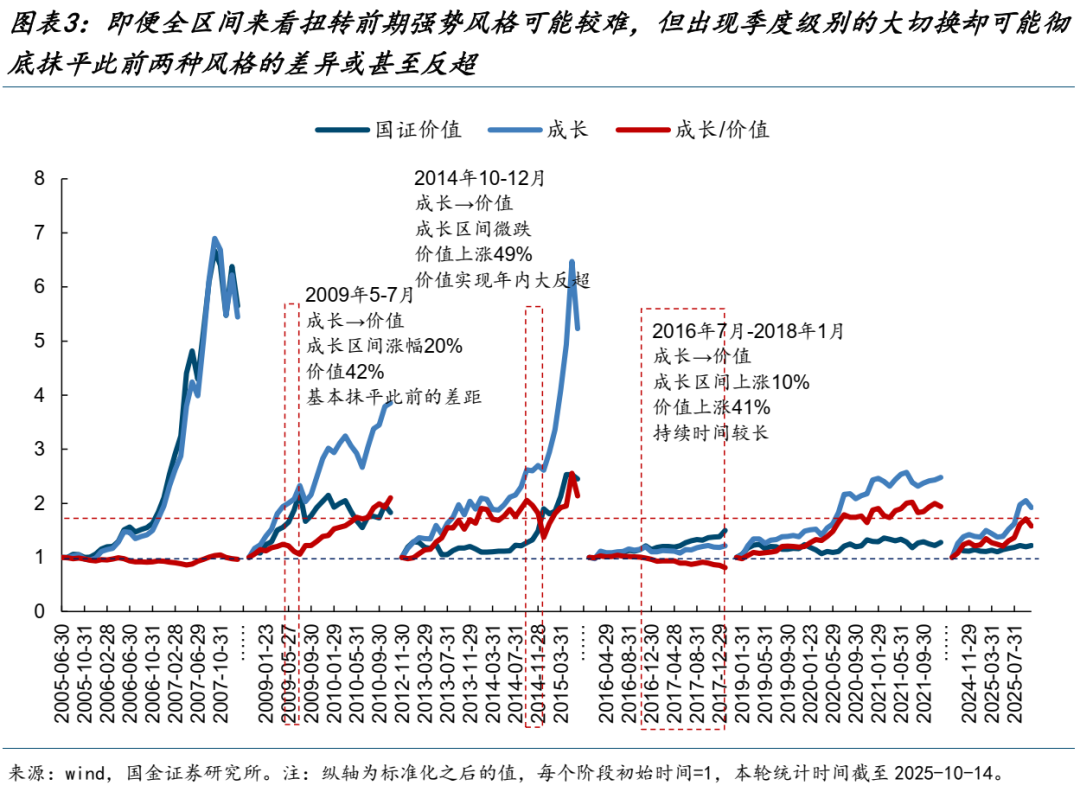
从关键指标看流动性牛市节奏
HUAXI Securities· 2025-11-03 11:23
Group 1: Market Overview - The current market is characterized as a liquidity bull market, where traditional fundamental analysis struggles to explain short-term fluctuations[1] - Since July, positive policies have driven the market upward, with significant contributions from sectors like technology and AI[9] - Economic data from Q3 shows production growth at 5.7% while demand indicators are at -0.6%, indicating a widening supply-demand gap[10] Group 2: Investor Behavior and Fund Flows - Net inflows into stock ETFs reflect large-scale investor sentiment, with significant inflows during market downturns indicating a stabilizing effect[2] - Personal investors' buying patterns show that after significant purchases, market performance tends to weaken, with current buying levels remaining reasonable[26] - As of October 31, the financing balance accounted for 2.54% of the A-share market capitalization, significantly lower than the 4.72% peak in 2015, indicating a less aggressive leverage environment[4] Group 3: Market Sentiment and Risk Indicators - Implied volatility has decreased since late August, suggesting a cooling of speculative sentiment and a move towards a more rational market consensus[2] - The concentration of trading activity, measured by the top 5% of stocks, reached 43.15% on October 31, approaching the historical warning level of 45%[4] - The proportion of stocks priced above the 95th historical percentile was 16.79%, exceeding the 15% threshold that historically signals adjustment risks[4] Group 4: Future Outlook - Despite structural risks, the bull market still has potential for further development, with implied volatility indicating sensitivity to both positive and negative news[4] - The report suggests increasing positions in dividend stocks while waiting for better entry points in thematic investments, particularly after improvements in concentration and high-price stock indicators[4]
通信行业 2025 年 11 月投资策略暨 25Q3 财报总结:北美持续加大 AI 投入,算力基础设施高景气度延续
Guoxin Securities· 2025-11-03 09:20
Investment Rating - The report maintains an "Outperform" rating for the communication industry [5] Core Viewpoints - The communication industry is experiencing robust growth driven by AI investments, particularly in the optical communication sector, which has shown significant profit increases [2][4] - The overall revenue and net profit for the communication industry (excluding operators) grew by 19.57% and 33.69% year-on-year in the first three quarters of 2025, respectively [2][42] - The report highlights a positive outlook for AI infrastructure, with recommendations to focus on optical devices, communication equipment, and liquid cooling technologies [4] Summary by Sections Market Performance - In October, the communication sector index fell by 0.45%, aligning closely with the broader market performance, ranking 20th among 31 primary industries [12][17] - The average PE ratio for the communication sector was 23.2, indicating a recovery from historical lows [17][22] Fund Holdings Analysis - As of Q3 2025, the market value of funds heavily invested in the communication sector reached 288.6 billion yuan, accounting for 7.14% of total fund holdings, with a 3.2 percentage point increase from the previous quarter [30][34] - The concentration of fund holdings in the top ten communication stocks increased, with significant preferences for optical modules and communication devices [35][40] Financial Performance - In Q3 2025, non-operator communication companies reported total revenues of 185.1 billion yuan, a 19.47% increase year-on-year, and net profits of 16.7 billion yuan, up 47.4% [2][42] - The optical module sector led revenue growth with a 63.5% increase, while profit growth was particularly strong in optical modules and AI-driven devices [43][51] Company-Specific Insights - Major companies like Zhongji Xuchuang and Xinyi Sheng reported substantial revenue and profit increases, benefiting from the growing demand for AI-related products [51][58] - The three major telecom operators showed slower growth, with net profit increases outpacing revenue growth, indicating a shift towards digital and innovative business models [49][58]






基金三季报:成长热 价值冷
Guo Ji Jin Rong Bao· 2025-11-03 08:17
Group 1: Core Insights - The third quarter report of public funds highlights a significant performance divergence, with high-growth sectors continuing to be the main profit drivers for many funds, while traditional value sectors lag behind [1][6][10] - Major funds like Ruiyuan Growth Value and Galaxy Innovation Growth saw net value increases exceeding 50% in Q3, focusing on high-growth areas such as artificial intelligence, semiconductors, and optical modules [1][3][4] - Traditional value fund managers are facing challenges, with sectors like consumer goods and dividends showing weak performance, leading to a cautious outlook on these investments [1][7][10] Group 2: Fund Performance and Strategies - Ruiyuan Growth Value, with over 20 billion yuan in assets, reported a net value increase of over 50% in Q3, heavily investing in internet technology and high-growth sectors [3] - Xingquan Helun, with nearly 25 billion yuan, achieved a net value increase of 36.16%, focusing on optical modules and PCB, while maintaining a high position in the market [3] - The China Medical Health fund, with over 32 billion yuan, saw a net value increase of over 20%, driven by optimism in innovative drugs and medical devices [4] Group 3: Challenges in Value Investing - The consumer sector, particularly food and beverage, showed minimal growth, with the industry index rising only 2.44% in Q3, leading to underperformance for consumer-focused funds [7][8] - Fund managers like Xiao Nan and Liu Yan Chun, who focus on traditional sectors, reported modest gains, with Xiao Nan's fund increasing by 8.83% and Liu's by 9.09% in Q3 [8][9] - Concerns about the sustainability of growth in traditional sectors persist, with managers emphasizing the need for a recovery in domestic consumption to improve performance [10][11] Group 4: Market Dynamics and Future Outlook - The market's structural changes have made it increasingly difficult for fund managers to achieve stable excess returns, particularly in a concentrated market environment [12][14] - Some fund managers express caution regarding the rapid market gains, indicating a need for a more prudent investment approach amidst high valuations in popular sectors like AI [13][14] - The AI sector, while presenting significant opportunities, also carries risks due to high valuations and the potential for increased volatility in response to market sentiment and macroeconomic factors [14]
光模块、PCB、液冷、机器人、核聚变等六大热门科技龙头业绩曝光!
私募排排网· 2025-11-03 07:00
Core Viewpoint - The A-share market has shown strong performance this year, driven by the AI technology boom, with significant growth in various tech sectors, including optical modules, PCB, AI chips, liquid cooling, humanoid robots, and controllable nuclear fusion [2] Optical Modules - The optical module sector has seen a surge in demand due to increased investment in AI computing infrastructure, with expectations for strong demand for 800G and 1.6T optical modules by 2026 [2] - Eleven leading stocks in the optical module sector have doubled in value this year, with an average increase of 135.52% [2] - Key players like Zhongji Xuchuang, Xinyi Technology, and Tianfu Communication reported significant revenue and profit growth in the first three quarters of 2025 [3][4] PCB (Printed Circuit Board) - The PCB market is experiencing a boom due to the explosive demand for AI servers and high-end switches, with global PCB market value projected to reach $73.6 billion in 2024 [5] - Twelve leading PCB stocks have seen an average increase of 199.26% this year [5] - Major companies such as Shenghong Technology and Shenyin Technology reported substantial revenue and profit growth in the first three quarters of 2025 [6] AI Chips - The AI chip market is accelerating domestic substitution due to export restrictions on high-end chips, with significant growth expected in the coming years [7][8] - The domestic AI chip market is projected to grow from ¥142.54 billion in 2024 to ¥1.34 trillion by 2029, with a compound annual growth rate of 53.7% [8] - Leading companies like Cambricon and Montage Technology have reported impressive revenue and profit growth in 2025 [8][9] Liquid Cooling - The liquid cooling market is gaining traction as a solution for efficient heat dissipation in AI computing facilities, with the global market expected to reach $2.84 billion in 2025 [10][11] - Six leading liquid cooling stocks have shown an average increase of 88.09% this year [11] - Companies like Yingweike and Yinlun reported strong revenue and profit growth in the first three quarters of 2025 [12] Humanoid Robots - The humanoid robot market is expanding rapidly, with significant advancements from both domestic and international companies [14] - The global humanoid robot market size forecast has been raised from $3 trillion to $5 trillion by 2035 [15] - Leading firms such as Wolong Electric and Zhejiang Rongtai have reported notable revenue and profit growth in 2025 [15][16] Controllable Nuclear Fusion - Controllable nuclear fusion is becoming a strategic focus for major countries, with significant growth expected in the sector [17] - The market for controllable nuclear fusion is projected to see an average increase of 80.17% among leading stocks this year [17] - Companies like Shanghai Electric and Jintian Co. reported strong performance in the first three quarters of 2025 [18]
基金老将,买胜宏科技、新易盛狂赚20亿
Sou Hu Cai Jing· 2025-11-03 05:46
Core Viewpoint - The performance of large-scale funds has shown significant divergence this year, with the top fund outperforming the bottom fund by nearly 70% [6]. Fund Performance Summary - The top-performing fund, Ruiyuan Growth Value A, has achieved a return of 68.09% year-to-date as of October 30 [2][4]. - Other notable funds include: - Dongfang New Energy Theme Fund with a return of 60.5% [3]. - Galaxy Innovation Growth A with a return of 57.91% [3]. - Zhongou Times Pioneer A with a return of 53.05% [3]. - Several funds have underperformed, with eight funds yielding less than 30%, including: - E Fund Consumer Industry with a return of -1.2% [5]. - Invesco Great Wall Emerging Growth A with a return of only 0.46% [5]. Ruiyuan Growth Value A Fund Analysis - Ruiyuan Growth Value A was established on March 26, 2019, and is managed by well-known fund managers Fu Pengbo and Zhu Lin [8]. - The fund experienced a significant decline of 53% over four years after an initial surge of 114% [11][12]. - The fund's strategy shifted towards technology stocks, leading to a substantial recovery with a 90.61% increase from April 8 to October 29, 2025 [13]. Investment Strategy and Holdings - The fund's recent performance is attributed to a focus on technology stocks, including PCB manufacturers and AI chip leaders [13][16]. - Key holdings include: - Xinyisheng, with a market value of approximately 2.2 billion yuan [14]. - Ningde Times, valued at around 2.15 billion yuan [14]. - Tencent Holdings, valued at about 2.08 billion yuan [14]. - The fund manager has expressed confidence in the growth potential of high-tech sectors, citing the rapid development of AI and automotive electronics [16]. Future Outlook - The fund manager anticipates a shift from broad market rallies to a focus on individual stock fundamentals due to high valuations across most sectors [16][17]. - There is a strategy in place to reduce holdings in overvalued stocks, indicating a cautious approach moving forward [17].


新易盛强势翻红彰显算力韧性,5G通信ETF、创业板人工智能ETF华夏受到资金关注
Sou Hu Cai Jing· 2025-11-03 03:11
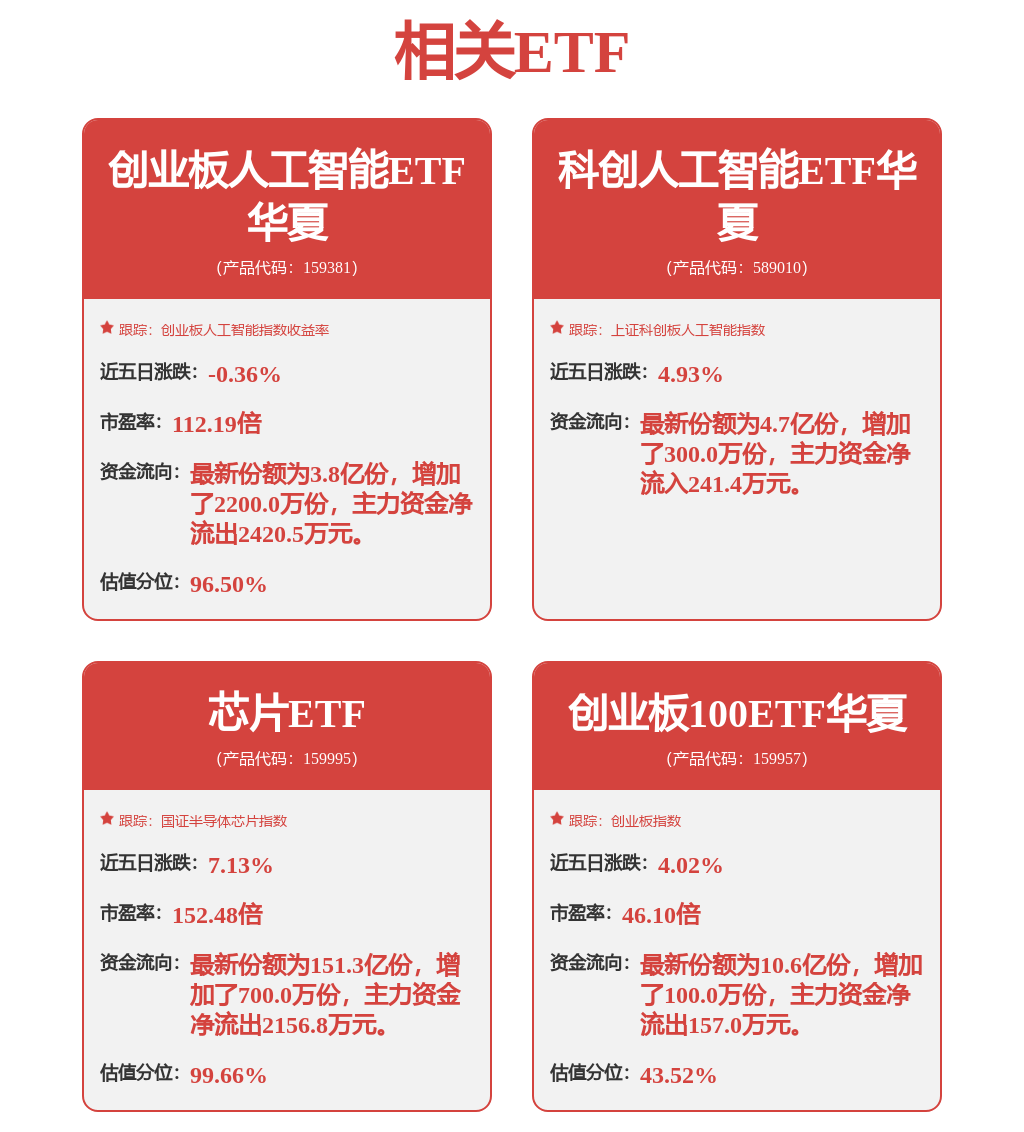
Group 1 - The A-share market continues to experience fluctuations, with sectors like optical modules and chips showing resilience despite initial declines [1] - The 5G Communication ETF (515050) has seen a net inflow of 133 million yuan over the past five days, while the AI ETF (159381) has attracted 167 million yuan [1] - Minsheng Securities expresses confidence in the long-term growth of the optical module industry, highlighting its strategic importance in AI and data center connectivity [1] Group 2 - The 5G Communication ETF (515050) tracks the CSI 5G Communication Theme Index, with a total scale exceeding 8 billion yuan, focusing on companies like Nvidia, Apple, and Huawei [2] - The index has a high concentration in "hard technology," with communication and electronics sectors accounting for nearly 80% of its weight [2] - The AI ETF (159381) tracks the ChiNext AI Index, with optical modules making up 51.8% of its weight, and the top three holdings being Zhongji Xuchuang (20.95%), Xinyi Sheng (20.42%), and Tianfu Communication (5.39%) [2]

解读AI超级周:英伟达、OpenAI与三季报
2025-11-03 02:36
Summary of Key Points from Conference Call Records Industry Overview - The conference call discusses the recent developments and investment opportunities in the AI sector among major US tech companies, including Meta, Google, Microsoft, and Amazon [1][2][4]. Company-Specific Insights Meta - Meta raised its capital expenditure (Capex) forecast for 2025 from $66 billion to $70 billion, with expectations for further increases in 2026 [2]. - The company reported a 26% year-over-year increase in advertising revenue, marking eight consecutive quarters of exceeding expectations [1][2]. - Key drivers of revenue growth include AI technologies such as the Lettuce advertising system, the Android Meta multi-modal ad search engine, and the generative AI tool Advaned Path [2]. Google - Google increased its Capex forecast for 2025 from $85 billion to between $90 billion and $93 billion, with significant increases expected in 2026 [2]. - The company reported strong performance in search and video advertising, with its generative AI model Gemini achieving over 650 million monthly active users and processing 1.3 trillion tokens monthly [1][2][4]. - YouTube generated over 230 million videos, contributing to a closed-loop ecosystem in computing power, cloud infrastructure, and multi-modal traffic entry [1][4]. Microsoft - Microsoft's cloud business growth did not meet expectations, with a current AI monthly active user base of 900 million, of which 150 million are using Copilot [4]. - The company has deepened its collaboration with OpenAI, committing to $250 billion in Azure usage, but concerns about profit impact due to increased Capex persist [1][4]. Amazon - Amazon's AWS reported a 20% year-over-year growth, the highest since 2022, with Capex raised to $125 billion [1][4]. - The company is optimizing retail logistics and accelerating the implementation of AI features, with significant profits driven by Apple Pig investments yielding $9.5 billion [1][4]. Additional Industry Trends - The AI application sector, particularly in AI comic segments, is experiencing explosive growth, with market size expected to exceed 20 billion yuan this year [3][16]. - The optical device industry is undergoing significant upgrades, with domestic products replacing overseas EMLs, indicating a clear trend towards domestic substitution [3][7]. Investment Opportunities - The software and application sectors are highlighted as areas of interest for 2025 and 2026, with companies like Palantir, AppLovin, and Shopify recommended for tracking [5]. - The performance of public funds in Q3 was strong, with leading companies showing improved net profit margins year-over-year and quarter-over-quarter [6]. Conclusion - The overall sentiment in the tech sector is optimistic regarding AI investments, although there are concerns about the impact of high capital expenditures on profits. The focus should be on software applications and related technology demands that exhibit strong growth potential [4][11].
中际旭创20251031
2025-11-03 02:36
Company and Industry Summary Company Overview - The company reported a revenue of 3 billion RMB in Q3 2025, representing a 30% quarter-over-quarter growth, with a net profit of 31 billion RMB, also reflecting a similar growth rate. Financial indicators have shown steady improvement since the beginning of 2025, with positive cash flow and asset-liability ratios indicating a favorable development trend [2][3][4]. Core Industry Insights - The demand from industry clients has significantly increased, particularly from overseas clients who are ramping up capital expenditures and planning AI data center constructions. This has led to strong demand for 800G and 1.6T optical module products, placing the optical module industry in a high prosperity state. The company anticipates continued improvement in key financial metrics over the next few quarters [2][4]. Financial Performance - In Q3 2025, the company achieved a revenue of 102 billion RMB, a 26% increase from Q2. The gross margin remained strong at nearly 43%, with a consolidated net profit of 33 billion RMB, up from 26 billion RMB in the previous quarter, marking a 30% increase. Overall, financial indicators have shown steady improvement since early 2025 [3][4]. Product Demand and Structure - The optimization of product structure has led to an increase in the proportion of high-end products like 800G and 1.6T in the revenue mix. Both product lines have a high silicon photonics ratio and have received recognition and validation from key clients, suggesting potential for further gross margin growth [2][6]. Supply Chain Management - To address the material shortages anticipated in 2026, the company has proactively stocked up and strengthened collaboration with suppliers. They have also locked in human resources and expanded production capacity to meet rapidly growing market demand, ensuring a competitive edge in a challenging market environment [2][8]. Material Shortages - Currently, optical chips, including EML and CW types, are among the most critical materials in short supply. Despite the company's advance planning and capacity locking, supply remains tight. However, with active cooperation from suppliers, relief is expected in the first half of 2026 [9][12]. Tax and Regulatory Impact - The effective tax rate for the quarter reached 15.8%, slightly higher than before, primarily due to the OECD's Pillar Two global tax reform aimed at preventing low-tax competition. The company has cautiously accounted for potential tax adjustments based on this new framework [10]. Future Outlook - The company is optimistic about the demand for 800G and 1.6T products in 2026, although it acknowledges that all materials are experiencing increased demand, with optical chips being the most constrained. The company aims to effectively manage raw material preparation issues to meet customer demands [12][14]. Investment and Expansion - The company has significantly increased its construction projects, with investments nearing 1 billion RMB, primarily for capacity expansion and factory infrastructure to align with expected orders in 2026. Continuous investment will be necessary to keep pace with demand [17]. Emerging Trends - The optical module sector is witnessing a new trend with the rise of SKU modules, driven by rapid bandwidth demand. Many CSP clients are looking to adopt Ethernet technology for in-cabinet connections, creating new demands for optical connection solutions [18]. Conclusion - The company is well-positioned to capitalize on the growing demand for high-end optical products, with proactive measures in supply chain management and capacity expansion. The anticipated material shortages and regulatory changes will require careful navigation, but the overall outlook remains positive for the upcoming quarters.