
银行业

Search documents
新华鲜报|平稳开局!开年首月社会融资规模增量达7.22万亿元
Xin Hua She· 2026-02-14 01:38
Core Viewpoint - The financial data for January 2026 indicates a strong start to the year for China's economy, supported by a significant increase in social financing and a favorable monetary policy environment [1][3][4]. Group 1: Financial Performance - In January 2026, the social financing scale increased by 7.22 trillion yuan, setting a historical record for the same period [1]. - The balance of RMB loans grew by 6.1% year-on-year, while the stock of social financing increased by 8.2% [3]. - The broad money supply (M2) reached 347.19 trillion yuan, with a year-on-year growth rate of 9%, reflecting a moderately loose monetary policy [4]. Group 2: Loan Dynamics - In January, RMB loans increased by 4.71 trillion yuan, with corporate loans accounting for 4.45 trillion yuan, indicating strong demand from enterprises [4]. - The balance of inclusive small and micro loans reached 37.16 trillion yuan, growing by 11.6% year-on-year, while medium to long-term loans in the service sector (excluding real estate) reached 60.03 trillion yuan, up by 9.2% [4]. Group 3: Consumer Activity - The consumer market showed robust activity, with personal consumption loans supported by government policies and increased demand for goods and services [4]. - In January, household loans increased by 456.5 billion yuan, with short-term loans rising by 109.7 billion yuan [4]. Group 4: Financing Costs - The average interest rate for newly issued corporate loans was approximately 3.2%, down by about 20 basis points year-on-year, while the rate for personal housing loans remained stable at 3.1% [7]. - The low financing costs reflect a relatively abundant credit supply and the effectiveness of financial support to the real economy [7]. Group 5: Policy Support - The People's Bank of China has implemented various monetary policies to support the real economy, including structural interest rate cuts and the development of technology, green, and inclusive finance [3][7]. - The ongoing support from a moderately loose monetary policy is expected to enhance financial services and stimulate economic growth [7].


陆家嘴财经早餐2026年2月14日星期六
Sou Hu Cai Jing· 2026-02-14 01:14
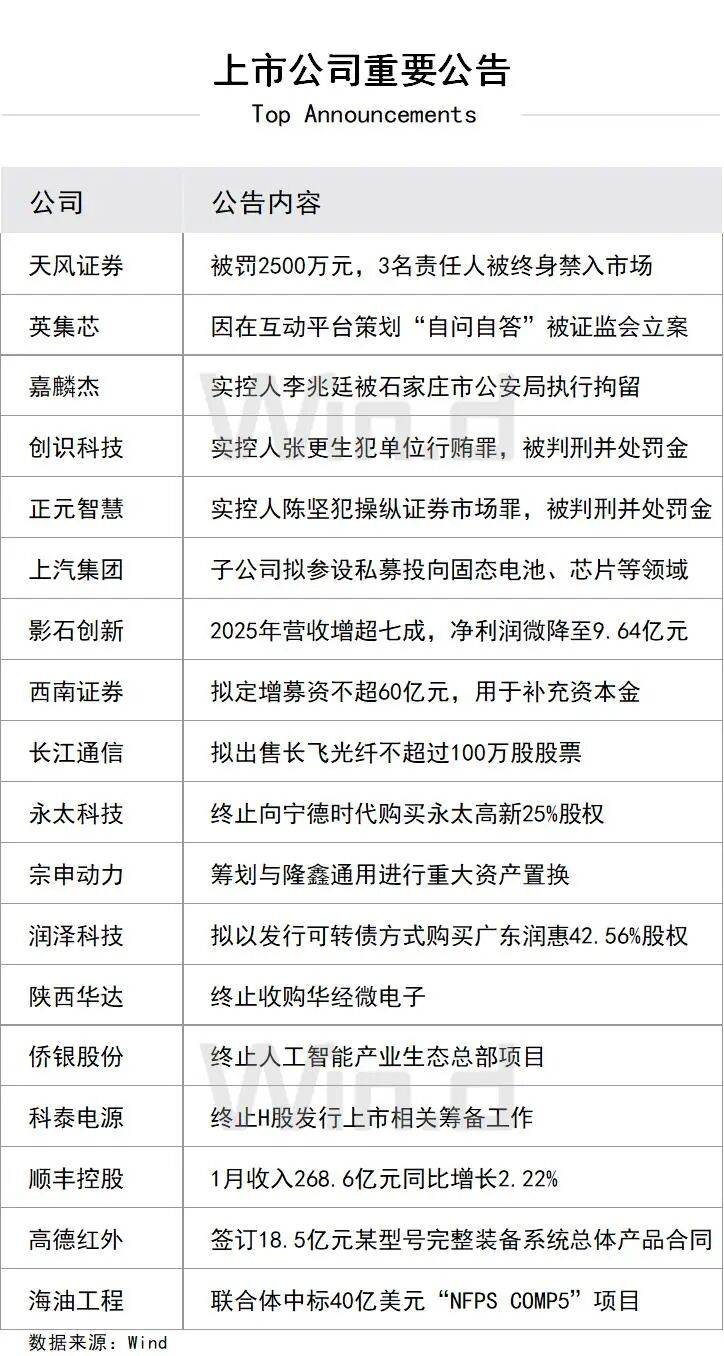
Financial Data - In January, China's social financing increased by 7.22 trillion yuan, up by 166.2 billion yuan year-on-year, while RMB loans rose by 4.71 trillion yuan, with a total balance of 276.62 trillion yuan, reflecting a year-on-year growth of 6.1% [1] - The weighted average interest rate for new corporate loans in January was approximately 3.2%, down by about 20 basis points year-on-year, while the rate for personal housing loans remained stable at 3.1% [3] - The M2 money supply grew by 9% year-on-year, and M1 increased by 4.9% [1] Real Estate Market - Data from the National Bureau of Statistics indicated that the month-on-month decline in second-hand housing prices in 70 cities narrowed, with first, second, and third-tier cities seeing reductions of 0.4, 0.2, and 0.1 percentage points respectively [1] - Year-on-year, new and second-hand housing prices in 70 major cities continued to decline, with the rate of decrease further widening [1] Stock Market Performance - The A-share market showed a positive trend in the post-Spring Festival period, with the Shanghai Composite Index rising by 4.85% in the first five trading days of 2024, marking the highest increase in nearly a decade [2] - The Shanghai Composite Index closed down by 1.26% at 4082.07 points on the last trading day before the Spring Festival, with a total market turnover of 2 trillion yuan [4] Regulatory Developments - The China Securities Regulatory Commission (CSRC) imposed strict penalties on Tianfeng Securities for illegal financing and information disclosure violations, with fines totaling 25 million yuan [4] - The State Administration for Market Regulation and the Ministry of Commerce announced enhanced supervision of cross-border e-commerce retail imports, focusing on recall regulations [3] Corporate News - Meituan projected a loss of over 23 billion yuan for the previous year, with continued losses expected in the first quarter of this year, primarily due to a significant decline in operating profit in its core local business segment [6] - The Hong Kong Stock Exchange is considering expanding the scope of confidentiality applications beyond technology and biotech sectors to include traditional industries [5]





——2026年1月金融数据点评:金融数据实现高质量开年
EBSCN· 2026-02-14 01:02
Financial Data Overview - In January 2026, new social financing (社融) reached 72,200 billion RMB, an increase of 1,654 billion RMB year-on-year, exceeding market expectations[3] - The year-on-year growth rate of social financing stock was 8.2%, slightly down from 8.3% in the previous month[1] - New RMB loans from financial institutions amounted to 47,100 billion RMB, a decrease of 4,200 billion RMB compared to the previous year[4] Loan Structure and Trends - In January, the structure of new loans showed that long-term loans to households increased by 3,469 billion RMB, down 1,466 billion RMB year-on-year, while short-term loans increased by 1,097 billion RMB, up 1,594 billion RMB year-on-year[4] - Corporate long-term loans decreased by 2,800 billion RMB year-on-year, while short-term loans increased significantly by 3,100 billion RMB[4] Monetary Supply and Deposits - M2 growth rate was 9.0%, up from 8.5% in the previous month, while M1 growth rate rose to 4.9%, an increase of 1.1 percentage points[5] - In January, RMB deposits increased by 80,900 billion RMB, a year-on-year increase of 37,700 billion RMB, with significant contributions from non-bank financial institutions[5] Market Dynamics and Implications - The government bond net financing in January was 9,764 billion RMB, up 2,831 billion RMB year-on-year, serving as a core support for social financing[3] - The active stock market has contributed to the increase in M2 growth, indicating a potential shift in capital flows towards equity investments[11] Economic Outlook - The weak "opening red" effect of credit growth suggests that the anticipated recovery in the real estate market may not meet expectations[16] - The demand for medium- to long-term loans remains weak, indicating ongoing concerns about economic recovery and internal demand[10]
央行开展万亿逆回购操作,国产大模型节前集体上新 | 财经日日评
吴晓波频道· 2026-02-14 00:39
Monetary Policy - The People's Bank of China conducted a 1 trillion yuan buyout reverse repurchase operation with a 6-month term, marking a net liquidity injection of 600 billion yuan for February, which is an increase of 300 billion yuan compared to the previous month [2][3] - The central bank's continued use of quantity-based tools indicates a reduced likelihood of interest rate cuts or reserve requirement ratio reductions in the short term [2][3] Real Estate Market - In January, new home prices in first-tier cities fell by 0.3% month-on-month, while second-tier cities saw a smaller decline of 0.2%, indicating a narrowing of price drops in these areas [4][5] - The overall trend shows an increase in cities with declining new home prices compared to late 2022, with the year-on-year decline in first-tier cities expanding to 2.1% [4][5] Automotive Industry - The State Administration for Market Regulation released guidelines to clarify legal risks in the automotive industry, aiming to promote healthy competition and compliance among manufacturers [6][7] - The guidelines address various pricing behaviors that could lead to legal issues, emphasizing the need for a clear competitive framework in the automotive sector [6][7] AI Industry - Anthropic raised $30 billion in its latest funding round, achieving a valuation of $380 billion, which is double its previous valuation [10][11] - The competition in the AI sector is intensifying, with major players like OpenAI and Anthropic attracting significant investments, indicating a growing interest in AI commercialization [10][11] Commodity Funds - Recent fluctuations in international oil prices have led to strict purchase limits on commodity funds, with some funds allowing purchases as low as 1 yuan [12] - The volatility in commodity markets has prompted fund companies to implement tighter risk control measures, reflecting a heightened speculative atmosphere [12] Stock Market - The A-share market experienced a decline, with the Shanghai Composite Index falling by 1.26% and trading volume decreasing by 161.8 billion yuan compared to the previous day [13][14] - The market is transitioning from an overheated phase to a more rational state, with the index seeking a new consolidation platform above 4000 points [14]


车贷“长跑”开启,汽车金融驶入共赢新赛道
Xin Lang Cai Jing· 2026-02-14 00:15
Core Insights - The automotive market is experiencing a shift in competitive dynamics with the introduction of long-term financing options such as "0 down payment" and "7-year ultra-low interest" loans, moving away from cash discounts [1][8][9] Group 1: Long-term Financing Options - Companies like Tesla, Xiaomi, and Li Auto have launched 7-year low-interest car loan products to attract new customer segments [2][10] - For instance, Xiaopeng Motors offers a 7-year financing plan with monthly payments starting at 1,355 yuan, while Xiaomi's new plan requires a down payment of 99,900 yuan with monthly payments starting at 1,931 yuan [2][10] - Nissan has also introduced an 8-year low-interest loan option, highlighting the trend towards extended loan terms in the market [2][10] Group 2: Consumer Demographics - The primary customers opting for these long-term loans include young individuals with limited savings, those facing existing financial pressures, and customers looking to replace their vehicles [3][11] - The extended repayment periods lower the barrier to entry for first-time buyers, particularly young families and those interested in electric vehicles [1][9] Group 3: Market Dynamics and Competition - The introduction of ultra-long-term loans is seen as a competitive strategy for automakers to stimulate demand and alleviate financial pressure on consumers [4][12] - The market for new energy vehicles (NEVs) is projected to grow significantly, with NEV sales expected to account for 47.9% of total new car sales by 2025, reflecting a 7% increase from 2024 [4][12] Group 4: Banking Sector Involvement - Banks are increasingly viewing high-quality auto loans as a key area for business expansion, collaborating with automakers to offer long-term low-interest products [5][13] - The regulatory environment is supportive, with policies allowing banks to extend personal loan terms from 5 to 7 years for long-term consumer needs [5][12] Group 5: Risk Management and Future Strategies - The shift to long-term loans raises concerns about asset depreciation and credit risk, particularly for electric vehicles, which may have lower resale values compared to traditional vehicles [6][15] - Financial institutions are encouraged to enhance risk management capabilities and develop a comprehensive service ecosystem that integrates vehicle financing with additional services [16][14]
盛松成:宏观调控精准施策 护航经济高质量发展
Shang Hai Zheng Quan Bao· 2026-02-14 00:09
Group 1 - The current economic operation is at a critical stage of transformation and upgrading, with a generally stable economic foundation and persistent resilience, but issues such as domestic demand stimulation and deep adjustments in the real estate market still need to be addressed [3][21] - The Central Economic Work Conference in December 2025 emphasized the need to fully tap economic potential, combining policy support with reform and innovation, and focusing on both investment in physical assets and human capital [3][21] - The coordination of fiscal and monetary policies is crucial, with a preference for reserve requirement cuts over interest rate reductions, as the latter is more suitable for the current national context [4][5][21] Group 2 - The "gradual reduction in reserve requirements and interest rates" approach is recommended due to high uncertainty, suggesting a "small steps" model for monetary policy [4][22] - The Chinese monetary policy framework differs fundamentally from Western countries, which primarily use interest rates for monetary control, as China's system still relies heavily on reserve requirements [5][23] - The People's Bank of China has begun to innovate structural monetary policy tools to enhance credit supply and demand, particularly in supporting small and medium-sized enterprises and key sectors [6][24] Group 3 - Recent measures to stabilize the real estate market include adjusting housing purchase restrictions and lowering housing provident fund loan rates, which have led to a narrowing decline in key real estate indicators [8][26] - The key to stabilizing expectations in the real estate market lies in improving liquidity and addressing employment and income expectations, which are critical for releasing policy effects [9][27] - Long-term reforms in land supply and fiscal structure are necessary to shift from a land-based development model to a more integrated approach that considers housing, land, and finance [9][27] Group 4 - The financial structure needs optimization, with a shift from indirect financing to direct financing to better support technological innovation and new production capabilities [10][28] - "Investment in people" focuses on directing more fiscal resources towards improving public services and human capital, which is essential for sustainable economic growth [10][29] - Key measures include implementing income increase plans for urban residents and increasing government spending on education, healthcare, and social services [11][30] Group 5 - Short-term fiscal transfer payments, such as consumption vouchers and targeted subsidies, are deemed more urgent and effective for boosting consumption in the current economic environment [13][31] - The government can stimulate demand in service sectors like childcare and elderly care through procurement and tax incentives, which will encourage investment in these areas [15][33] - The silver economy and childcare sectors present significant opportunities for consumption growth, with projections indicating substantial increases in their economic contributions by 2035 [16][36]

1月末中国广义货币余额同比增9% 新增人民币贷款4.71万亿元
Sou Hu Cai Jing· 2026-02-14 00:09
Group 1 - The People's Bank of China reported that the broad money supply (M2) reached 347.19 trillion yuan at the end of January, reflecting a year-on-year growth of 9%, which is 0.5 percentage points higher than the previous month and 2 percentage points higher than the same period last year, indicating a moderately loose monetary policy [1] - The increase in M2 growth rate is attributed to a base effect, as January 2025 saw an addition of approximately 5 trillion yuan, which is considered low compared to recent years. Additionally, the positive performance of the capital market at the beginning of the year is also a contributing factor [1] - Narrow money supply (M1) stood at 117.97 trillion yuan at the end of January, with a year-on-year increase of 4.9%, while the currency in circulation (M0) amounted to 14.61 trillion yuan, reflecting a year-on-year growth of 2.7%. A net cash injection of 519.1 billion yuan was recorded in January [1] Group 2 - Several banks reported an accelerated approval pace for infrastructure loans in the first quarter of this year, with a significant year-on-year increase in loan disbursement. In January, new renminbi loans increased by 4.71 trillion yuan [2] - Household loans increased by 456.5 billion yuan in January, with short-term loans rising by 109.7 billion yuan and medium to long-term loans increasing by 346.9 billion yuan. Meanwhile, corporate loans rose by 4.45 trillion yuan, with short-term loans up by 2.05 trillion yuan and medium to long-term loans increasing by 3.18 trillion yuan, while bill financing decreased by 873.9 billion yuan [2] - Non-bank financial institution loans decreased by 188.2 billion yuan [2]
每日机构分析:2月13日
Xin Hua Cai Jing· 2026-02-13 23:34
Group 1 - Morgan Stanley has raised South Korea's economic growth forecast for 2026 from 1.8% to 2.0%, primarily due to an unexpected recovery in the semiconductor industry. Despite the economic rebound, the Bank of Korea is expected to keep the benchmark interest rate unchanged this year due to limited inflation pressure, projected to remain at 2.1% [1][1][1] - Fundstrat Global Advisors' research head, Tom Lee, indicated that if inflation falls to around 2.5%, it would be reasonable enough to support the Federal Reserve in starting to cut interest rates, despite ongoing tariff impacts. The current target range for the federal funds rate is 3.5%-3.75%, providing ample policy space [1][1][1] - JPMorgan strategists recommend investors to sell two-year U.S. Treasury bonds, citing that the Federal Reserve is unlikely to make significant rate cuts in the short term. The upcoming U.S. inflation report is expected to be a crucial indicator for policy direction [1][1][1] Group 2 - Fitch's BMI forecasts that the Thai Baht will weaken to approximately 32.00 against the U.S. dollar by the end of 2026. To prioritize economic growth, the Bank of Thailand may further cut interest rates by 50 basis points in 2026, bringing the policy rate down to 0.75% [2][2][2] - Analysts from Malaysia's investment bank predict that Malaysia's Q4 GDP for 2025 will be revised up from an initial estimate of 5.7% to 5.9%, driven by strong performance in the services and mining sectors. If confirmed, the annual economic growth rate will rise to 5.0% [2][2][2] - The Central Bank of Russia may maintain its benchmark interest rate at 16% during the upcoming meeting due to recent tax policy disruptions affecting inflation outlook. The bank needs time to assess the impact of fiscal policy on prices, as indicated by Governor Nabiullina [2][2][2]
美国1月CPI同比上涨2.4% 通胀回落趋势压低美元
Xin Hua Cai Jing· 2026-02-13 23:26
Group 1 - The U.S. inflation report for January shows a year-on-year Consumer Price Index (CPI) increase of 2.4%, down from 2.7% in December and below the expected 2.5% [1] - The core CPI for January rose by 2.5% year-on-year and 0.3% month-on-month, indicating a continued but slowing inflation trend [1] - Companies like PepsiCo are lowering prices on certain products to attract budget-sensitive consumers, suggesting that price pressures are easing [1] Group 2 - Despite the slowdown in inflation, it remains above the Federal Reserve's 2% target, which may lead the Fed to maintain a cautious stance in the first half of the year [2] - Dallas Fed President Logan expresses optimism about inflation returning to the 2% target but warns of risks from tax policies and ongoing price increases due to tariffs [2] - JPMorgan economists anticipate continued inflationary pressures this year, influenced by potential cost pass-throughs to consumers and the impact of a weaker dollar [2]
2月14日隔夜要闻一览
Sou Hu Cai Jing· 2026-02-13 23:17
Group 1 - Trump plans to visit Venezuela, but the timing is yet to be determined, and has increased the deployment of a carrier to the Middle East [1] - The U.S. federal government has filed a new lawsuit against Harvard University seeking access to documents related to its admissions process [2] - SpaceX is considering a dual-class share structure for its IPO to solidify Elon Musk's control [3] Group 2 - OpenAI has partnered with two defense tech companies selected by the U.S. Department of Defense to bid on developing voice-controlled drone swarm command software for the military [4] - Goldman Sachs has launched a new customized stock basket aimed at addressing the increasing volatility in software stocks, betting on companies believed to be more resilient to AI disruption [5] - Wall Street is experiencing significant declines due to fears of disruption caused by AI, impacting sectors such as private credit, real estate brokerage, data analytics, legal services, and insurance [6] Group 3 - U.S. inflation in January showed relatively mild performance, alleviating concerns about a significant rise in inflation and boosting market expectations for a Federal Reserve rate cut [7] - Gold prices have risen as traders increased bets on a Federal Reserve rate cut following the mild inflation data, with some investors buying gold after a significant sell-off on Thursday [8] - Following the exposure of ties with Epstein, the head of Dubai Ports World, Bin Sulayem, has resigned [9]