有色金属

Search documents
有色金属ETF基金(516650)开盘涨3.12%,重仓股紫金矿业涨4.53%,洛阳钼业涨4.41%
Xin Lang Cai Jing· 2026-02-24 04:28
Group 1 - The core viewpoint of the article highlights the performance of the Nonferrous Metals ETF Fund (516650), which opened with a gain of 3.12% at 2.212 yuan [1] - Major holdings in the Nonferrous Metals ETF Fund include Zijin Mining, which rose by 4.53%, and other companies such as Luoyang Molybdenum, Northern Rare Earth, and Ganfeng Lithium, all showing significant increases in their stock prices [1] - The fund's performance benchmark is the CSI Sub-Industry Nonferrous Metals Theme Index, managed by Huaxia Fund Management Co., Ltd., with a return of 114.05% since its inception on June 9, 2021, and a 1.50% return over the past month [1]



长江有色:复工在即刚需补库激增及成本支撑 24日镍价或上涨
Xin Lang Cai Jing· 2026-02-24 03:57
镍期货市场:贸易政策不确定性引发市场情绪波动,隔夜伦镍收跌0.86%;伦镍最新收盘报17285,比 前一交易日下跌150美元/吨,跌幅为0.86%,成交6429手,国内市场春节期间2026年2月14日(星期六) 至2月23日(星期一)休市,2月24日(星期二)起开市交易,暂无夜盘数据更新。 新浪合作大平台期货开户 安全快捷有保障 镍市场供需呈现结构性分化。供应端长期收缩与短期宽松并存:印尼镍矿配额削减及雨季等因素,强化 了远期供应缺口与成本支撑的预期;但短期内,印尼低成本产品持续释放,叠加全球显性库存高企及国 内节前备货充足,现货供应压力依然显著。需求端恢复尚需时日:不锈钢行业仍处复工初期,采购以刚 需为主;新能源领域需求增长温和,未能形成强驱动。整体来看,市场处于"长期预期偏强"与"短期现 实偏弱"的博弈中,现货交投清淡,整体格局尚未摆脱弱势震荡。 今日镍价走势预测 2月24日镍价呈现震荡反弹格局,这一走势的核心驱动力来自宏观、产业与技术面的三重共振。宏观层 面,美元指数短线回落缓解了金属估值压力,同时风险偏好边际回暖,提振了市场情绪。产业方面,印 尼供应扰动事件的持续发酵与国内下游复工节奏快于预期,共同强 ...


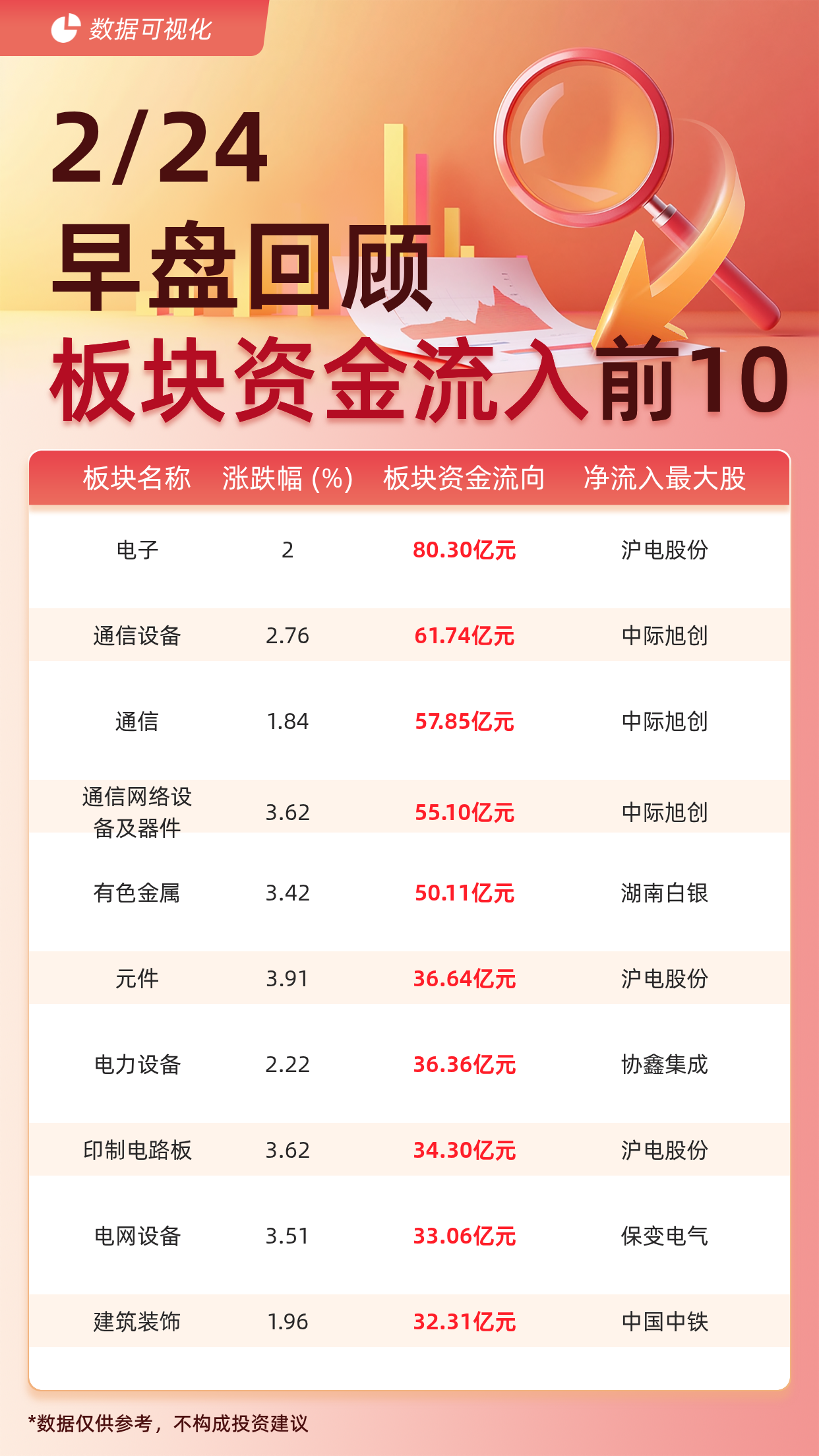
主力板块资金流入前10:电子流入80.30亿元、通信设备流入61.74亿元
Jin Rong Jie· 2026-02-24 03:50
Group 1 - The core point of the news is that as of February 24, the main capital inflow into the market reached 12.298 billion yuan, indicating strong investor interest in various sectors [1] - The top ten sectors with the highest capital inflow include Electronics, Communication Equipment, and Non-ferrous Metals, reflecting a diverse range of investment opportunities [1] Group 2 - The Electronics sector saw a capital inflow of 8.030 billion yuan with a price increase of 2% [2] - The Communication Equipment sector experienced a 2.76% increase with a capital inflow of 6.174 billion yuan [2] - The Communication sector had a capital inflow of 5.785 billion yuan and a price increase of 1.84% [2] - The Communication Network Equipment and Devices sector recorded a 3.62% increase with a capital inflow of 5.510 billion yuan [2] - The Non-ferrous Metals sector had a capital inflow of 5.011 billion yuan and a price increase of 3.42% [2] - The Components sector saw a capital inflow of 3.664 billion yuan with a price increase of 3.91% [2] - The Power Equipment sector experienced a 2.22% increase with a capital inflow of 3.636 billion yuan [3] - The Printed Circuit Board sector had a capital inflow of 3.430 billion yuan and a price increase of 3.62% [3] - The Power Grid Equipment sector recorded a 3.51% increase with a capital inflow of 3.306 billion yuan [3] - The Building Decoration sector saw a capital inflow of 3.231 billion yuan with a price increase of 1.96% [3]
A股午评:三大指数均涨超1%,超4200股上涨!油气、黄金及化工板块领涨
Ge Long Hui· 2026-02-24 03:44
Core Viewpoint - The A-share market experienced a strong opening on the first trading day of the Year of the Horse, with all three major indices rising over 1% [1] Group 1: Market Performance - The Shanghai Composite Index increased by 1.17%, closing at 4129.78 points [1] - The Shenzhen Component Index rose by 1.82% [1] - The ChiNext Index gained 1.76% [1] - The total trading volume in the Shanghai and Shenzhen markets reached 15,210 billion yuan, an increase of 3,074 billion yuan compared to the previous day [1] - Over 4,200 stocks in the market saw an increase [1] Group 2: Sector Performance - The oil and gas, gold, non-ferrous metals, and chemical sectors led the market gains [1] - The film and theater stocks experienced a collective adjustment [1] Group 3: Market Concerns - Geopolitical conflicts and uncertainties regarding U.S. tariff policies have reignited market concerns [1]
有色金属ETF国泰(159881)涨超3%,有色金属中长期价格中枢有望向上
Mei Ri Jing Ji Xin Wen· 2026-02-24 03:19
Group 1 - The core viewpoint is that the profit of large-scale non-ferrous metal industrial enterprises is expected to exceed 500 billion yuan in 2025, reaching 528.45 billion yuan, a year-on-year increase of 25.6%, marking a historical high [1] - The main factors supporting the rapid growth of the industry's profitability include high non-ferrous metal prices, continuous policy benefits, and the expansion of demand from emerging industries [1] - It is anticipated that after the Spring Festival, the domestic capital market will increase its allocation towards inflation (PPI) direction, as global pricing commodities like crude oil maintain strong price levels [1] Group 2 - The Guotai Non-ferrous Metal ETF (159881) tracks the CSI Non-ferrous Metal Index (930708), which focuses on the non-ferrous metal industry and includes listed companies involved in mining, smelting, and processing [1] - The index covers sub-sectors such as copper, gold, aluminum, rare earths, and lithium, using a market capitalization-weighted approach to reflect the investment value of resource assets [1]
2025年俄罗斯卢布升值的原因及影响分析
Sou Hu Cai Jing· 2026-02-24 03:19
Group 1 - The Russian ruble has appreciated significantly against the US dollar since 2025, despite low oil prices and weak economic growth, due to improved current and capital account balances, monetary tightening, and foreign exchange market interventions [1][2][3] - The correlation between the ruble and oil prices has weakened, with the ruble appreciating over 20% while Urals oil prices fell by 16%, indicating a breakdown of the previous "oil currency" logic [2][3] - The Russian government has shifted its economic strategy towards import substitution and developing non-oil industries, which has contributed to the ruble's strength [3] Group 2 - The trade surplus has been maintained through increased non-oil exports, which grew by 6% in the first three quarters of 2025, compensating for a 21% decline in oil and gas export revenues [4] - The "de-dollarization" of international trade has been significant, with 57% of exports and 53% of imports settled in rubles by Q3 2025, reducing reliance on US dollars and euros [4] - Russia's external debt has decreased from 3.9% of GDP in 2020 to 2.6% in 2024, leading to lower demand for foreign currency for debt repayment [5] Group 3 - The Central Bank of Russia has maintained high interest rates, with the benchmark rate reaching 21% in October 2024, which has attracted domestic investments in ruble-denominated debt [6] - The government has increased foreign exchange sales to support the ruble, with daily sales rising from 4.7 billion rubles in January 2025 to 14.8 billion rubles by December [6] - Tax adjustments have also impacted the economy, with a significant increase in the fiscal deficit leading to higher taxes on imports, particularly affecting the automotive sector [7] Group 4 - The appreciation of the ruble has negatively impacted federal revenue, with estimates suggesting a reduction of 1 trillion to 1.3 trillion rubles for each unit of ruble appreciation against the dollar [8] - Export-oriented companies are facing increased costs and reduced profit margins due to the ruble's strength, leading to cutbacks in investment plans [9] - Domestic companies are struggling against the influx of cheaper imported goods, with significant increases in imports of various consumer products, impacting local market competitiveness [9] Group 5 - The strong ruble is expected to maintain its position in the short term, but it poses risks for investments in Russia, particularly under sanctions [10] - Neighboring countries like Kazakhstan and Kyrgyzstan are experiencing inflationary pressures due to the strong ruble, prompting them to raise interest rates [10] - Investors in emerging markets should be cautious of similar currency fluctuations caused by government interventions [10]

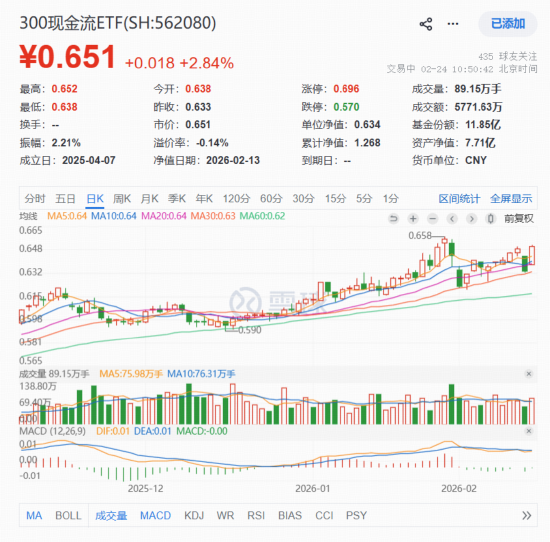
油气、有色板块强势领涨,300现金流ETF(562080)放量涨超2.8%
Xin Lang Cai Jing· 2026-02-24 03:16
Core Viewpoint - The A-share market opened significantly higher on February 24, with the cash flow strategy leading the way, as the 300 Cash Flow Index surged by 2.8% [1][11]. Group 1: ETF Performance - The 300 Cash Flow ETF (562080), which tracks the 300 Cash Flow Index, experienced a substantial increase of 2.84%, with real-time trading volume exceeding 57 million yuan by 10:50 AM [1][11]. - As of the end of 2025, the 300 Cash Flow ETF had a scale of 930 million yuan, ranking first in both scale and liquidity among similar ETFs in the Shanghai market [3][11]. Group 2: Stock Performance - Major stocks contributing to the rise included China National Offshore Oil Corporation (CNOOC) and China Petroleum, which increased by 7.88% and 5.5% respectively, while other large-cap "cash cow" stocks also saw gains exceeding 4% [3][11]. - The top performing stocks in the 300 Cash Flow Index included: - CNOOC: 10.31% weight, +7.88% [4] - China Petroleum: 10.15% weight, +5.50% [4] - Zhongtian Technology: 0.39% weight, +6.59% [4] - Weichai Power: 2.96% weight, +5.49% [4] - Salt Lake Potash: 1.33% weight, +4.99% [4]. Group 3: Market Influences - The rise in oil prices was driven by escalating geopolitical risks, particularly concerns over the tensions between the U.S. and Iran, with Brent crude oil prices increasing by 5.46% during the holiday period [3][13]. - The cash flow strategy aligns with current policy trends favoring "anti-involution," focusing on cash flow recovery opportunities rather than static dividend yields [7][15]. Group 4: Industry Composition - The 300 Cash Flow ETF selectively includes 50 "cash cow" companies from the CSI 300, with a sector distribution that emphasizes traditional and emerging industries, excluding finance and real estate [5][13]. - The top five industries represented in the ETF account for 62% of the total weight, focusing on sectors such as oil and petrochemicals, home appliances, and non-ferrous metals [5][13].


多因素共塑有色金属市场偏强运行,南方基金旗下有色金属ETF(512400)上涨3.69%,白银有色涨停
Xin Lang Cai Jing· 2026-02-24 03:12
Core Viewpoint - The article highlights the strong performance of the non-ferrous metal ETF (512400) and the underlying factors driving market sentiment, including U.S. tariff policy changes, geopolitical tensions, and macroeconomic data affecting interest rate expectations [1][2]. Group 1: Market Performance - The non-ferrous metal ETF (512400) increased by 3.69%, with a trading volume of 8.02 billion yuan and a turnover rate of 2.13% [1]. - Key stocks in the index, such as silver and platinum, saw significant gains, with silver rising by 10.03%, platinum by 8.23%, and Tongling Nonferrous Metals by 7.80% [1]. Group 2: Influencing Factors - The reversal of U.S. tariff policies, following a Supreme Court ruling, has led to increased market uncertainty, with tariffs raised from 10% to 15% on global goods [1]. - Geopolitical tensions between the U.S. and Iran have heightened global risk aversion, contributing to a shift in market sentiment [1]. - Strong employment data in the U.S. and hawkish comments from Federal Reserve officials have delayed interest rate cut expectations from June to July [1]. Group 3: Sector Analysis - **Precious Metals Sector**: The geopolitical tensions and tariff policy fluctuations have significantly increased market risk aversion and policy uncertainty premiums. Silver faces delivery concerns due to low inventory levels, while macroeconomic uncertainties support long-term investment value in precious metals [2]. - **Industrial Metals Sector**: This sector is currently in a phase of competition between macro expectations and seasonal fundamentals. Copper is supported by low terminal inventories, while aluminum faces temporary inventory pressures due to holiday shutdowns [2]. - **New Energy and Minor Metals Sector**: This sector is experiencing subdued trading activity due to holiday effects. Lithium prices are active, while nickel is supported by supply constraints from Indonesia. The rare earth market is seeing reduced demand, but financial attributes may increase price volatility in the future [3]. Group 4: ETF Overview - The non-ferrous metal ETF (512400) closely tracks the Zhongzheng Shenwan Non-ferrous Metal Index, which includes 50 listed companies to reflect the overall performance of the non-ferrous metal industry in the Shanghai and Shenzhen markets [3]. - The top ten weighted stocks in the index include Zijin Mining, Luoyang Molybdenum, Northern Rare Earth, and others [3].



国泰君安期货商品研究晨报:贵金属及基本金属-20260224
Guo Tai Jun An Qi Huo· 2026-02-24 03:03
1. Report Industry Investment Ratings - Not provided in the document 2. Core Views of the Report - Copper: Uncertainty increases, price fluctuates [2][4] - Zinc: Rangeside fluctuation [2][7] - Lead: Weak supply and demand, rangeside fluctuation [2][10] - Tin: Pay attention to the impact of tariffs [2][12] - Aluminum: Post - holiday trend is relatively strong; Alumina: Rangeside fluctuation; Cast aluminum alloy: Follows electrolytic aluminum [2][16] - Platinum: Boosted by the strengthening of silver [2][19] - Palladium: Tariff disturbances resurface, fluctuating with an upward bias [2][20] - Nickel: Speculative sentiment in Shanghai nickel still exists, continuously focus on nickel ore contradictions; Stainless steel: Cost support center moves up, off - season inventory accumulation restricts elasticity [2][24] 3. Summaries by Related Catalogs Copper - **Fundamental Data**: The closing price of the Shanghai copper main contract was 100,380, down 1.91%; the closing price of the LME copper 3M electronic disk was 12,901, up 0.35%. Trading volume and positions of Shanghai copper and LME copper changed, and inventory and spreads also had corresponding changes [4]. - **Macro and Industry News**: AI concerns intensify, tariff war risks resurface, and US stocks decline. The US Customs will stop collecting illegal tariffs, and the European Parliament suspends the approval of the EU - US trade agreement. Harmony Gold's new Australian copper mine needs two - year transformation. China promotes central enterprises to invest in computing power. Codelco's copper production increased in December 2025, and there was a global refined copper supply surplus in December 2025 [4][6]. - **Trend Intensity**: 0 [6] Zinc - **Fundamental Data**: The closing price of the Shanghai zinc main contract was 24,250, down 1.70%; the closing price of the LME zinc 3M electronic disk was 3,378, up 0.91%. There were changes in trading volume, positions, premiums, and inventory [7]. - **News**: The Chinese Ministry of Commerce urges the US to cancel unilateral tariff measures. Wall Street analyzes that tariffs may be lowered in the second half of the year [8][9]. - **Trend Intensity**: 0 [9] Lead - **Fundamental Data**: The closing price of the Shanghai lead main contract was 16,700, unchanged; the closing price of the LME lead 3M electronic disk was 1,966.5, up 0.69%. There were changes in trading volume, positions, premiums, and inventory [10]. - **News**: Similar to copper, AI concerns and tariff war risks affect the market, and the US stops collecting illegal tariffs [10]. - **Trend Intensity**: 0 [10] Tin - **Fundamental Data**: The closing price of the Shanghai tin main contract was 365,400, down 7.05%; the closing price of the LME tin 3M electronic disk was 47,370, up 1.35%. There were changes in trading volume, positions, inventory, and prices [13]. - **Macro and Industry News**: Trump mentions higher tariffs, the EU may suspend the US - EU trade agreement, the German Chancellor visits China, and the Fed official mentions AI - related job cuts [15]. - **Trend Intensity**: 1 [14] Aluminum, Alumina, Cast Aluminum Alloy - **Fundamental Data**: There were detailed data changes in the closing prices, trading volumes, positions, spreads, premiums, and inventory of aluminum, alumina, and cast aluminum alloy [16]. - **Comprehensive News**: US Democrats oppose tariff extension and advocate for refund. Trump may attack Iran. [18] - **Trend Intensity**: Aluminum: 1; Alumina: 0; Cast aluminum alloy: 1 [18] Platinum and Palladium - **Fundamental Data**: There were price changes in platinum and palladium futures and spot prices, as well as changes in trading volume, positions, and spreads [20]. - **Macro and Industry News**: Trump will visit China, the EU suspends the US - EU trade agreement, there are US economic data, and there are developments in US - Iran relations. Hong Kong aims to be an international gold trading center, etc. [23] - **Trend Intensity**: Platinum: 0; Palladium: 0 [22] Nickel and Stainless Steel - **Fundamental Data**: There were data changes in the closing prices, trading volumes, and related prices of nickel and stainless steel futures, as well as changes in the prices and spreads of products in the industrial chain [24]. - **Macro and Industry News**: Indonesia restricts new smelting licenses, revises the nickel ore benchmark price formula, and there are issues such as corporate violations, port monopolies, and mine restarts [24][25][26]. - **Trend Intensity**: Nickel: 0; Stainless steel: 0 [29]
国泰君安期货:节后归来,一文理清马年开市新变量
Xin Lang Cai Jing· 2026-02-24 03:00
Core Viewpoint - The article discusses the macroeconomic changes during the Chinese New Year holiday and their potential impact on the domestic futures market as trading resumes after the break [2]. Group 1: Key Events - The U.S. Supreme Court ruled some tariffs invalid, leading to a temporary 10% global tariff, which was quickly raised to 15%. This creates a short "policy window" before new tariffs take effect on February 24, potentially boosting export risk appetite, but does not alleviate trade pressure on China [3][16]. - Tensions between the U.S. and Iran escalated, with the U.S. increasing troop presence and Iran conducting military exercises. This "tense but controlled" situation supports international oil prices and may affect domestic chemical products linked to crude oil costs [4][17]. - There are rumors of a potential visit by the U.S. President to China at the end of March, which could lead to increased pressure in trade negotiations. Market participants should monitor developments in trade and technology that may introduce uncertainty into global trade dynamics [6][18]. - Key revisions in U.S. economic data showed a significant downward adjustment in non-farm employment for 2025 and that Q4 GDP growth did not outpace inflation. This may temper concerns about an overheating economy and influence expectations regarding Federal Reserve policy [7][19]. Group 2: Focused Sectors - The non-ferrous metals sector is experiencing renewed demand due to the rise of humanoid robots, which is expected to increase the long-term demand for copper, aluminum, and rare earth materials. The overall environment is supportive, with strong international precious metals and tight supply-demand dynamics [8][20][21]. - The oil and chemical sector is benefiting from rising crude oil prices due to geopolitical tensions, which directly supports downstream chemical products. Potential changes in domestic naphtha consumption tax and seasonal industry maintenance may also affect supply [9][22]. - The photovoltaic sector is seeing positive policy changes, with efforts to eliminate low-price competition and promote quality over quantity. The expiration of the "201 tariffs" on solar components may lower market entry costs for U.S. exports, providing a marginal benefit [10][11][23][24].