
海洋经济

Search documents
热点思考 |“四中”前瞻:新“五年”的新期待(申万宏观·赵伟团队)
赵伟宏观探索· 2025-10-21 16:03
Core Viewpoint - The article discusses the signals and implications from the recent Central Political Bureau meeting regarding the upcoming "15th Five-Year Plan," emphasizing themes such as fairness, localized development, high-level openness, and the integration of effective markets with proactive government roles [3][10]. Group 1: Signals from the September Central Political Bureau Meeting - The meeting highlighted the importance of "people" and "fairness," as well as the need for localized development and high-level openness [3][10]. - It emphasized the combination of effective markets and proactive government roles, indicating a shift in how these elements will be addressed in the "15th Five-Year Plan" [11]. - The meeting also reinforced the concept of "bottom-line thinking," stressing the importance of security in economic and social development [11][12]. Group 2: Main Lines of the "15th Five-Year Plan" - The "15th Five-Year Plan" is expected to focus on high-quality development, institutional reform, and industrial upgrading as its three main lines [5][18]. - It serves as a critical phase in the continuous process towards achieving the 2035 modernization goals, acting as both a deepening of the "14th Five-Year Plan" and a mid-term evaluation of the 2035 objectives [5][18]. - To meet the 2035 goals, the economy may need to maintain an average growth rate of around 4.4% during the "15th" and "16th" phases [21][26]. Group 3: Key Reform Tasks and Directions - The 20th Central Committee's third plenary session outlined over 300 reform tasks to be completed by 2029, indicating that the next five years will be crucial for comprehensive reforms [29]. - Key reform areas include market-oriented reforms, the cultivation of new productive forces, green low-carbon transitions, and improvements in social welfare systems [29][30]. - The focus on industrial transformation and upgrading is seen as a key means to achieve the core objectives of the five-year plan [31]. Group 4: Potential Industry Focus Areas - The "15th Five-Year Plan" is likely to prioritize the cultivation of "new productive forces," continuing the framework established in the "14th Five-Year Plan" [7][33]. - Emerging pillar industries such as artificial intelligence, marine economy, and low-altitude economy are expected to be highlighted in the plan [8][38]. - The plan may also address the integration of the digital economy with the real economy, emphasizing the need for a robust industrial structure [35][38].


尾盘涨停!688498,历史新高!A股全线爆发
Zheng Quan Shi Bao· 2025-10-21 08:56
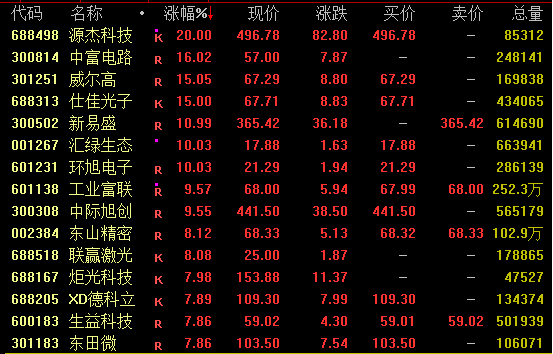
Market Overview - A-shares surged on October 21, with the Shanghai Composite Index returning above 3900 points, and the ChiNext Index rising over 3% [1] - The Shanghai Composite Index closed up 1.36% at 3916.33 points, the Shenzhen Component Index rose 2.06% to 13077.32 points, and the ChiNext Index increased by 3.02% to 3083.72 points [1] - Total trading volume in the Shanghai and Shenzhen markets reached 189.29 billion yuan, an increase of over 140 billion yuan from the previous day [1] AI Industry Chain - AI-related stocks experienced significant gains, with Yuanjie Technology hitting a 20% limit up, and other companies like Zhongfu Circuit and Weier Gao rising over 15% [2][3] - The demand for 1.6T optical modules is expected to increase, with total industry demand projected to rise from 10 million units to 20 million units due to accelerated deployment of AI training and inference networks [3] Ocean Economy - The ocean economy concept saw strong performance, with stocks like Deshi Co., CITIC Heavy Industries, and Shenkai Co. hitting their daily limit [5][6] - The Ministry of Natural Resources announced plans to strengthen standards for resource protection and utilization, focusing on emerging fields such as marine carbon sinks and smart cities [5][7] Consumer Electronics - The consumer electronics sector was active, with stocks like Yunzhu Technology and Yachuang Electronics seeing significant gains, including a 20% limit up for Yunzhu Technology [8][9] - Recent reports indicate strong early sales for the iPhone 17 series, with sales in China nearly doubling compared to the iPhone 16 series, suggesting a positive outlook for Apple's supply chain [10]


尾盘涨停!688498,历史新高!A股全线爆发
证券时报· 2025-10-21 08:47
Market Overview - A-shares surged on October 21, with the Shanghai Composite Index returning above 3900 points, and the ChiNext Index rising over 3% [1] - The total trading volume in the three major markets reached 1.8929 trillion yuan, an increase of over 140 billion yuan compared to the previous day [1] AI Industry Chain - Stocks in the AI industry chain experienced a collective surge, with Yuanjie Technology hitting the daily limit of 20% and closing at 496.78 yuan [3][4] - Other notable performers included Zhongfu Circuit and Weier Gao, which rose over 15%, and New Yisheng, which increased by over 10% [3][4] - Demand for 1.6T optical modules is expected to rise significantly, with total industry demand projected to increase from 10 million units to 20 million units due to accelerated deployment of AI training and inference networks [4] Ocean Economy - The ocean economy concept saw strong gains, with stocks like Deshi Co., CITIC Heavy Industries, and Shenkai Co. hitting the daily limit [7][8] - The Ministry of Natural Resources emphasized the importance of standardizing resource protection and utilization during the 14th Five-Year Plan, which is expected to boost the development of deep-sea technology and related industries [9] Consumer Electronics - The consumer electronics sector was active, with stocks like Yunzhu Technology and Yachuang Electronics seeing significant gains, with Yunzhu Technology hitting the daily limit of 20% [11][12] - Apple's stock rose nearly 4%, driven by strong demand for the new iPhone 17 series, which saw a 14% increase in early sales compared to the iPhone 16 series [13] - The global smart glasses market is projected to see a shipment volume of 4.065 million units in the first half of 2025, representing a year-on-year growth of 64.2% [13]

“十五五”规划研究系列之四:“四中”前瞻:新“五年”的新期待
Shenwan Hongyuan Securities· 2025-10-20 10:41
Group 1: Key Signals from the September Politburo Meeting - The meeting emphasized "people" and "fairness," indicating a focus on equitable development and high-level openness[1] - Core directives include "effective market and proactive government" and "strengthening bottom-line thinking" to ensure economic stability[1] - The meeting highlighted the importance of "tailored development" to address local conditions and avoid redundant construction[1] Group 2: Main Lines of the 15th Five-Year Plan - High-quality development, institutional reform, and industrial upgrading are identified as the three main lines of the new plan[3] - The 15th Five-Year Plan serves as a critical midpoint for assessing progress towards the 2035 modernization goals[3] - To achieve the 2035 goals, an average annual economic growth rate of approximately 4.4% is required during the 15th and 16th Five-Year Plan periods[3][25] Group 3: Focus Areas for Industrial Development - The plan will likely continue to support "emerging pillar industries" and "new quality productivity" as key areas for growth[5][39] - Specific industries mentioned include artificial intelligence, marine economy, and low-altitude economy, which are expected to receive significant attention[6][5] - The emphasis on service consumption and technology consumption indicates a shift towards more sustainable economic drivers[5][42]
“十五五”研究系列(一):“十五五”规划前瞻:从政策方向寻找产业线索
Ping An Securities· 2025-10-17 09:07
Group 1 - The "14th Five-Year Plan" has achieved high-quality completion of most policy goals, including economic growth, labor productivity, and R&D investment, with significant progress in urbanization and life expectancy indicators [9][10][11] - The "15th Five-Year Plan" is positioned as a critical period for achieving Chinese-style modernization, focusing on solidifying the foundation for modernization and comprehensive development [7][8] Group 2 - Four industrial clues are identified for the "15th Five-Year Plan": fostering new productive forces, expanding domestic demand, advancing the construction of a unified national market, and enhancing resource utilization and protection [4][12][16] - The macroeconomic environment shows new momentum in domestic growth, with a need to address insufficient effective demand, emphasizing the importance of technology innovation and expanding domestic consumption [13][14] Group 3 - The focus on new productive forces includes the development of emerging industries, traditional industry upgrades, and the stimulation of digital economy innovation [4][12][18] - Expanding domestic demand involves promoting consumption through initiatives like "old-for-new" exchanges and investing in human capital, alongside infrastructure investment to support urban renewal [4][12][16] Group 4 - The construction of a unified national market aims to reduce internal competition and enhance efficiency in sectors like new energy, traditional cycles, and consumer goods [4][12][16] - Resource utilization and protection strategies emphasize the development of the marine economy and the safeguarding of strategic mineral resources [4][12][16] Group 5 - The market outlook suggests that technology innovation sectors such as TMT, new energy, and biomedicine will continue to be key investment themes, supported by policy and industry growth [4][12][16] - Historical analysis indicates that A-share market trends around the announcements of previous five-year plans show a pattern of initial growth followed by sector rotation and differentiation [4][12][16]
经典重温 | “十五五”:产业破局与重构 ——“十五五”规划研究系列之三(申万宏观·赵伟团队)
申万宏源宏观· 2025-09-25 16:03
Core Insights - The article discusses the importance of industrial structure adjustment in China's 14th and upcoming 15th Five-Year Plans, emphasizing the shift from focusing on the ratio of the three industries to prioritizing technological innovation and R&D investment [3][5][28]. Group 1: Industrial Structure Adjustment in Five-Year Plans - Industrial structure adjustment is a crucial component of China's Five-Year Plans, serving as a key means to achieve core objectives [3][16]. - The focus of industrial structure adjustment has evolved from the ratio of the three industries to a greater emphasis on technological innovation and R&D investment [5][28]. - The 14th Five-Year Plan has introduced specific targets for R&D expenditure and digital economy core industries, reflecting a shift towards more refined and precise planning [5][28]. Group 2: Trends in Industrial Structure Adjustment - The direction of industrial structure adjustment has transitioned from emphasizing the three industries' ratios to focusing on technological innovation [5][28]. - The importance of the service sector has increased, with a notable shift from finance and real estate to information technology and production services [6][47]. - The 15th Five-Year Plan is expected to continue supporting technological innovation and address issues such as supply-demand mismatches and "involution" in the manufacturing sector [7][8][22]. Group 3: Key Areas of Focus in the 15th Five-Year Plan - The 15th Five-Year Plan is likely to prioritize emerging industries such as artificial intelligence, marine economy, and commercial aerospace [7][22]. - There is an anticipated increase in the emphasis on service industry development, particularly in enhancing service consumption and trade [8][26]. - The plan may also focus on improving the quality and efficiency of service industries, aligning with the broader economic development goals [8][49].
一图了解机构“十五五”规划展望
Xuan Gu Bao· 2025-09-16 08:19
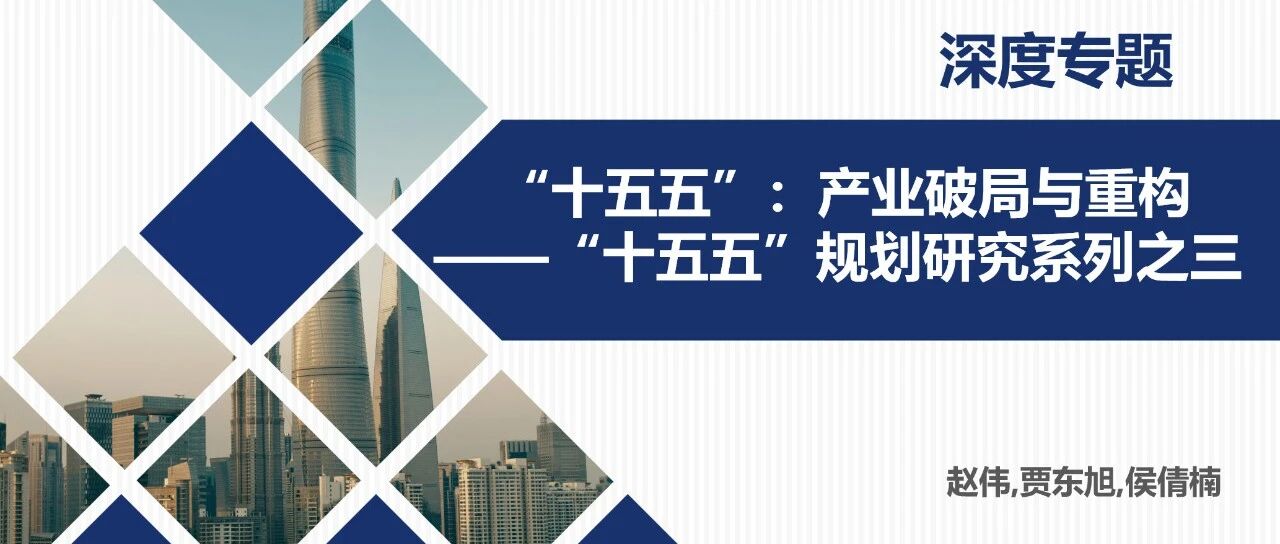
Group 1 - The core focus of the "14th Five-Year Plan" is on technology-driven industries, particularly in areas such as consumer electronics, semiconductor equipment, and quantum information [1][2][3] - The consumer electronics sector is expected to thrive with the activation of AI, leading to increased consumer upgrades and a flourishing market [1] - The semiconductor industry is experiencing strong demand for high-end materials and equipment, indicating a critical need for breakthroughs [1][2] Group 2 - Emerging industries such as intelligent robotics, marine economy, low-altitude economy, and smart connected vehicles are highlighted as key growth areas [2][3] - The development of 6G technology is anticipated to surpass 5G in performance, with significant applications across various sectors [2] - The focus on hydrogen energy and storage technologies aims to optimize energy structures and enhance energy efficiency [2][3] Group 3 - The plan emphasizes the importance of domestic demand, with a shift towards high-quality and innovative foreign trade [3][4] - The government aims to promote a unified market and enhance the efficiency of resource allocation [4][5] - The "14th Five-Year Plan" is expected to prioritize green transformation, with a target to reduce carbon intensity significantly [3][5] Group 4 - The plan includes fostering new and future industries, particularly in strategic emerging sectors such as AI, healthcare, and advanced manufacturing [5][6] - The focus on improving public services and promoting common prosperity is evident, with specific measures being implemented in various regions [5][6] - The capital market's stability and resilience are crucial for achieving the goals set in the "14th Five-Year Plan" [4][6]
房地产进入深度调整期,中国城市如何寻找新增长极?
Jing Ji Guan Cha Bao· 2025-09-14 11:55
Core Insights - The article discusses the transition of China's urban development from a reliance on real estate to new growth engines, emphasizing the need for innovation and quality improvement in urban governance [1][2][5]. Group 1: Economic Transition - The real estate market in China is undergoing a deep adjustment, with a shift from "supply shortage" to "oversupply" [2]. - The traditional growth model based on land finance and real estate investment is fundamentally changing, necessitating cities to seek sustainable economic engines [2][6]. - The "14th Five-Year Plan" period is characterized by profound changes in supply-demand relationships within the real estate market [2]. Group 2: Urban Development Strategies - Urbanization is transitioning from a rapid growth phase to a stable development phase, focusing on quality improvement rather than large-scale expansion [3]. - Future urban competition will center on industrial innovation, public service quality, governance precision, and living environment rather than land scale and GDP growth [3][6]. - The report highlights that cities like Changzhou, Yantai, and Guiyang are emerging with unique advantages in sectors such as new energy and big data [3][5]. Group 3: New Growth Opportunities - New growth opportunities are identified in technology innovation, high-level openness, and modern urban governance [5]. - Major cities like Beijing and Shanghai are leading in technological innovation, with significant investments in R&D and a concentration of high-tech enterprises [5]. - Smart governance initiatives, such as Hangzhou's "City Brain" and Chengdu's safety perception network, are enhancing urban resilience [5]. Group 4: Future Urban Competitiveness - The future of urban opportunities will depend on cities' ability to precisely position themselves and break away from homogeneous competition [6]. - The ability to effectively manage "stock updates" in the context of a declining population dividend will be crucial for cities to enhance their competitiveness [6].
自然资源资产家底更厚实 “十四五”期间我国新发现10个大型油田、19个大型气田
Jing Ji Ri Bao· 2025-09-10 22:10
Core Viewpoint - The Chinese government emphasizes the importance of high-quality development in natural resource management, aligning with the "green mountains and clear waters are invaluable assets" philosophy, and has made significant progress in achieving the goals set in the 14th Five-Year Plan [1] Group 1: Natural Resource Monitoring and Management - Since the beginning of the 14th Five-Year Plan, China has conducted comprehensive surveys and monitoring of nine types of natural resources, including land, minerals, and forests, to dynamically grasp their status [2] - By the end of 2024, the national arable land area is expected to reach 1.94 billion acres, an increase of 28 million acres from 2020, maintaining the arable land protection red line [2] - The forest coverage rate has reached 25.09%, an increase of approximately 2 percentage points since 2020, making China the fastest-growing country in terms of greening [2] Group 2: Ecological Protection and Restoration - The government has implemented significant ecological protection and restoration initiatives, achieving a cumulative area of over 10 million acres in comprehensive land remediation [3] - The efficiency of resource utilization has improved, with the area of construction land per unit of GDP decreasing by 16% [3] - Over 1,000 national-level green mines have been established, promoting sustainable resource development [3] Group 3: Marine Economy Development - China's marine production value has surpassed 10 trillion yuan, with a 34% increase compared to the end of the 13th Five-Year Plan, accounting for 7.8% of the national GDP [4] - Guangdong's marine production value is projected to exceed 2 trillion yuan in 2024, with cities like Shenzhen and Shanghai enhancing their marine functional advantages [4] - China has become one of the countries with the most complete marine industry categories, leading the world in marine aquaculture production for 36 consecutive years [4][5] Group 4: Mineral Resource Exploration - The government has invested nearly 450 billion yuan in a new round of mineral exploration, achieving significant breakthroughs in energy resources, including the discovery of 10 large oil fields and 19 large gas fields [7] - New resource bases are emerging, such as the lithium-rich "Asian Lithium Belt," which spans 2,800 kilometers across four provinces, indicating a strong focus on critical minerals for the electric vehicle industry [8]
高质量完成“十四五”规划|从山顶到海洋的“大账单”——国新办发布会聚焦“十四五”时期自然资源高质量发展成就
Xin Hua She· 2025-09-10 15:22
Core Insights - The press conference highlighted the achievements in high-quality development of natural resources during the "14th Five-Year Plan" period, emphasizing the effective support for economic and social development [1] Group 1: Natural Resource Management - The Ministry of Natural Resources presented a comprehensive "big account" of natural resources, indicating a solid foundation through continuous monitoring and investigation [2] - As of the end of 2024, the national arable land area reached 1.94 billion acres, an increase of 28 million acres since 2020, maintaining the protection of arable land [2] - The national forest coverage rate reached 25.09%, an increase of approximately 2 percentage points since 2020, making China the fastest-growing country in terms of greening [2] Group 2: Mineral Resources and Economic Support - During the "14th Five-Year Plan," China identified the quantity, distribution, and utilization status of 163 types of mineral resources, discovering 534 new large and medium-sized oil and gas fields and mineral sites [2] - The discovery of a significant "Asian lithium belt" across four provinces is crucial for the electric vehicle industry, with multiple large and super-large lithium mines found [3] Group 3: Economic Development and Resource Utilization - The Ministry of Natural Resources approved a total of 26.974 million acres of construction land and 11,200 square kilometers of marine and island use since the beginning of the "14th Five-Year Plan" [4] - The area of construction land used per unit of GDP decreased by 16%, indicating improved resource utilization efficiency [4] - The national marine production value and forestry industry output value are both expected to exceed 10 trillion yuan in 2024, highlighting the importance of marine and forestry sectors in economic growth [6] Group 4: Technological and Service Innovations - The national geographic information public service platform "Tianmap" has a daily service call volume exceeding 1 billion times, supporting the high-quality development of geographic information and low-altitude economy [5]