
电力设备

Search documents
【23日资金路线图】电子板块净流出202亿元居首 龙虎榜机构抢筹多股
证券时报· 2026-03-23 14:31
Market Overview - The A-share market experienced an overall decline on March 23, with the Shanghai Composite Index closing at 3813.28 points, down 3.63%, the Shenzhen Component Index at 13345.51 points, down 3.76%, and the ChiNext Index at 3235.22 points, down 3.49% [2] Capital Flow - The main capital outflow from the A-share market reached 794.83 billion yuan for the day [3][7] - The CSI 300 index saw a net capital outflow of 237.25 billion yuan, while the ChiNext experienced a net outflow of 349.25 billion yuan and the STAR Market had a net outflow of 43.7 billion yuan [4] Sector Performance - The electronics sector led the capital outflow with a net outflow of 202.07 billion yuan, followed by the communication sector with 107.15 billion yuan, and the power equipment sector with 94.81 billion yuan [6][12] - The top five sectors with the largest capital outflows included electronics (-5.94%), communication (-5.88%), power equipment (-3.46%), machinery (-5.67%), and pharmaceuticals (-5.75%) [8] Institutional Activity - Institutions showed significant interest in several stocks, with Huamin Co. seeing a net institutional buy of 51.92 million yuan, while Jinkai New Energy experienced a net sell of 217.13 million yuan [13][14] - The latest institutional focus includes stocks like Longjing Environmental Protection, New Spring Co., and Guizhou Moutai, with target price increases ranging from 17.01% to 53.74% [15]


银河证券北交所日报-20260323
Yin He Zheng Quan· 2026-03-23 13:52
Market Performance - On March 23, 2026, the Beijiao Exchange 50 index decreased by 5.48%, closing at 1,244.03 points[1] - The overall trading volume on the Beijiao Exchange was 16.946 billion yuan, with a turnover rate of 3.30%[1] - The total market capitalization of the Beijiao Exchange was 792.81 billion yuan, with a circulating market value of 479.93 billion yuan[1] Industry Trends - The majority of industries on the Beijiao Exchange experienced declines, with the beauty and personal care sector dropping by 8.8% and construction materials by 7.9%[1] - The only sector that saw an increase was oil and petrochemicals, which rose by 2.5%[1] Stock Performance - Among the 300 listed companies, only 14 saw an increase, while 286 experienced declines[1] - The top gainers included *ST Yunchuang (+28.09%) and Oputai (+10.45%), while the largest decliners were Xinhengtai (-18.46%) and Zuxing New Materials (-10.52%)[1] Valuation Insights - The overall valuation of the Beijiao Exchange was approximately 38.72 times earnings, lower than the ChiNext and STAR Market, which had P/E ratios of 42.15 and 69.05 respectively[1] - The highest average P/E ratio was in the oil and petrochemical sector at 132.9 times[1] Risk Factors - Potential risks include lower-than-expected policy support, insufficient technological innovation, intensified market competition, and market volatility[1]
危中有机:油价冲击下的行业配置
国泰海通· 2026-03-23 11:44
Group 1 - The report indicates that high oil prices will not lead to stagflation in China, as improved inflation expectations can catalyze an upward inventory cycle, benefiting manufacturing and cyclical industries amid global energy transition and capacity security [1] - High oil prices impact the A-share market through four main pathways: cost shock, inventory changes, external demand pressure, and valuation effects [4][33] - The report highlights that the cost transmission ability is ranked as upstream > downstream > midstream, with industries like transportation, chemicals, electricity, and construction being more affected by high oil prices [14][18] Group 2 - Historical analysis of the oil price shocks during the Libyan civil war (2010-2012) and the Russia-Ukraine conflict (2021-2022) shows that while upstream sectors benefited initially, sustained high oil prices eventually suppressed external demand and led to stagflation concerns [33][39] - The report emphasizes that the current economic cycle in China is in a recovery phase rather than overheating, suggesting that rising oil prices could accelerate the recovery of the Producer Price Index (PPI) [27][31] - Recommended sectors include those benefiting from the energy transition and capital goods exports, such as power equipment, new energy vehicles, and construction materials, which are expected to see price increases and inventory replenishment [4][33]
成立超10年,年化超6%,回撤控制在5%以内的稳健型基金 | 1分钟了解一只吾股好基(七十五)
市值风云· 2026-03-23 10:13
Core Viewpoint - The article highlights the performance and management strategy of the Dongfanghong Strategy Selected Mixed A Fund, which has consistently delivered positive returns over the years, making it a suitable investment option for risk-averse investors seeking alternatives to bank deposits [3][20]. Fund Performance - The Dongfanghong Strategy Selected Mixed A Fund has been established for over 10 years, with an annualized return exceeding 6% and a total return of 77.95% since the current manager, Kong Lingchao, took over in August 2016 [3][4]. - The fund has only experienced a slight decline of 0.94% in 2022, while achieving positive returns in all other years, outperforming the CSI 300 index during bear markets and significantly beating performance benchmarks during bull markets [9][10]. Fund Management - Kong Lingchao manages a total of 9 funds, with the Dongfanghong Strategy Selected Mixed A being the best performer among them, currently holding assets of 13.35 billion [4][6]. - The fund maintains a conservative stock allocation of below 25% and a bond allocation of over 70%, with a focus on managing drawdowns effectively, keeping the maximum dynamic drawdown under 5% [11][14]. Asset Allocation - As of the end of 2025, the fund's asset allocation includes 58.6% in financial bonds, with medium-term notes, corporate bonds, and corporate short-term financing bonds making up 22.2%, 10.36%, and 7.46% respectively [15]. - The equity allocation is diversified, with the largest sector being media at 9.18%, followed by electronics, pharmaceuticals, basic chemicals, textiles, non-ferrous metals, and others, all within the 5%-9% range [15][16]. Institutional Interest - The fund has attracted significant institutional interest, with institutional holdings reaching nearly 90% during the weak market of 2022, and still maintaining a 56% share as of mid-2025 [12]. Investment Strategy - The fund's strategy includes a balanced approach to equity investments, with a focus on sectors that may recover from pessimistic earnings expectations, particularly in AI and traditional industries [20].

——主题形态学输出0320:高送转主题右侧突破
Huafu Securities· 2026-03-23 08:46
Investment Highlights - The report identifies a new theme of "high share transfers" as a right-side breakout opportunity [4][9] - The ongoing right-side trend is noted in the water and electricity sector [4][11] - The report highlights sectors showing bottom stabilization, including trust, financial opening, small base stations, and COVID-19 testing [4][16] - Bottom reversal opportunities are identified in animal vaccines, the pig industry, and innovative drugs [4][18] Theme Morphology Outputs - The report categorizes themes into four types: right-side breakout, right-side trend, bottom stabilization, and bottom reversal [4][8] - The right-side breakout theme includes high share transfers, photovoltaic inverters, chicken industry, propylene, and water electricity indices [4][9] - The right-side trend theme is focused on the water electricity index [4][11] - Bottom stabilization themes include trust index, financial opening index, small base station index, and COVID-19 antigen testing index [4][16] - Bottom reversal themes encompass CAR-T therapy, pig fever vaccine, animal vaccine index, monoclonal antibody index, pig industry index, and innovative drugs index [4][18]
电力设备行业周报:能源安全重估催生新能源、储能与电网战略机遇,宇树科技IPO受理提升人形机器人关注度
Huaxin Securities· 2026-03-23 08:24
Investment Rating - The report maintains a "Recommended" rating for the electric power equipment sector [6]. Core Viewpoints - The escalation of the Iranian situation has evolved from traditional geopolitical conflicts into a systemic shock to the global energy supply system, significantly reinforcing energy security logic as a medium- to long-term pricing theme. Since February 28, 2026, military actions by the US and Israel against Iran have led to significant disruptions in the Strait of Hormuz, causing a decrease in Middle Eastern oil exports by approximately 60% and a median global daily oil supply-demand gap of about 9 million barrels, accounting for 9.3% of global consumption. Brent crude oil prices have surged past $100, increasing by 50% over 20 days, demonstrating a "supply contraction - price non-linear amplification - inflation spillover" impact path [4][14][15]. - The core impact of this conflict is the significant reassessment of the "security attributes" of the global energy system, reshaping energy allocation models and macro transmission paths. Countries are shifting policies towards "self-sufficiency + diversified alternatives," benefiting three main directions in the A-share market: an upward shift in new energy installation demand, enhanced strategic positioning and profitability of energy storage, and an accelerated investment cycle in power grid and equipment [5][16]. - The IPO acceptance of Yushu Technology, which aims to raise 4.202 billion yuan, marks a transition for humanoid robots from a "technology validation period" to a "capital acceleration period," likely enhancing industry chain attention and prosperity [5][17]. Summary by Sections Investment Viewpoints - The report expresses optimism about the Chinese wind power industry chain, highlighting its cost and delivery advantages, and suggests focusing on companies such as Dajin Heavy Industry, Tiensun Wind Energy, Goldwind Technology, Zhongji United, and Zhenjiang Co., Ltd. [6][18]. Industry Dynamics - The report notes that the electric power equipment sector has experienced a decline of 3.06% recently, ranking 10th among sectors [11]. - The report tracks the photovoltaic industry, indicating a 9.9% growth in solar power generation in January-February 2026, although the growth rate has slowed [20]. - The report highlights the issuance of 198 million green certificates by the National Energy Administration in February 2026, covering 610,200 renewable energy projects [21]. Key Companies and Profit Forecasts - The report provides profit forecasts for key companies, including: - Goldwind Technology (002202.SZ): EPS of 0.44 in 2024, 0.64 in 2025E, 0.78 in 2026E, with a PE of 66.36, 45.63, and 37.44 respectively, rated as "Buy" [19]. - Dajin Heavy Industry (002487.SZ): EPS of 0.74 in 2024, 1.36 in 2025E, 1.96 in 2026E, with a PE of 98.30, 53.49, and 37.11 respectively, rated as "Buy" [19]. - Zhenjiang Co., Ltd. (603507.SH): EPS of 0.97 in 2024, 0.88 in 2025E, 1.73 in 2026E, with a PE of 24.86, 43.37, and 21.92 respectively, rated as "Buy" [19].
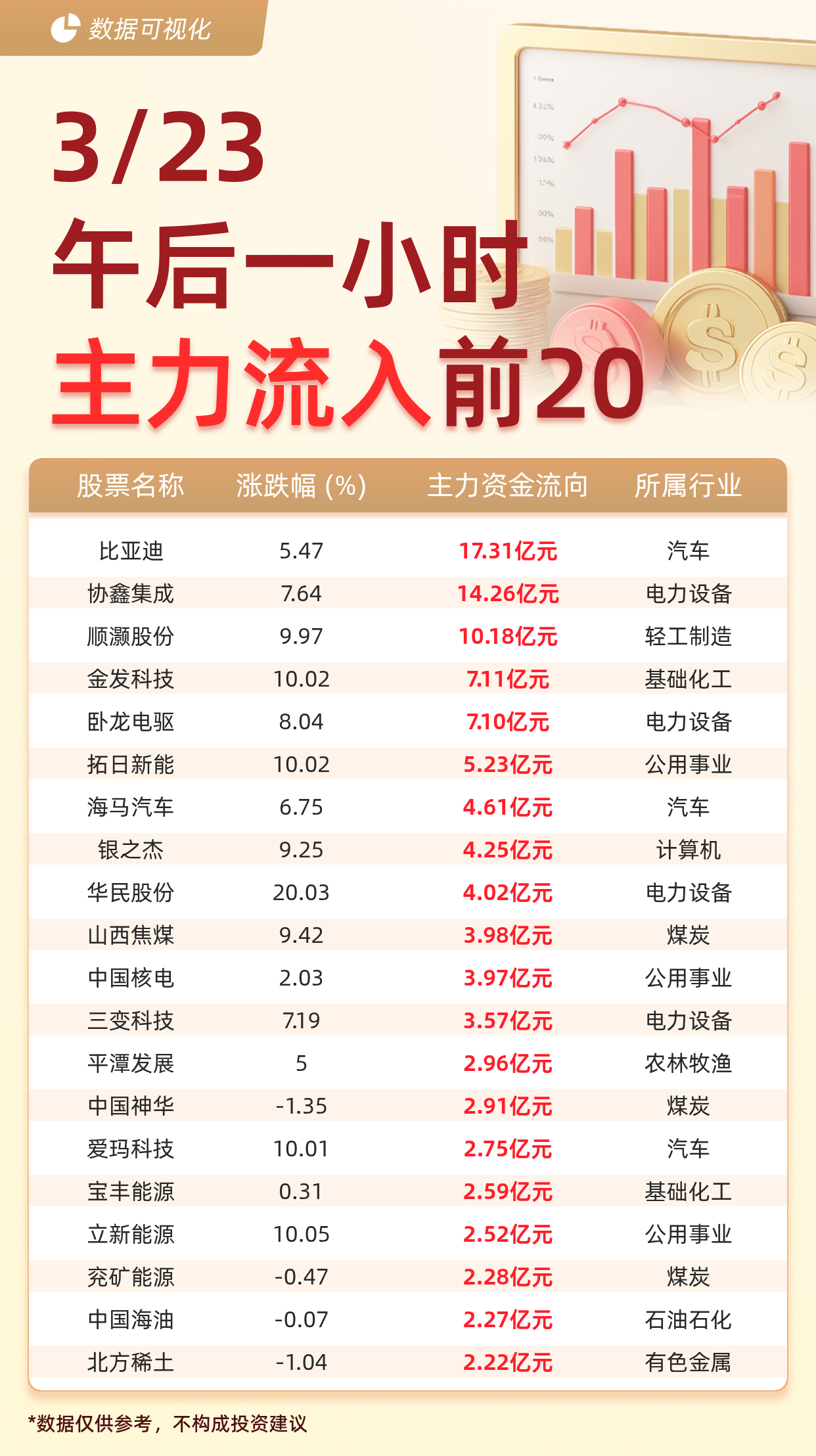
主力资金流入前20:比亚迪流入17.31亿元、协鑫集成流入14.26亿元
Jin Rong Jie· 2026-03-23 06:29
Core Insights - The main focus of the news is the significant inflow of capital into various stocks, highlighting the top 20 stocks by capital inflow as of March 23, with notable performances in sectors such as automotive, power equipment, and coal [1][2][3] Group 1: Stock Performance - BYD saw a capital inflow of 1.731 billion, with a price increase of 5.47% [2] - GCL-Poly Energy experienced a capital inflow of 1.426 billion, with a price increase of 7.64% [2] - Shunhao Co. reported a capital inflow of 1.018 billion, with a price increase of 9.97% [2] - Jinfat Technology had a capital inflow of 711 million, with a price increase of 10.02% [2] - Wolong Electric Drive received a capital inflow of 710 million, with a price increase of 8.04% [2] Group 2: Sector Analysis - The automotive sector, represented by BYD and Haima Automobile, showed strong capital inflows, indicating investor confidence [1][2] - The power equipment sector, including GCL-Poly Energy and Wolong Electric Drive, also attracted significant capital, reflecting growth potential [1][2] - The coal sector, represented by Shanxi Coal and China Shenhua, displayed mixed performance with varying capital inflows and stock price changes [1][3]




电力设备行业周报:能源安全重估催生新能源、储能与电网战略机遇,宇树科技IPO受理提升人形机器人关注度-20260323
Huaxin Securities· 2026-03-23 06:10
Investment Rating - The report maintains a "Recommended" rating for the electric power equipment sector [6]. Core Viewpoints - The escalation of the Iranian situation has evolved from traditional geopolitical conflicts into a systemic shock to the global energy supply system, significantly strengthening the logic of energy security, which is expected to become a long-term pricing mainline [5][14]. - The conflict has led to a re-evaluation of the "security attributes" of the global energy system, reshaping energy allocation models and macro transmission paths, with countries shifting towards "self-sufficiency and diversified alternatives" [15][16]. - The report identifies three main investment directions in the A-share market: increased demand for renewable energy generation, enhanced strategic position and profitability of energy storage, and accelerated investment cycles in power grid and electrical equipment [5][16]. Summary by Sections Investment Viewpoints - The report highlights the strategic opportunities in renewable energy, energy storage, and power grid sectors due to the re-evaluation of energy security [14]. - It suggests focusing on companies like Goldwind Technology, Daikin Heavy Industries, and others within the wind power industry, which are expected to benefit from cost and delivery advantages [6][18]. Industry Dynamics - The report notes that the electric power equipment sector has shown a significant performance increase, with a 53.7% rise over the past 12 months, compared to a 16.7% increase in the CSI 300 index [2]. - The report also tracks the performance of the photovoltaic industry, indicating a 9.9% growth in solar power generation in the first two months of 2026 [20]. Key Companies and Profit Forecasts - The report provides profit forecasts for key companies, including: - Goldwind Technology (002202.SZ): EPS forecast of 0.44 in 2024, 0.64 in 2025, and 0.78 in 2026, with a "Buy" rating [19]. - Daikin Heavy Industries (002487.SZ): EPS forecast of 0.74 in 2024, 1.36 in 2025, and 1.96 in 2026, also with a "Buy" rating [19]. - Other companies mentioned include TianShun Wind Energy, Zhenjiang Co., and Zhongji United, with varying ratings and forecasts [19].
每日市场观察-20260323
Caida Securities· 2026-03-23 05:13
Market Overview - On March 20, the market indices closed lower with a trading volume of 2.29 trillion, an increase of approximately 160 billion from the previous trading day[1] - The Shanghai Composite Index fell by 1.24%, while the Shenzhen Component decreased by 0.25%, and the ChiNext Index rose by 1.3%[4] Industry Performance - Most industries experienced declines, particularly in computer, military, media, chemical, and oil sectors, while only a few, such as power equipment and communication, showed gains[1] - The market sentiment remains unstable, with significant fluctuations observed in various sectors, despite some temporary rebounds[1] Monetary Policy - The People's Bank of China emphasized maintaining stability in financial markets, including stocks, bonds, and foreign exchange, indicating a potential liquidity support mechanism for non-bank financial institutions[1] Fund Flows - On March 20, net outflow from the Shanghai Stock Exchange was 14.153 billion, while the Shenzhen Stock Exchange saw a net inflow of 12.275 billion[5] - The top three sectors for capital inflow were photovoltaic equipment, batteries, and communication devices, while IT services, software development, and communication services saw the most outflows[5] Economic Indicators - The March Loan Prime Rate (LPR) remained unchanged, with the 5-year LPR at 3.5% and the 1-year LPR at 3%[8] Employment Initiatives - The Ministry of Human Resources and Social Security and the Ministry of Finance announced measures to enhance youth employment, particularly focusing on private enterprises and advanced manufacturing sectors[9]
未知机构:光大电新周观点0322高切低行情延续围绕能源安全与业绩主线布局-20260323
未知机构· 2026-03-23 02:25
Summary of Conference Call Notes Industry Overview - The current geopolitical situation in Iran has escalated, leading to attacks on energy infrastructure, which has resulted in increased volatility in energy prices and heightened concerns about stagflation [1][2] - The market is currently focused on performance metrics, with a notable trend of "high cut, low" in trading [1] Key Insights on Specific Sectors Electric New Energy Sector - The "North America electricity shortage" supply chain, which previously had high demand and valuation, is undergoing adjustments [1] - The household/commercial storage and European offshore wind sectors, which are closely related to the energy crisis and European natural gas prices, are performing well [1][2] - The photovoltaic sector has seen a rebound due to Tesla's plans to procure photovoltaic equipment, indicating a positive market reaction [1][3] Focused Companies - Key companies to watch include: - **Photovoltaic Sector**: JinkoSolar, Foster, Jiejia Weichuang, and Laplace [3] - **Energy Storage and Lithium Battery Sector**: Ningde Times, Defu Technology, and Sunshine Power [4] - **Electric Equipment Sector**: Teruid, Siyuan Electric, and Sifang Co. [5] Future Outlook - The photovoltaic sector is expected to see sustained catalysts if North American orders are fulfilled, potentially driving stock price rebounds [3] - The logic behind the North American electricity shortage remains strong, with long-term optimism, although short-term volatility in high-valued stocks may increase [5] Risks - Potential risks include domestic and international policy changes regarding new energy, as well as demand and technological development not meeting expectations [6]