
贵金属

Search documents
未知机构:天风金属沃什上任不终结贵金属牛市维持中长期看好静待降波260201-20260202
未知机构· 2026-02-02 02:00
【天风金属】沃什上任不终结贵金属牛市,维持中长期看好,静待降波260201 本周贵金属市场行情极致波动,回调的trigger是特朗普提名偏鹰的凯文沃什为联储主席,在波动率已较高的背 景下,市场急需一个卖出理由释放波动,最终造成了市场剧烈调整。 ▪沃什的主张:政治上合理、实操上矛盾,"明鹰实鸽"概率高,也难以逆转贵金属牛市底层逻辑 沃什主张的"缩表+降息"路径既满足了重塑财政 【天风金属】沃什上任不终结贵金属牛市,维持中长期看好,静待降波260201 本周贵金属市场行情极致波动,回调的trigger是特朗普提名偏鹰的凯文沃什为联储主席,在波动率已较高的背 景下,市场急需一个卖出理由释放波动,最终造成了市场剧烈调整。 因此在执行层面,降息举动能见度高,#但缩表举动更多停留在"预期管理"上,对市场流动性影响有限,也更不意 味着将终结贵金属牛市。 ▪黄金牛市底层逻辑不改,静待降波 由于沃什的政策对重塑美国财政纪律见效有限,#则由美元信用问题推动的黄金牛市趋势不变。 沃什主张的"缩表+降息"路径既满足了重塑财政纪律、强化美元信用的#政策诉求,又满足了托底经济、稳固金融 市场、响应中期选举的#政治诉求。 且提名沃什也#回 ...
贵研铂业股价跌9.98%,南方基金旗下1只基金位居十大流通股东,持有486.65万股浮亏损失1143.63万元
Xin Lang Cai Jing· 2026-02-02 01:57
Group 1 - The core point of the news is that Guiyan Platinum Industry experienced a significant drop of 9.98% in its stock price, reaching 21.20 yuan per share, with a trading volume of 77.1 million yuan and a turnover rate of 0.48%, resulting in a total market capitalization of 16.108 billion yuan [1] - Guiyan Platinum Industry, established on September 25, 2000, and listed on May 16, 2003, is located in Kunming, Yunnan Province, and specializes in the research, development, and production of precious metals and materials [1] - The company's main business revenue composition includes: 36.21% from precious metal recycling products, 35.17% from precious metal supply services, 16.05% from special functional materials, 8.65% from precursor materials, 3.01% from automotive catalytic purifiers, 0.59% from information functional materials, 0.21% from industrial catalysts, and 0.10% from other sources [1] Group 2 - From the perspective of the top ten circulating shareholders, a fund under Southern Fund is among the top shareholders of Guiyan Platinum Industry, specifically the Southern CSI 1000 ETF (512100), which reduced its holdings by 47,600 shares in the third quarter, now holding 4.8665 million shares, accounting for 0.65% of circulating shares [2] - The Southern CSI 1000 ETF (512100) was established on September 29, 2016, with a latest scale of 78.996 billion yuan, and has achieved a return of 8.67% this year, ranking 1569 out of 5579 in its category; over the past year, it has returned 43.07%, ranking 1731 out of 4285 [2] - The fund manager of Southern CSI 1000 ETF (512100) is Cui Lei, who has been in the position for 7 years and 89 days, managing a total fund asset scale of 137.02 billion yuan, with the best fund return during the tenure being 279.97% and the worst being -15.93% [2]

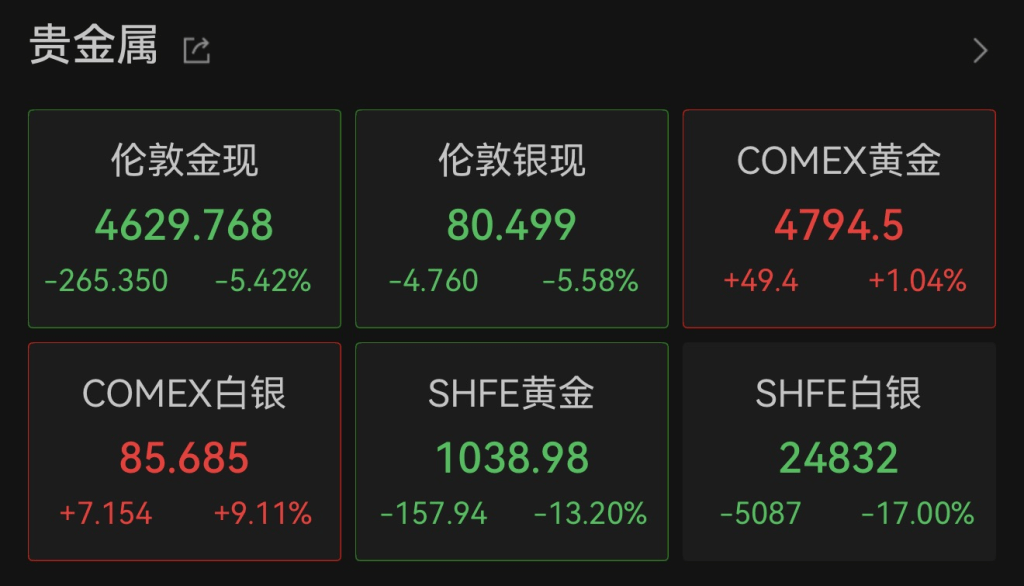
贵金属高位跳水后反弹乏力,现货黄金价格一度跌超6%
Sou Hu Cai Jing· 2026-02-02 01:56
贵金属价格高位"跳水"后反弹乏力。 国泰基金认为短期黄金或存在反弹窗口。首先,当前贵金属隐含波动率已升至极端水平,参考2020年3月末黄金大幅回撤后波动率冲高回落的历史 经验,短期降波修复行情值得期待。其次,市场对"降息+缩表"的定价可能过于抢跑。上周五黄金回调的直接催化是沃什获提名,市场预期其将推 行"降息+缩表"的保守主义货币政策从而推动美元走强,但本轮回调更多反映的是前期涨幅过大导致多头结构脆弱、对利空催化敏感度较高,而非 基本面的根本性转向——美债市场对该消息反应平淡、基本平收即为佐证。 从降息预期来看,国泰基金表示,据CME FedWatch数据,新主席人选公布前后,市场对年内首次降息时点的预期均稳定在6月,全年降息两次的 判断亦未改变;从缩表预期来看,本周FOMC会议延续了自去年12月以来的扩表操作,规模维持在每月400亿美元,市场对"缩表"的预期可能过于 超前,短期现实仍是联储扩表。此外,沃什的政策倾向主要源于其历史表态,但作为特朗普认可的人选,其立场是否会因政治考量而调整仍存不 确定性。 北京时间周一早盘,现货黄金(伦敦金现)失守4700美元/盎司关口,盘中跌逾6%;伦敦银现盘中大跌超7%。低 ...

资讯早间报:隔夜夜盘市场走势-20260202
Guan Tong Qi Huo· 2026-02-02 01:53
1. Report Industry Investment Rating - No information provided in the report. 2. Core Viewpoints - The overall trend of the domestic commodity futures market is mostly downward, with significant drops in precious metals and base metals, while some energy - chemical products show slight increases. In the financial market, the A - share market has different performance trends in various sectors, and the real estate market shows signs of stabilization. The global economic and political situation is complex, with potential impacts on the financial and commodity markets [4][41][42] 3. Summary by Directory Overnight Night - Market Trends - In the domestic commodity futures market on the 30th, most products closed lower. Shanghai silver hit the daily limit down with a 17% drop, Shanghai gold fell over 9%, and other metals like Shanghai tin, copper, and nickel also had significant declines. However, caustic soda rose nearly 3% and PVC rose over 2%. In the London base metals market, all metals declined. In the oil market, the US oil and Brent oil main contracts rose slightly, and the increase in net long positions in Brent crude reflected a bullish sentiment [4] Important Information Macroeconomic Information - Israel and the US are collaborating on potential military actions against Iran. China's National Development and Reform Commission and National Energy Administration issued a notice to improve the capacity price mechanism on the power generation side. In 2025, China's national general public budget revenue was 21.6 trillion yuan, a 1.7% decrease from 2024. Shipping indices declined, while the prices of polysilicon and silicon wafers increased at the end of 2025, and the price of thermal coal also rose. The China Securities Regulatory Commission solicited opinions on regulatory changes, and Trump nominated Kevin Warsh as the Fed Chair. The Fed's Bostic suggested no need for interest rate cuts. The manufacturing PMI in January was 49.3%, a 0.8 - percentage - point drop from the previous month [7][8][9][11][12] Energy - Chemical Futures - The output and capacity utilization of Chinese styrene factories decreased slightly in the week ending January 29. The US relaxed sanctions on Venezuela's downstream oil production. OPEC+ decided to suspend production increase in March 2026 due to seasonal factors [14][15][16] Metal Futures - The Thai Futures Exchange temporarily suspended trading of online gold futures. Chinese banks issued risk warnings and adjusted business rules for precious metal investments. The price of Indonesian nickel ore increased, and the Shanghai Futures Exchange will conduct a simulation trading of nickel futures and options. The lithium ore sector declined, but companies reported normal operations. A lead refinery in East China planned to suspend production, and the Osaka Exchange triggered a "circuit - breaker" for platinum futures. The production and sales of lithium concentrate by Pilbara had different trends, and the margin requirements for gold and silver futures were increased [18][21][23][26][27] Black - Series Futures - China adjusted the lower limit of the medium - and long - term coal - power market trading price. In 2025, China's steel exports increased in volume but decreased in price. The purchase prices of coke by steel mills in Shandong and Hebei increased. A coal mine in Inner Mongolia passed the resumption inspection. The inventory and daily throughput of imported iron ore in ports changed, and the situation of steel mills' production and profitability also had corresponding changes. The Indonesian coal industry faced production quota cuts [29][31][33] Agricultural Product Futures - Indonesia raised the reference price of crude palm oil in February. The actual soybean crushing volume of domestic oil mills increased in the 5th week of 2026. The inventory of imported cotton at ports increased, and the pig - breeding profits changed. The soybean sowing in Argentina was almost completed, and the global sugar supply balance and Brazilian sugar production forecasts were adjusted [35][37][38] Financial Market Finance - From a resource boom to a cycle boom, the price - increase clues may run through the first quarter in the A - share market. The performance forecasts of A - share listed companies in 2025 showed different results in various industries. The performance of 29 securities firms in 2025 was mostly positive. The February gold - stock lists of securities firms were concentrated in certain industries, and the semiconductor and real estate sectors had different performance trends. The telecom service VAT rate of Chinese telecom companies was adjusted, and a fund had a trading suspension [40][41][42][43] Industry - In 2025, the "trade - in" policy boosted the sales revenue of household appliances and communication equipment retail industries, and rural consumption increased. China's shipbuilding industry maintained its leading position globally. Most domestic car companies had year - on - year sales growth in January. The price of second - hand housing in 100 cities decreased, while the new - house price had a structural increase. The global AI computing power construction drove the upgrade of power - equipment transformers. The scale of "fixed - income +" funds reached a record high [45][46][47] Overseas - Trump hoped the Fed Chair nominee Warsh could lower interest rates. A new round of tripartite talks between Ukraine, the US, and Russia was scheduled. The Indian government's borrowing in the 2026 - 27 fiscal year would reach a record high, and the deficit and debt - to - GDP ratios were expected to change. South Korea's semiconductor exports in January increased significantly, driving up the total export volume [48] International Stock Markets - The Indian and Saudi stock markets tumbled on February 1. India's proposed increase in securities trading taxes on stock index futures and options led to a sharp decline in the Indian stock market, and the Saudi stock market also had a significant drop [49] Commodity - The international gold price had the largest single - day decline in 40 years on January 30, and experts advised caution. The price of pure benzene rebounded strongly in January [50] Bond - Convertible bond funds became the focus in the context of the overall underperformance of bond funds, with some funds having high yields [51] Foreign Exchange - New regulations on RMB cash payment came into effect on February 1, and the Bulgarian lev withdrew from circulation on the same day [52][54] Upcoming Events - The Bank of Japan will release the summary of the January monetary policy meeting, the People's Bank of China will have 150.5 billion yuan of reverse repurchases due, the Deputy Governor of the Bank of England will give a speech, the Asia Virtual Reality XR Industry Exhibition will be held, there will be new stock subscriptions, and the Atlanta Fed President will speak [56]
英大证券晨会纪要-20260202
British Securities· 2026-02-02 01:47
Group 1 - The report indicates that the A-share market is currently experiencing a significant rotation of themes, shifting from technology stocks to a focus on heavyweight stocks, with a notable reduction in the profitability effect [2][13] - The market is in a cooling cycle, with a decrease in trading volume and a prevailing cautious sentiment among investors as the Spring Festival approaches, leading to potential seasonal tightening of market liquidity [2][13] - The core logic supporting the market's medium-term positive outlook remains unchanged, driven by favorable domestic policies and capital [2][13] Group 2 - The report forecasts an increase in market volatility and a trend towards balanced styles in 2026, emphasizing the importance of following the "14th Five-Year Plan" and subsequent policy directions [3][13] - Investors are advised to focus on sectors with actual performance or future earnings support, including technology growth stocks, cyclical commodities, domestic consumption, dividend stocks, and sectors with improving economic conditions [3][13] - The semiconductor sector is highlighted as a key area for investment, with expectations of continued growth driven by digital transformation and geopolitical factors, while cautioning against purely speculative stocks lacking performance support [10][12] Group 3 - The agricultural and tourism sectors are noted for their active performance, supported by government policies aimed at stimulating consumption and shifting the macro policy focus towards consumer-driven growth [8][12] - The report identifies structural investment opportunities in the consumer sector, particularly in areas aligned with demographic trends and service consumption upgrades [8][12] - The report also discusses the performance of the precious metals sector, which has seen significant price increases due to various factors, including monetary policy shifts and geopolitical tensions, but advises against chasing prices after recent gains [11][12]
A股开盘速递 | 沪指跌0.93% 电网设备板块表现活跃
智通财经网· 2026-02-02 01:45
板块轮动预计仍是春节前的主基调,关注轮动中的结构性机会。主线一,科技创新主题。短期来看,关 注细分板块之间的轮动补涨机会。前期强势的商业航天、AI应用等主题受到产业趋势催化,但后续内 部分化或有所加大。主线二,制造业、资源板块盈利修复路径清晰。有色金属行情波动加大,业绩预告 显示基本面支撑较强,关注短线回调后的配置机会。辅助线一,消费品以旧换新政策延续,服务消费再 迎重磅政策利好,扩大内需导向下消费板块存在布局窗口。辅助线二,出海趋势带动企业盈利空间打 开。 申万宏源:春节之前市场可能会进入短暂的震荡修正阶段,但仍建议持股过节 申万宏源表示,本轮春季行情仍然值得期待,后续市场无论是在政策方面,还是在基本面层面,未来几 个月或仍有利好消息。不过市场表现未必会一帆风顺,春节之前,市场可能会进入短暂的震荡修正阶 段。结构性牛市突破前期震荡区间后,通常会出现阶段性的调整。但仍建议投资者持股过节,在春节之 后,市场交易热度会再度回升,结合假期高频数据以及产业热点消息,之后市场可能会迎来新一轮的上 涨行情。 A股三大股指开盘涨跌不一,沪指跌0.93%,创业板指涨0.65%。盘面上,电网设备板块表现活跃,贵金 属、油气开采 ...
宏观金融类:文字早评2026/02/02星期一-20260202
Wu Kuang Qi Huo· 2026-02-02 01:42
Report Industry Investment Rating No relevant information provided. Core Viewpoints of the Report - In the medium - long term, policies support the capital market, and the strategy for the stock index is to buy on dips [4]. - For treasury bonds, the economic recovery momentum's sustainability needs observation, and the market is expected to continue to fluctuate [8]. - For precious metals, temporarily hold a wait - and - see attitude due to multiple factors [13]. - For non - ferrous metals, although there are short - term pressures, some metals may stabilize in the future [16][19]. - For black building materials, the market is in a bottom - game stage with short - term range - bound fluctuations [34]. - For energy chemicals, different strategies such as taking profit on rallies, short - selling, etc. are proposed for different products [61][65]. - For agricultural products, different strategies are given according to the supply - demand situation of different products, such as short - selling on rebounds, waiting for callbacks to buy, etc. [84][92] Summary by Related Catalogs Macro - finance Stock Index - **Market Information**: Trump nominated Kevin Warsh as the next Fed chair, China's January 2026 manufacturing PMI was 49.3%, down 0.8 ppts from the previous month, and precious metals tumbled [2]. - **Strategy**: Adopt a strategy of buying on dips in the long - run as policies support the capital market, but pay attention to short - term market rhythms [4]. Treasury Bond - **Market Information**: TL, T, TF, and TS contracts had different price changes on Friday. The government emphasized the economic work in 2026, and the 2025 national general public budget revenue decreased by 1.7% compared to 2024 [5]. - **Strategy**: The economic recovery momentum's sustainability is uncertain, and the bond market is expected to continue to fluctuate. Pay attention to the impact of the stock market, government bond supply, and inflation expectations [8]. Precious Metals - **Market Information**: Gold and silver prices plunged due to Warsh's nomination and other factors. The short - term dollar is expected to remain strong, and emerging markets may face capital outflows and currency depreciation [9]. - **Strategy**: Temporarily hold a wait - and - see attitude. The reference range for the Shanghai gold main contract is 950 - 1160 yuan/gram, and for the Shanghai silver main contract is 18000 - 22450 yuan/kilogram [13]. Non - ferrous Metals Copper - **Market Information**: Affected by geopolitical and Fed news, the copper price fell on Friday. LME copper inventory decreased, and domestic inventory increased [15]. - **Strategy**: Although there are short - term pressure factors, the copper price is expected to stabilize gradually. The reference range for the Shanghai copper main contract is 102000 - 106000 yuan/ton, and for LME copper 3M is 12600 - 13500 dollars/ton [16]. Aluminum - **Market Information**: The aluminum price fell on Friday. Domestic inventory increased slightly, and LME inventory decreased [17]. - **Strategy**: If the precious - metal volatility decreases and domestic inventory performs better than the seasonality, the aluminum price is expected to stabilize. The reference range for the Shanghai aluminum main contract is 24300 - 25000 yuan/ton, and for LME aluminum 3M is 3080 - 3180 dollars/ton [19]. Other Non - ferrous Metals - **Zinc**: The zinc price followed the sector. Pay attention to the impact of the ISM manufacturing PMI data on February 2nd [20]. - **Lead**: The lead industry situation is weak. Pay attention to the impact of the ISM manufacturing PMI data on February 2nd [21]. - **Nickel**: The nickel price has a large short - term decline risk. It is recommended to sell on rallies. The reference range for the Shanghai nickel price is 12.0 - 15.0 million yuan/ton, and for LME nickel 3M is 1.6 - 1.8 million dollars/ton [22]. - **Tin**: The tin price may have a large short - term correction risk. It is recommended to wait and see. The reference range for the domestic main contract is 370000 - 430000 yuan/ton, and for overseas LME tin is 47000 - 51000 dollars/ton [24]. - **Carbonate Lithium**: The lithium price has accelerated its decline. It is recommended to wait and see or take a light - position approach. The reference range for the Guangzhou Futures Exchange carbonate lithium main contract is 136000 - 158000 yuan/ton [26]. - **Alumina**: The alumina price is expected to decline in the short - term. It is recommended to wait and see. The reference range for the domestic main contract AO2605 is 2700 - 2950 yuan/ton [28]. - **Stainless Steel**: Maintain a bullish view. It is recommended to lightly build long positions around 14000 yuan/ton. The reference range for the main contract is 13800 - 14700 yuan/ton [30]. - **Casting Aluminum Alloy**: The short - term price is supported by supply - side disturbances [32]. Black Building Materials Steel - **Market Information**: The prices of rebar and hot - rolled coil decreased on Friday. The inventory of rebar is accumulating, while that of hot - rolled coil is slightly decreasing [34]. - **Strategy**: The black - building materials market is in a bottom - game stage with short - term range - bound fluctuations. Pay attention to inventory changes, plate - demand recovery, and "dual - carbon" policies [34]. Iron Ore - **Market Information**: The iron - ore main contract price fell on Friday. The port inventory is at a high level, and the steel - mill inventory is increasing [35]. - **Strategy**: The iron - ore price is expected to fluctuate in the short - term. Pay attention to steel - mill restocking and iron - water production rhythms [36]. Coking Coal and Coke - **Market Information**: The prices of coking coal and coke fluctuated on January 30th. The coking - coal price is in a rebound cycle, and the coke price is approaching a long - term downward trend line [37]. - **Strategy**: The prices of coking coal and coke are expected to continue to fluctuate in the short - term. Pay attention to market - sentiment fluctuations [41]. Glass and Soda Ash - **Glass**: The glass price increased on Friday, and the inventory decreased. The market is expected to fluctuate in the short - term. The reference range for the main contract is 1025 - 1125 yuan/ton [42][43]. - **Soda Ash**: The soda - ash price increased on Friday, and the inventory increased. The market is expected to have a weak and stable fluctuation in the short - term. The reference range for the main contract is 1160 - 1250 yuan/ton [44][46]. Manganese Silicon and Ferrosilicon - **Market Information**: The prices of manganese silicon and ferrosilicon decreased on January 30th. The prices of both are in an oscillatory state [47]. - **Strategy**: The future market is affected by the overall market sentiment and cost - supply factors. Pay attention to manganese - ore supply and "dual - carbon" policies [49][50]. Industrial Silicon and Polysilicon - **Industrial Silicon**: The industrial - silicon price fell on Friday. The supply is expected to decrease, and the demand is weak. The price is expected to oscillate. Pay attention to the implementation of the large - factory production - reduction plan [51][52]. - **Polysilicon**: The polysilicon price fell on Friday. The supply is expected to contract in the first quarter, and the futures market is expected to be under pressure. Pay attention to terminal - demand feedback and policy adjustments [53][54]. Energy Chemicals Rubber - **Market Information**: The rubber market has large price fluctuations. The long and short sides have different views. The tire - enterprise开工率 has different changes, and the inventory is increasing [56][57]. - **Strategy**: Trade according to the short - term disk, set stop - losses, and consider building positions by buying the NR main contract and short - selling the RU2609 contract [58]. Crude Oil - **Market Information**: The crude - oil main contract price increased, and the inventories of some refined oils changed. The gasoline inventory increased, while the diesel and fuel - oil inventories decreased [59]. - **Strategy**: Take profit on rallies and focus on mid - term layout [61]. Other Energy Chemicals - **Methanol**: The current price has priced in most of the geopolitical premium, and the upside space is under pressure [63]. - **Urea**: The import window is opened, and the fundamentals are bearish. It is recommended to short - sell on rallies [65]. - **Pure Benzene and Styrene**: The pure - benzene price increased, and the styrene price decreased. The non - integrated profit of styrene has been repaired, and it is recommended to gradually take profit [66][68]. - **PVC**: The PVC market has a situation of strong supply and weak demand. Pay attention to changes in production capacity and开工率 [69][70]. - **Ethylene Glycol**: The ethylene - glycol market has a high load and high inventory. The supply - demand situation needs to be improved through production reduction [71][72]. - **PTA**: The PTA market is in the Spring - Festival inventory - accumulation stage. Pay attention to the risk of processing - fee correction and mid - term long - position opportunities [73][74]. - **Para - Xylene**: The PX market is expected to accumulate inventory before the maintenance season. The mid - term pattern is good, and pay attention to long - position opportunities following the crude - oil price [75][76]. - **Polyethylene PE**: The PE futures price fell. The supply pressure is relieved, and the demand is in the off - season [77][79]. - **Polypropylene PP**: The PP futures price fell. The supply pressure is relieved, and the demand is seasonally fluctuating. It is recommended to go long on the PP5 - 9 spread on dips [80][81]. Agricultural Products Live Pigs - **Market Information**: The pig price mainly increased over the weekend. The supply is large in the short - term, and the demand is relatively stable [83]. - **Strategy**: Short - sell on rebounds in the short - term and pay attention to the long - term support level [84]. Eggs - **Market Information**: The egg price generally decreased over the weekend. The supply is normal, and the demand is weak [85]. - **Strategy**: The near - month contract may oscillate weakly, and the far - month contract may continue to correct its valuation. It is recommended to short - sell [86]. Soybean and Rapeseed Meal - **Market Information**: The protein - meal futures price fell on Friday. The domestic soybean and soybean - meal inventories decreased. The overall balance sheet is better than that of the 2024/25 season [87][89]. - **Strategy**: The protein - meal price may be bottoming out [89]. Oils and Fats - **Market Information**: The oil - and - fat futures price fell on Friday. The Malaysian palm - oil production decreased in January, and the domestic three - major oil inventories decreased [91][92]. - **Strategy**: Wait for a callback and then try to go long [92]. Sugar - **Market Information**: The sugar futures price fluctuated on Friday. The Brazilian and Indian sugar productions had different changes, and China's sugar imports increased [93]. - **Strategy**: Wait for the international sugar price to rebound after the northern - hemisphere harvest in February. Temporarily wait and see in the domestic market [94]. Cotton - **Market Information**: The cotton futures price fell on Friday. The spinning - mill开机率 decreased, and the global cotton production and consumption have different changes [96][97]. - **Strategy**: The cotton price has room to rise in the long - term. Pay attention to low - buying opportunities before the Spring Festival [98].
黄金、有色金属板块持续下跌 中国黄金等多股跌停
Feng Huang Wang Cai Jing· 2026-02-02 01:41
Group 1 - The A-share market experienced a significant decline in the gold and non-ferrous metal sectors, with multiple stocks hitting the daily limit down, including China Gold, Hunan Gold, and Zhongjin Gold [1] - In the Hong Kong market, gold and non-ferrous metal stocks opened lower, with China Gold International down 12.28% and Lingbao Gold down 13.87% [1] - On February 2, spot gold prices fell below $4,700, with a daily drop exceeding 4%, while silver initially dropped over 10% before recovering slightly to a decline of over 2% [1] Group 2 - Domestic precious metal futures opened lower across the board, with palladium dropping over 15%, and Shanghai gold down over 13% [1] - On January 31, gold experienced a historic crash with an intraday drop exceeding 12%, ultimately closing down 9.25%, while silver saw an even larger decline of 36% at its peak, closing down 26.4% [1] - CITIC Securities' latest report predicts that precious metals will benefit from monetary attributes and sustained risk aversion, with gold expected to reach $6,000 per ounce by 2026 and silver potentially rising to $120 per ounce due to extreme shortages and trading enthusiasm [1]




贵金属板块全线走弱,晓程科技“20cm”跌停
Xin Lang Cai Jing· 2026-02-02 01:39
2月2日上午,贵金属板块全线走弱,晓程科技"20cm"跌停,湖南黄金、西部黄金、四川黄金等多股跌 停。消息面上,1月30日,国际贵金属市场出现崩盘式跳水,现货黄金盘中最高跌超12%,最终收跌 9.52%,报4865美元/盎司;现货白银盘中一度暴跌36%,最终收跌26.9%,报84.7美元/盎司。 ...


A股开盘:沪指跌0.93%失守4100点,创业板涨0.65%,黄金及有色金属板块现跌停,电网设备概念股走强
Jin Rong Jie· 2026-02-02 01:38
2月2日,A股三大股指开盘走势分化,其中上证综指下跌38.24点,跌幅0.93%报4079.71点;深证成指下 跌77.02点,跌幅0.54%报14128.87点;沪深300指数下跌32.06点,跌幅0.68%报4674.28点;创业板指数 上涨21.79点,涨幅0.65%报3368.14点;科创50指数下跌16.59点,跌幅1.1%报1492.81点;贵金属(核心 股)板块全线走弱,晓程科技20cm跌停,恒邦股份、招金黄金、四川黄金、西部黄金、赤峰黄金等多 股跌停;电网设备板块盘初走强,顺钠股份、白云电器等多股涨停,亿能电力涨超8%,安靠智电、三 变科技、新特电力等个股跟涨;光伏(核心股)设备、航空机场、美容护理等概念涨幅居前。 盘面上,市场焦点股锋龙股份(18板)竞价跌停,复牌的嘉美包装(26天17板)低开10.01%,AI应用 端的天地在线(10天6板)高开1.45%,并购重组的湖南黄金(5板)竞价跌停,化工(核心股)股百川 股份(3板)高开3.13%、万丰股份(2板)竞价涨停,机器人(核心股)概念股天奇股份(5天3板)高 开2.18%,食品饮料板块皇台酒业(2板)低开4.33%、中信尼雅(2板)低开4 ...
