通信

Search documents
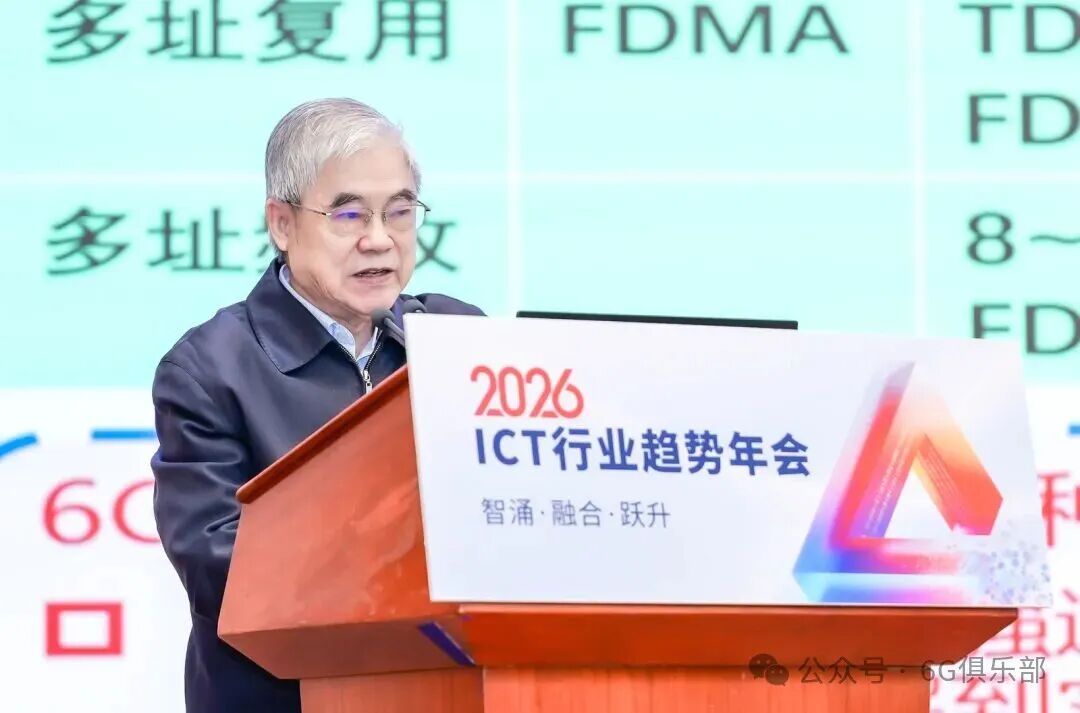
中国工程院邬贺铨院士:2026年ICT发展的七大趋势
Xin Lang Cai Jing· 2026-01-26 01:55
Core Insights - The report by the Chinese Academy of Engineering Academician Wu Hequan presents seven predictions for the development of the ICT industry by 2026, emphasizing the need for innovation and adaptation in the face of evolving technologies [1] Group 1: 6G Standardization and AI Integration - 6G standardization is expected to officially commence in 2026, but it will face more uncertainties compared to previous generations like 3G and 5G, as global operators and equipment suppliers have not yet reached a consensus [3][10] - Key technical directions for 6G include integrated modulation coding, joint source and channel coding, and collaborative resource management, with a focus on AI to unlock potential in wireless communication [3][10] Group 2: AI and Intelligent Terminal Transformation - The deep integration of large models and intelligent agents is transforming communication terminal models, leading to a shift from passive tools to proactive service partners [4][11] - The impact of AI intelligent terminals in 2026 is expected to include the proliferation of dedicated AI acceleration modules, standardization of AI agent frameworks, and a shift in focus from hardware to software and services [4][11] Group 3: New Digital Interaction Paradigms - The traditional app-based interaction model is being replaced by AI-driven systems that allow users to complete tasks through simple voice or text commands, fundamentally reshaping user engagement with digital services [5][12] - The new digital landscape will see intelligent agents as gatekeepers, with operating systems and chip manufacturers gaining significant control over service access and resource allocation [5][12] Group 4: Transition to Semantic Addressing - A shift from traditional DNS to semantic addressing is anticipated, which will decouple content from location and facilitate dynamic service assembly based on user intent [6][13] - This new paradigm will simplify device management and interoperability, allowing for more intuitive interactions in both consumer and business applications [6][13] Group 5: IPv6-Only Future - The transition to an IPv6-only model is deemed essential, as maintaining a dual-stack system incurs high costs and security risks [7][14] - The implementation of technologies like 464XLAT will enable compatibility with IPv4 services without hardware changes, enhancing cost-effectiveness and security [7][14] Group 6: Advancements in 2B Networking - The construction of 2B networks is expected to undergo significant advancements, focusing on specialized networks that leverage multiple technologies for enhanced performance [8][15] - The integration of local and cloud computing will allow small and medium enterprises to access intelligent computing resources at lower costs [8][15] Group 7: Data Element Action Plan - By 2026, the goal is to complete the establishment of 30 trusted data space pilot projects, focusing on building diverse data set systems and ensuring secure data circulation [9][16] - The transition from foundational infrastructure to value realization will empower enterprises to utilize data resources effectively, driving high-quality development in the digital economy [9][16]

万联晨会-20260126
Wanlian Securities· 2026-01-26 01:42
Core Insights - The A-share market saw collective gains last Friday, with the Shanghai Composite Index rising by 0.33%, the Shenzhen Component Index by 0.79%, and the ChiNext Index by 0.63%. The total trading volume in the Shanghai and Shenzhen markets reached 30,849.73 billion yuan [1][7] - In terms of industry performance, power equipment, non-ferrous metals, and national defense sectors led the gains, while communication, banking, and coal sectors lagged behind. Concept sectors such as BC batteries, perovskite batteries, and TOPCON battery concepts showed significant increases, while corn, Tonghuashun overseas 50, and soybean concepts experienced declines [1][7] Important News - Beijing has released measures to promote the development and utilization of commercial satellite remote sensing data resources from 2026 to 2030. The measures encourage capable enterprises to engage in mergers and acquisitions within the satellite data industry, aiming to create globally competitive leading enterprises [2][8] Industry Analysis - A joint document from nine government departments encourages horizontal mergers and acquisitions in the pharmaceutical retail sector. This initiative aims to enhance the professional services and health promotion functions of the pharmaceutical retail industry, establishing a better service platform for public health needs [3][9] - The document outlines several key policies, including optimizing the service of designated retail pharmacies, promoting participation in centralized drug procurement, and encouraging the integration of pharmaceutical wholesale and retail businesses. It also supports the development of commercial health insurance products tailored to the pharmaceutical retail sector [10][11] - The policy emphasizes support for prescription outflow, collaboration between retail and commercial insurance, and encourages the consolidation of retail pharmacies. This is expected to benefit leading companies in the pharmacy sector and open a window for industry consolidation [13]
中金回顾公募四季报:加仓有色、通信板块 电子、医药获减仓较多
Zhi Tong Cai Jing· 2026-01-26 00:19
Core Viewpoint - CICC reports a decrease in stock positions among public funds in Q4, with an increase in A-shares and a continued decline in Hong Kong stocks [2] Group 1: Public Fund Position Changes - In Q4, the overall stock position of public funds decreased, while A-share positions increased and Hong Kong stock positions continued to decline [2] - The Shanghai Composite Index rose by 2.2% in Q4, with the ChiNext Index down by 1.1% and the STAR Market down by 10.1% [2] - The median return of actively managed equity public funds dropped to -1.5%, marking the lowest quarterly return of the year [2] Group 2: Asset Scale and Composition - The total asset value of public funds increased from 38.1 trillion yuan to 39.5 trillion yuan in Q4, with stock assets slightly rising to over 9 trillion yuan [3] - The proportion of equity assets decreased by 0.7 percentage points to 22.9%, while bond assets increased by 0.6 percentage points to 53.4% [3] Group 3: Active Equity Fund Characteristics - The total value of actively managed equity funds decreased from 3.1 trillion yuan to 3 trillion yuan, with stock asset scale declining to 2.6 trillion yuan [4] - A-share positions rose from 71.7% to 72.3%, remaining at a relatively low level over the past decade [4] - The net redemption scale of actively managed equity funds decreased to 128.2 billion yuan in Q4 [4] Group 4: Heavyweight Stock Configuration - The concentration of holdings in leading companies decreased, with the market value of the top 100 companies held by actively managed equity funds dropping from 60.3% to 58.8% [5] - The top 50 companies' market value share fell from 47.7% to 46.7% [5] - The positions in the ChiNext increased by 1.2 percentage points to 24.9%, while the STAR Market positions decreased by 1.1 percentage points to 16.7% [5] Group 5: Sector Adjustments - Increased allocations were seen in sectors such as non-ferrous metals, communication, and non-bank financials, while reductions occurred in consumer electronics and innovative pharmaceuticals [6][7] - Non-ferrous metals saw a 2.3 percentage point increase in positions, supported by strong industry fundamentals [6] - The communication sector's position rose by 2 percentage points, while consumer electronics saw a decrease of 2.5 percentage points [7] Group 6: ETF Fund Developments - The total asset value of public ETFs rose from 6.6 trillion yuan to 7.1 trillion yuan, with stock assets accounting for 65% [8] - The total asset value of stock ETFs reached 3.8 trillion yuan, reflecting a slight increase [8] Group 7: Future Market Outlook - The A-share market is expected to show a "long-term" and "steady" trend, supported by multiple factors including industry hotspots and improved liquidity [9] - The market is anticipated to perform strongly at the beginning of the year, with trading volumes reaching new highs [9] Group 8: Investment Recommendations - Suggested areas for investment include AI technology, overseas expansion opportunities, cyclical reversals, high dividend stocks, and sectors with promising annual report highlights [10]

中金 | 公募四季报回顾:加仓有色/通信,减仓电子/医药
中金点睛· 2026-01-25 23:51
Core Viewpoint - The public fund market shows a mixed performance in Q4 2025, with a decline in stock positions and a rise in A-shares, while Hong Kong stocks continue to decrease. The overall market sentiment is influenced by various factors including US-China relations and concerns over AI valuation bubbles [1][2]. Group 1: Market Performance - In Q4 2025, the Shanghai Composite Index increased by 2.2%, while the ChiNext Index fell by 1.1% and the STAR Market Index decreased by 10.1% [1]. - The median return of actively managed equity public funds dropped to -1.5%, marking the lowest quarterly return of the year [1]. Group 2: Fund Asset Allocation - The total asset value of public funds rose from 38.1 trillion yuan to 39.5 trillion yuan, with equity assets slightly increasing to over 9 trillion yuan, but the proportion of equity assets decreased by 0.7 percentage points to 22.9% [2]. - Bond assets saw an increase in proportion by 0.6 percentage points to 53.4%, while cash assets also rose by 1.2 percentage points [2]. Group 3: Active Equity Fund Trends - The total value of actively managed equity funds decreased from 3.1 trillion yuan to 3 trillion yuan, with stock assets declining by 0.1 trillion yuan to 2.6 trillion yuan, and the equity position dropping by 1.4 percentage points to 87% [3]. - The A-share allocation in actively managed equity funds increased from 71.7% to 72.3%, although it remains at a relatively low level compared to the past decade [3]. Group 4: Sector Allocation Changes - The concentration of holdings in leading companies decreased, with the top 100 companies' market value share falling from 60.3% to 58.8% [4]. - There was an increase in allocations to sectors such as non-ferrous metals, communications, and non-bank financials, while reductions were seen in electronics and biopharmaceuticals [5]. Group 5: ETF Market Dynamics - The total asset value of public ETFs increased from 6.6 trillion yuan to 7.1 trillion yuan, with stock ETFs accounting for 3.8 trillion yuan, reflecting a slight increase [7]. - The proportion of stock assets in ETFs decreased from 67.9% to 65% [7]. Group 6: Future Market Outlook - The A-share market is expected to show a "long-term" and "steady" trend, supported by multiple factors including industry hotspots, improving profit expectations, and a favorable liquidity environment [8]. - Recommendations for future investments include focusing on sectors with growth potential such as AI technology, overseas demand, and cyclical recovery areas [9].

广发策略:从不买就跑输到买了就跑输——再看南下定价权
智通财经网· 2026-01-25 23:38
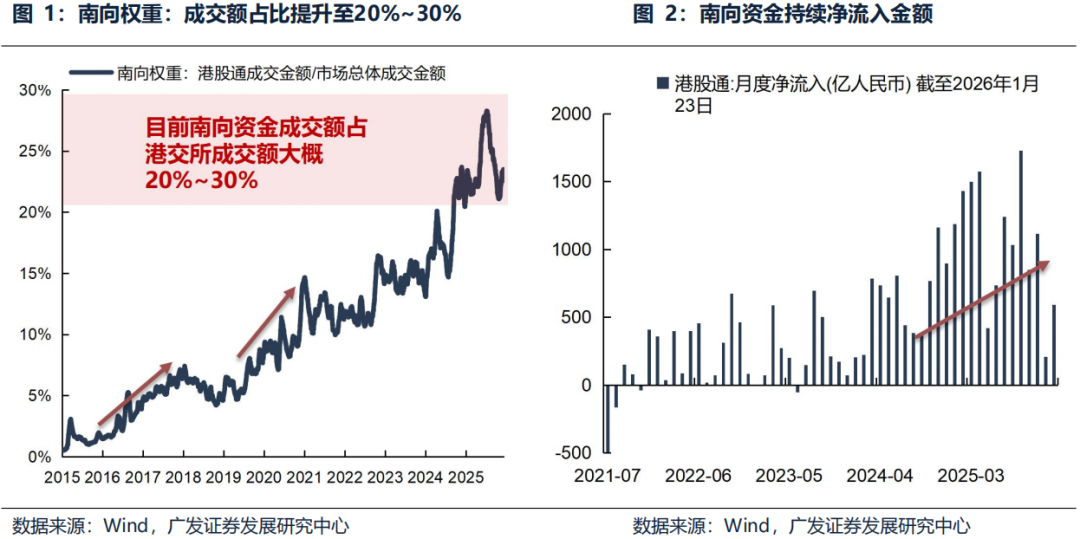
Group 1 - Since September 2024, the proportion of southbound capital transactions has rapidly increased to 20%-30%, nearly doubling compared to before 2024 [2][5] - In 2025, both active and passive foreign capital have become synchronous indicators of the Hong Kong stock market, showing no leading characteristics [2][5] - During sharp declines or corrections in the Hong Kong stock market, southbound capital tends to buy against the trend [2][5] Group 2 - Each round of pricing power competition typically begins with the optimization of the Stock Connect policy or the influx of incremental capital, which usually flows into dividend and scarce assets [5] - Net outflows of southbound capital often occur in response to adverse industry policies or external macroeconomic environments, particularly in sectors where foreign capital pricing power is increasing, such as software services, hardware equipment, consumer services, and discretionary retail [5][12] - Industries less likely to experience significant net outflows include those favored by long-term capital, such as banking, telecommunications, and public utilities, unless there are clear adverse policies affecting the sector [5][12] Group 3 - The proportion of medium to long-term capital in the current round of southbound capital inflow into Hong Kong stocks has increased, with insurance capital making 41 stakes, 35 of which are in H-shares, marking the highest record in the past decade [8] - Key industries for increased holdings include discretionary retail, finance (banking, insurance), innovative pharmaceuticals, software services, and hardware equipment [8] Group 4 - Current industries with pricing power for southbound capital and Chinese capital include semiconductors and dividend stocks, while industries lacking pricing power include internet, hardware equipment, software services, home appliances, and media [11][12] - Active management public funds have low pricing power in the Hong Kong stock market, focusing heavily on AI-related CSP giants, electronics, and innovative pharmaceuticals [16]
机构研究周报:全球流动性宽松,人民币资产吸引力上升
Wind万得· 2026-01-25 22:43
Core Insights - The article discusses the potential impact of the US and Japan bond turmoil on global liquidity and the attractiveness of Chinese assets, suggesting that the US Federal Reserve may initiate Yield Curve Control (YCC) [5][6] - It highlights the expectation of a reversal from deflation in 2026, with a positive Producer Price Index (PPI) leading to a recovery in asset prices and cyclical sectors [6] Group 1: Fund Holdings and Market Trends - Zhongji Xuchuang has become the largest holding for public funds, surpassing Ningde Times, with significant investments in core sectors like electronic components and power equipment [3] - By the end of 2025, the total market size of public funds is expected to approach 37 trillion yuan, setting a new historical high [3] - Public funds have increased their allocation to A-shares, which now account for 72.18% of their asset allocation, reflecting a continued upward trend [3] Group 2: Equity Market Insights - The attractiveness of RMB assets is rising due to expectations of a weaker dollar, which may enhance the appeal of Chinese markets, particularly A-shares and Hong Kong stocks [5] - The anticipated end of deflation in 2026 is expected to boost asset prices, with a focus on cyclical sectors such as non-ferrous metals, chemicals, and insurance [6] - A shift in market style is suggested, with high-valuation tech stocks potentially facing pressure as the narrative around deflation concludes [6] Group 3: Industry Research - The technology sector is experiencing rapid development, with a focus on collaborative growth across various segments, including computing power and applications [10] - Investment opportunities in the new energy sector, particularly in storage and lithium battery industries, are highlighted, with a significant increase in demand expected [12] - The article emphasizes the importance of selecting individual stocks in a favorable market environment, particularly in the context of the "anti-involution" policy promoting healthy economic development [9]

春季行情或仍有演绎空间机构建议紧扣业绩主线
Shang Hai Zheng Quan Bao· 2026-01-25 18:54
Group 1 - The core viewpoint is that the spring market still has room for further development, with a focus on performance-driven investment strategies as earnings forecasts are set to be disclosed intensively in late January [1][5] - A-shares have shown a fluctuating upward trend, with significant money-making effects being restored, while major indices have exhibited mixed performances, indicating a divergence in market styles [1][3] - The liquidity in the market remains relatively abundant, despite large-scale net redemptions in broad-based ETFs, with active interest in industry and thematic ETFs [2][3] Group 2 - The recent market differentiation is characterized by small-cap stocks outperforming large-cap stocks, growth stocks outperforming value stocks, and technology and cyclical sectors outperforming stable and consumer sectors [3][4] - The importance of fundamental performance is expected to increase as the market focuses on earnings disclosures, with a notable percentage of companies forecasting positive earnings [5] - High-growth sectors such as computing, communications, lithium batteries, and energy storage are anticipated to experience explosive growth in earnings [5]
双主线领航:2026能否再攀高峰?
Shang Hai Zheng Quan Bao· 2026-01-25 15:07
Core Viewpoint - The global stock market had a strong performance in 2025, with major indices such as the Korean Composite Index, Shenzhen Component Index, Hang Seng Index, Nikkei 225, and DAX all rising over 20%. The technology and resource sectors emerged as the two main themes driving market growth. Looking ahead to 2026, multiple institutions believe that these sectors will continue to perform actively due to a favorable liquidity environment, ongoing advancements in artificial intelligence, and generally supportive policies [2][3][13]. Group 1: Market Performance in 2025 - In 2025, global stock markets performed exceptionally well, with indices like the Korean Composite Index, Shenzhen Component Index, Hang Seng Index, Nikkei 225, DAX, FTSE 100, and Nasdaq all rising over 20%. Additionally, the Shanghai Composite Index, S&P 500, Dow Jones Industrial Average, and CAC40 rose over 10% [3][14]. - The technology and resource sectors were the most prominent themes in the global stock market, with 398 stocks in the U.S. market alone rising over 100%, primarily concentrated in these sectors [4][15]. - The Korean Composite Index achieved a remarkable 75.63% increase, ranking first among major global markets, driven by significant gains in key components like Samsung Electronics and SK Hynix, which rose 125% and 275%, respectively [4][15]. Group 2: Factors Driving Market Growth - The strong performance of global markets in 2025 was attributed to three main factors: the Federal Reserve's easing policies reducing funding costs, supportive policies across various countries, and robust capital expenditures from major U.S. tech companies [5][16]. - The technology sector, particularly in AI and cloud computing, attracted significant capital due to its disruptive innovation and high growth potential, while resource assets were viewed as a hedge against potential inflation and currency depreciation [5][16]. Group 3: Outlook for 2026 - As of January 22, 2026, the Korean Composite Index continued to lead with a 17.52% increase, and other indices also showed positive growth. Institutions expect the global stock market to maintain strong performance in 2026, driven by expectations of preventive rate cuts by the Federal Reserve and a continued favorable liquidity environment [6][17]. - Analysts express optimism for 2026, anticipating a friendly capital market environment due to the U.S. implementing relatively loose fiscal and monetary policies and potential further easing in China [6][17]. - The capital expenditures of major U.S. tech companies are expected to continue rising, providing new momentum for global economic growth [7][18]. Group 4: Investment Themes for 2026 - Multiple institutions predict that the technology and resource sectors will remain key investment themes in 2026, with structural market trends expected to continue [8][19]. - Despite discussions about potential market "bubbles," the current situation is not as extreme as during the internet bubble, with AI expected to remain a key driver for the stock market [9][19]. - The resource sector is anticipated to offer significant investment opportunities, with a focus on identifying and selecting the best opportunities among many [9][19].

长安基金王浩聿:以产业周期视角迎接AI投资浪潮
Shang Hai Zheng Quan Bao· 2026-01-25 14:24
Core Insights - The article emphasizes the importance of identifying trends, validating performance, and respecting valuations in investment strategies, particularly in the context of the current AI wave, which is described as a once-in-20-years opportunity [1][4]. Industry Development Trends - The investment framework developed by the fund manager focuses on industry trends, competitive landscapes, and selecting quality companies, with continuous tracking of orders and performance [2]. - The analysis of the Apple supply chain illustrates that understanding the core development logic of companies is crucial, rather than just focusing on order performance [2][3]. - The manager has experienced multiple industry cycles, including the rise of the Apple supply chain, the 5G boom, and the semiconductor localization trend, emphasizing the importance of identifying core targets within large industry cycles [2]. AI Sector Focus - The AI sector is highlighted as a primary focus in the current industry cycle, with the manager asserting that the potential of the AI wave surpasses previous opportunities [4]. - The fund managed by the company has achieved a return of over 95% by 2025, with all top ten holdings being AI-related stocks, including leading companies in optical modules and PCB [4]. - The outlook for the A-share market remains optimistic, with AI continuing to be a central theme as the industry undergoes constant iterations and improvements [4]. Demand and Subsector Insights - The demand in the computing power industry is expected to continue increasing, with many clients providing order guidance extending to 2027 and 2028 [5]. - Key subsectors benefiting from AI include servers, PCBs, and optical modules, with the storage industry entering a super price increase cycle due to AI demand [5]. - Emerging fields such as liquid cooling, new PCB materials, and CPO are also entering a phase of explosive growth, warranting ongoing attention [5].
公募去年四季度亏超千亿终结七连盈,科技周期成加仓核心
第一财经· 2026-01-25 13:23
Core Viewpoint - The A-share market experienced significant fluctuations around the 4000-point mark, leading to a loss of profitability for public funds in the fourth quarter of 2025, marking the first loss after seven consecutive profitable quarters. However, the overall annual profit reached a record 2.6 trillion yuan, recovering losses from previous years [3][6]. Fund Performance - In Q4 2025, public funds reported a total loss of approximately 1.1 billion yuan, ending a streak of profitability. Despite this, the annual profit of 2.6 trillion yuan set a historical record, covering cumulative losses of 1.87 trillion yuan from 2022 to 2023 [6][8]. - Equity funds were the hardest hit in Q4, with a combined loss of 1.81 trillion yuan, while mixed funds also faced losses. In contrast, bond and money market funds continued to perform well, contributing significantly to overall profits [6][9]. Fund Adjustments - Public funds actively adjusted their holdings in response to market conditions, increasing their positions in technology and cyclical sectors. Notably, Zhongji Xuchuang replaced Ningde Times as the top holding among active funds [3][11]. - The top ten heavy stocks saw minimal changes in total market value, but individual rankings shifted significantly, with Zhongji Xuchuang and Xinyi Sheng surpassing Guizhou Moutai in holdings [12][13]. Sector Focus - The electronic sector emerged as the largest area of investment for public funds, with a total market value of 741 billion yuan. The power equipment sector followed closely, while the communication sector became the third-largest focus, overtaking the pharmaceutical sector [17]. - Public funds increased their positions in oil, non-bank financials, and metals, with significant additions in stocks like Industrial Bank and China Petroleum [15][16]. Market Outlook - Analysts suggest that while sectors like new consumption and AI show strong fundamentals, valuation concerns may arise due to market liquidity tightening. Dividend investments are expected to perform better in 2026 compared to the previous year [17].