传媒

Search documents
20余只ETF涨停,这个赛道为何疯狂?
Guo Ji Jin Rong Bao· 2026-01-12 15:43
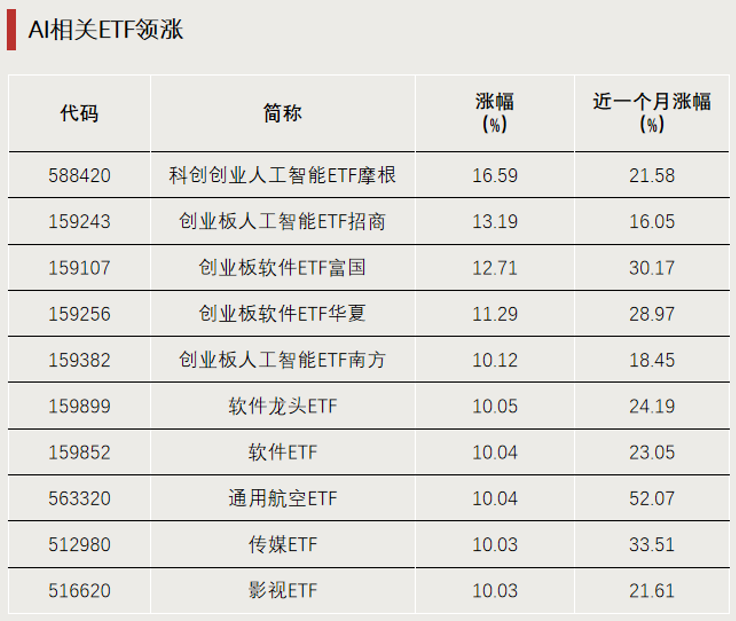
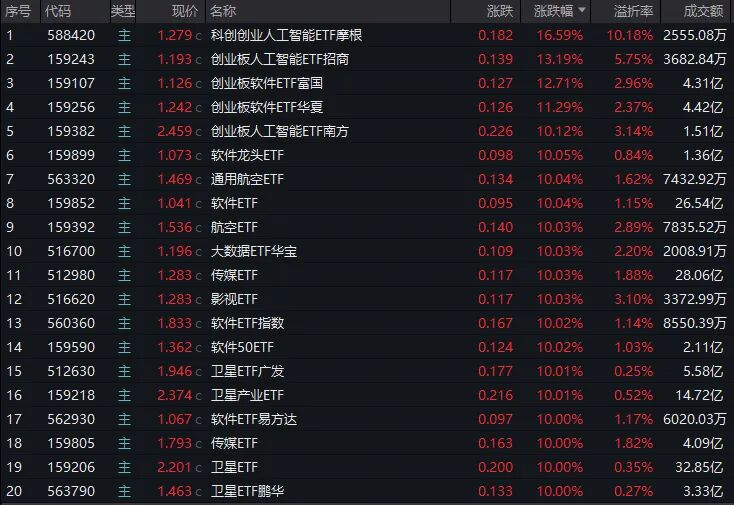
Core Viewpoint - The A-share market experienced a record trading volume on January 12, with a significant surge in various industry sectors, particularly in ETFs, driven by strong investor sentiment and favorable policies [1][3][8]. Trading Performance - On January 12, the total trading volume in the A-share market exceeded 3.6 trillion yuan, surpassing previous records, with 201 stocks hitting the daily limit [3]. - A total of 27 stock ETFs reached their daily limit, with 20 ETFs rising over 10% in a single day [2][6]. Sector Highlights - The leading sectors included satellite, media, aviation, artificial intelligence, and software, with notable performances from satellite-themed ETFs, which saw an average increase of over 30% year-to-date [1][10]. - The top-performing ETF was the Morgan Science and Technology Innovation ETF, which surged by 16.59% on the same day [5]. Investor Sentiment - Analysts noted that the surge in ETF prices reflects strong investor confidence in the Chinese economy and stock market, with increasing interest from both institutional and individual investors [8]. - The rise in specific industry-themed ETFs indicates a positive shift in market sentiment and a willingness to invest in high-potential sectors like satellite and media [8][10]. Market Dynamics - The commercial aerospace and AI application sectors have emerged as key market drivers, with several ETFs in these categories achieving remarkable short-term gains [10]. - The current phase of the commercial aerospace industry is characterized by initial infrastructure development, with strong policy support and visible order visibility, particularly in rocket launch and satellite manufacturing [10]. Risk Considerations - Despite the positive market trends, analysts caution against potential risks such as valuation overextension, technology validation, and short-term speculative trading [11].

1月第1周立体投资策略周报:“十六连阳”背后是哪些资金在买-20260112
Guoxin Securities· 2026-01-12 15:25
Group 1 - In the first week of January, a total net inflow of funds into the market reached 721 billion, reversing a previous outflow of 104 billion [1][8] - The financing balance increased by 858 billion, public fund issuance rose by 70 billion, and estimated net inflow from northbound funds was 96 billion [1][8] - The short-term sentiment indicator is at a high level since 2005, with the recent weekly turnover rate (annualized) at 564%, placing it in the 87th percentile historically [1][12] Group 2 - The long-term sentiment indicator is at a medium-low level since 2005, with the recent A-share risk premium at 2.43%, which is in the 46th percentile historically [2][14] - The recent dividend yield of the CSI 300 index (excluding financials) compared to the ten-year government bond yield is 1.17, placing it in the 7th percentile historically [2][14] - The highest turnover rates among industries in the past week were in defense and military (100%), media (98%), and automotive (97%), while the lowest were in liquor (18%), utilities (56%), and beauty care (59%) [2][14] Group 3 - The highest financing transaction ratios were in power equipment (95%), beauty care (95%), and machinery (94%), while the lowest were in coal (32%), food and beverage (36%), and construction decoration (44%) [2][14] - The total market capitalization of A-shares is 101.25 trillion, with a circulating market value of 93.05 trillion [3]
金融工程日报:沪指17连阳,两市成交额3.6万亿元破历史记录-20260112
Guoxin Securities· 2026-01-12 15:20
- The report does not contain any quantitative models or factors for analysis
3.65万亿天量成交!A股还能上攻吗?
Guo Ji Jin Rong Bao· 2026-01-12 14:52
Market Overview - A-share market experienced a significant increase in trading volume, with a record turnover of 3.65 trillion yuan, reflecting strong market sentiment and active trading [3][11][13] - The market saw 4,144 stocks rise, with 201 stocks hitting the daily limit, indicating a broad-based rally across various sectors [3][10] Sector Performance - The technology sector, particularly computer software and AI-related stocks, led the gains, with the computer sector rising by 7.26% and the media sector by 7.80% [4][6][7] - Notable stocks included BlueFocus Communication (20.02% increase) and Tuoer Si (20.02% increase), both hitting the daily limit [5][6][10] Investment Trends - There is a notable influx of incremental capital into the market, driven by public funds and long-term institutional investors, including social security and insurance funds [11][13] - The recent surge in trading volume is attributed to the strong demand for thematic ETFs focused on artificial intelligence and satellite industries, appealing to retail investors [11][13] Market Dynamics - The current market environment is characterized by a "slow bull" consensus, with investors encouraged to maintain a positive strategic outlook [13] - The continuous inflow of northbound capital and the active participation of margin trading are contributing to the market's upward momentum [11][13] Risks and Volatility - Despite the positive market sentiment, there are concerns about potential short-term volatility and profit-taking following the high trading volume [2][14] - Some sectors are showing signs of being overbought, which may lead to increased rotation and potential pullbacks [14][15]


600696,将被终止上市!
Sou Hu Cai Jing· 2026-01-12 14:33
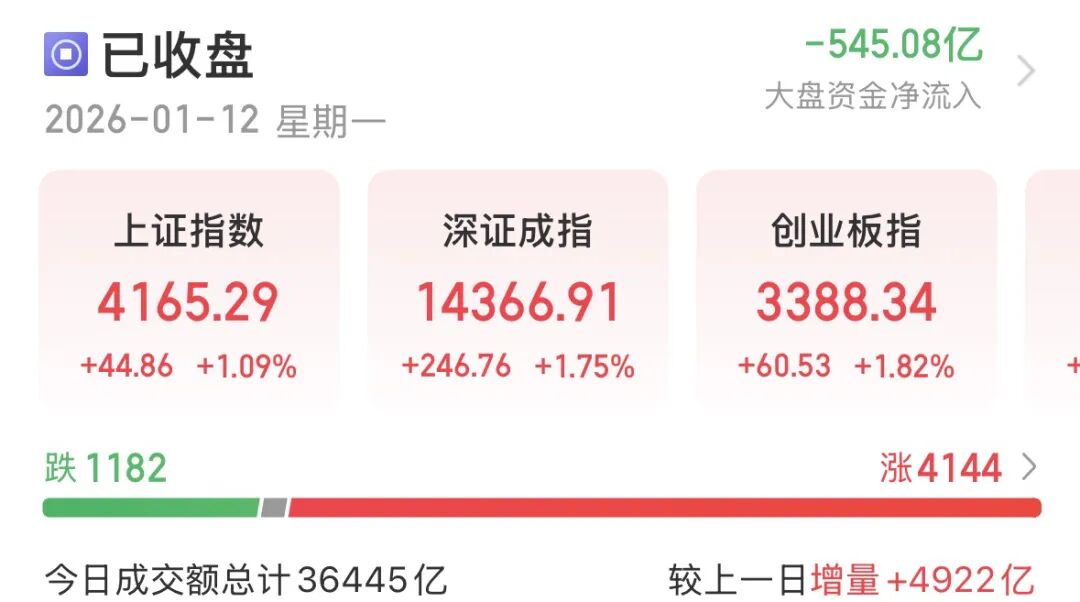
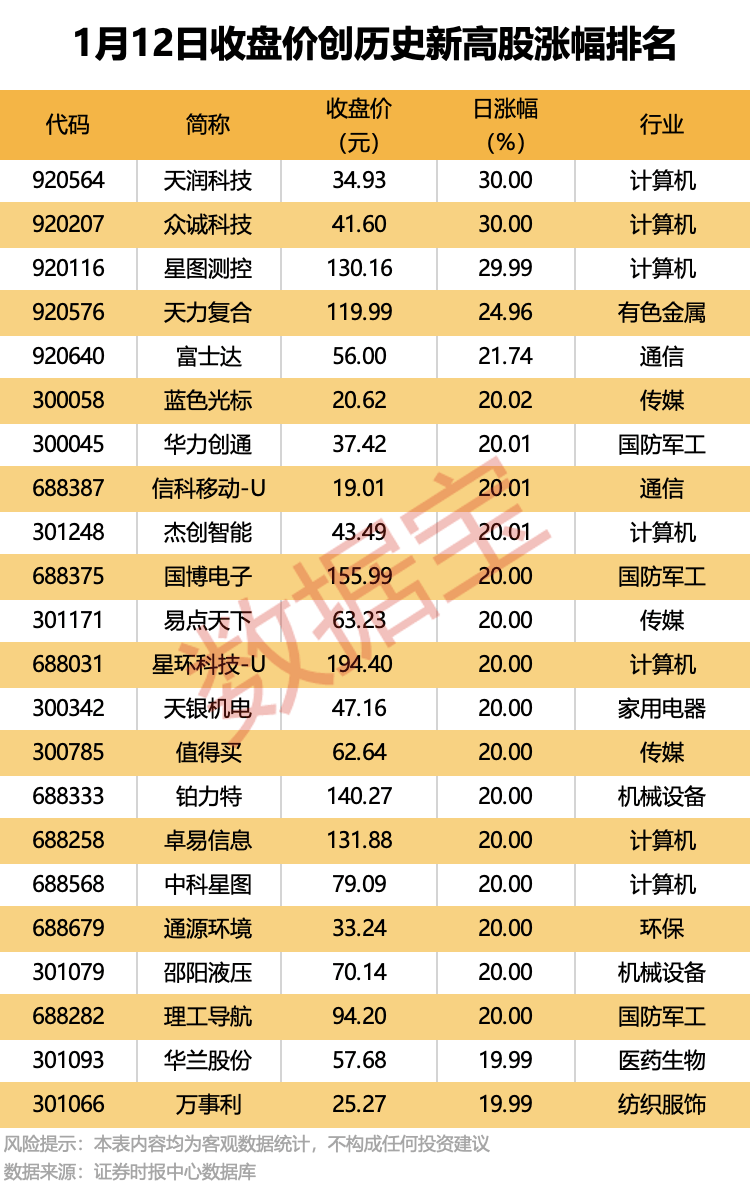
Market Overview - The A-share market saw all three major indices rise, with the Shanghai Composite Index closing at 4165.29 points, up by 1.09% [1] - The total market turnover reached 3.64 trillion yuan, an increase of over 490 billion yuan compared to the previous trading day, with more than 4100 stocks closing higher [1] Sector Performance - The Sora concept led the gains, with stocks like Yidian Tianxia and Zhongwen Online hitting the daily limit [1] - Other rising concepts included MLOps, AI corpus, and Zhipu AI, while sectors such as insurance, oil and gas extraction and services, and agricultural chemicals saw declines [1] Historical Highs - A total of 185 stocks reached historical closing highs, with significant concentrations in the defense, machinery, and electronics sectors, recording 28, 27, and 24 stocks respectively [2] - The average price increase for stocks reaching historical highs was 9.28%, with notable gainers including Tianrun Technology, Zhongcheng Technology, and Xingtou Measurement Control [2] Institutional Activity - In the Dragon and Tiger list, 20 stocks were net bought, with 22 stocks net sold; 17 stocks had net purchases exceeding 10 million yuan, led by Shanzi Gaoke with 484 million yuan [5] - The top net selling stock was Kunlun Wanwei, with a net sell amount of 536 million yuan [5] Notable Stocks - Stocks like Tianrun Technology and Xingtou Measurement Control saw significant daily increases of 30% and 29.99% respectively, while other notable gainers included Tianli Composite and Fujida [3][4] - The net buying activity from institutions included stocks such as Zhongke Xingtou and Bolite, with net purchases of 186.5 million yuan and 127.68 million yuan respectively [6] Announcements - *ST Yanshi is expected to have an operating income of less than 300 million yuan in 2025, leading to potential delisting due to financial issues [11] - Rongchang Bio signed a licensing agreement with AbbVie, potentially earning up to 4.95 billion USD in milestone payments [11]



博瑞传播:关于股票交易异常波动公告
Zheng Quan Ri Bao Zhi Sheng· 2026-01-12 13:41
(编辑 丛可心) 证券日报网讯 1月12日,博瑞传播发布公告称,公司股票于2026年1月8日、9日、12日连续三日收盘涨 幅偏离值累计达20%,属异常波动。公司自查及函询控股股东后确认生产经营正常,无应披露未披露事 项;2025年前三季度净利784.68万元,同比降35.97%,GEO业务营收为0,提醒投资者注意风险。 ...

A股单日成交额突破3.6万亿元
Mei Ri Jing Ji Xin Wen· 2026-01-12 13:35
Market Overview - On January 12, the total trading volume of the Shanghai and Shenzhen stock markets reached 3.6 trillion yuan, marking the highest single-day trading amount in history. However, the current trading volume is still significantly lower than the historical peak observed during the "9.24" market period in 2024 [1][4]. Investor Sentiment - There is a strong bullish sentiment among domestic and foreign institutions, with many foreign investment firms expressing a more favorable view towards Chinese assets. This shift indicates a significant change in overseas investors' attitudes [3][8]. Sector Performance - The "technology bull" characteristics remain prominent in the market, with high-tech sectors such as media, computer, defense, and communication leading the gains on January 12. This mirrors the sector performance during the historical peak on October 8, 2024 [6][5]. Institutional Insights - Institutions are generally optimistic about the market outlook, with discussions at the recent China Chief Economist Forum focusing on the revaluation opportunities for Chinese assets as the yuan gradually appreciates. There is a consensus on the structural opportunities in the technology growth sector [7][8]. Foreign Investment Trends - International investors are increasingly interested in participating in the Chinese market, with a 32% year-on-year increase in investor attendance from regions including the US, Europe, the Middle East, and Africa at recent forums. By the third quarter of 2025, the underweight position of foreign capital in Chinese stocks has narrowed from -2.5% to -1.3% [9]. Market Dynamics - Looking ahead to 2026, the A-share market is expected to experience structural differentiation, characterized by industry, profit, and demand disparities. Key investment themes include high-value manufacturing, global expansion of Chinese consumer goods, and the impact of passive investment flows on index-weighted stocks [10].
【12日资金路线图】两市主力资金净流出超210亿元 计算机等行业实现净流入
Zheng Quan Shi Bao· 2026-01-12 12:40
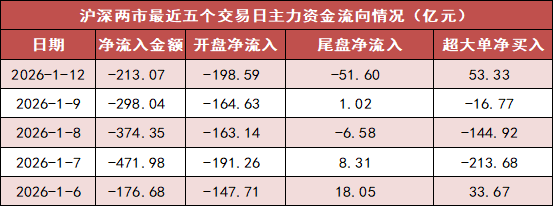
Market Overview - The A-share market experienced an overall increase on January 12, with the Shanghai Composite Index closing at 4165.29 points, up 1.09%, the Shenzhen Component Index at 14366.91 points, up 1.75%, and the ChiNext Index at 3388.34 points, up 1.82% [1] - The total trading volume for both markets reached 360.14 billion yuan, an increase of 47.87 billion yuan compared to the previous trading day [1] Capital Flow - The net outflow of main funds from the Shanghai and Shenzhen markets exceeded 21 billion yuan, with an opening net outflow of 19.86 billion yuan and a closing net outflow of 5.16 billion yuan, totaling 21.31 billion yuan for the day [2] - The CSI 300 index saw a net outflow of 7.26 billion yuan, while the ChiNext index experienced a net outflow of 1.42 billion yuan [3] Sector Performance - The computer industry saw a significant net inflow of 36.56 billion yuan, with a growth rate of 6.97%, driven by stocks like Tonghuashun [5] - Other sectors with notable inflows included defense and military (7.07 billion yuan, 6.02% increase), media (7.02 billion yuan, 7.35% increase), non-bank financials (3.70 billion yuan, 1.62% increase), and retail (3.61 billion yuan, 2.83% increase) [5] - Conversely, sectors with significant outflows included power equipment (-8.94 billion yuan, 1.73% increase), non-ferrous metals (-6.92 billion yuan, 2.06% increase), electronics (-5.97 billion yuan, 1.97% increase), basic chemicals (-5.47 billion yuan, 1.00% increase), and real estate (-3.79 billion yuan, -0.13% decrease) [5] Institutional Activity - The top stocks with net inflows from institutions included Shanzigaoke (484.20 million yuan, 10.09% increase), Leike Defense (234.98 million yuan, 10.00% increase), and Zhongke Xingtai (186.52 million yuan, 20.00% increase) [8] - Notable stocks with significant institutional outflows included Kunlun Wanwei (-5.36 billion yuan, 19.99% decrease) and other companies like Xinyuan Technology and Yanjin Technology, which also faced substantial outflows [8] Analyst Recommendations - Analysts have given strong buy ratings to stocks such as Xianle Health (target price 32.5 yuan, current price 24.39 yuan, 33.25% upside) and ZheShang Securities' recommendation for Dongfang Securities (target price 15.06 yuan, current price 10.99 yuan, 37.03% upside) [10] - Other stocks with favorable ratings include Yaxiang Integration (target price 162.8 yuan, current price 124.59 yuan, 30.67% upside) and China Merchants Bank (target price 55 yuan, current price 41.12 yuan, 33.75% upside) [10]
【12日资金路线图】两市主力资金净流出超210亿元 计算机等行业实现净流入
证券时报· 2026-01-12 12:37
1月12日,A股市场整体上涨。 截至收盘,上证指数收报4165.29点,上涨1.09%;深证成指收报14366.91点,上涨1.75%;创业板 指收报3388.34点,上涨1.82%。两市合计成交36013.76亿元,较上一交易日增加4786.81亿元。 1. 两市主力资金净流出超210亿元 今日沪深两市主力资金开盘净流出198.59亿元,尾盘净流出51.6亿元,全天净流出213.07亿元。 | | | 沪深两市最近五个交易日主力资金流向情况(亿元) | | | | --- | --- | --- | --- | --- | | 日期 | | 净流入金额 开盘净流入 | 尾盘净流入 | 超大单净买入 | | 2026-1-12 | -213.07 | -198.59 | -51. 60 | 53. 33 | | 2026-1-9 | -298.04 | -164. 63 | 1.02 | -16. 77 | | 2026-1-8 | -374. 35 | -163. 14 | -6. 58 | -144. 92 | | 2026-1-7 | -471.98 | -191.26 | 8. 31 | -213. ...

最新公告!这只黄金ETF将暂停申购
Zhong Guo Zheng Quan Bao· 2026-01-12 12:05
Group 1: ETF Performance - On January 12, several ETFs related to AI, satellites, and media sectors saw significant gains, with the Morgan Innovation and Entrepreneurship AI ETF rising over 16% [1][2] - The Satellite ETF (563230) and Aviation ETF (159392) hit the daily limit, while the Fortune Software ETF (159107) increased by 12.71%, reaching a new high since its listing [2] - The Media ETF (512980) surged by 10.03%, with a year-to-date increase exceeding 28%, making it one of the top performers among all ETFs [3] Group 2: Fund Flows and Trading Activity - On January 9, several broad-based ETFs experienced significant net inflows, particularly two Satellite ETFs and a Semiconductor Equipment ETF [8] - Six ETFs had trading volumes exceeding 10 billion yuan on January 12, indicating high trading activity, with the Short-term Bond ETF and Hong Kong Securities ETF leading the way [6][7] - The Satellite ETF (563230) has seen continuous net buying for ten consecutive trading days, with its latest scale exceeding 1.5 billion yuan and a year-to-date increase of over 34% [2] Group 3: Market Catalysts and Trends - The market's recent rise is supported by liquidity factors and themes from industries such as semiconductors, robotics, and commercial aerospace, with a positive outlook for the first quarter [10] - The satellite sector is highlighted for its investment value due to supportive policies, expanding demand scenarios, and technological advancements that reduce costs and improve efficiency [11]