
有色

Search documents
业绩是牛市第二阶段的主要驱动力
猛兽派选股· 2025-10-08 01:31
Group 1 - The article discusses the correlation between stock price movements and earnings performance, emphasizing the importance of understanding the details of each phase in the four-stage theory of market cycles [1][2] - Historical experiences indicate that the first and third phases are characterized by speculative trading, while the second phase focuses on earnings growth, and the fourth phase highlights the advantages of dividends and cross-market arbitrage [1][2] - The current market phase, starting from June 8, has shifted towards a focus on companies with solid earnings, moving away from speculative stocks that have been historically unprofitable [1] Group 2 - The second phase of the economic cycle is a response to recovery, with the first recovering industries receiving the most attention [2] - The third phase reflects the residual effects of economic prosperity, where high-growth earnings reports continue, but core company stock prices may have peaked, leading investors to seek undervalued companies [2] - The fourth phase sees a shift towards stability, with a preference for high-dividend stocks and cross-market arbitrage as investors become more risk-averse [2]


用电量折射经济向好态势
Jing Ji Ri Bao· 2025-10-08 00:20
Core Insights - In August, China's total electricity consumption reached 10,154 billion kilowatt-hours, marking a 5% year-on-year increase, and achieving a historical high for the second consecutive month [1] - The first industry saw a significant growth in electricity consumption, with a total of 1,012 billion kilowatt-hours in the first eight months, reflecting a 10.6% year-on-year increase [1] - The second industry continued its recovery, with electricity consumption of 4.34 trillion kilowatt-hours in the first eight months, up 3.1% year-on-year [1] - The third industry maintained rapid growth, with electricity consumption of 1.33 trillion kilowatt-hours in the first eight months, showing a 7.7% year-on-year increase [1] Industry-Specific Insights - High-tech and equipment manufacturing industries collectively saw a 5.3% year-on-year increase in electricity consumption in the first eight months, outperforming the average growth rate of the manufacturing sector by 2.5 percentage points [1] - The new energy vehicle manufacturing sector experienced a remarkable growth of 23% in electricity consumption during the first eight months [1] - The information transmission/software and IT services sector reported a 15.8% year-on-year increase in electricity consumption, driven by the rapid development of mobile internet, big data, and cloud computing [2] - The wholesale and retail sector's electricity consumption grew by 11.8%, with the electric vehicle charging and swapping services seeing a substantial increase of 44.1% [2] Economic Context - The high electricity consumption levels are attributed to the summer heat, with record high loads reported in July and August due to high temperatures across the country [2] - Government policies aimed at promoting consumption and stabilizing industrial growth have contributed to a warming macroeconomic environment, leading to a release of production capacity across various industries [3] - In August, the manufacturing sector's electricity consumption grew by 5.5%, the highest monthly increase this year, with notable recovery in raw material industries such as steel, building materials, non-ferrous metals, and chemicals [3] - The resilience of high-tech and equipment manufacturing is evident, with all sub-sectors achieving positive growth, indicating the emergence of new economic growth points [3]
连续两月创历史新高—— 用电量折射经济向好态势
Jing Ji Ri Bao· 2025-10-07 22:07
Core Insights - In August, China's total electricity consumption reached 10,154 billion kilowatt-hours, marking a 5% year-on-year increase, and setting a historical record for the second consecutive month [1][2] Group 1: Electricity Consumption by Sector - The primary industry saw a robust growth in electricity consumption, with a total of 1,012 billion kilowatt-hours in the first eight months, reflecting a 10.6% year-on-year increase, which is 3.6 percentage points higher than the same period last year [1] - The secondary industry continued its recovery, with electricity consumption of 4.34 trillion kilowatt-hours in the first eight months, up 3.1% year-on-year [1] - The high-tech and equipment manufacturing sectors collectively experienced a 5.3% increase in electricity consumption, surpassing the average growth rate of the manufacturing sector by 2.5 percentage points [1] - The new energy vehicle manufacturing sector maintained rapid growth, with an electricity consumption increase of 23% year-on-year in the first eight months [1] Group 2: Trends in Specific Industries - The information transmission/software and IT services sector saw a significant electricity consumption increase of 15.8%, driven by the rapid development of mobile internet, big data, and cloud computing [2] - The wholesale and retail sector's electricity consumption grew by 11.8%, with the electric vehicle charging and swapping services experiencing a remarkable 44.1% increase [2] - Urban and rural residents' electricity consumption rose by 6.6% in the first eight months, totaling 1.1 trillion kilowatt-hours [2] Group 3: Economic and Policy Influences - The macroeconomic environment is showing signs of recovery, supported by policies aimed at promoting consumption and stabilizing industrial growth, leading to a continuous release of production capacity across various industries [3] - In August, the manufacturing sector's electricity consumption increased by 5.5%, the highest monthly growth rate observed this year, with notable recovery in raw material industries such as steel, building materials, non-ferrous metals, and chemicals [3] - The high-tech and equipment manufacturing sectors demonstrated strong resilience, with a year-on-year electricity consumption growth of 9.1%, indicating positive growth across all sub-industries [3]
A股创历史新高,投资热潮再起,财富机遇全面爆发
Sou Hu Cai Jing· 2025-10-06 20:01
又有新纪录!——A股的2025年9月,像一场意外暴雨砸在地上,溅起泥点,也砸碎不少人的幻想,数据在屏幕上跳舞,交易大厅的屏气凝神,和手机 屏幕背后的碎碎念,交织成一张巨网。 有人说:"今年的9月,A股疯了",有人却在微信群里喊,"不就是成交额创个新高吗,历史每年都在刷"。但今年的9月,沪深北三市合计成交53.2万 亿,记录簿翻了又翻,前一次月成交股数还能追溯到去年11月,3.3万亿股,这个月只差一点点就追上了,这种"只差一点点",有时候比直接超越更让 人焦虑。 有朋友问我,"是不是整个市场都涨?"其实不是,大盘指数只涨了零点几个点,北证50还跌了2.9%,一边天高云淡,一边泥里打滚,谁也说不清哪个 更真实。深证成指也只有29%出头的涨幅,上证指数12.73%,远没到疯狂的地步,但创业板、科创那头的热血数据,很容易让人误以为"全民皆牛"。 9月刚收官那天,我蹲在中关村地铁口,听到一群年轻人讨论,"创业板涨疯了,三季度直接翻了一倍多,谁信啊",另一人插嘴,"你炒了没?"前者摇 头,"没,怕得很"。三季度创业板涨幅50.40%,科创50也快50%,数据就摆在那里,像考卷分数,不认可也得接着看。 "行业都涨吗?"我查 ...

券商陆续发布10月金股名单 芯片、新能源、有色板块受关注
Xin Lang Cai Jing· 2025-10-05 09:13
Core Viewpoint - Nearly 20 brokerage firms have released their "golden stock" lists for October, indicating a positive outlook for sectors such as electronics, non-ferrous metals, and gaming [1] Sector Analysis - Brokerages are particularly optimistic about the performance of the electronic, non-ferrous metals, and gaming sectors [1] - Upcoming third-quarter reports are expected to reveal companies with performance that may exceed expectations, especially in the electric new energy, innovative pharmaceuticals, and new consumption industries [1] Company Focus - Zhaoyi Innovation has emerged as the most popular "golden stock" for October, receiving recommendations from three brokerage firms: Guohai Securities, Zhongtai Securities, and AVIC Securities [1]

港股单日暴涨3.5%!恒生指数突破27000点,资本很有可能进行重新评估
Sou Hu Cai Jing· 2025-10-03 18:44
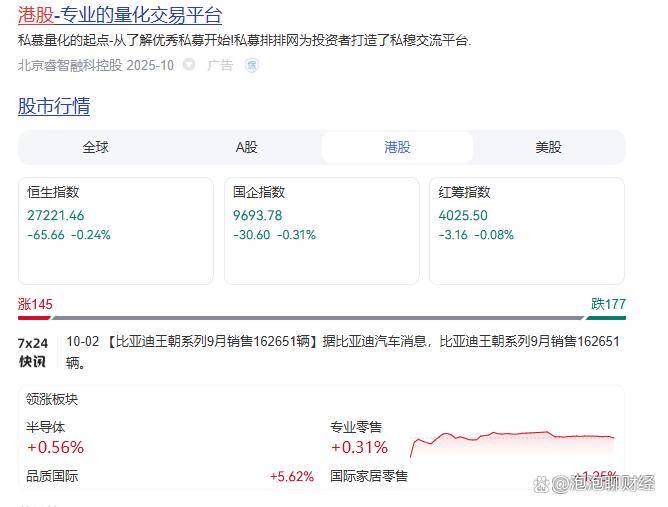
Group 1 - The Hang Seng Index rose by 1.61%, surpassing the 27,000-point mark, reaching a new high for the year, while the Hang Seng Tech Index surged by 3.36% [1] - Semiconductor leader SMIC's stock price skyrocketed by 12.7%, and Hua Hong Semiconductor followed with a 7.13% increase, indicating strong performance in the semiconductor sector [1][3] - The recent influx of northbound capital exceeded 40 billion yuan in a single week, focusing on industries with clear trends such as semiconductors and new energy, rather than short-term speculative stocks [1] Group 2 - BlackRock and Goldman Sachs have upgraded their ratings on Chinese stocks to "overweight," citing narrowing US-China interest rate differentials and valuation opportunities [3] - The semiconductor industry is driven by breakthroughs in Huawei's chip technology and surging demand for computing power, with SMIC reaching a historical high of 90.35 HKD [3] - The price of copper has surpassed 10,500 USD per ton, and gold has reached 3,895 USD per ounce, influenced by supply constraints and declining domestic copper inventories [3] Group 3 - The current drivers for the semiconductor and non-ferrous metal sectors stem from technological breakthroughs and global supply-demand mismatches, suggesting sustainability over multiple quarters [5] - The market is experiencing a significant increase in retail investor participation, with daily account opening applications during the holiday reaching four times the usual volume [5][7] - The expectation of liquidity influx post-holiday is high, with banks adjusting transfer times to manage trading pressure [7] Group 4 - The Federal Reserve's interest rate cuts are leading to a weaker dollar, while China's unconventional counter-cyclical policies and technological innovations are making RMB assets a preferred choice for global capital allocation [8] - Alibaba's market value has returned to 3.49 trillion HKD, and Tencent is nearing 800 billion USD, as these assets are being re-evaluated due to technological advancements [8] Group 5 - DBS Bank has raised its 12-month target for the Hang Seng Index to 28,000 points, indicating nearly a 10% upside from current levels [10] - Current net profit growth for non-financial sectors in A-shares is only 3%, but leading tech companies are showing early signs of profit recovery, suggesting potential synchronization with the Hong Kong market [10] - The ongoing bull market may be driven by industrial revolution and capital re-evaluation rather than merely monetary easing, indicating a shift from previous speculative trading patterns [10]
9/30财经夜宵:得知基金净值排名及选基策略,赶紧告知大家
Sou Hu Cai Jing· 2025-09-30 13:56
Core Insights - The article provides a ranking of mutual funds based on their net asset value changes, highlighting the top and bottom performers in the market [2][3]. Fund Performance Summary - The top 10 mutual funds with the highest net value growth as of September 30, 2025, include: 1. Yongying Pioneer Semiconductor Selected Mixed Fund A: Unit Net Value 1.1956, Cumulative Net Value 1.1956, previous unit net value 1.1101 [2] 2. Yongying Pioneer Semiconductor Selected Mixed Fund C: Unit Net Value 1.1952, Cumulative Net Value 1.1952, previous unit net value 1.1098 [2] 3. AVIC Vision Leading Mixed Fund A: Unit Net Value 1.5769, Cumulative Net Value 1.6569, previous unit net value 1.4925 [2] 4. AVIC Vision Leading Mixed Fund C: Unit Net Value 1.5659, Cumulative Net Value 1.6459, previous unit net value 1.4821 [2] 5. Huaxia Military Industry Safety Mixed Fund C: Unit Net Value 1.8520, Cumulative Net Value 1.8520, previous unit net value 1.7540 [2] 6. Huaxia Military Industry Safety Mixed Fund A: Unit Net Value 1.8920, Cumulative Net Value 1.8920, previous unit net value 1.7920 [2] 7. Founder Fubon Core Advantage Mixed Fund C: Unit Net Value 1.1395, Cumulative Net Value 1.1395, previous unit net value 1.0822 [2] 8. Founder Fubon Core Advantage Mixed Fund A: Unit Net Value 1.1527, Cumulative Net Value 1.1527, previous unit net value 1.0948 [2] 9. Great Wall Prosperity Growth Mixed Fund C: Unit Net Value 1.3620, Cumulative Net Value 1.3620, previous unit net value 1.2983 [2] 10. Great Wall Prosperity Growth Mixed Fund A: Unit Net Value 1.3788, Cumulative Net Value 1.3788, previous unit net value 1.3144 [2] - The bottom 10 mutual funds with the lowest net value growth include: 1. AVIC Opportunity Leading Mixed Fund C: Unit Net Value 3.0084, previous unit net value 3.0827 [4] 2. AVIC Opportunity Leading Mixed Fund A: Unit Net Value 3.0479, previous unit net value 3.1231 [4] 3. Shanzheng Asset Management Strategy Selected Mixed Fund: Unit Net Value 1.6137, previous unit net value 1.6531 [4] 4. E Fund Rui Xiang Mixed Fund E: Unit Net Value 4.8647, previous unit net value 4.9776 [4] 5. E Fund Rui Xiang Mixed Fund I: Unit Net Value 6.0069, previous unit net value 6.1462 [4] 6. Debon Xin Xing Value Fund A: Unit Net Value 3.3260, previous unit net value 3.4030 [4] 7. Debon Xin Xing Value Fund C: Unit Net Value 3.1973, previous unit net value 3.2713 [4] 8. Guotai Zhongzheng All Index Communication Equipment ETF: Unit Net Value 2.6750, previous unit net value 2.7344 [4] 9. Huatai Bairui Quality Growth Mixed Fund C: Unit Net Value 1.5167, previous unit net value 1.5501 [4] 10. Huatai Bairui Quality Growth Mixed Fund A: Unit Net Value 1.5426, previous unit net value 1.5765 [4] Market Trends - The Shanghai Composite Index opened high and experienced fluctuations, closing with a small gain, while the ChiNext index saw a peak and then returned to flat, with a total trading volume of 2.19 trillion [7]. - Leading sectors included aviation and non-ferrous metals, both rising over 3%, while communication equipment and advertising packaging sectors faced declines [7].

A股节后怎么走?谁会站上风口?机构最新研判来了!
天天基金网· 2025-09-30 06:19
Core Viewpoint - The article discusses the sentiment and strategies of private equity funds as they approach the National Day holiday, indicating a generally optimistic outlook for the market post-holiday, with a significant portion of funds choosing to hold high positions in their portfolios [4][6][11]. Group 1: Private Equity Fund Positioning - Over 65% of private equity funds are opting for heavy or full positions during the holiday, believing that external market disturbances will be limited and that domestic fundamentals and policy environments provide a solid safety margin [6][4]. - The overall private equity position index reached 78.41% as of September 19, marking a 0.37 percentage point increase from the previous week and reflecting a trend of increased allocations [6][4]. - The majority of private equity funds are optimistic about the market's performance after the holiday, with 70.19% expecting a gradual recovery driven by policy and capital support [9][4]. Group 2: Investment Focus Areas - The primary investment focus is on technology growth sectors, with 59.62% of private equity funds highlighting areas such as AI, semiconductors, and innovative pharmaceuticals as key opportunities [10][4]. - A significant portion of funds (21.15%) is also looking at the valuation recovery in the new energy and real estate sectors, anticipating that clearer industry policies will provide rebound opportunities [10][4]. - There is a belief that the market will exhibit a balanced style post-holiday, with 62.50% of funds expecting a rotation among technology growth, value blue chips, and leading stocks [9][10]. Group 3: Market Sentiment and Future Outlook - The sentiment among private equity funds is generally positive, with many viewing the current market as transitioning from the second to the third phase of a bull market [11][12]. - The article notes that historical data shows a greater than 70% probability of market gains following the National Day holiday, supported by liquidity from institutional investments and retail participation [11][12]. - The anticipated "slow bull" market trend suggests that while short-term volatility may occur, the long-term outlook remains favorable, particularly for technology growth sectors [12][11].

和讯投顾蒲宇宁:机构节后布局3大方向!年报行情才是真正的大肉
Sou Hu Cai Jing· 2025-09-30 05:44
Core Viewpoint - The article emphasizes that the real investment opportunities will emerge during the annual report season, despite the current market index reaching 3800 points, indicating a focus on performance-driven investments by institutions [1] Group 1: Investment Directions - Institutions are expected to focus on three main areas for investment post-holiday: resource sectors, overseas demand, and industries benefiting from reduced competition [1] Group 2: Resource Sector - The resource sector, particularly non-ferrous metals and precious metals, is highlighted as a stable investment choice due to price increases driven by the Federal Reserve's interest rate cuts [1] Group 3: Overseas Demand - The demand from overseas markets, particularly in sectors related to Tesla, Nvidia, and Apple supply chains, is seen as a reliable growth area, despite some trade friction [1] Group 4: Anti-Competition Dynamics - Industries such as photovoltaics, silicon wafers, and chemicals are expected to transition from widespread losses to significant profitability due to production cuts and reduced supply chain inventories, indicating a high potential for recovery [1]
“牛市旗手”如愿爆发!行情要来了?别慌!一定要抓住主线
Mei Ri Jing Ji Xin Wen· 2025-09-30 05:40
Core Viewpoint - The "15th Five-Year Plan" is being formulated, focusing on stabilizing growth across key industries, with a series of measures aimed at enhancing supply capacity, expanding effective markets, and optimizing the development ecosystem [1][2]. Industry Summaries - **Key Industries for Growth**: At least nine industries have released growth stabilization plans, including electronics, power equipment, automotive, steel, non-ferrous metals, petrochemicals, building materials, machinery, and light industry, covering both high-end manufacturing and traditional raw materials [1]. - **Investment Focus Areas**: Key investment themes identified include new productive forces, "anti-involution" sectors, consumer sectors, and "dual" fields. Technology companies with genuine technological barriers are expected to be a significant investment focus under the "15th Five-Year Plan" [1]. - **Market Performance**: The A-share market saw collective gains, with the Shanghai Composite Index rising by 0.90%, and the Shenzhen Component and ChiNext Index increasing by 2.05% and 2.74%, respectively, indicating a positive market sentiment [3][4]. - **Sector Highlights**: The securities sector experienced a significant short-term surge, with the index rising nearly 7%, contributing to overall market optimism. Other sectors such as light industry, non-ferrous metals, and battery technology also showed strong performance [4][10]. - **Battery and Energy Storage Demand**: The demand for energy storage batteries is robust, with major battery manufacturers operating at full capacity and orders extending into early next year. The goal is to reach a new energy storage installation capacity of over 180 million kilowatts by 2027, driving an estimated investment of about 250 billion yuan [10]. - **AI and Robotics Sector**: The "AI+" initiative is expected to be a core driver of new productive forces, with a focus on integrating AI with the real economy for large-scale application [2][12]. The humanoid robot sector is also gaining attention, with key stocks showing significant price increases [12][13]. - **Gold and Silver Market**: The expectation of continued interest rate cuts by the Federal Reserve is driving the current bull market in gold and silver, with companies like Zijin Mining being pivotal in the performance of the non-ferrous metals sector [11].

