制造业

Search documents
资本密度决定城市高度,顺德用上市小镇重新定义制造业未来
2 1 Shi Ji Jing Ji Bao Dao· 2026-01-10 12:53
Core Insights - Shunde is innovating by creating a "Cloud Egret Listing Town" to support listed and prospective companies with comprehensive resources, marking a shift from traditional paths of corporate growth [1][2] - The transformation in corporate growth drivers is moving from traditional factors like land and labor to a focus on technology, patents, and capital management, making listing a necessity for survival and growth [1][2] - The establishment of the Cloud Egret Town aims to reduce the complexities and costs associated with the listing process, providing a supportive ecosystem for companies [2][3] Group 1 - The Cloud Egret Town is designed to provide a full-cycle service package for companies, addressing challenges before, during, and after the listing process [3] - The initiative reflects Shunde's ambition to maintain its competitive edge by fostering a new development model that emphasizes capital-driven growth and resource allocation [2][4] - The town's location near a wetland park aims to create an attractive environment for talent, blending business and lifestyle [3] Group 2 - Shunde's goal is to cultivate a cluster of companies with a total market value of one trillion, enhancing the region's capital flow and innovation [3][4] - The initiative encourages a shift in mindset among entrepreneurs from a family-oriented approach to a shareholder-focused perspective, promoting market engagement [3] - The Cloud Egret Town symbolizes a new competitive landscape where industrial ecology and capital intelligence are key to success [4]
12月非农数据点评:就业中性偏弱,政策取向谨慎
Guoxin Securities· 2026-01-10 11:05
Employment Data Overview - December non-farm payrolls increased by 50,000, below the expected 60,000, while the unemployment rate fell to 4.4%[2] - The labor force participation rate declined to 62.4%, which statistically suppresses the unemployment rate, diluting its actual significance[4] Employment Sector Insights - Private sector added 37,000 jobs, with leisure and hospitality, and education and healthcare contributing 88,000 jobs combined, significantly boosting overall non-farm employment[14] - Job losses were evident in the goods-producing sectors, with construction, manufacturing, and mining losing 11,000, 8,000, and 2,000 jobs respectively, indicating weakening demand in the real economy[14] Wage Trends - Average hourly earnings in the service sector rose by 3.7% year-on-year, while goods-producing sectors saw a 4.1% increase, driven more by structural factors than by demand[20] - The increase in average wages reflects a structural effect where low-wage positions are being eliminated, raising the average wage of remaining employees[20] Monetary Policy Outlook - The probability of a rate cut in January is near zero, with the Federal Reserve likely to maintain a cautious stance due to the current employment and inflation dynamics[24] - The Fed's policy decisions will be influenced by upcoming inflation data and potential changes in the Federal Open Market Committee (FOMC) membership, which could reshape market expectations[24]
投资大家谈 | 摩根资产管理中国权益投资团队2026展望
点拾投资· 2026-01-10 11:00
Core Viewpoint - The article emphasizes the potential for value re-evaluation in Chinese equity assets, particularly in the context of structural opportunities arising from macroeconomic shifts and technological advancements such as AI and lithium battery industries [2][6][12]. Group 1: Market Outlook - The Chinese equity market is at a critical juncture of transitioning from old to new growth drivers, with significant structural opportunities emerging from sectors like AI, high-end manufacturing, and new energy [2][6]. - Morgan Asset Management's China equity team focuses on long-term investment value through in-depth industry research, aiming to provide sustainable alpha for investors [2][6]. Group 2: Investment Strategies - Investment Director Du Meng believes that the future of Chinese equity assets is likely to see a value re-evaluation, driven by international investors reassessing the allocation value of Chinese assets [6][12]. - The investment strategy includes a focus on AI as a major industry trend, with a dynamic approach to participation and adjustment based on ongoing developments [6][12]. Group 3: Sector-Specific Insights - The lithium battery industry is viewed positively for 2026 due to a balanced supply-demand state, new demand from energy storage, and attractive valuations as profit margins are currently low [8][12]. - The AI industry is recognized as a significant trend, with expectations of sustained capital expenditure growth and a focus on companies with strong technological barriers and high order visibility [12][16]. Group 4: Consumer and Financial Sectors - The consumer sector is expected to show structural opportunities, particularly driven by younger generations' spending habits, which differ significantly from previous generations [12][35]. - The financial sector is anticipated to benefit from favorable policies aimed at building a strong financial system, with specific attention to the potential of brokerage and insurance companies [33][35]. Group 5: ETF and Index Investment - The global trend towards index investing continues to grow, with significant inflows into ETFs, particularly in the Asia-Pacific region, where China's ETF market is rapidly expanding [39][40]. - Morgan Asset Management's strategy in the ETF space focuses on providing differentiated solutions and enhancing investor experience through a "boutique" approach [40].


专场招聘会开进零工市场
Xin Lang Cai Jing· 2026-01-10 08:10
Group 1 - The core initiative "Warm Winter Job Delivery, Double Festival Employment Stabilization" aims to address the seasonal labor shortage during the holiday period in Beijing [3] - The job fair held at the Beijing Majia Bridge Gig Economy Market featured 62 companies offering over 3,000 job positions across various sectors including logistics, property security, factory workers, hotel catering, and domestic services [3] - This event is part of a broader effort to promote the standardized development of the gig economy market and enhance service quality [3]

深圳不敢干的它干,香港没完成的它接!海南接盘11万亿海外资本
Sou Hu Cai Jing· 2026-01-10 03:37
Group 1 - The Hainan Free Trade Port officially commenced its operations on December 18, 2025, coinciding with the anniversary of China's reform and opening-up in 1978 [1] - The initial phase focused on institutional innovations, such as easing foreign investment access and simplifying administrative approvals, with zero-tariff lists covering numerous goods by 2023 [1][3] - The first week of zero-tariff imports saw a value exceeding 400 million yuan, significantly reducing costs for enterprises [3] Group 2 - The free flow of goods has transformed Hainan into a hub for trade, with over 10,000 new enterprises, primarily in trade and technology sectors, established following the policy implementation [3][5] - Economic indicators post-implementation are promising, with duty-free sales during the New Year holiday exceeding 700 million yuan, doubling year-on-year [7] - The integration of Hainan's policies with Shenzhen's innovation and Hong Kong's financial experience is expected to attract 11 trillion yuan in overseas capital, enhancing the island's role as a new gateway for China's openness [5][9] Group 3 - The local government is actively investing in infrastructure, including undersea cables to improve internet speed, which is crucial for attracting international businesses [5] - The emergence of offshore finance and the establishment of international business operations by banks indicate a growing financial sector [7][9] - The overall transformation of Hainan is leading to improved public services, including international schools and hospitals, enhancing the quality of life for residents [9]

特朗普“泄密”!提前12小时发帖曝光美非农就业数据
Hua Er Jie Jian Wen· 2026-01-09 19:03
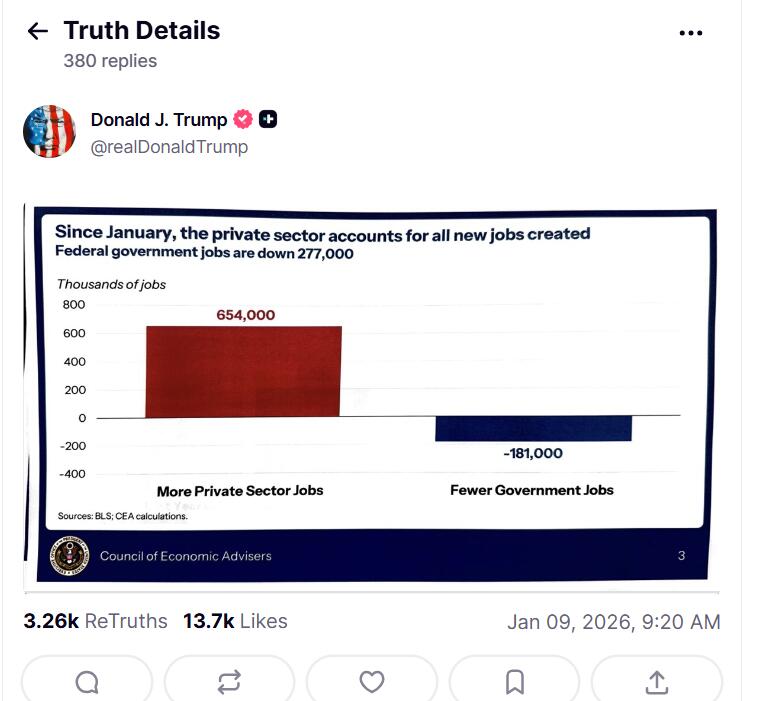
Core Insights - President Trump disclosed part of the U.S. employment data ahead of its official release, revealing that the private sector added 654,000 jobs since January, while government jobs decreased by 181,000 [1][2] - The official report from the Bureau of Labor Statistics (BLS) showed that non-farm employment increased by only 50,000 in December, falling short of the expected 65,000, marking the worst annual performance since the pandemic [3][6] - The private sector's job growth in December was only 37,000, significantly lower than the previous year's figures, indicating a weak labor market [6][8] Employment Data Summary - The BLS reported a total increase of 584,000 non-farm jobs for the year, the lowest since the pandemic caused a loss of 9.2 million jobs [3][6] - The average monthly job addition in the private sector for 2025 was 61,000, the weakest since 2003 without an economic recession [6][8] - Employment growth was primarily in the leisure and hospitality sectors, with healthcare adding 21,000 jobs in December, but other sectors like retail, construction, and manufacturing saw declines [8] Historical Data Revisions - The BLS revised previous months' data significantly, with October's job loss adjusted from 105,000 to 173,000 and November's from a gain of 64,000 to 56,000, totaling a downward revision of 76,000 jobs [10] - The three-month moving average for job growth now shows a decline of 22,000 jobs, indicating a weakening labor market trend [10] Unemployment Rate Insights - Despite weak job growth, the unemployment rate fell from 4.6% to 4.4%, attributed to a decrease in labor force participation to 62.4% [12] - The drop in unemployment has diminished expectations for a Federal Reserve rate cut in January, with traders anticipating no changes in the upcoming meeting [12] - Average hourly earnings increased by 0.3% month-over-month, with a year-over-year growth of 3.8%, outpacing inflation by about 1 percentage point [12]
美国12月非农增5万人不及预期,失业率降至4.4%,年度增幅创2020年以来新低
Sou Hu Cai Jing· 2026-01-09 14:04
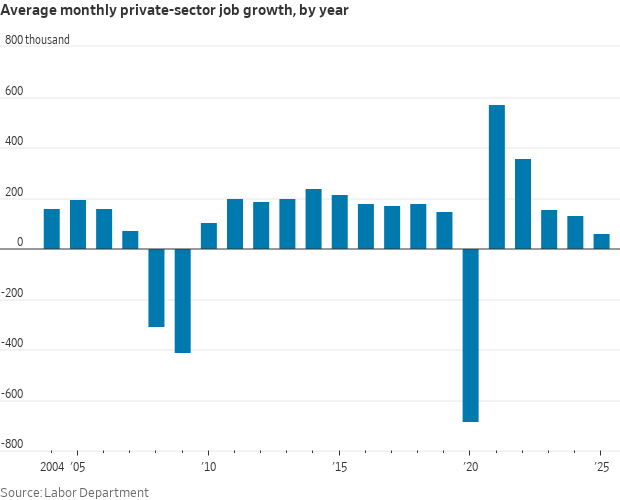
Core Viewpoint - The U.S. non-farm employment growth in December fell short of expectations, with significant downward revisions to the previous two months' data, leading to the weakest annual employment growth since the pandemic began [1][3]. Employment Data Summary - The Bureau of Labor Statistics reported that October's non-farm employment was revised from a loss of 105,000 to a loss of 173,000, and November's from an increase of 64,000 to an increase of 56,000, resulting in a total downward revision of 76,000 jobs for November and December combined [3]. - For the entire year, U.S. non-farm employment increased by 584,000, marking the weakest annual growth since the sharp decline of 9.2 million jobs in 2020 due to the pandemic [3]. - The three-month moving average of employment data has entered negative territory, indicating a significant decline in labor market momentum [1][4]. Unemployment Rate Insights - Despite the disappointing employment data, the unemployment rate decreased to 4.4%, which was better than the expected 4.5% and the previous 4.6% [9]. - The decline in the unemployment rate is partly attributed to a shrinking labor force participation rate, suggesting that some unemployed individuals have exited the labor market entirely [3]. Sector-Specific Employment Trends - Private sector employment growth remains weak, with manufacturing jobs continuing to decline. The healthcare sector added 21,000 jobs, although this is below the average monthly increase of 34,000 jobs seen last year [5]. - Analysts predict that in 2025, private sector employers will add an average of 61,000 jobs per month, the weakest level of growth since 2003 without an economic recession [5]. Wage Growth Analysis - Average hourly earnings increased by 0.3% month-over-month, with the previous value revised to 0.2%. Over the past 12 months, wages have grown by 3.8%, outpacing inflation by approximately 1 percentage point [7]. Interest Rate Expectations - The report has dispelled market expectations for a Federal Reserve rate cut in January, as the decline in the unemployment rate is seen as a key factor supporting the Fed's patience [8]. - The likelihood of a rate cut in January is currently viewed as zero, despite the weak employment data and downward revisions [2][8].
美国12月非农就业人数增加5万人,低于预期
Hua Er Jie Jian Wen· 2026-01-09 14:03
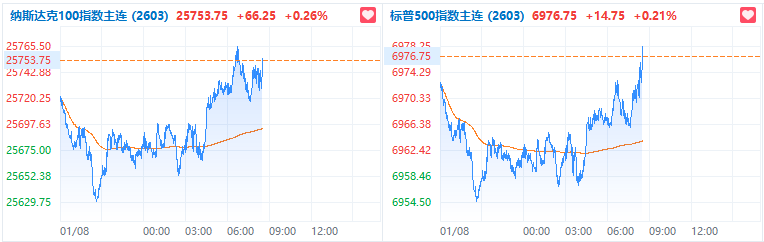
Core Insights - The U.S. non-farm employment growth in December was below expectations, with a total increase of 50,000 jobs compared to the forecast of 65,000 jobs, marking the weakest annual performance since the pandemic [1] - The unemployment rate in December was reported at 4.4%, slightly better than the expected 4.5% [1] - The total non-farm employment increase for the year was 584,000, the weakest annual growth since the significant job losses during the COVID-19 pandemic [3] Employment Data - The October non-farm employment figure was revised down from a loss of 105,000 to a loss of 173,000, while November's figure was adjusted from an increase of 64,000 to an increase of 56,000, resulting in a total downward revision of 76,000 jobs for November and December combined [1][3] - The three-month moving average employment data has entered negative territory, indicating a significant decline in labor market momentum [1][3] Sector Performance - The private sector showed weak employment growth, with manufacturing jobs continuing to decline [3] - The healthcare sector was a primary driver of job creation, adding 21,000 jobs, although this was below the average monthly increase of 34,000 jobs in 2023 [3] Wage Growth - Average hourly earnings increased by 0.3% month-over-month, with the previous value revised to 0.2% [4] - Over the past 12 months, wages have grown by 3.8%, outpacing inflation by approximately 1 percentage point [4] Market Reaction - Following the employment data release, U.S. stock futures saw a short-term rise, with the Nasdaq futures up by 0.43%, S&P 500 futures up by 0.33%, and Dow futures up by 0.28% [5] - U.S. Treasury bonds fell, and the dollar index experienced a short-term decline [5] - Spot gold prices rose, reaching $4,490 per ounce, with a daily increase of 0.30% [6]
连续六年经济增长低迷,泰国冀望中国重寻增长动能?
2 1 Shi Ji Jing Ji Bao Dao· 2026-01-09 13:36
Economic Overview - Thailand is experiencing prolonged economic stagnation, with the central bank projecting a GDP growth rate of only 1.5% by 2026 due to weak exports, high debt, and a slowdown in tourism [1][2] - Since 2019, Thailand's economy has been in a "deceleration" mode, significantly lagging behind other major ASEAN economies [1][2] - The OECD has noted that Thailand's economic recovery post-pandemic remains weak compared to other ASEAN countries [1] Industrial Strategy - Thailand is actively promoting the "Industry 4.0" strategy, focusing on emerging sectors such as renewable energy and the digital economy to regain growth momentum [1] - Chinese investments in Thailand are increasing, with a reported 49% year-on-year growth in Chinese investments reaching 22 billion yuan in the first half of 2025, particularly in electronics, automotive, and food sectors [1][12] Tourism Sector - The tourism sector, which contributes 20%-25% to Thailand's economy, is still far from recovery, with a projected decline in foreign tourist arrivals to 32.9 million in 2025, down 7.23% year-on-year [3][4] - The tourism ministry anticipates a slight increase to 36.7 million tourists in 2026, but this is still below pre-pandemic levels of 40 million [3] Export Challenges - Thailand's export sector, crucial for its economy, is facing challenges with a projected growth rate of 11.6% to 12.1% for 2025, but risks a 1.2% contraction in 2026 due to high base effects and global demand slowdown [4][5] - The strong Thai baht, which appreciated over 10% against the US dollar, is negatively impacting export competitiveness [6] Structural Issues - Thailand is grappling with structural challenges such as an aging population, outdated industrial structures, and a shortage of skilled labor, which are hindering potential growth rates [8][9] - The proportion of the population aged 65 and older is expected to reach 15.36% by 2024, with predictions of becoming the first developing country in Asia to enter a super-aged society by 2029 [8] Government Initiatives - The Thai government has introduced various economic stimulus measures, including a 44 billion baht consumption stimulus plan aimed at benefiting around 20 million citizens [10][11] - Efforts to attract foreign investment include tax incentives for emerging industries and initiatives to open new markets for Thai agricultural products [11] Bilateral Cooperation - China remains Thailand's largest trading partner, with bilateral trade reaching $76.1 billion in the first half of 2025, a 17% increase year-on-year [11][12] - The deepening political trust between Thailand and China is expected to enhance cooperation across trade, culture, and infrastructure [13]
破局2.5万亿!中国并购市场:存量洗牌下的产业重构与科技突围
Zhong Guo Jing Ying Bao· 2026-01-09 12:53
Core Insights - The Chinese M&A market experienced significant growth in 2025, with a total of 8,151 disclosed transactions and a transaction volume of approximately 25,894 billion yuan, representing a year-on-year increase of about 16.12% [1] - The recovery of the M&A market is attributed to a combination of policy, industry, and capital resonance, marking a shift in China's economic development from "quantity increase" to "quality improvement" [1][3] - The trend indicates a transition in the regulatory framework from "fatherly" control to a "market-friendly" service model, significantly reducing institutional transaction costs and enhancing market vitality [1][3] Regional Distribution - Beijing led the M&A market with a transaction volume of 10,930 billion yuan, up 48.59% year-on-year; Shanghai followed with 6,092 billion yuan, down 14.92%; and Guangdong ranked third with 4,593 billion yuan, down 17.89% [2] - There were 28 M&A events exceeding 100 billion yuan, with notable transactions including China Shenhua's acquisition of Guoyuan Power at 1,335.98 billion yuan, and CICC's mergers with Dongxing Securities and Xinda Securities at 1,142.75 billion yuan [2] Industry Distribution - The industrial sector led M&A activity with a transaction volume of 7,605 billion yuan, up 11.67% year-on-year; the real estate sector saw a remarkable increase of 549.36% to 4,443 billion yuan; and the information technology sector reached 2,855 billion yuan, up 35.84% [2][3] - The significant growth in the real estate sector is attributed to necessary asset-liability restructuring, with many transactions aimed at project clearance and risk mitigation [3] M&A Trends and Strategies - The industrial sector's M&A activity reflects a shift from "spreading out" to "stepping up," focusing on enhancing supply chain resilience and precision [3][4] - Horizontal integration M&A events accounted for 5,966 billion yuan, representing 22.70% of total transaction volume, indicating a deep structural phase of "stock reshuffling" across various industries [4] - Companies are increasingly pursuing "structural power" through horizontal mergers, aiming to establish stronger competitive barriers and enhance management efficiency and technological innovation [4] Future Outlook - In 2026, two key areas of focus are expected: strategic acquisitions in hard technology industries, particularly in semiconductors and industrial software, and professional integration led by state-owned enterprises in sectors like new energy and high-end equipment [5] - Cross-border M&A in the high-tech sector is anticipated to gain momentum as Chinese companies seek to acquire advanced technologies and talent globally, enhancing their position in the global tech supply chain [5][6]