
石化

Search documents
中国民营企业500强、中国制造业民营企业500强,盛泽“双骄”名列前十!
Sou Hu Cai Jing· 2025-08-29 15:44
Core Insights - The 2025 China Private Enterprises Top 500 list was released by the All-China Federation of Industry and Commerce, highlighting the strong performance of private enterprises in China [2][9] - Hengli Group ranked third among private enterprises and first in the manufacturing sector, while Shenghong Holding Group ranked ninth among private enterprises and sixth in manufacturing [1][8] Group 1: Hengli Group - Hengli Group has maintained its position as the third largest private enterprise in China for five consecutive years and has topped the manufacturing sector for four years [5] - The company focuses on transforming and upgrading key sectors such as textiles, chemical fibers, new materials, petrochemicals, and high-end equipment manufacturing, enhancing its core competitiveness in the global supply chain [5] - Hengli Group emphasizes collaboration with domestic and international research institutions and universities to foster innovation and develop high-level innovation platforms [5] Group 2: Shenghong Holding Group - Shenghong Holding Group has achieved significant milestones, ranking ninth among private enterprises and sixth in the manufacturing sector [8] - The company has developed an integrated industrial chain in petrochemical refining, new energy, and high-end textiles, with notable production capacities in various sectors [8] - Shenghong is committed to innovation and sustainability, having established the first national manufacturing innovation center led by a private enterprise and developed the world's first recycling fiber production line [8] Group 3: Regional Economic Impact - The success of Hengli and Shenghong is seen as a driving force for the private economy in Shengze, contributing to the creation of a favorable business environment and enhancing the confidence of private enterprises [9] - Shengze aims to leverage the strengths of these leading companies to build a world-class high-end textile industry cluster and promote new industrialization [9]



“反内卷”的风在化工市场掠过
Guo Tou Qi Huo· 2025-08-29 12:59
Report Industry Investment Rating - Not provided in the given content Core Viewpoints of the Report - Since 2019, domestic petrochemical production capacity has grown rapidly, but demand has faced difficulties, resulting in an oversupply of traditional petrochemical products and poor industry profitability [11] - The production capacity growth rates of varieties such as PX and ethylene glycol have begun to slow down significantly this year, and the rapid growth of polyester industry production capacity may be coming to an end [11] - In the future, the trend of reducing oil and increasing chemicals will continue, and the R & D and scale growth of high - value - added new materials will accelerate. Policy regulation is expected to reduce supply growth and relieve the pressure of future concentrated production [11] Summary by Related Catalogs 1. Some old - fashioned production capacities have undergone a transformation - In the petrochemical industry, the proportion of pre - 1996 production facilities is relatively high in ethylene, downstream PE, and pure benzene (about 17%), and about 15% in propylene. The proportion of mainstream petrochemical products such as ethylene glycol, polypropylene, styrene, PX, and PTA is within 10% [3] - The over - 20 - year - old facilities in the industry are concentrated in state - owned enterprises and are mostly refining - supporting facilities. Some old - fashioned state - owned production capacities have gradually withdrawn, while others have been upgraded through technological transformation [3] - It is difficult to simply eliminate production capacity by "one - size - fits - all". Policy tends to "close first and then open" the refining capacity, and the replacement of refining capacity often leads to continuous growth in chemical product production capacity [3] 2. "Solving oversupply through major overhauls" is essentially industrial upgrading - The integration of upstream and downstream refining and chemical industries in the domestic petrochemical industry has deepened. Enterprises are actively deploying high - value - added petrochemical products, and profit accounting has shifted to comprehensive benefits [6] - Due to the complexity of refinery terminal product layout and comprehensive consideration of benefits, short - term market - based adjustment may fail for individual products, and it is difficult to reach a unified production reduction agreement [6] - The path to "solve petrochemical oversupply through major overhauls" may be to upgrade old - fashioned facilities, but it is a complex system project with many challenges and unclear implementation paths [7] 3. Controlling new additions and project approvals to relieve supply growth pressure - The state's approval of large - scale refining and chemical integration or chemical production projects using crude oil as raw materials has become stricter. The production capacity growth rate of domestic PX has slowed down significantly [8] - In the future, ethylene project construction may be subject to strict national approval. Although new production capacity will bring pressure, strengthening project approval may relieve the pressure of continuous production [8] - Overseas, the scale of naphtha cracking production capacity tends to shrink, and the improvement of the overseas olefin supply - demand pattern will help relieve China's import pressure [9] 4. Summary and outlook - The petrochemical industry has an oversupply of traditional products and poor profitability. The production capacity growth of some products has slowed down, and the rapid growth of polyester industry production capacity may end [11] - The proportion of old - fashioned production capacity in the industry is relatively low, and the impact of policies is expected to be limited. Attention should be paid to the upgrading and withdrawal of supporting facilities of small - scale old - fashioned refining capacity [11] - In the future, the trend of reducing oil and increasing chemicals will continue, and policy regulation will focus on olefin downstream products, reducing supply growth and relieving the pressure of concentrated production [11]
宏观氛围好转 短期PTA维持震荡格局
Jin Tou Wang· 2025-08-29 08:19
Core Viewpoint - PTA futures experienced a slight decline of 0.29%, closing at 4784.00 yuan/ton, indicating a downward trend in the market [1] Industry Summary - A 1.2 million ton PTA facility in East China has recently been shut down, with an uncertain restart timeline. The new 3.2 million ton PTA facility is currently operating at 80-90% capacity [2] - As of the week ending August 28, PTA factory inventory stands at 3.81 days, an increase of 0.1 days from the previous week and up 0.05 days year-on-year [2] - On August 28, the number of PTA futures warehouse receipts was 29,938, a decrease of 1,002 from the previous trading day [2] Institutional Perspectives - Donghai Futures noted that aside from increased short positions in PTA, the overall market has shown a downward trend. However, adjustments in domestic and Korean petrochemical capacities may stabilize the sector in the short term, with environmental regulations causing temporary shutdowns in Huizhou providing some support. The basis has slightly recovered, reducing to levels seen in January to mid-February. Downstream operating rates have rebounded to 89.9%, with inventory replenishment accelerating ahead of the peak season, suggesting a potential slight inventory reduction in September [3] - Ningzheng Futures highlighted a decrease in PTA operating rates and social inventory. With an improving macroeconomic environment and expectations for traditional demand peaks in September and October, downstream polyester operating rates are stabilizing, although sustainability remains uncertain. On the cost side, the supply-demand outlook for PX has weakened marginally in August, with crude oil showing a weak fluctuation [3]
聚酯数据日报-20250829
Guo Mao Qi Huo· 2025-08-29 03:18
Report Summary 1) Report Industry Investment Rating No information provided. 2) Core View of the Report - PTA market: The PTA market is bearish due to weak crude oil prices and news of possible production cuts in downstream polyester bottle chips. Domestic PTA production has slightly decreased due to concentrated breakdowns and maintenance of PTA plants. The spread between PX and naphtha has widened, and the weak benzene price has restricted the further increase of PX production. The spread between PX and MX has recovered, and the downstream polyester load has remained at around 88%. The polyester price has shown a positive trend, especially the inventory of filament has been well reduced, and the production and sales have been continuously optimistic with obvious profit repair. [2] - MEG market: There are rumors that China is planning a major reform of its petrochemical and refining industries, aiming to gradually eliminate small - scale and outdated facilities and shift investment to advanced materials. South Korean naphtha cracking units are planning to cut production, and olefin varieties have risen significantly. The price of ethylene glycol has recovered, and the continuous postponement of overseas ethylene glycol plant maintenance, especially in Saudi Arabia, may have a significant impact on the market outlook. The future arrival volume of ethylene glycol has decreased, the polyester inventory is in good condition, and the downstream weaving load has increased. [2] 3) Summary by Relevant Catalogs Market Data - **Crude Oil and PTA - Crude Oil Relationship**: INE crude oil price increased from 479.7 yuan/barrel on August 27, 2025, to 481.7 yuan/barrel on August 28, 2025. The PTA - SC spread decreased from 1338.0 yuan/ton to 1291.4 yuan/ton, and the PTA/SC ratio decreased from 1.3838 to 1.3689. [2] - **PX Data**: CFR China PX price decreased from 854 to 849, and the PX - naphtha spread increased from 254 to 259. [2] - **PTA Data**: PTA主力期价 decreased from 4824 yuan/ton to 4792 yuan/ton, and the PTA spot price decreased from 4835 yuan/ton to 4775 yuan/ton. The spot processing fee decreased from 220.5 yuan/ton to 215.2 yuan/ton, and the disk processing fee decreased from 239.5 yuan/ton to 237.2 yuan/ton. The PTA warehouse receipt quantity decreased from 30940 to 29938. [2] - **MEG Data**: MEG主力期价 decreased from 4481 yuan/ton to 4465 yuan/ton. The MEG - naphtha spread decreased from (93.21) yuan/ton to (95.40) yuan/ton, and the MEG inner - market price decreased from 4553 yuan/ton to 4527 yuan/ton. [2] - **Industry Chain Start - up Rate**: PX start - up rate remained at 80.38%, PTA start - up rate decreased from 72.16% to 70.76%, MEG start - up rate remained at 60.27%, and polyester load decreased from 86.11% to 86.03%. [2] - **Polyester Product Data**: - **Polyester Filament**: POY150D/48F price decreased from 6882 to 6860, and its cash flow increased from (24) to 11. FDY150D/96F price remained at 7140, and its cash flow increased from (269) to (209). DTY150D/48F price remained at 8040, and its cash flow increased from (69) to (9). The filament production and sales rate increased from 40% to 43%. [2] - **Polyester Staple Fiber**: 1.4D direct - spun polyester staple fiber price decreased from 6680 to 6655, and its cash flow increased from 121 to 156. The staple fiber production and sales rate increased from 39% to 40%. [2] - **Polyester Chip**: Semi - bright chip price decreased from 5880 to 5860, and its cash flow increased from (129) to (89). The chip production and sales rate decreased from 67% to 42%. [2] Device Maintenance A 2.5 - million - ton PTA plant in South China has started maintenance today, and another 2.5 - million - ton plant is expected to start maintenance around August 23, with an expected maintenance time of about one month. [2] Trading Suggestions - PTA: Due to significant fluctuations in the recent polyester futures price, investors are advised to participate with caution and pay attention to the impact of subsequent plant progress on the market. [2] - MEG: The price recovery of ethylene glycol is affected by multiple factors such as industry reform rumors and overseas plant maintenance postponement, and attention should be paid to the impact of these factors on the market. [2]
产科教融合:要从追求短期转向可持续
Zhong Guo Hua Gong Bao· 2025-08-29 03:02
Core Viewpoint - The integration of education, technology, and talent is a key strategy for enhancing national innovation capabilities and supporting industrial transformation and upgrading, although challenges remain in talent quality and research outcome efficiency [1] Group 1: Achievements in Integration - China University of Petroleum (East China) has invested over 800 million yuan to establish 13 national key research platforms and has formed partnerships with companies like Shandong Energy Group to create a dual leadership system in education [2] - The university has developed a "four-stage" training pathway and implemented order-based talent classes, enhancing the alignment between educational and industrial chains [2] - The establishment of the Jixia Academy's integration research center aims to create a new ecosystem for collaborative education, successfully implementing the "N1N integration model" to drive efficient research outcome transformation [3] Group 2: Challenges in Integration - The shift of higher education management to local authorities has weakened the direct support from industries, leading to a decline in education quality and reduced willingness for collaboration from enterprises [4] - There are discrepancies in the evaluation standards and growth paths between enterprises, which focus on economic benefits, and universities, which prioritize comprehensive student development [4] - A lack of unified quantitative assessment standards for various stakeholders in the integration process has been identified as a core challenge [4] Group 3: Future Directions - Experts emphasize the need for a long-term investment mindset in the integration process, advocating for a shift from short-term gains to sustainable development [7] - The establishment of a mutually beneficial goal between educational institutions and enterprises is crucial for aligning talent development with industry needs [7] - A collaborative effort among universities, enterprises, governments, and associations is essential to create a scientific benefit-sharing and evaluation mechanism for deeper integration [7]
多家化企获评重庆创新型中小企业
Zhong Guo Hua Gong Bao· 2025-08-29 02:17
中化新网讯日前,重庆经济和信息化委员会公布《2025年重庆市创新型中小企业申报和复核通过名 单》。830家企业申报通过,1724家企业复核通过,涉及多家石化、化工、新材料企业。 据了解,此次未参加复核的2022年创新型中小企业,属于有效期内专精特新中小企业且满足评价认定基 本条件的,其创新型中小企业有效期与专精特新中小企业有效期保持一致,其余未参加的企业和未通过 此次复核的企业,即日取消其创新型中小企业称号。 据记者梳理,在申报通过的830家企业中,涉及石化、化工、新材料的企业有中石化重庆页岩气有限公 司、重庆宜亚新材料科技有限公司、重庆华希活性炭有限公司、重庆富地化工有限公司、重庆江南化工 (002226)科技有限责任公司等。在复核通过的1724家企业中,涉及石化、化工、新材料的企业有中化 重庆涪陵化工有限公司、重庆腾泽化学有限公司、中化学华陆新材料有限公司、立邦涂料(重庆)化工有 限公司、重庆卡贝乐化工有限责任公司等。 ...
破解“减排成本高”难题 碳市场建设进入新阶段
Di Yi Cai Jing· 2025-08-28 16:39
Core Viewpoint - The issuance of the "Opinions on Promoting Green and Low-Carbon Transition and Strengthening National Carbon Market Construction" marks a new phase in China's carbon market development, aiming to enhance the green and low-carbon development mechanism and better utilize market mechanisms [1] Group 1: Carbon Market Development - The carbon market serves as a crucial policy tool for addressing climate change and accelerating the green transition of the economy and society [2] - China has established the largest national carbon emissions trading market globally, along with a voluntary greenhouse gas reduction trading market, creating a unique carbon market system [2][3] - The carbon price acts as a "barometer" reflecting the scarcity of carbon emissions resources, guiding capital flow towards low-carbon sectors and technologies [2][3] Group 2: Mechanisms and Flexibility - The carbon market provides a flexible mechanism for achieving greenhouse gas control targets at lower costs, allowing companies to choose compliance paths [3] - The national carbon emissions trading market will accelerate the transition to clean energy in key industries such as electricity, metallurgy, and cement, promoting decarbonization across supply chains [3] Group 3: Market Expansion and Coverage - The national carbon market is expected to cover approximately 70% of the total carbon emissions in major industries like electricity, steel, and cement, driving the development of new green market competitiveness [3] - The construction of a unified national carbon market requires standardized quota management, trading, regulation, and data management to enhance resource allocation efficiency [4] Group 4: Voluntary Emission Reduction Market - The national voluntary greenhouse gas reduction trading market is a vital component of the carbon market system, aimed at creating significant green market opportunities and supporting national contributions to global climate governance [5] - As of now, the voluntary reduction trading market has registered 5,635 accounts and 47 projects, with 23 projects officially registered, amounting to approximately 9.48 million tons of CO2 equivalent verified reductions [5][6] Group 5: Future Directions - The development of the voluntary reduction trading market is still in its early stages, with plans to focus on key technologies for carbon peak and neutrality, and to enrich market products and participants [6]
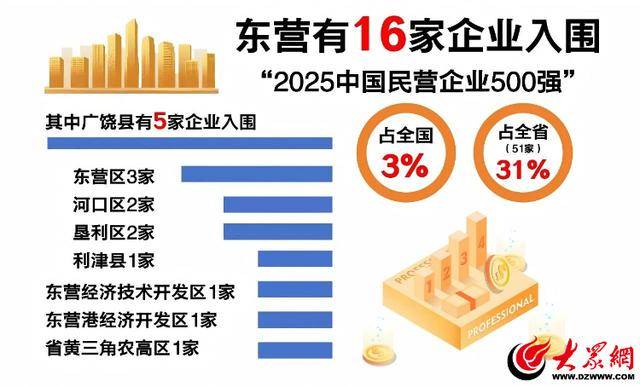
喜报!2025中国民营企业500强榜单发布!东营市企业入围数量蝉联全省第一!
Sou Hu Cai Jing· 2025-08-28 12:09
Core Insights - The "2025 China Top 500 Private Enterprises" and related rankings were announced at a conference held by the All-China Federation of Industry and Commerce in Shenyang, Liaoning [2] - Dongying City had 16 enterprises listed in the "2025 China Top 500 Private Enterprises," maintaining the highest number in the province [2] - Additionally, 17 enterprises from Dongying were included in the "2025 China Top 500 Private Manufacturing Enterprises" [2] Summary of Rankings 2025 China Top 500 Private Enterprises from Dongying - Lihua Yi Group Co., Ltd. ranked 48th nationally [3] - Wanda Holding Group Co., Ltd. ranked 49th [3] - Qicheng (Shandong) Petrochemical Group Co., Ltd. ranked 112th [3] - Fuhai Group New Energy Holdings Co., Ltd. ranked 113th [3] - Huatai Group Co., Ltd. ranked 127th [3] - Other notable rankings include Shandong Haike Holdings Co., Ltd. at 145th and Shandong Qirun Holdings Group Co., Ltd. at 147th [3] 2025 China Top 500 Private Manufacturing Enterprises from Dongying - Lihua Yi Group Co., Ltd. ranked 35th nationally [4] - Wanda Holding Group Co., Ltd. ranked 40th [4] - Qicheng (Shandong) Petrochemical Group Co., Ltd. ranked 79th [4] - Fuhai Group New Energy Holdings Co., Ltd. ranked 80th [4] - Other significant rankings include Huatai Group Co., Ltd. at 90th and Shandong Haike Holdings Co., Ltd. at 105th [4]
化工行业有望开启周期新起点,石化ETF(159731)近3个月超越基准年化收益达8.15%
Xin Lang Cai Jing· 2025-08-28 06:37
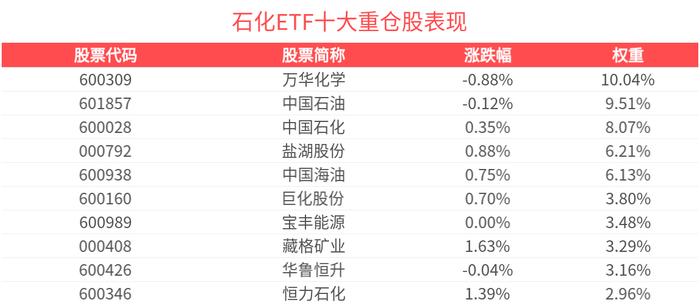
Core Viewpoint - The petrochemical industry is experiencing a mixed performance, with the China Petrochemical Industry Index showing a slight decline, while the petrochemical ETF has demonstrated significant annual growth and high tracking accuracy [1][2]. Group 1: Index Performance - As of August 28, 2025, the China Petrochemical Industry Index has decreased by 0.1% [1]. - The petrochemical ETF (159731) has dropped by 0.39%, with the latest price at 0.77 yuan [1]. - Over the past year, the petrochemical ETF has seen a net value increase of 20.37% [1]. Group 2: ETF Performance Metrics - The highest single-month return for the petrochemical ETF since inception was 15.86%, with the longest consecutive monthly gains being three months and a maximum increase of 19.49% [1]. - The average monthly return during the rising months is 5.30% [1]. - The ETF has outperformed its benchmark with an annualized excess return of 8.15% over the last three months [1]. Group 3: Industry Insights - Since 2024, the growth rate of fixed asset investment in the industry has noticeably slowed, leading to marginal improvements on the supply side [1]. - China's global market share in chemical products is steadily increasing, indicating a potential new cycle for the chemical industry [1]. - Short-term overseas demand may face challenges, but there is optimism for domestic demand and supply dynamics to improve, particularly for related industry targets [1]. - In the medium to long term, the chemical sector is expected to restart a new cycle against a backdrop of low oil prices and global recovery [1]. Group 4: Top Holdings in the Index - As of July 31, 2025, the top ten weighted stocks in the China Petrochemical Industry Index account for 56.18% of the index, including Wanhua Chemical, China Petroleum, and China Petrochemical [2]. - The top three stocks by weight are Wanhua Chemical (10.04%), China Petroleum (9.51%), and China Petrochemical (8.07%) [4].






资讯早间报-20250828
Guan Tong Qi Huo· 2025-08-28 01:56
Report Industry Investment Rating No relevant information provided. Core Viewpoints - The report presents a comprehensive overview of overnight market trends, important macro - economic news, and developments in various financial and commodity markets, including futures, stocks, bonds, and foreign exchange [3][4][5][6]. Summary by Category Overnight Market Trends - **Domestic Futures**: On Wednesday night, domestic futures contracts showed mixed performance, with corn rising over 1% and many contracts such as zinc, SC crude oil, and others falling over 1% [3]. - **International Crude Oil**: International crude oil settlement prices increased, with the US WTI crude oil up 0.96% at $63.86/barrel and Brent crude up 0.75% at $67.20/barrel [4]. - **International Precious Metals**: International precious metal futures generally rose, with COMEX gold up 0.55% at $3451.80/ounce and COMEX silver up 0.22% at $38.69/ounce [5]. - **London Base Metals**: Most London base metals declined, except for tin which rose 0.91%. LME zinc fell 1.76%, LME aluminum fell 1.29%, etc. [5]. - **International Agricultural Products**: International agricultural product futures all declined, with US soybeans down 0.12%, US corn down 0.85%, etc. [6]. Important Macroeconomic News - **Macro - Economy**: In July, the operating income of industrial enterprises above designated size increased year - on - year, and the profit decline narrowed. The Ministry of Commerce will introduce policies to promote service exports. The New York Fed President hinted at possible interest - rate adjustments [9]. - **Energy and Chemical Futures**: UAE's fuel inventory changed, China's methanol port inventory increased, Japan's commercial crude inventory decreased, and the US had changes in oil exports, production, and inventory. South Korea may reduce naphtha imports [14][15]. - **Metal Futures**: India may lift restrictions on pension investment in gold ETFs. The new - energy vehicle retail and wholesale in China from August 1 - 24 increased year - on - year [19]. - **Black - Series Futures**: Some steel enterprises in Tangshan plan to conduct blast furnace maintenance, and Mongolia's coking coal auction had a full - scale failure [21]. - **Agricultural Product Futures**: Malaysia's palm oil exports from August 1 - 25 increased. Ukraine's wheat output may decline, and corn output may rise. Domestic and international soybean prices have different trends [23][24][25]. Financial Markets - **Stocks**: A - shares, Hong Kong stocks, US stocks, and European stocks had different performances. Hong Kong's IPO market was strong in the first seven months. Some companies had major announcements such as acquisitions and listings [28][38][40]. - **Bonds**: Domestic bank - to - bank bond yields had mixed changes, new bond indices were released, and US bond yields fell [44][45][46]. - **Foreign Exchange**: The on - shore RMB against the US dollar declined slightly, and the US dollar index fell slightly [47]. Upcoming Events - There are various economic data releases and events scheduled, including central bank meetings, policy announcements, and corporate earnings reports [50][52].