
贵金属

Search documents
白银单日暴跌14%!有色板块遭223亿资金出逃,金银高位剧烈震荡,市场进入高危波动期
Sou Hu Cai Jing· 2026-02-01 17:13
Core Viewpoint - The A-share non-ferrous metal sector experienced a significant drop on January 30, 2026, with the non-ferrous metal index falling by 7.80% and precious metals dropping even more, indicating a rapid shift from bullish sentiment to panic selling [1][2]. Market Performance - On January 30, 2026, the A-share non-ferrous metal index plummeted by 7.80%, while the precious metals sector saw an 8.87% decline, and the silver concept sector dropped by 9.03% [1]. - Individual stocks such as Nanshan Aluminum, Tongling Nonferrous Metals, and Silver Nonferrous were heavily affected, with nearly 30 stocks hitting the daily limit down [1]. - In the futures market, Shanghai Gold's T D price fell to 1127.08 CNY per gram, a drop of 4.64%, while silver T D plummeted to 24764 CNY per kilogram, down 14.35% [1]. Market Dynamics - The rapid decline was preceded by a strong upward trend in 2025, where gold and silver prices reached historical highs, leading to profit-taking actions by investors [4]. - On January 30, over 22.3 billion CNY in net outflows from the non-ferrous metal sector were recorded, with significant sell orders impacting leading stocks like Zijin Mining [4]. - High leasing rates for silver and record trading volumes in ETFs indicated an overcrowded market, contributing to the sell-off [4]. Policy Changes - Regulatory changes, including increased margin requirements for gold and silver futures by the Shanghai Futures Exchange and the CME, pressured leveraged investors, leading to forced liquidations [5]. - Speculation about potential hawkish shifts in U.S. monetary policy, particularly with the rumored appointment of Kevin Warsh as Fed Chair, added to market anxiety [5][7]. Investor Sentiment - The market's panic was contagious, creating a feedback loop where falling futures prices led to declining stock prices, further eroding investor confidence [8]. - Different metal types exhibited varying levels of volatility, with gold showing more resilience due to its monetary attributes, while silver's smaller market size led to more pronounced fluctuations [10]. Future Outlook - Analysts suggest that the market may require time to digest the panic, with gold and silver prices likely entering a high-volatility range [11]. - Recommendations for investors lean towards caution, advising against impulsive buying or selling in the current volatile environment [13].

财经观察丨突然大跌!比特币跌破8万美元,市场遭遇大抛售,什么原因?
Sou Hu Cai Jing· 2026-02-01 15:39
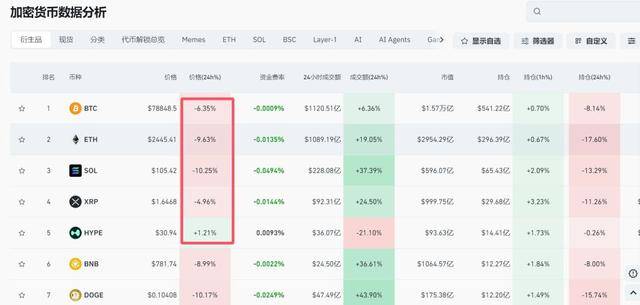
Group 1: Bitcoin Market Overview - Bitcoin has dropped below the $79,000 mark, reaching a low of $78,130, the lowest level since April 2025, with a daily decline of 6.35% [1] - As of the latest update, Bitcoin is priced at $78,848.5, having previously dipped to $75,687 [1] - Other cryptocurrencies such as SOL and Dogecoin have also seen declines exceeding 10% [1] Group 2: Market Liquidation Data - In the past 24 hours, the total liquidation in the cryptocurrency market reached $2.559 billion, affecting over 420,000 traders [2] - Long positions accounted for $2.4 billion of the liquidations, while short positions were liquidated for $150 million [2] - The largest single liquidation occurred on Hyperliquid-ETH, valued at $223 million [2] Group 3: Precious Metals and Economic Factors - Precious metals have experienced significant declines, with silver dropping over 25% and gold falling more than 9% [4] - The market reaction is attributed to the nomination of Kevin Warsh as the next Federal Reserve Chairman, which has raised concerns about the independence of the Fed and strengthened the dollar, negatively impacting gold and silver prices [4][5] - Warsh's nomination is seen as a move towards a more accommodative monetary policy, which could lead to lower interest rates to alleviate the burden of the $37 trillion national debt [5] Group 4: Market Sentiment and Future Outlook - Recent weeks have shown that Bitcoin has not responded positively to market changes that would typically benefit its price, indicating a lack of investor confidence [6] - The recent crash in precious metals did not lead to an influx of capital into Bitcoin, suggesting a shift in investor interest towards traditional safe-haven assets [8] - Analysts note that the current price levels indicate extremely low retail interest in Bitcoin, with trading volumes expected to remain subdued for one to two more quarters [9]
白银下跌后,出现一个有意思的现象,那就是有些银店不回收银子了,说是没办法定价,其实,就是失去流动性了
Sou Hu Cai Jing· 2026-02-01 15:34
Core Viewpoint - The recent volatility in silver prices has led to a significant decline in physical demand, with silver shops halting purchases due to market instability, indicating a sudden loss of liquidity in the market [2][4]. Group 1: Market Dynamics - The Silver Institute's report indicates that industrial demand for silver is expected to reach a record high of 680 million ounces in 2024, with continued strength in sectors like photovoltaics, AI servers (growing over 50% annually), and automotive electronics [5]. - Approximately 58% of silver demand comes from industrial production, where companies are rational buyers, purchasing based on need rather than speculative trends [7]. - The speculative investment demand for silver peaked at 26.3% in 2022 but has since declined as the Federal Reserve signaled a pause in interest rate cuts, impacting market expectations for silver prices [7][9]. Group 2: Supply and Demand Imbalance - Current market conditions have created a situation where speculative buyers are retreating, leading to a lack of buyers for silver, as evidenced by silver shops refusing to buy back silver [9][11]. - Despite a decrease in silver inventories at the Shanghai Gold Exchange, global supply is projected to increase by 3% in 2025, reaching 1.05 billion ounces, creating a mismatch between rising supply and declining speculative demand [9][11]. - The volatility of silver, often referred to as a "widow maker," highlights its tendency to oscillate between financial and commodity attributes, leading to potential price declines when speculative interest wanes [11][14].
金银遇史诗级风暴 贵金属板块将如何演绎?
Mei Ri Jing Ji Xin Wen· 2026-02-01 15:25
Core Viewpoint - The global precious metals market experienced an unprecedented sell-off, with gold prices dropping over 12% and silver prices plummeting by more than 35%, raising concerns about the end of the precious metals bull market [1][2]. Group 1: Market Performance - On January 31, gold prices fell from approximately $5400 to a low of $4700 per ounce, ultimately closing around $4907.5, marking a single-day decline of 9.3% [1]. - Silver prices saw an even more dramatic decline, crashing from $116 to around $74, with a maximum drop exceeding 35%, and closing at approximately $85.25, reflecting a single-day decrease of 26.37% [1]. - The A-share precious metals sector had already declined by 8.93% on January 30, with most stocks hitting the daily limit down, and the negative sentiment is expected to continue following the further declines on January 31 [3]. Group 2: Causes of the Sell-off - One of the triggers for the sell-off was the nomination of Kevin Warsh as the next Federal Reserve Chairman, which is perceived as a hawkish move that could lead to tighter monetary policy, diminishing the appeal of precious metals as a safe haven [1]. - The sell-off was exacerbated by a chain reaction of leveraged positions being liquidated, as rising margin requirements from exchanges increased pressure on traders, leading to a vicious cycle of selling and further price declines [2]. Group 3: Future Outlook - Short-term market sentiment remains fearful, with the possibility of continued declines in the precious metals sector [4]. - Analysts from various firms suggest that while short-term adjustments are expected, the long-term outlook for gold remains positive, driven by unresolved U.S. debt issues and a weakening dollar [5].
核心逻辑未变!关于A股和黄金走势,机构最新研判
Xin Lang Cai Jing· 2026-02-01 15:13
Core Viewpoint - The A-share market is experiencing a weak and volatile trend, with the core logic supporting the spring market remaining unchanged, and the precious metals sector expected to enter a wide fluctuation phase in the short term [1][6] Market Trends - The non-manufacturing business activity index for January is reported at 49.4%, a decrease of 0.8 percentage points from the previous month, indicating a decline in overall non-manufacturing sector activity [1] - The capital market service index is above 65%, reflecting high market activity in sectors such as monetary financial services and insurance [1] Investment Recommendations - Focus on sectors with lower price increases but strong logical support, including storage chips, embodied intelligence, AI edge computing, energy storage, and the lithium battery supply chain [1][5] - Emphasize sectors mentioned in the "14th Five-Year Plan," such as commercial aerospace, 6G, nuclear power, hydrogen energy, quantum communication, and brain-computer interfaces [5] Precious Metals Sector - Banks have issued risk warnings regarding precious metals business, citing increased market uncertainty and price volatility, while still recognizing the medium to long-term investment value of gold and similar assets [2] - The precious metals sector is currently in a high congestion state after rapid previous gains, expected to enter a wide fluctuation phase, but the fundamental outlook remains positive due to unresolved supply-demand gaps [6] Sector-Specific Insights - The AI industry is expected to significantly drive electricity demand, creating investment opportunities in the energy storage and power equipment sectors [6] - The pharmaceutical industry is anticipated to continue its upgrade trend driven by innovation, with a long-term positive outlook for globally competitive drugs and devices [7] - The technology growth sector is favored due to abundant liquidity and industry theme catalysts, with a focus on sectors supported by industry trends [8]
有色金属周报:美联储主席更替,贵金属波动放大-20260201
SINOLINK SECURITIES· 2026-02-01 14:57
Investment Rating - The report indicates a positive outlook for copper and aluminum sectors, with expectations of stable production and demand recovery in the near term [2][3][13]. Core Insights - Copper prices increased by 3.98% to $13,650.5 per ton on LME, while domestic prices rose by 2.31% to 103,700 CNY per ton. The overall production stability in the copper industry is noted, with a slight decrease in operating rates expected due to seasonal demand fluctuations [2][14]. - Aluminum prices saw a 1.75% increase to $3,229.0 per ton on LME, with domestic prices at 24,600 CNY per ton. The report highlights a seasonal decline in aluminum processing rates, indicating a shift towards the off-peak season [3][15]. - Gold prices surged by 8.58% to $5,410.8 per ounce, driven by geopolitical risks and market volatility. The report emphasizes the impact of U.S. monetary policy on gold prices [4][16]. - The rare earth sector shows a positive trend, with prices for praseodymium and neodymium oxide rising by 11.30%. The report anticipates a favorable demand outlook due to easing export restrictions [5][32][34]. Summary by Sections Copper - LME copper price increased by 3.98% to $13,650.5 per ton, with domestic prices at 103,700 CNY per ton. Copper inventory decreased by 2.24% week-on-week, while total inventory increased by 4.97% year-on-year [2][14]. - The operating rate for copper cable enterprises rose to 59.46%, indicating stable production driven by prior orders [2][14]. Aluminum - LME aluminum price rose by 1.75% to $3,229.0 per ton, with domestic prices at 24,600 CNY per ton. The overall aluminum processing rate recorded a decline to 59.4% [3][15]. - Domestic aluminum oxide production capacity remains high, but the operating rate decreased by 1.66% to 77.31% [3][15]. Precious Metals - Gold prices increased significantly due to geopolitical tensions, with a notable rise in SPDR gold holdings remaining stable at 1,086.53 tons [4][16]. - The report discusses the implications of U.S. monetary policy on gold price fluctuations, particularly in light of recent geopolitical developments [4][16]. Rare Earths - The price of praseodymium and neodymium oxide rose to 748,700 CNY per ton, reflecting a strong demand outlook. The report notes a 7% year-on-year increase in rare earth permanent magnet exports [5][32][34]. - The report suggests that the rare earth sector is poised for growth, driven by easing export restrictions and increased global demand [5][32][34]. Tungsten - Tungsten prices increased by 12.99%, with strategic reserves being a focus in the U.S. market, indicating a potential for continued price support [5][36]. Tin - Tin prices showed a slight decrease of 0.03%, but the report maintains a positive long-term outlook due to supply constraints from Indonesia and Myanmar [5][37]. Lithium - Lithium carbonate prices increased by 7.15% to 171,000 CNY per ton, with production slightly declining. The report highlights a robust demand outlook despite recent price fluctuations [5][57]. Cobalt - Cobalt prices increased by 1.8% to 445,000 CNY per ton, with supply constraints expected to support price stability in the near term [5][58].
核心逻辑未变!关于A股和黄金走势 机构最新研判
Zhong Guo Zheng Quan Bao· 2026-02-01 14:46
Group 1: Market Overview - The A-share market is experiencing a weak and volatile trend, with significant fluctuations in precious metal prices impacting market sentiment [1] - Despite short-term volatility, the fundamentals of the precious metal sector have not reversed, and it is expected to enter a wide-ranging fluctuation phase [1][8] Group 2: Investment Recommendations - Institutions suggest focusing on sectors with lower price increases but strong logical support, including storage chips, embodied intelligence, AI edge computing, energy storage, and the lithium battery supply chain [1][6] - The core logic supporting the spring market remains unchanged, driven by favorable domestic fundamentals, policy support, and ample liquidity [5] Group 3: Economic Indicators - In January, the non-manufacturing business activity index was reported at 49.4%, a decrease of 0.8 percentage points from the previous month, indicating a decline in overall non-manufacturing sector activity [2] - However, the capital market services and financial services sectors reported business activity indices above 65%, indicating high market activity [2] Group 4: Sector-Specific Insights - The precious metals market has seen increased volatility, prompting banks to issue risk warnings and advise clients to manage positions carefully [3] - The energy storage and power equipment sectors present notable investment opportunities, driven by the significant demand for electricity from the AI industry [9] - The pharmaceutical industry is expected to continue its upgrade trend, driven by innovation and global competitiveness in drug development [10] Group 5: Strategic Investment Changes - The China Securities Regulatory Commission is seeking to expand the types of strategic investors for listed companies, including various institutional investors [4] - Institutions recommend paying attention to sectors highlighted in the "14th Five-Year Plan," such as commercial aerospace, 6G, nuclear power, hydrogen energy, quantum communication, and brain-computer interfaces [6]
史诗级暴跌引发流动性踩踏,金银后市怎么走?
第一财经· 2026-02-01 14:45
Core Viewpoint - The article discusses a significant market crash in gold and silver prices, triggered by the nomination of Kevin Warsh as the new Federal Reserve Chairman, leading to a liquidity crunch and forced selling across various asset classes [3][4][5]. Market Reaction - On the last trading day of January, gold prices fell by over 12%, dropping below $5000 per ounce, while silver experienced a maximum drop of over 35%, marking its largest single-day decline in nearly 40 years [3][4]. - The sell-off was exacerbated by increased margin requirements from exchanges, leading to a vicious cycle of forced liquidations [7][8]. Federal Reserve Nomination Impact - Kevin Warsh's nomination is perceived as a hawkish shift, altering market expectations regarding the Federal Reserve's independence and monetary policy, which previously supported rising gold prices [5][6]. - Warsh's stance on reducing the Fed's balance sheet and being cautious about inflation has led to a significant rebound in the dollar index and a sharp correction in commodity markets [6]. Technical Indicators and Market Conditions - Prior to the crash, gold and silver markets showed extreme overbought signals, with gold's Relative Strength Index (RSI) reaching 90 and silver's RSI exceeding 93, indicating a high likelihood of a technical correction [10][11]. - The volatility in the market was further amplified by algorithmic trading and forced liquidation, which triggered additional selling pressure [11]. Retail Market Response - Retail investors faced challenges in responding to the price drop, with many unable to intercept orders for gold jewelry purchased at higher prices, as retailers often do not accept returns for precious metals [12][13]. Future Outlook - Short-term market sentiment remains cautious, with expectations of continued forced selling and volatility, while long-term views suggest a potential shift towards a de-dollarization trend, which may support gold prices in the future [14][16]. - Despite the recent crash, gold and silver still recorded significant gains for January, with COMEX gold and silver futures up 13% and 20% respectively [15].

板块轮动加速,2月风格切换正当时?丨每周研选
Xin Lang Cai Jing· 2026-02-01 14:09
Core Viewpoint - The recent acceleration in sector rotation within the A-share market indicates a shift in investment strategies, with previously underperforming sectors like liquor and real estate gaining traction while high-performing sectors like technology and new energy are experiencing corrections [1][6]. Group 1: Market Dynamics - The recent ETF redemption wave has largely ended, signaling a potential recovery window for large-cap stocks as funds shift from small-cap to large-cap and from thematic to quality styles [1]. - The market is currently experiencing a structural adjustment, with high turnover rates leading to increased volatility, particularly in sectors like metals, which have seen significant trading volume [2][11]. - Despite short-term adjustments, the underlying fundamentals supporting the spring market rally remain intact, driven by domestic economic improvements and favorable policies [3][4]. Group 2: Sector Performance - The performance of cyclical sectors is strong, supported by a recovery in profit margins, as China's policy focus shifts from expansion to quality enhancement [1]. - The liquor and real estate sectors have shown notable performance, reflecting a convergence in market structure as the spring rally progresses into its latter stages [8]. - The AI sector continues to be a focal point for growth, with expectations of significant earnings improvements, while traditional sectors like chemicals and power equipment remain solid investment choices [7][9]. Group 3: Future Outlook - February is anticipated to continue the spring market rally, with structural opportunities emerging from macroeconomic catalysts and corporate earnings forecasts [2][4]. - The overall market sentiment remains optimistic, with expectations of a stable upward trajectory supported by robust liquidity and favorable seasonal trends [4][6]. - The A-share market is expected to maintain a balanced performance across various sectors, with an emphasis on both growth and value opportunities as the market evolves [8].
贵金属双周报(2026/01/19-2026/02/01):交投情绪回落不改贵金属长期逻辑-20260201
Hua Yuan Zheng Quan· 2026-02-01 14:05
Investment Rating - The investment rating for the precious metals industry is "Positive" (maintained) [5] Core Viewpoints - The report indicates that despite recent fluctuations in gold and silver prices, the long-term logic for precious metals remains intact. The recent price movements are attributed to various factors including the Federal Reserve's decision to maintain interest rates and political developments in the U.S. [4][6] - The report emphasizes that the "Trump 2.0" and "rate cut trade" themes will continue to provide strong momentum for gold prices in the medium term. It suggests that investors should look for phase-specific allocation opportunities [6] - Long-term expectations are that the combination of "rate cut trade" and "Trump 2.0" will catalyze further price increases for gold, supported by central bank purchases and geopolitical factors [6] Price Trends - Over the past two weeks, as of January 30, 2026, London spot gold increased by 8.04% to $4,981.85 per ounce, while the Shanghai gold price rose by 12.51% to ¥1,161.42 per gram. The holding volume for Shanghai gold decreased by 5.88% to 326,700 contracts [11] - London spot silver rose by 13.65% to $103.19 per ounce, and the Shanghai silver price increased by 24.28% to ¥27,941 per kilogram, with Shanghai silver holding volume down by 8.54% to 657,700 contracts [11] - The report notes that palladium prices increased by 3.70% to $1,820 per ounce, while platinum prices slightly decreased by 0.04% to $2,300 per ounce [11] Economic Data and Federal Reserve Tracking - The report highlights the importance of upcoming U.S. economic data releases, including the ADP employment numbers and unemployment rates, which are expected to influence market sentiment and precious metal prices [6] - The Federal Reserve's current stance is viewed as appropriate, with a focus on balancing inflation and employment risks, which may extend the timeline for potential rate cuts [6] Holding and Trading Volume - The report provides insights into the trading volumes, noting a decrease in holding volumes for both gold and silver in the Shanghai market, indicating a potential shift in market sentiment [11] Price Differentials and Futures Basis - The report states that the gold price differential between domestic and international markets has increased, with the current differential at ¥62.04 per gram, up from two weeks prior [61] - The international gold basis (spot-futures) has risen to $74.35 per ounce, indicating a tightening market [63]