茶饮

Search documents
一看名字就想买,这几支秋冬奶茶新品要赢了
3 6 Ke· 2025-09-04 02:15
Core Viewpoint - The naming of milk tea products has become increasingly complex and artistic, leading to consumer confusion and discussions on social media about the trend of difficult-to-understand names [1][5][21] Group 1: Consumer Reactions - Many consumers express frustration over the complexity of milk tea names, comparing ordering to "unpacking a blind box" and noting that names are often too long and hard to remember [1][5] - Some consumers adopt a more tolerant attitude, stating that they prioritize the visual appeal and sound of the names, even if they are difficult to understand [3][5] Group 2: Trends in Naming - The trend of complex naming in the milk tea industry reflects a broader phenomenon where names are becoming longer and more literary, increasing the cognitive load on consumers [5][21] - Despite the criticism, there are also new product names that resonate well with consumers, often featuring more concrete and distinctive descriptions that trigger purchase desires [6][8] Group 3: Effective Naming Strategies - Successful milk tea names often incorporate "uncommon yet familiar" fruits, creating a sense of novelty and anticipation among consumers [8][9] - Including specific varieties and origins in product names serves as a quality endorsement, providing consumers with a sense of trust and traceability [12][13] - Associating names with familiar flavors or popular snacks can lower the barrier for trying new products, as seen with names that evoke traditional desserts [14][16] Group 4: Evolution of Naming Practices - The evolution of milk tea naming reflects changing consumer demands, transitioning from straightforward names to those that entice consumers to try new flavors [21] - While creative names can enhance product appeal, there is a risk of overemphasizing novelty at the expense of product quality, which can hinder customer retention if expectations are not met [21]

古茗(01364):2025H1业绩点评:外卖拉动单量效果明显,门店扩张加速
Changjiang Securities· 2025-09-03 14:42
Investment Rating - The report maintains a "Buy" rating for the company [2][10]. Core Insights - In H1 2025, the company achieved revenue of 5.66 billion, a year-on-year increase of 41.2%, and adjusted profit of 1.09 billion, up 42.4% year-on-year. The growth is significantly driven by the competitive landscape in the takeaway market, which is expected to further enhance performance in Q3 [2][6]. - The company has a clear growth strategy with substantial room for store expansion, focusing on densely populated regions and leveraging a self-controlled supply chain for efficiency. High R&D investment supports rapid product innovation, which is anticipated to contribute to steady revenue growth [2][10]. - The company’s total GMV reached 14.1 billion, reflecting a 34.4% year-on-year increase, with average daily GMV per store at 7.6 thousand, up 21.2% year-on-year. The number of cups sold per store per day increased by 17% to 439 cups, while the average price per cup rose by 3% to 17.3 [10][11]. Summary by Sections Financial Performance - In H1 2025, the company reported a gross profit of 1.79 billion, a 41.0% increase year-on-year, and an adjusted core profit of 1.14 billion, up 49.0% year-on-year [6][10]. - The gross margin for H1 2025 was 31.5%, slightly down by 0.1 percentage points year-on-year, while the adjusted profit margin improved by 0.2 percentage points to 19.2% [10][11]. Store Expansion - The company opened 1,570 new stores in H1 2025, a 105.2% increase year-on-year, bringing the total number of stores to 11,179, which is a 17.5% increase year-on-year. The distribution of stores across different city tiers shows a significant focus on lower-tier cities, with 81% of stores located in second-tier and below [10][11]. Product Development - The company launched 52 new products in H1 2025, demonstrating its strong R&D capabilities. The number of registered members on the company’s mini-program reached 178 million, with 50 million active members, indicating high consumer engagement [10][11]. - The company has equipped over 8,000 stores with coffee machines, achieving a coverage rate of approximately 72%, and introduced 16 new coffee products, which are expected to contribute to sales growth [10][11].
拆解五家上市茶饮企业半年报 外卖补贴大战谁赢谁输?
Nan Fang Du Shi Bao· 2025-09-03 13:51
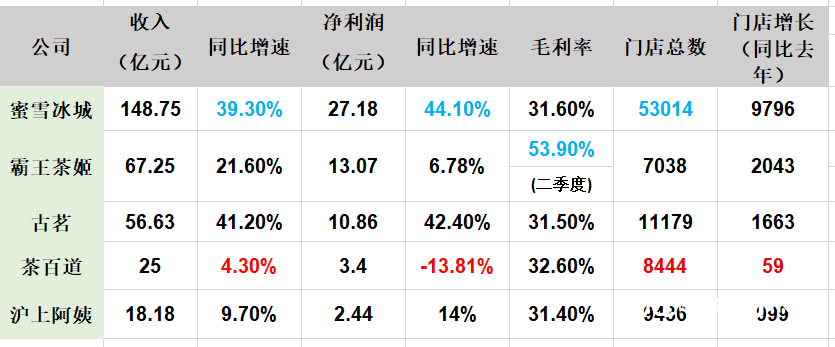
Core Viewpoint - The ongoing "subsidy war" in the food delivery sector is leading to a phase where certain tea beverage companies are emerging as potential "winners," with significant revenue growth reported across major players despite varying net profit performances [1][2]. Group 1: Company Performance - Major tea beverage companies, including Mi Xue Bing Cheng, Gu Ming, Cha Bai Dao, and Hu Shang A Yi, all reported positive revenue growth in the first half of the year, with Mi Xue Bing Cheng achieving over 100 billion yuan in revenue, marking a 39.3% year-on-year increase [1][2]. - Gu Ming's revenue reached 56.63 billion yuan, a 41.2% increase, while Hu Shang A Yi, despite having the lowest revenue at 18.18 billion yuan, showed a growth rate of 9.7% [1][2]. - Cha Bai Dao was the only company to report a decline in net profit, with a year-on-year decrease of 13.81% [1][2]. Group 2: Market Dynamics - The "subsidy war" has led to a significant increase in order volumes for tea beverage companies, particularly benefiting those with a large number of stores, such as Gu Ming, which added 1,663 new stores, bringing its total to 11,179 [3][4]. - Mi Xue Bing Cheng also capitalized on this trend, increasing its global store count to 53,014, with a net profit of 27.18 billion yuan, reflecting a 44.1% increase [2][4]. - In contrast, Cha Bai Dao's slow expansion, with only 59 new stores added, limited its ability to leverage scale effects, leading to increased marketing expenditures to maintain market share [5][6]. Group 3: Competitive Strategies - Gu Ming's low delivery costs and effective supply chain management allowed it to maintain profitability despite the competitive landscape, with delivery costs being less than 1% of total GMV [3][4]. - Cha Bai Dao's increased marketing expenses, which rose by 42.7% to 150 million yuan, were aimed at countering market competition and launching new products [5][6]. - Bawang Chaji, which chose not to participate in the subsidy war, faced customer attrition, reporting a significant drop in same-store GMV by 23% [6][7]. Group 4: Long-term Outlook - The long-term sustainability of the current growth driven by subsidies remains uncertain, as companies must navigate the transition from subsidy dependence to value-based competition [7][8].
茶百道(02555):运营效率环比提升,下半年展店有望提速
HUAXI Securities· 2025-09-03 11:56
Investment Rating - The investment rating for the company is "Buy" [1] Core Views - The company achieved a revenue of 2.5 billion yuan in H1 2025, representing a year-on-year increase of 4.3%, and a net profit attributable to shareholders of 326 million yuan, up 37.5% [2] - The company continues to innovate its product offerings, launching 55 new products and upgrading 9 existing ones in H1 2025, which has positively impacted sales [3] - The company is focusing on improving the quality of its domestic stores while actively expanding its overseas business, with a net increase of 49 domestic stores and 7 overseas stores in H1 2025 [4] - Cost management and supply chain optimization have led to an improvement in the company's cost-to-income ratio, with a gross margin of 32.6%, up 0.9 percentage points year-on-year [5] - The company has adjusted its earnings forecast for 2025-2027, expecting revenues of 5.747 billion, 6.267 billion, and 6.866 billion yuan respectively, with net profits of 872 million, 1.002 billion, and 1.132 billion yuan [6] Summary by Sections Financial Performance - In H1 2025, the company reported a revenue of 2.5 billion yuan, a 4.3% increase year-on-year, and a net profit of 326 million yuan, a 37.5% increase [2] - The adjusted net profit was 340 million yuan, reflecting a decrease of 13.8%, with an adjusted net profit margin of 13.6%, down 2.9 percentage points [2] Product and Sales Growth - The company launched 55 new products and upgraded 9 existing products in H1 2025, contributing to a 7.8% increase in product sales [3] - The sales from single stores averaged approximately 270,000 yuan, marking a 3.7% increase [3] Store Expansion and Quality Improvement - The company added 49 new domestic stores, bringing the total to 8,444, while also expanding its international presence with 7 new stores, totaling 21 overseas locations [4] Cost Management and Efficiency - The gross margin improved to 32.6%, with a year-on-year increase of 0.9 percentage points, and a sequential increase of 1.9 percentage points [5] - The sales expense ratio, management expense ratio, and R&D expense ratio were reported at 6.0%, 10.3%, and 0.6% respectively, with a notable reduction in the sequential expense ratios [5] Earnings Forecast - The revised earnings forecast for 2025-2027 includes revenues of 5.747 billion, 6.267 billion, and 6.866 billion yuan, and net profits of 872 million, 1.002 billion, and 1.132 billion yuan respectively [6]
38%订单跨商圈,餐饮选址逻辑彻底被平台算法颠覆!
Sou Hu Cai Jing· 2025-09-03 10:26
Core Insights - The traditional concept of geographic protection in the restaurant industry is being redefined by algorithm-driven consumer behavior, with 38% of consumers choosing to order from outside traditional business districts [1][3]. Group 1: Changes in Consumer Behavior - Consumers are increasingly crossing physical distance boundaries for food delivery, as evidenced by a case where a chain restaurant located 3-5 kilometers away received 27% more orders than a closer competitor with slower service [3]. - The distribution of platform traffic is breaking down traditional business barriers, illustrated by a chicken restaurant in Beijing that attracted 19% of its orders from a 5-kilometer radius through targeted promotions [3]. - User review systems are facilitating cross-regional order flows, with a noodle shop in Shanghai capturing 15% of its orders from across the river in Pudong [3]. Group 2: New Competitive Strategies - A new tea brand in Hangzhou has implemented a "3-kilometer competitor monitoring system" to track promotions of 298 competitors, leading to an average monthly order volume of over 12,000 for a single store [3]. - In contrast, franchisees relying on traditional regional protection strategies are struggling, as seen in Guangzhou where three same-brand tea shops fell out of the top 20 rankings due to neglecting online operations [3]. Group 3: Operational Capabilities and Investment Strategies - The industry is experiencing a generational shift in operational capabilities, with a couple in Chengdu achieving a 45% repurchase rate through innovative content creation, surpassing standardized operational models [5]. - Investors are advised to upgrade their decision-making models by establishing a three-dimensional evaluation system that includes competitive density analysis, platform traffic cost assessment, and the formation of a multidisciplinary team [5]. - The true competitive advantage lies in the ability to continuously evolve digital survival skills, with operators who can interpret platform rules and create localized content thriving in the new landscape [7].
美股最新评级 | 招商证券(香港)给予阿里巴巴“增持”评级,目标价163美元
Xin Lang Cai Jing· 2025-09-03 08:09
Group 1: Alibaba (BABA.N) - Company received a "Buy" rating from招商证券(香港) with a target price of $163, driven by a 2% year-on-year revenue growth in Q2, a 10% increase in Chinese commercial revenue, and a 26% growth in cloud business [1] - 申万宏源 maintained a "Buy" rating, reporting a 2% year-on-year revenue increase to 247.7 billion yuan in Q1 FY26, with a 10% growth on a same-entity basis after excluding disposed businesses [1] - The company is focusing on AI and instant retail investments, enhancing user engagement and ecosystem synergy, despite short-term pressure on EBITA [1] Group 2: Bawang Tea (CHA.O) - Company maintained an "Outperform" rating from海通国际 with a target price of $22.7, reporting a 10% year-on-year revenue increase to 3.33 billion yuan in Q2 [2] - The number of stores in Greater China expanded to 7,038, a 41% increase year-on-year, while overseas GMV grew by 77% [2] - Profit forecasts for 2025 were lowered due to reduced delivery subsidies and overseas expansion costs, leading to a target valuation of $4.2 billion [2] Group 3: Tesla (TSLA.O) - Company maintained a "Buy" rating from第一上海, focusing on global expansion of FSD and the launch of Cybertruck in South Korea [3] - Subscription model optimization is expected to enhance penetration rates, with significant expansions in Robotaxi services [3] - Despite short-term delivery challenges in China, ongoing technology iterations and product upgrades are expected to strengthen long-term competitiveness [3] Group 4: Marvell Technology (MRVL.O) - Company received an "Overweight" rating from华泰证券 with a target price of $71.20, reporting strong performance in data center business and high demand for optical interconnect products [4] - ASIC business guidance for Q3 FY26 is weak, but long-term benefits are anticipated from the AI custom chip market expansion [4] - The company has secured 18 XPU projects, expected to contribute billions in revenue over the next 18-24 months [4]

开卖599元外套,霸王茶姬要做“百货店”?
3 6 Ke· 2025-09-03 01:23
Core Insights - Bawang Chaji has expanded its product line to include clothing, which has surprised consumers and sparked discussions about its brand strategy [1][11] - The company aims to position itself as a competitor to Starbucks, with ambitions to modernize and globalize Chinese tea culture [10][24] - Despite a significant increase in store count and revenue growth, Bawang Chaji has faced a decline in net profit and same-store sales, raising concerns about its market performance [18][19] Group 1: Product Expansion - Bawang Chaji has launched a clothing line with a premium pricing strategy, including items like denim jackets priced at 599 yuan and t-shirts at 199 yuan, which are higher than some fast-fashion brands [1][18] - The brand's merchandise strategy has evolved from simple promotional items to a diverse range of products, including bags and accessories, which have gained popularity among consumers [13][23] - The company has developed a unique "1+1+9+N" franchise model that allows for efficient market expansion and localized product offerings [14][15] Group 2: Market Performance - Bawang Chaji reported a 21.61% increase in revenue to 6.725 billion yuan in the first half of the year, but net profit fell by 38.22% to 755 million yuan [18][19] - The company has 7,038 stores globally, with a net increase of 598 stores in the first half of the year, but has seen a decline in average monthly GMV and same-store sales [18][19] - The brand's stock performance has been volatile, with a significant drop of 54.3% from its peak shortly after its IPO, indicating market skepticism about its business model [24][26] Group 3: Brand Strategy - Bawang Chaji is attempting to create a long-term customer relationship by diversifying its product offerings and enhancing its brand image to appeal to younger consumers [21][27] - The company aims to leverage its cultural heritage and unique aesthetic to attract international consumers, particularly in the North American market [27][29] - The brand's strategy includes positioning itself as a lifestyle brand, moving beyond traditional tea consumption to encompass broader lifestyle aesthetics [23][29]

聚焦茶饮行业,粤Tea2025秋季展于广州举办
Nan Fang Du Shi Bao· 2025-09-03 00:11
Core Insights - The "Yue Tea 2025 Autumn Exhibition" held in Guangzhou focuses on product innovation and industry collaboration in the ready-to-drink tea sector [1][3] - The event highlights the shift in the ready-to-drink tea industry from scale expansion to quality enhancement and differentiated innovation [3] Group 1: Event Overview - The exhibition was guided by the Guangzhou Municipal Bureau of Commerce and featured over seventy suppliers presenting new autumn and winter product proposals [1][3] - A themed forum titled "The Future of Tea Drinks in the Next Ten Years" addressed key issues such as homogenization, health demands, and brand value enhancement [3] Group 2: Industry Trends - The event showcased a new tea drink R&D competition, attracting talent from across the country to evaluate innovations in flavor, technology, and health concepts [3] - The Guangzhou Municipal Bureau of Commerce emphasized Guangdong's role as a key innovation hub in China's tea drink industry and outlined supportive policies for quality development and international expansion [5] Group 3: Evolution of the Exhibition - The "Yue Tea" exhibition has evolved from a ToC (business-to-consumer) model in its first two editions to a ToB (business-to-business) model starting from the third edition, facilitating industry communication [7]

8点1氪丨宇树科技将在四季度提交IPO申请;雀巢CEO因与下属恋爱被解雇;微信客服回应“去世后朋友圈是否会消失”
3 6 Ke· 2025-09-03 00:10
Group 1 - Good Products' acquisition case has entered the acceptance stage, with Wuhan Yangtze International Trade Group acquiring 29.99% of Good Products' shares [6][7] - Bawang Tea has officially entered the Philippine market, opening three stores in key business districts and selling over 23,000 cups in the first three days [8] - Nestlé's CEO was dismissed due to a romantic relationship with a subordinate, which violated the company's code of conduct [3] Group 2 - Yushun Technology plans to submit an IPO application to the Chinese stock exchange between October and December 2025, with quadruped and humanoid robots expected to account for 65% and 30% of sales in 2024, respectively [2] - Tencent responded to a lawsuit from miHoYo, stating it will comply with legal regulations regarding user data requests [6] - The fast delivery industry is experiencing a price increase in core areas, driven by a national "anti-involution" policy aimed at improving profitability [11] Group 3 - The current spot gold price has surpassed $3,500 per ounce, marking a historical high with a year-to-date increase of over 33% [11] - The U.S. stock market saw all three major indices decline, while many Chinese concept stocks experienced gains [12] - Google was ruled not to divest its Chrome and Android systems in an antitrust case, but must share data with competitors [13] Group 4 - The Chinese Ministry of Foreign Affairs announced a visa-free policy for Russian passport holders from September 15, 2025, to September 14, 2026 [5] - WeChat's customer service clarified that inactive accounts may be reclaimed by the system after one year of inactivity, leading to the loss of all associated data [4] - The company "Sina" announced the resignation of its CEO due to an investigation into the purchase of illegal health products [16] Group 5 - Companies such as Jiadou Technology and XGIMI Technology are planning to issue H-shares and list on the Hong Kong Stock Exchange to enhance competitiveness and international presence [17][19] - "Si Ai Ran Medical" completed a financing round exceeding 100 million yuan to advance its ophthalmic medical device product line [22] - "Lai Mu Technology" secured several million yuan in Series A financing to enhance its smart lawnmower product development and market expansion [24]





“三朵金花”中报业绩亮眼 港股新消费进入下半场
Zhong Guo Zheng Quan Bao· 2025-09-02 22:31
Core Viewpoint - The new consumption sector in the Hong Kong stock market has become a focal point in 2023, with several companies reporting impressive mid-year performance, particularly the "three golden flowers": Pop Mart, Lao Pu Gold, and Mixue Group [1][4]. Group 1: Company Performance - Pop Mart achieved a revenue of 13.876 billion yuan, a year-on-year increase of 204.4%, and a net profit of 4.682 billion yuan, up 385.6%. The plush toy category was a significant driver, generating 6.139 billion yuan, a staggering growth of 1276.2% [4]. - Lao Pu Gold reported a revenue of 12.354 billion yuan, a 251% increase, and a net profit of 2.35 billion yuan, up 290.6%. Same-store sales grew by 200.8% [4]. - Mixue Group's revenue reached 14.875 billion yuan, a 39.3% increase, with a net profit of 2.718 billion yuan, up 44.1% [5]. Group 2: International Expansion - Pop Mart's overseas revenue reached 2.851 billion yuan in the Asia-Pacific market (excluding China), a 257.8% increase, and 2.265 billion yuan in the Americas, up 1142.3%. The company operates 571 stores in 18 countries, with nearly 40% of total revenue coming from international markets [6]. - Lao Pu Gold's overseas revenue was 1.597 billion yuan, a 455.2% increase, with plans to expand into the Hong Kong and Macau markets [7][8]. - Mixue Group opened its first store in Kazakhstan and has around 4,700 overseas stores across 12 countries, optimizing operations in Indonesia and Vietnam [7]. Group 3: Market Trends and Consumer Behavior - The Hong Kong new consumption sector is transitioning from a "beta" market to a more differentiated "alpha" market, with a focus on building long-term competitive advantages [9]. - The shift in consumer focus from family to individual spending, particularly among younger generations, is driving demand for emotional and social value in consumption [10]. - The influx of capital into the Hong Kong new consumption sector is expected to continue, with public funds projected to flow into the sector significantly in 2025 [10].