电力设备与储能

Search documents
券商谈A股布局:春节效应与反弹契机,锂电半导体迎机遇
Sou Hu Cai Jing· 2026-02-09 09:54
Group 1 - The core viewpoint of the reports indicates that the A-share market experienced a decline driven by reduced risk appetite, with external macro risks being initially priced in and a notable shift in trading dynamics [1][3] - The reports suggest that the adjustment phase in the A-share market may be nearing its end, with a positive calendar effect expected in February, recommending a gradual increase in portfolio flexibility [1] - There is a significant "calendar effect" observed in the A-share market around the Spring Festival, with historical trends showing a preference for high-dividend, consumer, and defensive sectors leading up to the holiday [3] Group 2 - Investment recommendations include focusing on sectors with a high beta and relatively attractive valuations, such as the lithium battery chain, communication equipment, semiconductors, and certain building materials and chemicals [3] - The reports highlight that the recent adjustment in the A-share market is primarily driven by internal factors, with external disturbances not significantly impacting the fundamental industry landscape in China [3] - Post-Spring Festival, there is an expectation for a continuation of the spring market rally, with suggested focus areas including AI computing power, chemicals, and power equipment and storage sectors [3]


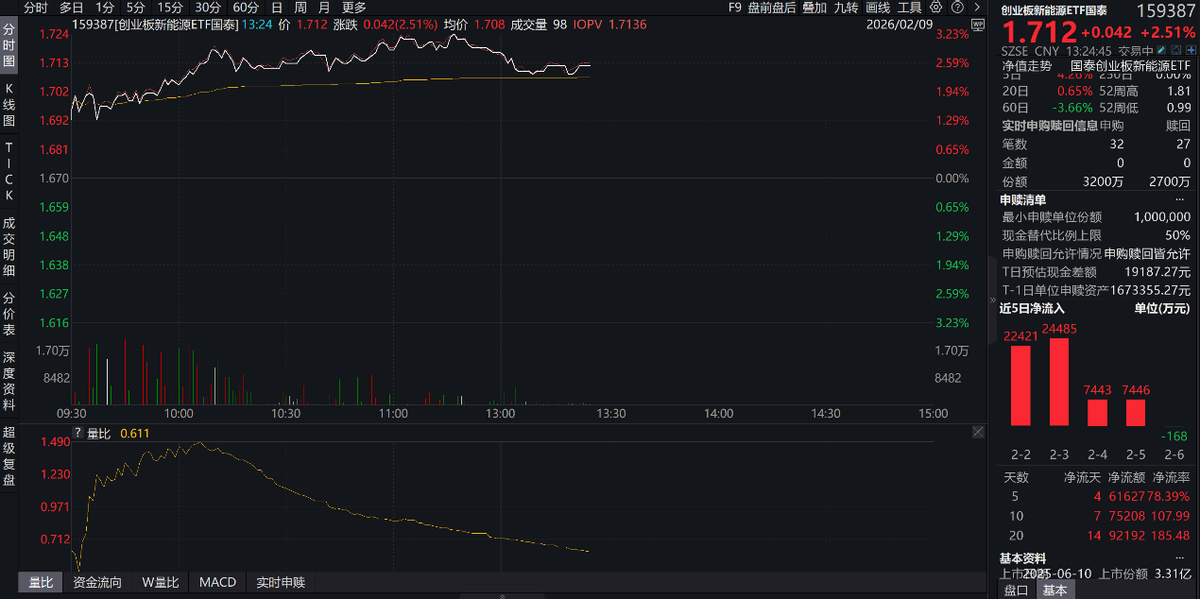
政策与产业共振驱动,创业板新能源ETF国泰(159387)大涨超3%
Mei Ri Jing Ji Xin Wen· 2026-02-09 05:45
Core Viewpoint - The recent performance of the new energy sector indicates a recovery phase, driven by supply-side adjustments, demand recovery, and technological upgrades, creating structural investment opportunities [3][6]. Group 1: Market Performance and Trends - The ChiNext New Energy ETF (159387) saw an intraday increase of over 3.2%, with a net inflow of over 600 million yuan in the past five trading days, indicating a clear sentiment recovery [1]. - The new energy sector is stabilizing after a period of volatility, with signs of bottoming out in the industry chain, particularly in solid-state batteries and space photovoltaic themes [3]. Group 2: Catalysts and Policy Support - Key catalysts for the renewed interest in the new energy sector include advancements in solid-state battery technology and increasing attention on themes like space photovoltaics and energy storage systems [4]. - The new energy sector remains a core focus of the "dual carbon" strategy and the construction of a new power system, with policies emphasizing electric equipment, grid transformation, and new energy storage [5]. Group 3: Supply Chain Adjustments and Profitability - The solar and lithium battery supply chains are showing signs of supply-side adjustments, with significant price corrections leading to a gradual stabilization of the industry [7]. - The lithium carbonate price has significantly dropped, and the profitability of battery manufacturers is recovering, while energy storage demand is emerging as a new growth driver [7]. Group 4: Investment Opportunities and Structural Changes - The current market offers three levels of investment logic: clear cyclical advantages, structural differentiation among companies, and the integration of new energy with AI, electrification, and digitalization [8]. - The new energy industry is expected to unlock new growth spaces due to technological breakthroughs, with the ChiNext New Energy ETF tracking companies involved in clean energy production, storage, and application [9].

十大券商一周策略:持股过节成共识,海外波动不改春季攻势,聚焦资源制造与消费修复
Jin Rong Jie· 2026-02-09 00:06
Core Viewpoint - The market outlook around the Spring Festival shows a consensus among major institutions that the pre-holiday adjustment has been sufficient, fostering confidence in the spring market and the strategy of "holding stocks over the holiday" [1][4][13]. However, there are differing opinions on whether to continue focusing on high-growth technology sectors or shift towards stable growth and high-dividend defensive stocks [1]. Group 1: Market Trends and Adjustments - Recent overseas market volatility has heightened the contradiction between short-term gains and long-term value, with a notable shift in risk appetite and liquidity [2]. - The A-share market has experienced a phase of adjustment, primarily driven by internal factors, with external disturbances having limited impact on China's industrial fundamentals [4]. - Historical data suggests that the period from February to the Spring Festival typically sees strong market performance, particularly for small-cap stocks [5]. Group 2: Investment Strategies - Recommended investment strategies include maintaining a base in "resources + traditional manufacturing," while increasing allocations to consumer and real estate chains, particularly in sectors like duty-free, aviation, hotels, and quality real estate developers [3][9]. - Focus on high-growth technology sectors such as AI computing, robotics, and semiconductors remains strong, despite recent adjustments [4][10]. - Emphasis on physical assets and sectors with global comparative advantages, such as energy and equipment exports, is advised, alongside a focus on consumer recovery channels [7][10]. Group 3: Sector-Specific Insights - Key sectors to watch include AI computing, high-end manufacturing, and cyclical industries like chemicals and materials, which are expected to benefit from policy signals and market recovery [4][8][10]. - The high-dividend sector is anticipated to gain traction as market conditions stabilize, with a focus on stable cash flow and dividend-paying stocks such as banks and consumer goods [10][12]. - The technology sector, particularly AI applications and semiconductor equipment, is expected to remain active in the short term, with potential for recovery post-holiday [10][14]. Group 4: External Influences and Market Sentiment - External factors, including geopolitical tensions and changes in U.S. monetary policy, are influencing market sentiment but are not expected to have a substantial impact on China's economic fundamentals [2][4]. - The market is likely to experience a rebound following the Spring Festival, driven by improved risk appetite and the return of capital [9][15]. - The current market environment suggests a transition from high-risk trading to more stable, value-oriented investments as policy expectations evolve [12][16].
20cm速递|创业板新能源ETF国泰(159387)涨超0.9%,机构称我国新能源全链条在全球能源转型中占据关键位置
Mei Ri Jing Ji Xin Wen· 2025-11-26 05:09
Core Insights - China's new energy sector plays a crucial role in the global energy transition, with leading technologies and significant production capacity in photovoltaic, wind power, and battery storage [1] - The surge in electricity demand driven by AI makes new energy the only option to fill the short-term "electricity gap," creating structural growth opportunities in the power equipment and storage industries [1] - A severe price war has emerged in certain segments of the new energy sector, prompting policies aimed at optimizing competition in photovoltaic, battery, and storage sectors to enhance China's bargaining power in the global supply chain [1] - The rapid deployment of AI data centers necessitates upgrades in the power grid and storage systems, particularly benefiting equipment manufacturers that provide integrated solutions for self-generation and storage [1] - The Guotai New Energy ETF (159387) tracks the Innovation Energy Index (399266), which saw a daily fluctuation of 20%, focusing on companies involved in clean energy production, storage technology, and smart grids [1] Industry Summary - The new energy sector is experiencing significant technological advancements and maintaining a leading position globally [1] - Structural growth opportunities are emerging in the power equipment and storage sectors due to increased electricity demand from AI [1] - Policies are being implemented to address competition issues and improve the market landscape for photovoltaic and storage technologies [1] - The integration of self-generation and storage solutions is becoming increasingly important for equipment manufacturers [1] - The performance of the Guotai New Energy ETF reflects the overall market dynamics and innovation within the new energy sector [1]

中泰证券:本轮“反内卷”政策或更加聚焦于具备全球“类稀土”特征的重点领域
智通财经网· 2025-11-23 23:39
Core Viewpoint - The report from Zhongtai Securities highlights the intensifying low-price competition in industries such as photovoltaics, batteries, and automobiles since 2024, prompting policy attention towards "anti-involution" measures aimed at optimizing supply-side structures and enhancing national competitiveness [1][2]. Group 1: Policy Development - The "anti-involution" policy has evolved from departmental advocacy to institutionalization, with significant milestones including its introduction in the 2024 Politburo meeting and its incorporation into the 2025 government work report and the "14th Five-Year Plan" [2]. - The current governance approach is characterized by top-level institutionalization, market-driven clearing, and comprehensive expectation management [2]. Group 2: Background of the Current "Anti-Involution" - The current "anti-involution" policy is initiated in a macroeconomic context where growth has slowed to 5% or lower, contrasting with the previous supply-side reforms that occurred during a period of over 6% growth [3]. - The industrial structure has shifted, with China now holding leading capacities in sectors like photovoltaics and new energy vehicles, yet facing overcapacity due to slowed demand and intensified competition [3]. Group 3: Strategic Logic of "Anti-Involution" - The core of current high-level policies is to address international competition and enhance national competitiveness, positioning "anti-involution" as a critical tool for optimizing supply-side structures [4]. - The ultimate goal is to establish industries with global pricing power, technological barriers, and resource control, transforming them into strategic assets in international negotiations [4]. Group 4: Lessons from the Rare Earth Experience - Prior to 2010, the rare earth industry faced chaotic competition and low prices, leading to resource wastage and a low global value chain position [5]. - The establishment of large rare earth enterprise groups in 2014 and the completion of industry consolidation by 2016 significantly improved the situation, positioning China as a key player in the global high-tech supply chain [5]. Group 5: Focus Areas for "Anti-Involution" - The current "anti-involution" policy is likely to concentrate on sectors with "rare earth-like" characteristics, which include global capacity and technological leadership, the presence of chaotic expansion and low-price competition, and potential for long-term growth driven by external demand [6]. - The new energy sector is positioned as a strategic tool in international relations, with China maintaining technological leadership and significant global production capacity in areas like photovoltaics and battery storage [6]. Group 6: Investment Recommendations - Investment focus should be on upstream new energy sectors, particularly companies with raw material barriers and cost advantages in lithium, silicon materials, and electrolyte production [7]. - Opportunities in power equipment and energy storage are highlighted due to structural growth driven by AI-related electricity demand, with recommendations for companies targeting overseas markets [7]. - Emphasis on resource security and small metal materials as strategic pillars, recommending companies with high resource concentration and barriers, including leaders in rare earths, copper, cobalt, and lithium [7].

茅台利好发布,A股风险显现,投资需谨慎
Sou Hu Cai Jing· 2025-11-09 23:12
Core Viewpoint - Guizhou Moutai's significant share buyback and interim cash dividend announcement has sparked market interest, particularly in the liquor sector, despite overall market weakness and low trading volume [3][14]. Company Actions - Guizhou Moutai announced a share buyback amounting to 1.5 billion to 3 billion and an impressive interim dividend of 30 billion, signaling strong governance and a response to external market pessimism [3][8]. - A fund manager noted that the buyback is relatively small compared to Moutai's market capitalization of 1.78 trillion, but the dividend reflects genuine intent [4]. Market Reactions - The liquor sector saw a rebound following Moutai's announcement, although trading volume remained subdued with a total market turnover of 1.87 trillion [3][14]. - Investor sentiment is mixed, with some expressing frustration over declining stock prices despite solid fundamentals and dividends [9][15]. Broader Market Context - The global market faced pressures, including a strong dollar and potential U.S. government shutdown, which affected investor sentiment [5]. - Historical data indicates that November is often a volatile month for the stock market, with significant fluctuations in major indices [7][9]. Sector Performance - The energy sector emerged as a new market favorite, driven by positive reports and external commentary on power and computing relationships [11]. - Despite overall market gains, internal market divergence was noted, with limited median gains among a majority of rising stocks, indicating selective investor interest [14]. Investor Behavior - Retail investors are increasingly focused on short-term trading strategies rather than long-term fundamentals, reflecting a shift in market dynamics [16]. - Discussions among investors reveal a common theme of patience and profit-taking, highlighting the emotional and rational divide in investment decisions [15].


周三A股探底回升:消费与周期板块补位,科技风险加剧,资金切换进入关键阶段
Sou Hu Cai Jing· 2025-11-06 01:20
Market Overview - A-shares demonstrate strong resilience amid external negative impacts, with significant sector rotation observed, particularly in consumption, cyclical, and some traditional industries, countering the pressure from the technology sector's adjustment [1][20] - As of Wednesday's close, the Shanghai Composite Index reported 3969.25 points, up 0.23%, while the Shenzhen Component Index and the ChiNext Index rose by 0.37% and 1.03%, respectively, indicating a rebound despite external market pressures [2] Sector Performance - The consumption and cyclical sectors are recovering, with active performances noted in local Hainan stocks, food and beverage, tourism, chemicals, and steel [3] - The power equipment and energy storage sectors have surged, with numerous stocks hitting their upper limits [3] - The technology sector, including CPO, quantum technology, and AI applications, is experiencing a collective pullback, indicating a release of risks as chips concentrate at high levels [3][10] Sector Rotation Logic - The technology sector's high-level fluctuations are seen as inevitable due to previous significant gains driven by CPO and AI, leading to a lack of new incremental funds and resulting in a necessary period of consolidation or adjustment [5] - The rise of the consumption sector is attributed to the traditional peak season in Q4, with increased seasonal demand for liquor, food, and tourism [6] - Policy measures are expected to further stimulate domestic demand, with consumer confidence gradually recovering [7] - The cyclical sector is active due to stabilizing raw material prices, with chemicals, non-ferrous metals, and steel entering a replenishment cycle [8] - Improvement in overseas economic data is enhancing export expectations [9] - Accelerated domestic infrastructure investment is boosting upstream demand, leading to a shift in funds towards lower-priced sectors and industries with improving conditions [10] Structural Opportunities - Investment focus areas include: - Consumption (liquor, tourism, retail): driven by seasonal effects and policy support, focusing on leading companies and those benefiting from regional consumption policies [13] - Cyclical (chemicals, non-ferrous metals, steel): driven by replenishment and stabilizing raw materials, focusing on leading enterprises or undervalued stocks [13] - Power equipment and energy storage: supported by new energy expansion and policy backing, focusing on storage components and leading grid equipment [13] - Small-cap growth stocks (CSI 2000): indicating a style shift, with attention on newly listed stocks with good performance expectations [13] Investment Recommendations - For the technology sector, it is advised to refrain from chasing high prices and to wait for consolidation or rapid adjustments to complete trend repairs [14] - The consumption and cyclical sectors are recommended for short to medium-term allocations to capture continuous opportunities arising from improving conditions [14] - Small-cap stocks should be closely monitored for fund inflows, with low-priced quality growth stocks being worthy of attention [15]