
全乳胶

Search documents
格林大华期货早盘提示:白糖,红枣,橡胶系-20260331
Ge Lin Qi Huo· 2026-03-31 02:34
1. Report Industry Investment Ratings - The investment rating for the sugar industry in the agricultural, forestry, and livestock sector is "oscillating" [1]. - The investment rating for the rubber - related industry in the energy and chemical sector is "oscillating", with the synthetic rubber part being "oscillating and slightly bullish" [4]. 2. Core Views - For the sugar market, the overseas market is focused on India and Thailand's final sugar production and Brazil's new - season sugar - making process. High oil prices may lead to a higher ethanol - making ratio in Brazil, tightening sugar supply. In the domestic market, the 2025/26 sugar - making season is near the end, with a supply - demand structure that is relatively loose. However, high raw sugar prices and potential policy support provide some support for Zhengzhou sugar, which is expected to oscillate in the short term [1]. - For the rubber market, natural rubber has a mixed fundamental situation. Seasonal reduction in Southeast Asia supports raw material prices, but demand drag from some semi - steel tire enterprises and high inventory in Qingdao suppress prices. The market still has a bullish sentiment due to high raw material and synthetic rubber prices, and NR performs stronger than RU. Synthetic rubber, especially BR, is in an upward channel. High raw material costs and geopolitical conflicts keep the price rising, and it may continue to oscillate upwards in the short term [4]. 3. Summary by Relevant Catalogs Sugar Market Market Conditions - SR605 contract closed at 5441 yuan/ton yesterday with a daily decline of 0.42%, and 5431 yuan/ton at night. SR609 contract closed at 5467 yuan/ton with a daily decline of 0.36%, and 5464 yuan/ton at night [1]. - ICE raw sugar's main contract was at 15.54 cents/pound yesterday, with a daily decline of 1.33% [1]. Important Information - Guangxi's white sugar spot transaction price was 5446 yuan/ton, up 32 yuan/ton. Guangxi's sugar - making group's quotation range was 5430 - 5510 yuan/ton, up 10 - 20 yuan/ton. Yunnan's sugar - making group's quotation was 5280 - 5340 yuan/ton, with some up 10 yuan/ton. The mainstream quotation range of processing sugar factories was 5690 - 5860 yuan/ton, with individual prices up 10 yuan/ton [1]. - From the 2025/26 sugar - making season to mid - March, the cumulative crushing volume in the central - southern region of Brazil was 603.667 billion tons, a year - on - year decrease of 13.65 billion tons (2.21%). The ATR of sugarcane was 138.25 kg/ton, a decrease of 3.07 kg/ton compared to the same period last year. The cumulative sugar - making ratio was 50.61%, an increase of 2.53% compared to the same period last year. The cumulative ethanol production was 32.962 billion liters, a year - on - year decrease of 1.45 billion liters (4.21%). The cumulative sugar production was 402.5 million tons, an increase of 282,000 tons (0.71%) compared to the same period last year [1]. - In the 2025/26 sugar - making season in India's Maharashtra state, 183 out of 210 sugar mills have stopped production, and the remaining 27 are expected to stop in the next 15 days. In Uttar Pradesh, about 78 sugar mills are expected to continue production until mid - April [1]. - From March 27th to 30th, 10 more sugar mills in Guangxi stopped production. As of March 30th, the number of sugar mills that have stopped production in the 2025/26 sugar - making season in Guangxi has reached 38, more than half of the total [1]. - The white sugar warehouse receipts of Zhengzhou Commodity Exchange were 16,862 yesterday, a daily increase of 520 [1]. Market Logic - Overseas: ICE raw sugar rose and then fell. The market focuses on India and Thailand's sugar production and Brazil's new - season sugar - making. High oil prices may lead to a higher ethanol - making ratio in Brazil, tightening sugar supply. If oil prices remain high or rise, raw sugar may have more upside potential [1]. - Domestic: Zhengzhou sugar rose first and then fell. The 2025/26 sugar - making season is near the end, and the domestic supply - demand structure is relatively loose. However, high raw sugar prices and potential policy support provide some support. Technically, it is in an upward channel but faces pressure and may oscillate in the short term [1]. Trading Strategy - Temporarily observe Zhengzhou sugar and focus on short - term trading in the near future [1]. Rubber Market Market Conditions - As of March 30th, the closing price of the RU main contract was 16,540 yuan/ton, with a daily increase of 0.18%. The closing price of the NR main contract was 13,845 yuan/ton, with a daily increase of 0.80%. The closing price of the BR main contract was 17,725 yuan/ton, with a daily decrease of 0.64% [4]. Important Information - Thailand's raw material glue price was 79.5 Thai baht/kg, and cup - rubber price was 59.5 Thai baht/kg. In Yunnan, the price of glue for making whole - milk rubber was 15,000 yuan/ton, and for making concentrated latex was 15,200 yuan/ton. The price of rubber blocks in Yunnan was 13,800 yuan/ton. In Hainan, the price of glue for making whole - milk rubber was 15,000 yuan/ton, and for making concentrated latex was 16,500 yuan/ton [4]. - As of March 29th, 2026, the total inventory of natural rubber in bonded and general trade in Qingdao was 691,400 tons, a month - on - month increase of 5,800 tons (0.85%). The bonded area inventory was 120,100 tons, a decrease of 1.62%. The general trade inventory was 571,300 tons, an increase of 1.38% [4]. - The price of whole - milk rubber was 16,400 yuan/ton, 20 - grade Thai standard rubber was 2,035 US dollars/ton (equivalent to 14,087 yuan/ton in RMB), and 20 - grade Thai mixed rubber was 15,800 yuan/ton [4]. - The price difference between the RU and NR main contracts was 2,695 yuan/ton, a month - on - month decrease of 80 yuan/ton. The price difference between mixed standard rubber and the RU main contract was - 740 yuan/ton, a month - on - month decrease of 90 yuan/ton [4]. - The delivery price of butadiene in the central Shandong region was 17,900 - 18,300 yuan/ton, and the ex - tank self - pick - up price in East China was about 17,800 - 18,000 yuan/ton [4]. - The market prices of cis - butadiene rubber and styrene - butadiene rubber were stable or slightly decreased. The price of Daqing BR9000 in the Shandong market was stable at 18,000 yuan/ton, and the price of Qilu styrene - butadiene 1502 in the Shandong market fell 200 yuan/ton to 18,400 yuan/ton [4]. Market Logic - Natural rubber: It was consolidating at a high level. Seasonal reduction in Southeast Asia supported raw material prices, but some semi - steel tire enterprises' production cuts dragged down overall capacity utilization. High inventory in Qingdao suppressed prices. However, due to high raw material and synthetic rubber prices, the market still had a bullish sentiment, and NR performed stronger than RU [4]. - Synthetic rubber: BR was in an upward channel and was consolidating at a high level due to long - position reduction. High raw material costs and frequent butadiene export news increased the raw material cost of cis - butadiene rubber. Although downstream procurement was cautious, the price may still rise in the short term under geopolitical conflicts [4]. Trading Strategy - Partially take profits on NR long positions; hold BR long positions [4].
橡胶周报:橡胶:警惕BR快速下跌-20260328
Wu Kuang Qi Huo· 2026-03-28 14:10
1. Report Industry Investment Rating There is no information provided in the document about the report industry investment rating. 2. Core Views of the Report - The conflict between the US and Iran has led to a significant increase in the prices of oil and chemical products. Butadiene and butadiene rubber have risen sharply due to increased costs. Attention should be paid to the spot prices of SC and Oman crude oil, while Brent and WTI crude oil have weak reference value. Asian supply is mainly pegged to the spot price of Oman crude oil, and the current spot premium is high [11]. - Currently, the increase in crude oil prices is much greater than that of downstream products. Downstream industries, especially those in Japan and South Korea, have gradually reduced their production loads, leading to a decrease in supply. As a result, crude oil prices will gradually be transmitted to downstream products, including a significant catch - up increase in butadiene rubber [11]. - The logic behind butadiene rubber is that Japan and South Korea prioritize (finished) oil over chemicals. Although demand is also suppressed by high oil prices, Asian refineries have reduced their operating rates due to a lack of raw materials or losses. This has led to a sharp contraction in the supply of intermediate chemicals from refineries and a catch - up increase in prices. The supply of butadiene has decreased significantly. China has reduced its imports of butadiene from South Korea, while South Korea and Japan have increased their exports, driving up the price of butadiene and, in turn, butadiene rubber [11]. - The operating rates of butadiene refineries and downstream butadiene rubber factories are decreasing, while the operating rate of downstream tire factories fluctuates slightly, and raw material procurement is on the sidelines. Macro - funds' sentiment temporarily dominates the market. It is expected that there will be significant short - term fluctuations, and the market will later return to being driven by fundamentals [11]. - The fundamentals of natural rubber suggest that it is prone to decline and difficult to rise after the winter storage period in the first half of the year. A sharp increase in crude oil prices will lead to a significant deterioration in demand expectations. However, the expectation of capital allocation to commodities limits the downside space. The market's expectation of state - reserve purchases has increased the upside potential of RU [11]. - RU as a whole fluctuates widely within a range, and flexible responses and risk control are recommended. If the negotiation between the US, Israel, and Iran is successful, the prices of oil and chemical products may fall rapidly. Butadiene rubber will decline due to the rapid drop in butadiene costs, driving down RU and NR rapidly. If the cost drops sharply and the refining profit improves, and mid - stream refineries resume production and increase their operating rates, it will lead to a rapid decline in BR, driving down RU and NR rapidly. Buying put options on BR can be considered to hedge against the risk of price decline [13]. 3. Summary by Directory 3.1 Week - on - Week Assessment and Strategy Recommendations - The conflict between the US and Iran has caused significant price increases in oil and chemical products. Butadiene and butadiene rubber have risen due to cost increases. Attention should be paid to the spot prices of SC and Oman crude oil [11]. - The operating rates of butadiene refineries and downstream butadiene rubber factories are decreasing, while the operating rate of downstream tire factories fluctuates slightly. Macro - funds' sentiment temporarily dominates the market [11]. - It is expected that there will be significant short - term fluctuations, and the market will later return to being driven by fundamentals. The fundamentals of natural rubber suggest it is prone to decline after the winter storage period in the first half of the year. The expectation of state - reserve purchases has increased the upside potential of RU [11]. - If the negotiation between the US, Israel, and Iran is successful, the prices of oil and chemical products may fall rapidly. Buying put options on BR can be considered to hedge against the risk of price decline [13]. - The industry's demand is normal, with the full - steel tire factory operating rate at 70.75% (0.03%). After the Spring Festival holiday, the resumption of work has returned to normal. The inventory in the exchange and Qingdao is 88.63 (0.79) million tons. The supply in Hainan and Yunnan is expected to start tapping in late March, while most of Thailand has stopped tapping. There are still differences in the medium - term supply expectations, with some expecting a slight fluctuation and others expecting an increase of 15 - 25 million tons [16]. - The market expects subsequent state - reserve purchase plans. The market's long - position logic is mainly based on macro - expectations and positive expectations for China's policies, while the short - position logic is mainly due to the current dull demand and the expectation of poor demand caused by tariff policies. Thailand and Cote d'Ivoire have increased their rubber exports [16]. - The rubber price is significantly affected by macro - funds in the short term, and its direction is unclear. Pay attention to the opportunity of going long on NR main contract and shorting RU2609 for band - trading [16]. 3.2 Futures and Spot Markets - Rubber maintains its seasonal pattern, with prices prone to decline in the first half of the year. In 2018, 2019, and 2020, the decline occurred earlier. In 2023, the rubber price was lower than the industry's expectations and was below the rubber farmers' cost for a long time [26]. - The overseas demand for rubber is expected to weaken marginally, while the demand in China is stable. The ratio of rubber to crude oil has been declining since Q4 2020 [32][35]. - The comparison between rubber and other commodities, such as copper, Brent crude oil, rebar, iron ore, the Shanghai Composite Index, and the ChiNext Index, shows no special values or points of concern [43][47][51]. 3.3 Profits and Ratios - The comparison between rubber and other commodities, such as copper, Brent crude oil, rebar, iron ore, the Shanghai Composite Index, and the ChiNext Index, shows no special values or points of concern [43][47][51]. 3.4 Cost Side - The cost of cup rubber in Thailand is generally considered to be between 30 - 35 Thai baht. The cost of Hainan full - latex in China is generally considered to be 13,500 yuan, and the cost of Yunnan full - latex is generally considered to be between 12,500 - 13,000 yuan [56]. - The maintenance cost of rubber is a dynamic concept. When the rubber price is high, rubber farmers are more motivated to maintain, resulting in higher costs; when the price is low, they maintain less, and the cost decreases. In the first half of 2024, rubber farmers were highly motivated [56]. 3.5 Demand Side - The operating rates of full - steel and semi - steel tire factories show no special values or points of concern [62]. - The business climate of trucks and commercial vehicles is slowly improving from a low level, and it is expected to gradually recover in the later stage, which will affect the supporting tires. The sales volume of commercial vehicles corresponds to the domestic supporting demand [66]. - The export of truck tires is booming, but it is expected to decline slightly in the later stage, corresponding to the monthly export value of new pneumatic rubber tires for passenger cars or freight motor vehicles [69]. 3.6 Supply Side - The rubber import data is mainly updated until December 2021, and the import data after the 2020 pandemic is no longer updated, reducing the analyzability of imports [74]. - The supply of rubber in major producing countries is generally normal, with no special values or points of concern [78][82][86][90][94][98][102][106][110]. - In January 2026, the rubber production was 1,115,900 tons, a year - on - year increase of 8.67% and a month - on - month decrease of 4.38%. The cumulative production was 1,116,000 tons, a year - on - year increase of 8.67%. The export was 834,400 tons, a year - on - year decrease of 2.11% and a month - on - month decrease of 12.07%. The cumulative export was 834,000 tons, a year - on - year decrease of 2.11%. The consumption was 931,500 tons, a year - on - year increase of 1.74% and a month - on - month decrease of 2.57%. The cumulative consumption was 932,000 tons, a year - on - year increase of 1.74% [114][115].
格林大华期货早盘提示:橡胶系-20260302
Ge Lin Qi Huo· 2026-03-02 02:27
1. Report Industry Investment Rating - The rating for the rubber series in the energy - chemical sector is "oscillating and bullish" [1] 2. Core View of the Report - Natural rubber has stabilized after the post - holiday upward trend. The current low - production season in Southeast Asia provides strong cost support, but downstream demand for high - priced raw materials is limited, and the social inventory accumulation trend is obvious. Attention should be paid to the impact of the Iran situation on commodities, especially the potential boost to synthetic rubber with energy - chemical properties. - The fundamentals of butadiene and butadiene rubber have been dragged down by high downstream inventory and trading atmosphere, but the military conflict in the Middle East has led to a strong bullish expectation for the energy - chemical sector. - Considering the uncertainty of macro factors, it is recommended that previous long positions can be considered for profit - taking on rallies, and those who have not entered the market can enter short - term long positions and then leave the market in time [1] 3. Summary According to Relevant Catalogs 3.1 Market Quotes - As of February 27th, the closing price of the RU main contract was 17,155 yuan/ton, with a daily increase of 0.18%. The closing price of the NR main contract was 13,765 yuan/ton, with a daily decrease of 0.65%. The closing price of the BR main contract was 12,630 yuan/ton, with a daily decrease of 1.10% [1] 3.2 Important Information - On Friday, the price of Thai raw material glue was 68.3 Thai baht/kg (0.3/0.44%), and the price of cup rubber was 57 Thai baht/kg (0.2/0.35%) [1] - As of February 23, 2026, the total inventory of natural rubber in bonded and general trade in Qingdao was 66.77 million tons, a month - on - month increase of 6.1 million tons, an increase of 10.05%. The bonded area inventory was 11.08 million tons, an increase of 12%; the general trade inventory was 55.69 million tons, an increase of 9.67%. The inbound rate of Qingdao's natural rubber sample bonded warehouses increased by 6.8 percentage points, and the outbound rate decreased by 1.38 percentage points; the inbound rate of general trade warehouses increased by 2.65 percentage points, and the outbound rate decreased by 4.36 percentage points. As of February 23, 2026, China's social inventory of natural rubber was 136.6 million tons, a month - on - month increase of 7 million tons, an increase of 5.4%. China's total social inventory of dark - colored rubber was 92.6 million tons, an increase of 7.1%. Among them, the spot inventory in Qingdao increased by 10%; Yunnan increased by 0.2%; Vietnam 10 increased by 3%; the total inventory of NR decreased by 0.4%. China's total social inventory of light - colored rubber was 44 million tons, a month - on - month increase of 1.9%. Among them, the old whole latex decreased by 0.12% month - on - month, 3L increased by 12.9% month - on - month, and the total inventory of RU remained flat [1] - On Friday, the price of full latex was 16,950 yuan/ton (0/0%); the price of 20 - grade Thai standard was 2,060 US dollars/ton, a decrease of 5 US dollars (- 0.24%), equivalent to 14,261 yuan/ton in RMB; the price of 20 - grade Thai mixed rubber was 15,880 yuan/ton, a decrease of 20 yuan (- 0.13%) [1] - On Friday, the price difference between the RU and NR main contracts was 3,390 yuan/ton, a month - on - month expansion of 120 yuan/ton; the price difference between the mixed standard rubber and the RU main contract was - 1,275 yuan/ton, a month - on - month expansion of 50 yuan/ton [1] - On Friday, the delivery price of butadiene in the central Shandong region was between 10,100 - 10,450 yuan/ton, and the ex - tank self - pick - up price in East China was around 9,800 - 10,000 yuan/ton [1] - On Friday, the market prices of butadiene rubber and styrene - butadiene rubber were stable. The price of Daqing BR9000 in the Shandong market was stable at 12,400 yuan/ton, and the price of Qilu styrene - butadiene 1502 in the Shandong market was stable at 12,900 yuan/ton [1] 3.3 Market Logic - Natural rubber: After the post - holiday upward trend, natural rubber has gradually stabilized. Fundamentally, the current low - production season in Southeast Asia provides strong cost support, but the downstream's ability to accept high - priced raw materials is limited, and the social inventory accumulation trend is obvious. Macroscopically, attention should be paid to the impact of the Iran situation on commodities, especially the potential boost to synthetic rubber with energy - chemical properties [1] - Synthetic rubber: Recently, the fundamentals of butadiene and butadiene rubber have been dragged down by high downstream inventory and trading atmosphere. However, the military conflict in the Middle East has led to a strong bullish expectation for the energy - chemical sector. Short - term attention should be paid to the macro atmosphere [1] 3.4 Trading Strategy - Considering the uncertainty of macro factors, it is recommended that previous long positions can be considered for profit - taking on rallies, and those who have not entered the market can enter short - term long positions and then leave the market in time [1][3]
橡胶月报:橡胶:大幅震荡后将回归基本面-20260206
Wu Kuang Qi Huo· 2026-02-06 13:25
Group 1: Report Overview - The report focuses on the rubber market, analyzing factors such as cost, supply, demand, and price trends [1] - It also provides an assessment of rubber products like RU and NR, and offers trading strategy recommendations [15] Group 2: Core Views - Rubber prices are expected to experience significant fluctuations in the short - term due to macro - economic factors, and then gradually return to the fundamentals of demand and supply [10][11] - The market logic involves bullish sentiment driven by China's winter storage expectations and policy - related positives, while bearish sentiment stems from weak demand and potential negative impacts of tariff policies [13] - The demand for rubber is currently flat, with tire factories facing inventory pressure, and supply expectations vary, with some predicting a small increase in production [13] Group 3: Monthly Assessment and Strategy Recommendation - Reasons for rubber price fluctuations: factors include geopolitical tensions, changes in Fed personnel, and macro - capital sentiment. The price may be limited in its decline due to capital allocation to commodities and may have an upward potential due to state reserve purchase expectations [10][11] - Key points for rubber RU: after fluctuations, it will return to the fundamentals of weak demand and increasing inventory [12] - Trading strategy: consider a neutral approach in the short - term, and pay attention to the opportunity of going long on NR and short on RU2609 for potential band trading [13][15] Group 4: Cost End - The cost of rubber in Thailand is generally considered to be 30 - 35 Thai baht for cup rubber. In Hainan, China, the cost of whole latex is around 13,500 yuan, and in Yunnan, it is 12,500 - 13,000 yuan [48] Group 5: Futures and Spot Market - Rubber maintains its seasonal pattern, with prices more likely to fall in the first half of the year. The ratio of rubber to other commodities such as crude oil and copper shows certain trends [22][30] - Overseas demand for rubber is expected to weaken marginally, while Chinese demand remains stable [27] Group 6: Profit and Ratio - The ratios of rubber to various commodities such as copper, Brent crude oil, and others generally show normal trends without significant special values [37][40] Group 7: Demand End - The operating rate of tire factories' all - steel tires is 60.7% (- 1.74%), and there is inventory pressure on all - steel tires [13] - The demand from the mid - stream, such as truck and commercial vehicle sales, is gradually improving, and the export of truck tires is booming but expected to decline slightly later [56][59] Group 8: Supply End - The rubber production in December 2025 showed different trends in various regions. For example, Thailand's production decreased year - on - year, while Vietnam's increased [98] - The export of rubber also had different year - on - year and month - on - month changes in different regions in December 2025 [99] - The data on rubber imports are less available after 2021, reducing the analyzability of imports [63] Group 9: Industry - related Data and Forecasts - The capacity of butadiene and ethylene is expected to increase in the coming years. The butadiene capacity will follow the increase of refining projects, and the supply pressure of butadiene will decrease in 2026 compared to 2025 [117][120][123] - The price of butadiene rubber is mainly affected by the price of butadiene, and the balance of supply and demand depends on the progress of downstream supporting projects [123]
瑞达期货天然橡胶市场周报-20260116
Rui Da Qi Huo· 2026-01-16 09:23
Report Summary 1. Report Industry Investment Rating No relevant content provided. 2. Core Viewpoints - This week, the fundamentals of the natural rubber market were mixed, with commodity sentiment driving the rubber price to rise and then回调. The offer center of the imported rubber market moved up, but the factory procurement sentiment was average. The futures market maintained a relatively strong oscillation pattern, and the domestic spot price slightly followed the rise of the futures market. The downstream procurement willingness was relatively weak, mainly for appropriate rigid - demand replenishment, and the overall market trading atmosphere was average with light actual transactions [7]. - The domestic natural rubber main production areas are in the off - season, while the Thai production area is still in the peak production season. Recently, the total inventory at Qingdao Port has continued to accumulate, with both bonded and general trade warehouses showing inventory accumulation. The overall inventory accumulation rate has narrowed month - on - month, but the inventory accumulation intensity remains high. The arrival and warehousing at Qingdao Port show a seasonal decline trend, with the overall warehousing volume decreasing month - on - month, and the downstream rigid demand has improved, increasing the overall outbound volume [7]. - In terms of demand, this week, as the production arrangements of maintenance enterprises gradually stabilized, the operating rate of domestic tire enterprises increased significantly month - on - month. In the short term, supported by foreign trade orders, the operating rate of some semi - steel tire enterprises will remain high, and the overall production arrangement is expected to remain basically stable; full - steel tire enterprises still have production control phenomena to control inventory [7]. - The ru2605 contract is expected to fluctuate in the range of 15,700 - 16,400 in the short term, and the nr2603 contract is expected to fluctuate in the range of 12,700 - 13,250 in the short term [7]. 3. Summary by Directory 3.1 Week - on - Week Summary - **Market Review**: The natural rubber market fundamentals were mixed, and the rubber price rose and then回调. The offer center of imported rubber moved up, and the futures market was relatively strong. The domestic spot price slightly followed the rise, and the downstream procurement was mainly for rigid demand, with light transactions [7]. - **Market Outlook**: Domestic production areas are in the off - season, and Thailand is in the peak season. Qingdao Port inventory is accumulating, but the arrival and warehousing are decreasing seasonally. The downstream rigid demand has improved, and the tire enterprise operating rate has increased [7]. - **Strategy Suggestion**: The ru2605 contract is expected to fluctuate between 15,700 - 16,400, and the nr2603 contract between 12,700 - 13,250 [7]. 3.2 Futures Market - **Price Movement**: This week, the main contract price of Shanghai rubber futures oscillated and closed down, with a weekly decline of 1.22%; the main contract price of No. 20 rubber oscillated and closed down, with a weekly decline of 1.58% [12]. - **Position Analysis**: No specific data analysis content provided, only mentioned the position changes of the top 20 in Shanghai rubber and No. 20 rubber [13][15]. - **Inter - period Spread**: As of January 16, the spread between Shanghai rubber 5 - 9 was 30, and the spread between No. 20 rubber 2 - 3 was - 35 [20]. - **Warehouse Receipts**: As of January 15, Shanghai rubber warehouse receipts were 105,590 tons, an increase of 1,100 tons from last week; No. 20 rubber warehouse receipts were 57,758 tons, an increase of 806 tons from last week [26]. 3.3 Spot Market - **Domestic Natural Rubber Spot Price**: As of January 15, the state - owned whole latex was reported at 15,700 yuan/ton, unchanged from last week [29]. - **No. 20 Rubber Basis and Non - standard Basis**: As of January 15, the No. 20 rubber basis was 535 yuan/ton, an increase of 149 yuan/ton from last week; the non - standard basis was - 995 yuan/ton, a decrease of 15 yuan/ton from last week [38]. 3.4 Industry Situation - **Upstream**: As of January 16, the field latex in the Thai natural rubber raw material market was 58 (+2) Thai baht/kg; the cup lump was 52.2 (+0) Thai baht/kg. The theoretical processing profit of standard rubber was 12 US dollars/ton, a decrease of 12 US dollars/ton from last week. The domestic Yunnan and Hainan production areas are in the off - season [41][44]. - **Import**: In November 2025, China's natural rubber imports were 643,600 tons, a month - on - month increase of 25.98% and a year - on - year increase of 14.69%. From January to November 2025, the cumulative import volume was 5.8716 million tons, a cumulative year - on - year increase of 16.98% [50]. - **Inventory in Qingdao**: As of January 11, 2026, the total inventory of natural rubber in bonded and general trade in Qingdao was 568,200 tons, a month - on - month increase of 19,800 tons, an increase of 3.62%. The bonded area inventory was 93,500 tons, an increase of 6.14%; the general trade inventory was 474,700 tons, an increase of 3.13%. The warehousing rate of the sample bonded warehouses decreased by 1.64 percentage points, and the outbound rate increased by 1.97 percentage points; the warehousing rate of general trade warehouses decreased by 0.33 percentage points, and the outbound rate increased by 0.33 percentage points [54]. 3.5 Downstream Situation - **Tire Operating Rate**: As of January 15, the capacity utilization rate of Chinese semi - steel tire sample enterprises was 72.53%, a month - on - month increase of 8.75 percentage points and a year - on - year decrease of 5.03 percentage points; the capacity utilization rate of Chinese full - steel tire sample enterprises was 63.02%, a month - on - month increase of 7.52 percentage points and a year - on - year increase of 5.21 percentage points [57]. - **Tire Exports**: In November 2025, China's tire exports were 688,300 tons, a month - on - month increase of 54,000 tons and a year - on - year increase of 1.82%. From January to November, China's cumulative tire exports were 7.7321 million tons, a cumulative year - on - year increase of 3.51%. Among them, the export volume of passenger car tires was 237,100 tons, a month - on - month increase of 4.99% and a year - on - year decrease of 7.04%; the export volume of truck and bus tires was 418,500 tons, a month - on - month increase of 5.00% and a year - on - year increase of 6.65% [60]. - **Domestic Demand (Heavy - Truck Sales)**: In December 2025, China's heavy - truck market sold about 95,000 vehicles (wholesale, including exports and new energy), a month - on - month decrease of about 16% compared with November 2025 and a year - on - year increase of about 13% compared with 84,200 vehicles in the same period last year. In 2025, China's heavy - truck market ended with nearly 1.14 million vehicles [63].

橡胶:转向谨慎思路
Wu Kuang Qi Huo· 2026-01-04 13:33
1. Investment Rating No investment rating for the industry is provided in the report. 2. Core Views - The rubber market should adopt a cautious approach. The demand in December is relatively high due to winter storage, but the marginal supply benefits are decreasing. According to seasonal patterns, rubber prices are likely to reach a phased high between January and February. The high premium of RU over NR increases the price risk of RU [10][12]. - The market logic shows that the bulls are mainly driven by China's winter storage expectations and positive policy expectations, while the bears are mainly concerned about the current weak demand and the expected decline in demand due to tariff policies. The export of rubber from Thailand and Cote d'Ivoire has increased [15]. - The EU's anti - deforestation law (EUDR) has been postponed, which has a short - term negative impact on demand. The marginal impact of different postponement announcements varies [16]. 3. Summary by Directory 3.1 Monthly Assessment and Strategy Recommendation - **Demand**: The full - steel tire production start - up rate of tire factories is 59.55% (-2.40%), with normal demand for full - steel tires. The export expectations of semi - steel and full - steel tires to Europe are weakening. The combined inventory of the exchange and Qingdao is 69.83 (1.52) million tons [15]. - **Supply**: The rainy season in Thailand has basically ended. There are still significant differences in the medium - term supply expectations, with some expecting small fluctuations and others expecting an increase of 20 - 30 million tons. The market expects subsequent rubber storage plans [15]. - **Trading Strategy**: Adopt a cautious approach and temporarily observe. Consider the strategy of going long on the NR main contract and shorting RU2609 for potential band trading opportunities when the spread is above 3250 [15][17]. 3.2 Cost End - The cost of cup rubber in Thailand is generally considered to be between 30 - 35 Thai baht. The cost of Hainan full - latex in China is around 13,500 yuan, and that of Yunnan full - latex is between 12,500 - 13,000 yuan. Rubber maintenance costs are dynamic, with higher prices leading to higher maintenance enthusiasm and costs [50]. 3.3 Periodic and Spot Market - Rubber maintains its seasonal pattern, with prices more likely to decline in the first half of the year. The overseas demand expectations for rubber are marginally weakening, while China's demand is stable. The comparison data between rubber and other commodities are basically normal, with no special values [24][29][35]. 3.4 Profit and Ratio - The comparison data between rubber and other commodities such as copper, crude oil, and black commodities are basically normal, with no special values [39][42][46]. 3.5 Demand End - The start - up rates of full - steel and semi - steel tires show no special values. The prosperity of trucks and commercial vehicles is slowly improving from a low level, and the export of truck tires is highly prosperous but expected to decline slightly in the future [55][58][61]. 3.6 Supply End - Most of the rubber import data sources are no longer updated after 2021, reducing the analyzability of imports. The supply data of major rubber - producing countries are basically normal, with no special values [65][69][83]. - In November 2025, the rubber production was 1.1677 million tons, a year - on - year decrease of 5.40% and a month - on - month decrease of 0.49%. The export was 0.8696 million tons, a year - on - year decrease of 7.42% and a month - on - month increase of 0.27% [100][101]. 3.7 Rubber - Related Industry Chain (Butadiene and Ethylene) - **Butadiene**: In 2025, new butadiene production capacity was put into operation, increasing the supply expectation and decreasing the processing profit expectation. The import expectation is high, weakening the price. In the 14th Five - Year Plan period (2026 - 2030), the butadiene production capacity is expected to increase passively with the expansion of refining and chemical projects. The new production capacity growth rate in 2026 is lower than that in 2025, but the supply is still under pressure [120][122][125]. - **Ethylene**: During the 14th Five - Year Plan period, the Chinese ethylene industry will enter a new round of capacity expansion cycle. It is expected that the total capacity will reach 8500 - 9000 million tons/year by 2030, maintaining the world's first position [122].
国内天胶产业演进将呈现四大趋势
Qi Huo Ri Bao· 2025-12-23 02:48
Core Insights - Hainan is a crucial natural rubber production base in China, facing significant challenges due to typhoons and climate anomalies affecting supply and prices [1][2] - The natural rubber industry in Hainan is experiencing structural contradictions, with competition from other crops and aging rubber trees impacting production [3] - Different companies are adopting varied strategies to navigate the challenging environment, with state-owned enterprises focusing on global resource allocation and technology innovation, while private firms are implementing defensive measures [4][5] Group 1: Industry Challenges - Typhoon "Mojia" caused substantial damage to rubber plantations in Hainan, leading to a tight supply of raw materials and rising prices [1] - The aging tree structure and adverse weather conditions have resulted in reduced rubber production, with local processing capacity facing fierce competition [2][3] - The economic benefits of alternative crops like betel nut and agarwood are leading to decreased willingness among farmers to harvest rubber, further exacerbating supply issues [3] Group 2: Company Strategies - A leading state-owned enterprise is focusing on global resource layout and technological innovation, including the promotion of smart tapping technology to reduce labor costs [4] - Private processing companies are adopting a defensive strategy by reducing production to control losses and seeking to import raw materials from lower-cost regions [5] - Some companies are extending their operations downstream to enhance product value and cope with high local raw material prices [5] Group 3: Future Trends - The natural rubber industry in China is expected to undergo a significant transformation, balancing strategic resource security with economic realities [6] - The planting area and raw material output in Hainan are projected to decline slowly, while processing capacity will undergo consolidation due to strict environmental regulations [6] - The industry is likely to evolve into a dual-circulation model, combining domestic resource security with overseas resource expansion [6]
化工日报:上游原料价格小幅回升-20251217
Hua Tai Qi Huo· 2025-12-17 02:47
Report Industry Investment Rating - The investment rating for RU and NR is neutral [11]. - The investment rating for BR is neutral [11]. Report's Core View - The support for natural rubber is still at the cost - end. The conflict in Thailand and Cambodia and the rain in southern Thailand may support the raw material prices, but the overall supply is increasing. Domestic port inventory is expected to rise further, and downstream tire orders are in the off - season, resulting in weak supply - demand drivers [11]. - For cis - butadiene rubber, supply remains abundant. Downstream tire orders are in the off - season, with weak supply - demand drivers. The stable price of upstream butadiene raw materials provides some cost support [11]. Summary by Related Catalogs Market News and Data - In the futures market, on the previous trading day's close, the RU main contract was at 15,170 yuan/ton, down 30 yuan/ton from the previous day; the NR main contract was at 12,385 yuan/ton, up 25 yuan/ton; the BR main contract was at 10,930 yuan/ton, up 85 yuan/ton [1]. - In the spot market, the price of Yunnan - produced full - latex in the Shanghai market was 14,900 yuan/ton, unchanged from the previous day; the price of Thai mixed rubber in the Qingdao Free Trade Zone was 14,450 yuan/ton, unchanged; the price of Thai 20 - standard rubber in the Qingdao Free Trade Zone was 1,835 US dollars/ton, unchanged; the price of Indonesian 20 - standard rubber in the Qingdao Free Trade Zone was 1,755 US dollars/ton, unchanged; the ex - factory price of Sinopec Qilu Petrochemical's BR9000 was 10,700 yuan/ton, up 100 yuan/ton; the market price of Zhejiang Chuanhua's BR9000 was 10,650 yuan/ton, unchanged [1]. Market Information - In November 2025, the sales volume of heavy - duty trucks was 113,000 units, a year - on - year increase of 65%, achieving an "8 - consecutive - month year - on - year increase" and setting the highest monthly sales volume in the heavy - duty truck market this year [2]. - In November, China's automobile production and sales reached 3.532 million units and 3.429 million units respectively, with a month - on - month increase of 5.1% and 3.2%, and a year - on - year increase of 2.8% and 3.4%. The monthly production exceeded 3.5 million units for the first time, setting a new record [2]. - In December 2025, the trading of all - steel tires was dull. Affected by the seasonal off - season, market demand weakened further. With relatively sufficient market supply, channels and terminal stores mainly focused on digesting existing inventory, and the enthusiasm for restocking was average. The market transaction price was stable with a weak trend, and some merchants carried out promotional activities according to their inventory [2]. - From January to October 2025, China's rubber tire exports reached 8.03 million tons, a year - on - year increase of 3.8%; the export value was 140.2 billion yuan, a year - on - year increase of 2.8%. Among them, the export volume of new pneumatic rubber tires was 7.74 million tons, a year - on - year increase of 3.6%; the export value was 134.8 billion yuan, a year - on - year increase of 2.6%. In terms of the number of pieces, the export volume reached 586.64 million, a year - on - year increase of 4%. From January to October, the export volume of automobile tires was 6.85 million tons, a year - on - year increase of 3.3%; the export value was 115.8 billion yuan, a year - on - year increase of 2.1% [2]. Import and Export Data - In October 2025, China's natural rubber (including technical - classified, latex, smoked sheets, primary shapes, mixed rubber, and compound rubber) imports were 510,800 tons, a month - on - month decrease of 14.27% and a year - on - year decrease of 0.9%. From January to October 2025, the cumulative import volume was 5.2281 million tons, a cumulative year - on - year increase of 17.27% [3]. - According to QinRex data, in the first three quarters of 2025, Thailand's exports of natural rubber (excluding compound rubber) totaled 1.993 million tons, a year - on - year decrease of 8%. Among them, the total exports of standard rubber were 1.116 million tons, a year - on - year decrease of 20%; the exports of smoked sheet rubber were 308,000 tons, a year - on - year increase of 22%; the exports of latex were 556,000 tons, a year - on - year increase of 10%. From January to September, the total exports of natural rubber to China were 759,000 tons, a year - on - year increase of 6%. Among them, the exports of standard rubber to China totaled 459,000 tons, a year - on - year decrease of 19%; the exports of smoked sheet rubber to China totaled 99,000 tons, a year - on - year increase of 330%; the exports of latex to China totaled 199,000 tons, a year - on - year increase of 70% [3]. Market Analysis Natural Rubber - On December 16, 2025, the RU basis was - 270 yuan/ton (+30), the spread between the RU main contract and mixed rubber was 720 yuan/ton (- 30), the NR basis was 570 yuan/ton (- 35); the price of full - latex was 14,900 yuan/ton (unchanged), the price of mixed rubber was 14,450 yuan/ton (unchanged), the price of 3L spot was 15,250 yuan/ton (unchanged); the STR20 was quoted at 1,835 US dollars/ton (unchanged); the spread between full - latex and 3L was - 350 yuan/ton (unchanged); the spread between mixed rubber and styrene - butadiene rubber was 3,350 yuan/ton (- 100) [4][5]. - The price of Thai smoked sheet was 58.69 Thai baht/kg (+0.06), the price of Thai latex was 55.50 Thai baht/kg (unchanged), the price of Thai cup lump was 50.25 Thai baht/kg (+1.89), and the spread between Thai latex and cup lump was 5.25 Thai baht/kg (- 1.39) [6]. - The operating rate of all - steel tires was 64.55% (+0.55%), and the operating rate of semi - steel tires was 70.14% (+1.81%) [7]. - The social inventory of natural rubber was 498,888 tons (+10,159), the inventory of natural rubber at Qingdao Port was 1,123,406 tons (+20,841), the RU futures inventory was 56,990 tons (+11,460), and the NR futures inventory was 59,573 tons (+2,218) [7]. Cis - Butadiene Rubber - On December 16, 2025, the BR basis was - 330 yuan/ton (- 85), the ex - factory price of butadiene from Sinopec was 7,550 yuan/ton (unchanged), the quoted price of Qilu Petrochemical's BR9000 was 10,700 yuan/ton (+100), the quoted price of Zhejiang Chuanhua's BR9000 was 10,650 yuan/ton (unchanged), the price of Shandong private cis - butadiene rubber was 10,350 yuan/ton (unchanged), and the import profit of cis - butadiene rubber in Northeast Asia was - 1,207 yuan/ton (- 214) [8]. - The operating rate of high - cis cis - butadiene rubber was 70.69% (- 2.84%) [9]. - The inventory of cis - butadiene rubber traders was 5,450 tons (+220), and the inventory of cis - butadiene rubber enterprises was 26,500 tons (- 600) [10]. Strategy - For RU and NR, maintain a neutral view. The support for natural rubber comes from the cost - end. The conflict in Thailand and Cambodia and the rain in southern Thailand are expected to keep the raw material prices in Thailand firm this week. However, the overall supply is increasing, and the domestic port inventory is expected to rise. The downstream tire orders are in the off - season, so the supply - demand drivers are weak [11]. - For BR, maintain a neutral view. Yulong Petrochemical has restarted, and only Maoming Petrochemical is under maintenance, which is expected to restart in mid - January. The supply of cis - butadiene rubber remains abundant. The downstream tire orders are in the off - season, with weak supply - demand drivers. The stable price of upstream butadiene raw materials provides some cost support [11].
天然橡胶一周市场价格分析 2025年第41期(2025.10.6-10.10)
Xin Lang Cai Jing· 2025-12-16 14:10
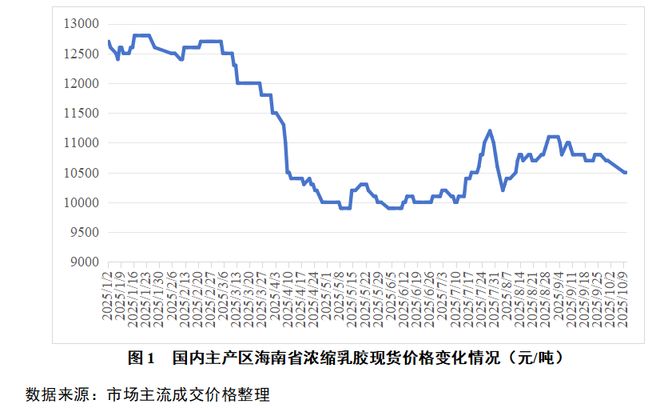
Domestic Prices - The average price of concentrated latex in Hainan Province is 10,500 yuan/ton, down 1.87% compared to last week [3] - The average price of all latex in Qingdao is 14,575 yuan/ton, up 1.57% from last week; the same price is observed in Tianjin [4] - The average price of all latex in Shanghai is 14,675 yuan/ton, up 1.56% from last week [4] - The average price of mixed rubber in Qingdao is 14,800 yuan/ton, up 0.68% from last week [4] International Prices - The average price of Thai smoked sheets in the bonded zone and CIF is 2,130 USD/ton and 2,120 USD/ton, down 1.62% from last week [6] - The average price of Thai standard rubber in the bonded zone and CIF is 1,855 USD/ton and 1,815 USD/ton, with the bonded zone price up 1.09% and CIF down 1.11% from last week [6] - The average price of Indonesian standard rubber in the bonded zone and CIF is 1,745 USD/ton and 1,712.5 USD/ton, up 1.16% and 0.44% respectively from last week [9] - The average price of Malaysian standard rubber in the bonded zone and CIF is 1,855 USD/ton and 1,800 USD/ton, up 1.09% and 0.84% respectively from last week [10] - The average price of Vietnamese 3L remains unchanged at 1,875 USD/ton [13] Futures Prices - The average price of all latex (RU) and 20 standard rubber (NR) on the Shanghai Futures Exchange is 15,342.5 yuan/ton and 12,390 yuan/ton, up 0.54% and 0.69% respectively from last week [14] - The average prices for the same products in 2024 are 18,746 yuan/ton and 14,351 yuan/ton, down 18.16% and 13.67% compared to the same period last year [14] - The average price of RSS3 futures on the Singapore Exchange is 201.6 cents/kg, down 3.63% from last week; TSR20 futures average price is 172.7 cents/kg, up 0.7% from last week [17] - The average price of RSS3 futures on the Japan Exchange is 311 yuan/kg, up 1.9% from last week [18]

化工日报:青岛港口库存继续回升-20251125
Hua Tai Qi Huo· 2025-11-25 06:02
Report Industry Investment Rating - The rating for RU and NR is neutral, and the rating for BR is also neutral [10] Core Viewpoints - For natural rubber, recent cooling in China may accelerate the end of the tapping season in Yunnan, reducing the output of RU deliverable products. Hainan has good weather with expected raw material growth. Thailand's northern region is in the peak production season, but the south is affected by rainfall, limiting glue output. Cup - rubber production may increase. Domestic dark - colored rubber may continue to accumulate inventory. Downstream demand lacks highlights, and the upside potential of tire factory operating rates is limited. The supply - demand structure may favor the widening of the spread between RU and NR and the reverse - arbitrage logic of NR, with prices moving in a range [10] - For cis - butadiene rubber, some upstream devices have changes such as restarts and shutdowns for maintenance. The supply is expected to remain abundant as private enterprises' production profits improve and operating rates rise. Downstream demand lacks highlights, and the upside potential of tire factory operating rates is limited. The price of upstream butadiene is expected to be weak due to inventory pressure [10] Summary by Related Catalogs Market News and Data - Futures: On the previous trading day, the closing price of the RU main contract was 15,320 yuan/ton, up 80 yuan/ton from the previous day; the NR main contract was 12,275 yuan/ton, down 10 yuan/ton; the BR main contract was 10,395 yuan/ton, up 10 yuan/ton [1] - Spot: The price of Yunnan - produced whole latex in the Shanghai market was 14,900 yuan/ton, up 100 yuan/ton. The price of Thai mixed rubber in Qingdao Free Trade Zone was 14,600 yuan/ton, up 50 yuan/ton. The price of Thai 20 - grade standard rubber in Qingdao Free Trade Zone was 1,840 US dollars/ton, up 5 US dollars/ton. The price of Indonesian 20 - grade standard rubber was 1,730 US dollars/ton, unchanged. The ex - factory price of BR9000 from PetroChina Qilu Petrochemical was 10,700 yuan/ton, unchanged. The market price of BR9000 in Zhejiang Transfar was 10,350 yuan/ton, unchanged [1] Market Information - China's rubber tire exports in the first 10 months of 2025: The export volume reached 8.03 million tons, a year - on - year increase of 3.8%; the export value was 140.2 billion yuan, a year - on - year increase of 2.8%. New pneumatic rubber tire exports: The volume was 7.74 million tons, up 3.6% year - on - year; the value was 134.8 billion yuan, up 2.6% year - on - year. By quantity, the export volume was 586.64 million pieces, up 4% year - on - year. Automobile tire exports from January to October were 6.85 million tons, up 3.3% year - on - year; the export value was 115.8 billion yuan, up 2.1% year - on - year [2] - China's natural rubber imports in October 2025 were 510,800 tons, a month - on - month decrease of 14.27% and a year - on - year decrease of 0.9%. From January to October 2025, the cumulative import volume was 5.2281 million tons, a cumulative year - on - year increase of 17.27% [2] - ANRPC's September 2025 report predicted that global natural rubber production in September would increase by 5% to 1.433 million tons, a 1% decrease from the previous month; consumption would decrease by 3.3% to 1.274 million tons, a 1.2% increase from the previous month. In the first three quarters, the cumulative global natural rubber production was expected to increase by 2.3% to 10.374 million tons, and the cumulative consumption was expected to decrease by 1.5% to 11.422 million tons [2] - Thailand's natural rubber exports (excluding compound rubber) in the first three quarters of 2025 totaled 1.993 million tons, a year - on - year decrease of 8%. Among them, standard rubber exports totaled 1.116 million tons, down 20% year - on - year; smoked sheet exports were 308,000 tons, up 22% year - on - year; latex exports were 556,000 tons, up 10% year - on - year. From January to September, exports to China totaled 759,000 tons, up 6% year - on - year. Standard rubber exports to China totaled 459,000 tons, down 19% year - on - year; smoked sheet exports to China totaled 99,000 tons, up 330% year - on - year; latex exports to China totaled 199,000 tons, up 70% year - on - year [3] - In October 2025, the retail volume of the national passenger car market was 2.242 million vehicles, a year - on - year decrease of 0.8% and a month - on - month decrease of 0.1%, ending two consecutive months of "double - increase". From January to October, the cumulative retail volume of passenger cars was 19.25 million vehicles, a year - on - year increase of 7.9% [3] - In September 2025, the EU passenger car market sales increased by 10% to 888,672 vehicles. The cumulative sales in the first three quarters increased by 0.9% year - on - year to 8.06 million vehicles [3] Market Analysis Natural Rubber - Spot and spreads on November 24, 2025: RU basis was - 420 yuan/ton (+20), the spread between RU main contract and mixed rubber was 720 yuan/ton (+30), NR basis was 761.00 yuan/ton (+40.00); whole latex was 14,900 yuan/ton (+100), mixed rubber was 14,600 yuan/ton (+50), 3L spot was 15,250 yuan/ton (+50). STR20 was quoted at 1,840 US dollars/ton (+5), the spread between whole latex and 3L was - 350 yuan/ton (+50); the spread between mixed rubber and styrene - butadiene rubber was 3,700 yuan/ton (+50) [4] - Raw materials: Thai smoked sheet was 61.37 Thai baht/kg (-1.42), Thai glue was 57.00 Thai baht/kg (unchanged), Thai cup - rubber was 52.95 Thai baht/kg (+0.85), the spread between Thai glue and cup - rubber was 4.05 Thai baht/kg (-0.15) [5] - Operating rates: The operating rate of all - steel tires was 62.04% (-2.25%), and the operating rate of semi - steel tires was 69.36% (-3.63%) [6] - Inventory: The social inventory of natural rubber was 468,877 tons (+16,288), the inventory of natural rubber in Qingdao Port was 1,061,881 tons (+5,524), the RU futures inventory was 39,600 tons (-68,870), and the NR futures inventory was 50,199 tons (+504) [6] Cis - Butadiene Rubber - Spot and spreads on November 24, 2025: BR basis was - 95 yuan/ton (-10), the ex - factory price of butadiene from Sinopec was 7,200 yuan/ton (unchanged), the quotation of BR9000 from Qilu Petrochemical was 10,700 yuan/ton (unchanged), the quotation of BR9000 in Zhejiang Transfar was 10,350 yuan/ton (unchanged), the price of private cis - butadiene rubber in Shandong was 9,950 yuan/ton (unchanged), and the import profit of cis - butadiene rubber in Northeast Asia was - 1,607 yuan/ton (+13) [7] - Operating rate: The operating rate of high - cis cis - butadiene rubber was 72.64% (+2.71%) [8] - Inventory: The inventory of cis - butadiene rubber traders was 4,880 tons (-90), and the inventory of cis - butadiene rubber enterprises was 26,630 tons (+780) [9]