家装

Search documents
李迅雷专栏 | 如何提高“以旧换新”受益人口覆盖率
中泰证券资管· 2026-03-04 11:32
Core Viewpoint - The "old-for-new" policy for consumer goods, implemented from 2024 to 2025, is supported by a total of 450 billion yuan in long-term special government bond funds, benefiting over 480 million consumers and driving retail sales growth by 0.6 percentage points. However, the policy's multiplier effect is less than expected, with a decline in the number of beneficiaries in the latter half of 2025 [1][2][24]. Group 1: Policy Implementation and Financial Support - The State Council issued measures in July 2024, allocating approximately 150 billion yuan for 2024 and 300 billion yuan for 2025 to support the "old-for-new" policy, expanding the number of eligible product categories from 8 to 12 [3][4]. - The estimated sales driven by the "old-for-new" policy for various categories in 2024 and 2025 include over 1.15 million vehicles and over 1.29 billion home appliances, with total sales exceeding 2.6 trillion yuan in 2025 [4]. Group 2: Sales Growth and Market Impact - Retail sales growth for "old-for-new" related products showed an initial acceleration followed by a decline, with significant growth in communication equipment and cultural office supplies, while home appliances and automotive sales growth lagged behind [4][11]. - The first year after the policy implementation saw a 10% increase in sales for related categories, but the second year showed only a 2% increase, indicating a diminishing effect [8][10]. Group 3: Consumer Demographics and Coverage - The policy has primarily benefited high-income and middle-income groups, with a significant portion of the total consumption driven by automotive sales, which accounted for 61.5% of the total consumption increase in 2025 [24]. - The number of beneficiaries was limited, with only 480 million participants, suggesting that the coverage of the policy needs to be expanded to include more low- and middle-income consumers [24][25]. Group 4: Future Recommendations and Adjustments - To enhance the effectiveness of the "old-for-new" policy, considerations include increasing funding, broadening the range of eligible products, and lowering the average price of subsidized items to better engage low-income consumers [24][25]. - Future adjustments to the policy may focus on promoting employment and income stability, rather than solely on consumption scale, to ensure a more sustainable economic impact [25].

挖掘经济潜能系列二:消费补贴和信贷贴息如何推动扩内需?
East Money Securities· 2026-02-27 06:05
Group 1: Consumption Subsidies - In 2025, over 360 million people applied for consumption subsidies, driving related sales exceeding 2.6 trillion yuan, directly boosting social retail sales by 0.6 percentage points[17] - The retail sales of key subsidized products such as furniture, home appliances, and communication equipment grew by 14.6%, 11.0%, and 20.9% respectively, significantly outpacing the overall retail sales growth of 3.7%[18] - The government allocated 300 billion yuan in special bonds for consumption subsidies in 2025, doubling the amount from 2024[12] Group 2: Investment Support - Fixed asset investment in China decreased by 3.8% in 2025, with equipment updates and high-tech services countering declines in real estate and private investment[23] - The government supported 1,459 projects with 800 billion yuan in "two heavy" investments in 2025, an increase from 700 billion yuan in 2024[27] - Equipment investment grew by 11.8% in 2025, accounting for 18.0% of total fixed asset investment, contributing 1.8 percentage points to overall investment growth[23] Group 3: Policy Optimization - The "two new" policies were optimized in 2026, expanding support for old equipment updates and consumption subsidies to include more product categories and enhance subsidy standards[30] - Structural monetary policy tools were adjusted, with a 0.25 percentage point reduction in interest rates, expected to lower interest costs by approximately 12.5 billion yuan[37] - Fiscal policies in 2026 will focus on increasing total expenditure while optimizing the structure to enhance the effectiveness of spending on consumption and investment[42]
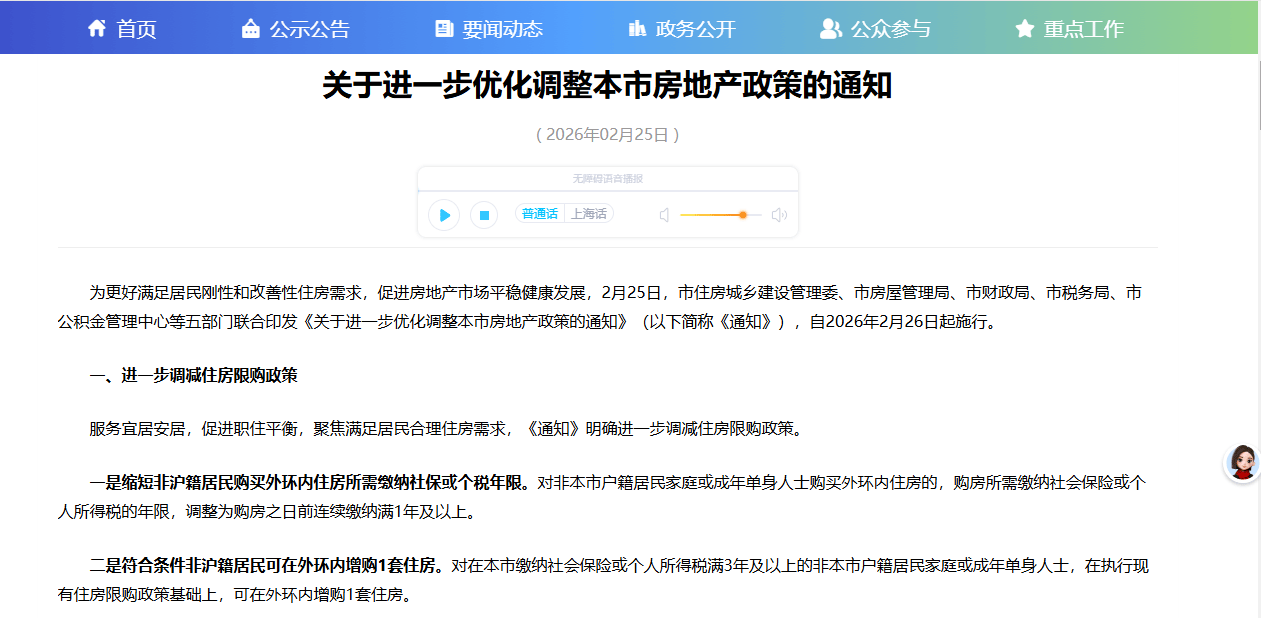
上海发布“沪七条”房地产新政:限购放宽、公积金提额,家居市场迎利好
Sou Hu Cai Jing· 2026-02-26 02:10
Group 1 - The core viewpoint of the news is the introduction of Shanghai's new real estate policy "沪七条" aimed at better meeting the housing needs of residents, effective from February 26, 2026 [1] - The policy includes adjustments in three major areas: purchase restrictions, public housing fund policies, and property tax regulations [1] - The new policy allows non-residents to purchase homes in the outer ring of Shanghai with a social security or individual tax payment period reduced from "3 years" to "1 year" [2] Group 2 - The maximum public housing fund loan for first-time homebuyers has been increased from 1.6 million yuan to 2.4 million yuan, with potential maximum loans reaching 3.24 million yuan for families with multiple children or those purchasing green buildings [2] - Families that have cleared their public housing fund loans can reapply for loans when purchasing a new home, provided they own no property or only one property in Shanghai [2] - The property tax policy will exempt adult children in household registrations from personal housing property tax if the newly purchased home is their only residence, supporting housing upgrades [2] Group 3 - Industry analysts believe the new policy will stimulate demand for both first-time and improved housing purchases, positively impacting downstream markets such as home decoration and furniture, leading to optimistic expectations for Shanghai's home furnishing industry in 2026 [2]
关于四川省2025年国民经济和社会发展计划执行情况及2026年计划草案的报告
Si Chuan Ri Bao· 2026-02-10 22:26
Core Viewpoint - The report outlines the execution of the 2025 National Economic and Social Development Plan in Sichuan Province, highlighting significant achievements and setting the stage for the 2026 plan, emphasizing high-quality development and strategic initiatives for economic growth. Group 1: 2025 Economic and Social Development Plan Execution - The GDP reached 67,665.3 billion yuan, growing by 5.5%, meeting the expected target [3] - Fixed asset investment (excluding farmers) decreased by 2.4%, falling short of the expected target due to declines in real estate and infrastructure investments [3] - Retail sales of consumer goods increased by 5.1%, exceeding the expected target [4] - Total import and export volume was 10,318.1 billion yuan, meeting the expected target [5] - Local general public budget revenue reached 5,853.9 billion yuan, growing by 3.9%, surpassing the expected target [6] - Urban residents' per capita disposable income grew by 4.4%, meeting the expected target [7] - Rural residents' per capita disposable income increased by 5.6%, meeting the expected target [8] - Consumer prices decreased by 0.3%, meeting the expected target [9] - Urban employment increased by 1.073 million, exceeding the expected target by 223,000 [10] - The urbanization rate of the permanent population is expected to exceed 61%, increasing by about 1 percentage point from the previous year, roughly meeting the expected target [11] - Grain production reached 732.5 billion jin, exceeding the expected target by 75 million jin [13] Group 2: Economic and Social Development Situation - The regional coordinated development pattern has been optimized, with significant progress in the Chengdu-Chongqing economic circle [14] - The "Five Districts Common Prosperity" development strategy has been advanced, with key projects achieving substantial investment [15] - County economies have shown significant improvement, with 39 underdeveloped counties receiving targeted support [16] - Domestic demand has been steadily increasing, with consumption policies stimulating growth [17] - Key projects have accelerated implementation, with a high completion rate of provincial key projects [18] - Innovation capabilities have significantly improved, with the establishment of high-level innovation platforms and successful technology breakthroughs [19][20] - The traditional industries are undergoing rapid transformation and upgrading, with significant growth in key sectors [22] - New and future industries are being rapidly developed, with a focus on emerging technologies [23] - A new service system is being actively constructed, with notable growth in the service sector [24] Group 3: Market Vitality and Economic Environment - The environment for private economic development is steadily improving, with significant growth in private sector contributions to GDP [26][27] - State-owned enterprise reforms have shown significant results, with increased revenue and strategic restructuring [28] - Digital infrastructure development is advancing, with initiatives to enhance data utilization and government services [29] Group 4: High-Level Opening Up - The opening channels and platforms are becoming increasingly complete, with enhanced logistics and transportation networks [30] - The scale of the open economy is stabilizing and improving, with significant growth in foreign trade and investment [31][32] Group 5: Urban-Rural Integration and Environmental Protection - New urbanization is accelerating, with significant improvements in urban infrastructure and rural revitalization efforts [33][34] - Ecological environment quality is improving, with successful implementation of environmental protection measures [36][37] Group 6: Social Welfare and Public Services - Employment and income growth measures have been effective, with significant increases in disposable income and job creation [38][39] - Public service systems are becoming more robust, with improvements in healthcare, education, and social security [40] Group 7: Safety and Risk Management - Food and energy security measures are being effectively implemented, ensuring stable supply chains [41] - Risk prevention and control measures are in place, addressing financial and operational risks [42]
北京市政协委员李旭红:发挥税收杠杆效应 多措并举促进北京消费
Xin Jing Bao· 2026-01-24 13:39
Core Viewpoint - The article emphasizes the need for effective tax policies to stimulate consumption in Beijing, leveraging the city's demographic advantages and rising income levels to unlock potential growth in domestic demand [1] Group 1: Current Consumption Landscape - Current consumer expectations are cautious, and the cost on the supply side is high, leading to short-term and fragmented consumption promotion policies [1] - Existing consumption incentives rely heavily on subsidies and vouchers, which are effective in the short term but lack sustainability and structural guidance [1] Group 2: Recommendations for Tax Policy - Enhance the directness and efficiency of tax reduction policies to boost consumer confidence and spending power, including better promotion of individual income tax deductions and support for flexible employment [2] - Utilize tax policies to drive the renewal of durable goods, focusing on sectors like automobiles and home appliances, to shift consumption from "incremental purchases" to "quality upgrades" [2] Group 3: Support for New Consumption Models - Increase tax support for service consumption and new business models, particularly in cultural and sports sectors, to lower initial costs for enterprises and stimulate market supply [3] - Focus on nighttime economy and community commerce, maintaining tax incentives for small businesses to stabilize employment and local consumption [3] Group 4: Long-term Mechanisms for Consumption Promotion - Establish a collaborative mechanism among various departments to shift consumption policies from "single-point stimulation" to "comprehensive efforts" for sustainable impact [3] - Improve digital tax services and create a dynamic evaluation mechanism to ensure tax policies are precise, effective, and sustainable [3] Group 5: Reflection on Past Year - The article reflects on the past year's efforts in enhancing Beijing's fiscal strength and industry development through grassroots research and effective policy suggestions [4]
今年以来福建经济稳中有进 重点项目超序时推进
Zhong Guo Xin Wen Wang· 2025-12-30 13:37
Core Insights - Fujian Province's economy has shown steady progress this year, with GDP growth rates of 5.7% in Q1, 5.7% in Q2, and 5.2% in Q3 [1][2] - The province has completed investments of 676.7 billion yuan in 1,550 key projects from January to November, exceeding the planned schedule [1] - Significant developments in transportation and energy sectors include the completion of the F1 line of the Fuzhou to Changle Airport intercity railway and the first phase of Fuzhou Metro Line 4 [1] Economic Performance - The overall economic operation in Fujian is stable, with efforts focused on stabilizing employment, enterprises, markets, and expectations [1] - Consumer spending has been effectively boosted, with over 7.44 million consumers benefiting from the appliance and home decoration subsidy programs, leading to sales exceeding 77.1 billion yuan [1] Investment and Reforms - Fujian is enhancing its development vitality through reforms and opening up, with the approval of the comprehensive reform pilot for market-oriented allocation of factors in Fuzhou, Xiamen, and Quanzhou [2] - The province has implemented the New Era Private Economy Strong Province Strategy, resulting in a 5.5% increase in the added value of the private economy, surpassing the provincial average [2] Infrastructure and Connectivity - The "Silk Road Maritime" international cooperation forum and the construction of the "Maritime Silk Road" core area have been successfully held, increasing the number of named routes to 148 [2] - Fujian is actively building a cross-strait integration development demonstration zone, with 206 key projects promoting cross-strait economic integration [2]
2026年“国补”继续!范围和标准将持续优化
Sou Hu Cai Jing· 2025-12-30 09:52
Group 1 - The National Financial Work Conference was held in Beijing on December 27-28, where the Minister of Finance, Lan Fo'an, emphasized the importance of boosting consumption in the upcoming year [1] - The government plans to continue the "National Subsidy" policy into 2026, with adjustments to the scope and standards of subsidies [1] - The fiscal policy will focus on expanding fiscal spending, optimizing government bond tools, enhancing transfer payment efficiency, and improving expenditure structure [1] Group 2 - The subsidy standards for certain consumer goods have been raised, with the scrap and replacement subsidy for qualifying vehicles increasing from 10,000 yuan to 20,000 yuan for new energy vehicles, and from 7,000 yuan to 15,000 yuan for fuel vehicles [2] - The funding for the "National Subsidy" comes from the issuance of ultra-long special bonds, with an issuance amount of 150 billion yuan in 2024 and increasing to 300 billion yuan in 2025 [2] - Experts suggest that the "National Subsidy" policy should shift focus from goods consumption to service consumption, exploring cash subsidies and digital currency as new forms of consumption incentives [2]
2026年“国补”继续
Jing Ji Guan Cha Bao· 2025-12-29 03:22
Core Viewpoint - The "National Consumption Upgrade" policy, aimed at boosting consumer spending through subsidies for replacing old products, will continue into 2026 with adjustments to its scope and standards to enhance its effectiveness [1][2]. Group 1: Policy Evolution - The "National Consumption Upgrade" policy originated during the 2008 global financial crisis to stimulate consumption by providing subsidies for major consumer goods, focusing on rapid market activation [1]. - The 2024 reintroduction of the policy marks a shift from a short-term emergency response to a long-term empowerment strategy, with three major upgrades compared to earlier versions [2]. Group 2: Coverage and Standards - The coverage of the policy will expand from a single category to multiple scenarios, including automotive scrappage and eight categories of home appliances in 2024, and further extending to "all-scenario quality consumption" in 2025 [2][3]. - Subsidy standards will transition from a uniform approach to a differentiated optimization, with increased subsidies for electric vehicles and fuel vehicles to encourage green consumption [2][3]. Group 3: Funding Mechanism - Funding for the policy will shift from annual budgets to long-term special government bonds, with allocations increasing from 150 billion yuan in 2024 to 300 billion yuan in 2025, providing stable support for the policy's sustainability [2][3]. - The systematic design of "coverage-standards-funding" will transform the policy from an emergency stimulus tool to a normalized consumption promotion mechanism [3]. Group 4: Challenges and Recommendations - Despite the policy's effectiveness, challenges such as regional protectionism and cumbersome application processes may hinder its universal benefits, particularly for older consumers [4][5]. - To enhance the policy's impact, it is recommended to refine coverage, standard design, and supporting mechanisms, ensuring a precise and sustainable policy framework [5].
2026年“国补”继续!如何调整?
Jing Ji Guan Cha Bao· 2025-12-28 15:42
Core Viewpoint - The "National Consumption Upgrade" policy, aimed at boosting consumer spending, will continue into 2026 with adjustments to subsidy scope and standards, as announced by the Minister of Finance at the national fiscal work conference [1] Group 1: Policy Evolution - The "National Consumption Upgrade" policy originated during the 2008 global financial crisis to stimulate consumption through subsidies for major consumer goods, focusing on rapid market activation [1] - The 2024 reintroduction of the policy marks a shift from short-term emergency measures to long-term empowerment, with three major upgrades compared to earlier versions [1] Group 2: Coverage and Standards - The coverage of the policy will expand from single categories to multiple scenarios, with the 2024 focus on vehicle scrappage and eight types of household appliances, and a broader scope for 2025 that includes digital products and home decoration [2] - Subsidy standards will transition from a uniform approach to differentiated optimization, such as increasing subsidies for new energy vehicles from 10,000 yuan to 20,000 yuan [2][3] - The funding source will shift from annual budgets to long-term special government bonds, with 150 billion yuan allocated in 2024 and 300 billion yuan in 2025, ensuring stable support for the policy [2][3] Group 3: Systematic Design - The expansion of subsidy categories and optimization of standards are coordinated with strengthened funding sources, creating a systematic design that transforms the policy from an emergency stimulus tool to a normalized consumption promotion mechanism [3] - Despite the policy's effectiveness, challenges remain, such as the temporary suspension of subsidies in some regions due to faster consumption of funds than bond issuance, necessitating a focus on existing funds rather than increasing the budget [3] Group 4: Implementation Challenges - The increase in subsidy categories may lead to local protectionism, where local brands receive preferential treatment, potentially distorting market competition [4] - Complicated application processes may deter consumers, particularly older individuals or those in rural areas, from accessing subsidies, undermining the policy's universality [4] - To ensure the policy effectively stimulates consumption, precise efforts are needed in coverage, standard design, and supporting mechanisms, including the establishment of a unified information platform for the entire process [5]
明年“国补”范围和标准将调整
第一财经· 2025-12-28 11:48
Core Viewpoint - The article discusses the new developments in China's "National Subsidy" policy for consumer goods, emphasizing the continuation and optimization of the subsidy program in 2026 to boost consumption [3][4]. Group 1: Policy Continuation and Adjustments - The "National Subsidy" policy will continue in 2026, with adjustments to the scope and standards of subsidies [4]. - Since the implementation of the "National Subsidy" policy in 2024, the range of eligible products has been continuously optimized, expanding from 8 categories in 2024 to include additional products in 2025 [5]. - The subsidy standards for certain consumer goods have been adjusted, such as increasing the subsidy for scrapping and updating cars from 10,000 yuan to 20,000 yuan for eligible new energy vehicles [5]. Group 2: Funding and Financial Support - The funding for the "National Subsidy" primarily comes from the issuance of ultra-long-term special government bonds, with the amount increasing from 150 billion yuan in 2024 to 300 billion yuan in 2025 [5]. - The Ministry of Finance has confirmed that it will continue to issue ultra-long-term special government bonds in 2026 to support the "National Subsidy" [5]. Group 3: Recommendations for Future Implementation - Experts suggest that the effectiveness of the "National Subsidy" has declined due to previous demand being pulled forward and recommend shifting the focus from product subsidies to service consumption [6][7]. - There is a call for the inclusion of cash subsidies, digital currency, and support for childcare and employment in future subsidy programs [6].